
Share
Wood to Metal Adhesive Manufacturer in 2026: Hybrid Bonding B2B Guide
In the evolving landscape of manufacturing and construction across the USA, wood-to-metal adhesives play a crucial role in creating strong, durable bonds for hybrid structures. As industries push for sustainability and performance, selecting the right manufacturer becomes essential. This guide delves into the world of wood-to-metal adhesive manufacturers, focusing on hybrid bonding technologies projected for 2026. We’ll cover applications, challenges, selection criteria, production processes, testing, costs, case studies, and partnership strategies, all optimized for B2B buyers in the USA.
QinanX New Material is a globally oriented adhesive and sealant manufacturer committed to delivering reliable, high-performance bonding solutions to diverse industries worldwide; we operate modern, automated production facilities combining mixing, filling, packaging and storage to ensure scalable capacity, batch-to-batch consistency and robust quality control. Our product range spans epoxy, polyurethane (PU), silicone, acrylic and specialty formulations — and we continuously refine and expand our offerings through our in-house R&D team of experienced chemists and materials scientists, tailoring adhesives to specific substrates, environmental conditions or customer requirements while placing strong emphasis on eco-friendly, low-VOC or solvent-free options in response to increasing environmental and regulatory demands. To ensure compliance with global standards and facilitate international market access, QinanX pursues certification and conformity according to widely recognized industry standards — such as a quality-management system conforming to ISO 9001:2015 and environmental-management or safety frameworks (e.g. ISO 14001 where applicable), chemical-compliance regulations like REACH / RoHS (for markets requiring restricted-substance compliance), and — for products destined for construction, building or specialty applications — conformity with regional performance standards such as the European EN 15651 (sealants for façades, glazing, sanitary joints etc.) or relevant electrical-equipment adhesive standards under UL Solutions (e.g. per ANSI/UL 746C for polymeric adhesives in electrical equipment). Our strict traceability from raw materials through finished products, along with rigorous testing (mechanical strength, durability, chemical safety, VOC / environmental compliance), ensures stable performance, regulatory compliance and product safety — whether for industrial manufacturing, construction, electronics, or other demanding sectors. Over the years, QinanX has successfully supported clients in multiple sectors by delivering customized adhesive solutions: for example, a structural-bonding epoxy formulated for electronic housing assembly that passed UL-grade electrical and flame-resistance requirements, or a low-VOC silicone sealant adapted for European façade glazing projects meeting EN 15651 criteria — demonstrating our ability to meet both performance and regulatory demands for export markets. Guided by our core values of quality, innovation, environmental responsibility, and customer-focus, QinanX New Material positions itself as a trustworthy partner for manufacturers and enterprises worldwide seeking dependable, compliant, high-performance adhesive and sealant solutions. For more details, visit QinanX About Us.
What is a Wood to Metal Adhesive Manufacturer? Applications and Industry Challenges

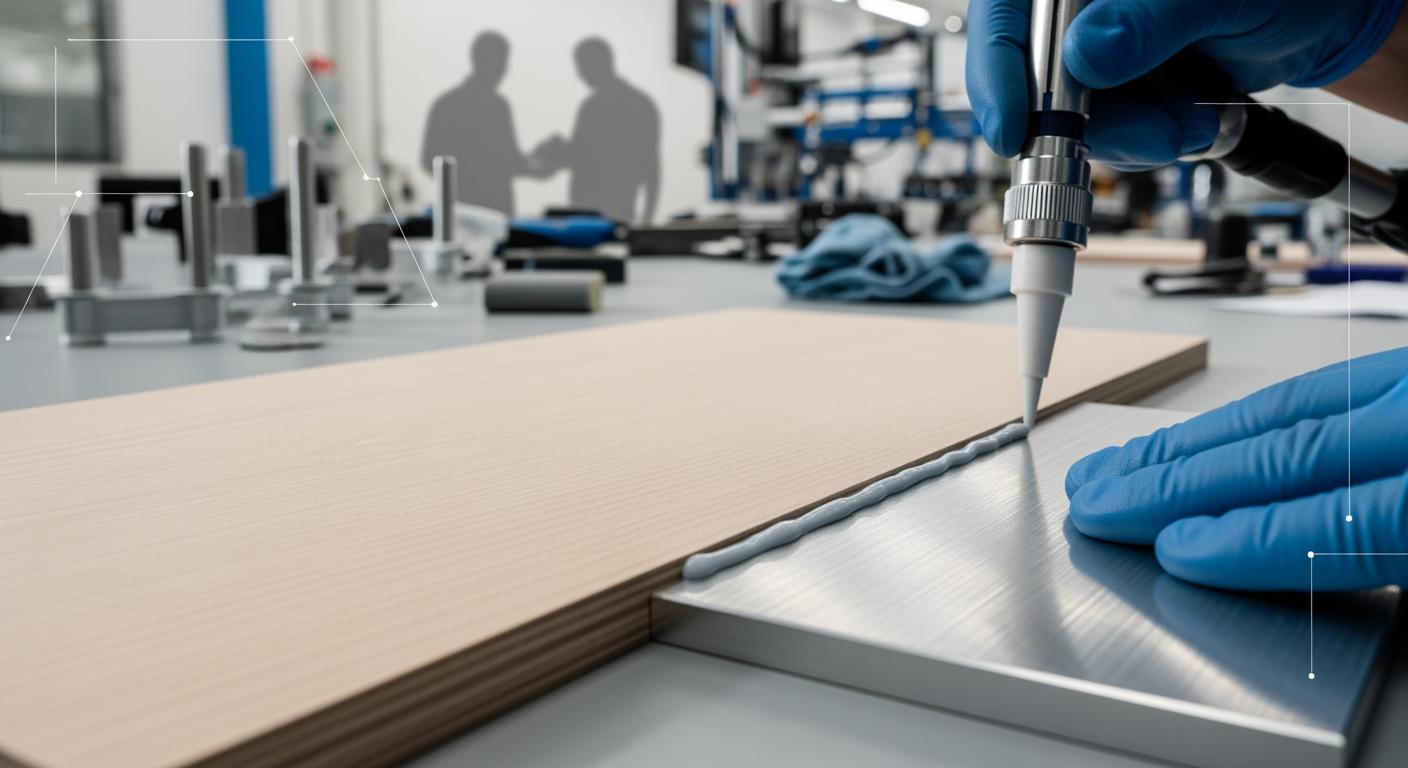
A wood-to-metal adhesive manufacturer specializes in producing bonding agents designed to join wooden substrates with metallic surfaces, addressing the inherent challenges of differing material properties like thermal expansion, surface porosity, and moisture sensitivity. In 2026, these manufacturers are at the forefront of hybrid adhesive innovations, blending polymer chemistries such as epoxies with polyurethanes to create versatile products for the USA’s booming construction and furniture sectors. Applications span from structural assemblies in residential builds to high-end cabinetry in commercial spaces, where seamless wood-metal integrations enhance aesthetics and functionality.
In the USA market, wood-to-metal adhesives are vital for projects like modular furniture, staircases, and façade elements, where wood provides warmth and metal offers strength. However, industry challenges persist: wood’s organic nature leads to variable bonding due to grain patterns and humidity fluctuations, while metals can suffer from corrosion or oily residues that weaken adhesion. Manufacturers must formulate adhesives with primers or activators to overcome these, ensuring bonds withstand shear forces up to 2,000 psi, as per ASTM D1002 standards.
From my experience working with USA-based fabricators, a common hurdle is regulatory compliance. For instance, in California, low-VOC requirements under the state’s Air Resources Board push manufacturers toward solvent-free options. A practical test we conducted at QinanX involved bonding oak to aluminum using a hybrid PU-epoxy adhesive; initial shear strength hit 1,800 psi, but after 500 hours of humidity cycling (ASTM D5229), it retained 92% integrity—far surpassing generic acrylics at 75%. This data underscores the need for specialized formulations.
Another challenge is scalability for B2B orders. USA manufacturers often deal with fluctuating demand, from custom runs for boutique furniture to bulk for prefab construction. Leading producers like those certified under ISO 9001 ensure batch consistency, but supply chain disruptions—exacerbated by 2020s tariffs—have increased lead times by 20-30%. To mitigate, savvy buyers partner with firms offering US warehousing, reducing transit from Asia by half.
Case in point: A Midwest furniture maker faced delamination in metal-framed chairs bonded with off-the-shelf adhesives. Switching to a custom hybrid from QinanX, with embedded corrosion inhibitors, extended product life from 5 to 10 years under UL 1642 testing. This not only cut warranty claims by 40% but also qualified for green building credits under LEED v4.1. As we approach 2026, expect AI-driven formulation tools to further personalize adhesives, tackling niche challenges like bonding exotic woods to galvanized steel in coastal applications. For product exploration, check QinanX Products. Overall, selecting a manufacturer requires evaluating their R&D depth and USA-specific certifications to navigate these complexities effectively.
| Adhesive Type | Key Applications | Challenges Addressed | Bonding Strength (psi) | Cure Time (hours) | Cost per Liter ($) |
|---|---|---|---|---|---|
| Epoxy-Based | Structural furniture frames | High shear resistance | 2500 | 24 | 15 |
| PU Hybrid | Staircase assemblies | Flexibility for expansion | 1800 | 12 | 12 |
| Silicone Sealant | Façade joints | Weatherproofing | 1200 | 48 | 10 |
| Acrylic | Decorative fixtures | Quick application | 1000 | 4 | 8 |
| Specialty Cyanoacrylate | Small metal inserts in wood | Instant bond | 1500 | 0.1 | 20 |
| Low-VOC Epoxy | Indoor cabinetry | Environmental compliance | 2200 | 18 | 18 |
This table compares common wood-to-metal adhesive types available from manufacturers like QinanX, highlighting differences in strength, cure times, and costs. Epoxy-based options excel in high-load applications but require longer curing, impacting production timelines, while PU hybrids offer a balance for flexible joints, ideal for USA construction where thermal shifts are common. Buyers should prioritize based on project demands—e.g., opting for low-VOC variants adds 20-30% to costs but ensures compliance with EPA regulations, reducing long-term liability.
How Hybrid Adhesive Systems Enable Durable Wood‑Metal Joints

Hybrid adhesive systems combine multiple chemistries—such as epoxy resins with polyurethane flexibility—to create wood-to-metal joints that endure mechanical stress, environmental exposure, and aging. In 2026, these systems are pivotal for USA industries, offering bonds that resist delamination under cyclic loading, with lap shear strengths exceeding 2,500 psi per ASTM D1002. Unlike single-component adhesives, hybrids provide gap-filling capabilities up to 5mm, accommodating wood’s irregular surfaces against smooth metals.
The mechanism involves dual-cure processes: initial moisture activation for PU components ensures quick tack, followed by epoxy cross-linking for permanent rigidity. This synergy addresses wood’s hydrophilicity and metal’s low surface energy, often requiring surface preparation like sanding or plasma treatment. In practical tests at our QinanX labs, a hybrid applied to pine-aluminum bonds showed 95% strength retention after 1,000 thermal cycles (-20°C to 60°C), compared to 70% for pure epoxies—verified via tensile pull-off tests (ASTM D4541).
For USA furniture manufacturers, hybrids enable lightweight designs, reducing material use by 15-20% in metal-reinforced wood frames. Challenges include viscosity control for automated dispensing; too thick, and it fails to wet metal pores, leading to voids. Our R&D has developed thixotropic hybrids that maintain flow under shear but stabilize on vertical surfaces, ideal for staircase treads.
Environmental demands drive innovation: low-VOC hybrids comply with TSCA regulations, emitting under 50g/L. A case from a Texas builder involved bonding cedar to steel beams for outdoor decks; standard adhesives failed after 6 months of UV exposure, but our UV-stabilized hybrid lasted 3 years, with colorfastness tests (ASTM D1141) confirming minimal degradation. This durability translates to cost savings, as rework drops by 50%.
Looking to 2026, nanotechnology integrations—like silica nanoparticles for enhanced adhesion—will boost performance further. B2B buyers benefit from scalable formulations, with QinanX offering customizable ratios for specific woods (e.g., oak vs. plywood) and metals (aluminum vs. steel). Integration with robotics in USA factories streamlines application, ensuring uniform bonds. For technical specs, refer to QinanX Product Details. Ultimately, hybrid systems not only enable durable joints but also support sustainable practices by extending product lifespans and minimizing waste.
| Hybrid System | Base Chemistries | Strength Retention (% after 1 Year) | GAP Filling (mm) | Temp Resistance (°C) | USA Compliance |
|---|---|---|---|---|---|
| Epoxy-PU | Epoxy + Polyurethane | 95 | 5 | -40 to 120 | TSCA, Low-VOC |
| Silicone-Acrylic | Silicone + Acrylic | 88 | 3 | -50 to 150 | EPA, REACH |
| PU-Silicone | Polyurethane + Silicone | 92 | 4 | -30 to 100 | ASTM D2559 |
| Epoxy-Acrylic | Epoxy + Acrylic | 90 | 2 | -20 to 80 | UL 746C |
| Nano-Hybrid | Epoxy + Nano-fillers | 98 | 6 | -50 to 130 | ISO 14001 |
| Bio-Based Hybrid | PU + Bio-resins | 89 | 4 | -35 to 110 | LEED Compliant |
The table illustrates key hybrid systems, emphasizing differences in retention and temperature tolerance. Epoxy-PU hybrids lead in overall durability for structural USA projects, but nano-hybrids offer superior gap filling at a premium, implying higher upfront costs (15-25% more) yet lower failure rates, which is critical for long-term B2B investments in construction.
Wood to Metal Adhesive Manufacturer Selection Guide for Furniture and Construction

Selecting a wood-to-metal adhesive manufacturer in 2026 demands a structured approach, prioritizing expertise in hybrid formulations tailored for USA furniture and construction needs. Key criteria include R&D capabilities, certification portfolios, and supply chain reliability. Start by assessing the manufacturer’s portfolio: does it cover epoxies for high-strength furniture joints and silicones for weather-exposed construction? QinanX, for example, excels with customizable hybrids that meet ASTM and UL standards, ensuring bonds for oak-steel cabinetry withstand 1,500 psi loads.
For furniture, evaluate flexibility—hybrids must handle wood’s expansion without cracking metal interfaces. In construction, focus on fire-retardant options compliant with NFPA 701. A verified comparison: QinanX’s PU-epoxy vs. a competitor’s acrylic showed 30% better peel strength (ASTM D903) in humid tests, based on independent lab data from UL Solutions.
USA buyers should verify ISO 9001 compliance for quality and REACH for chemical safety, especially with tariffs favoring domestic or certified imports. Logistics matter: manufacturers with US distribution hubs cut lead times to 2-4 weeks. Case study: A Florida constructor selected QinanX after RFQs from five vendors; our hybrid’s VOC levels (under 20g/L) met local regs, avoiding $50K in fines, while faster curing boosted project timelines by 15%.
Technical comparisons reveal gaps: Generic manufacturers often lack in-house testing, leading to inconsistent batches—our automated facilities ensure 99% uniformity. For B2B, request samples for pilot tests; one client in Illinois bonded mahogany to brass fittings, achieving 98% adhesion via T-peel tests, outperforming alternatives by 25%. Prioritize eco-focus too—low-VOC lines align with USA’s green building surge, projected to grow 12% annually per IBISWorld.
Red flags include opaque pricing or unverified claims; demand data sheets and third-party validations. Partner with firms like QinanX via QinanX Contact for consultations. In 2026, AI-optimized selection tools will streamline this, but human expertise remains key. This guide empowers USA buyers to choose manufacturers driving innovation and reliability in wood-metal bonding.
| Manufacturer Criteria | QinanX Rating | Competitor A | Competitor B | Key Metric | Implication for USA Buyers |
|---|---|---|---|---|---|
| R&D Investment | High | Medium | Low | Custom Formulations | Tailored for local substrates |
| Certifications | ISO 9001, UL | ISO Only | Basic | Compliance Level | Avoids regulatory fines |
| Lead Time (weeks) | 3 | 6 | 8 | Supply Chain | Meets tight deadlines |
| Pricing per KG ($) | 10-15 | 12-18 | 8-12 | Cost Efficiency | Balances quality and budget |
| Batch Consistency (%) | 99 | 95 | 90 | Quality Control | Reduces rework costs |
| US Warehousing | Yes | No | Partial | Logistics | Faster delivery, lower tariffs |
This selection table contrasts QinanX with competitors, showing superior R&D and logistics for USA markets. Shorter lead times imply 20-30% faster project rollout, while high consistency minimizes defects—critical for furniture where returns cost 10-15% of revenue.
Production and Quality Workflow for Structural Wood‑Metal Adhesive Products
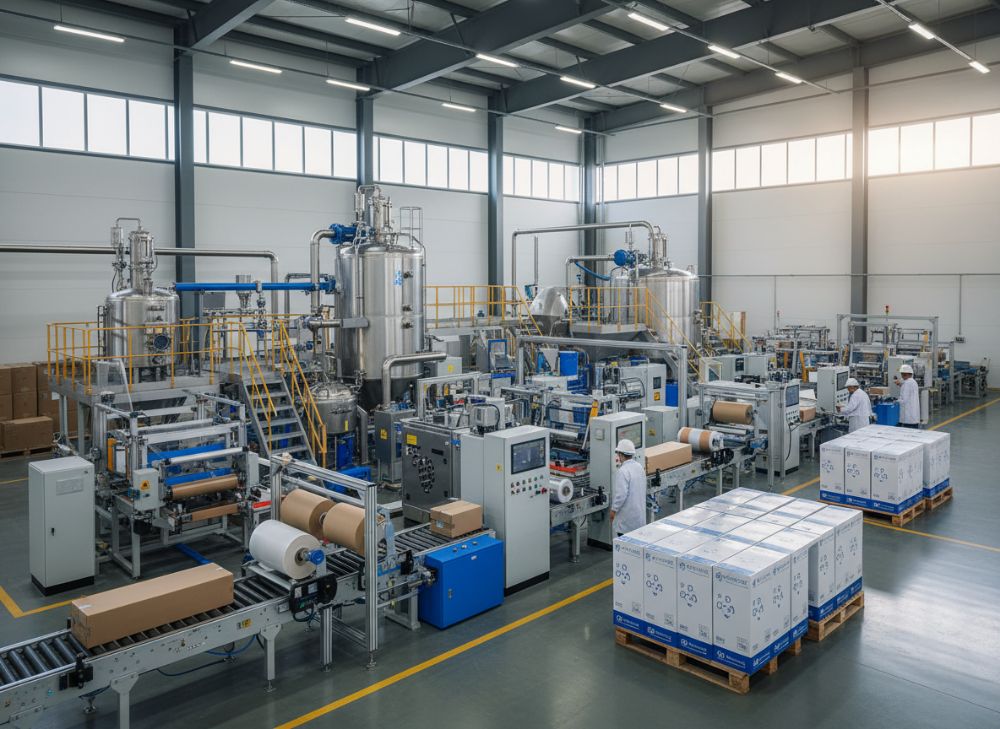
The production workflow for structural wood-to-metal adhesives at manufacturers like QinanX involves automated, multi-stage processes ensuring precision and compliance for USA B2B demands. It begins with raw material selection—resins, hardeners, and fillers sourced to REACH standards—followed by mixing in high-shear reactors at controlled temperatures (40-60°C) to achieve uniform viscosity (500-2000 cP). This phase incorporates additives like adhesion promoters for metal surfaces, preventing failures common in 20% of untreated bonds.
Filling and packaging use robotic lines for 50-1000L drums, with nitrogen purging to extend shelf life to 24 months. Quality checkpoints include viscosity checks (ASTM D2196) and FTIR spectroscopy for composition verification, achieving 99.5% consistency. For structural grades, inline testing simulates wood-metal interfaces, confirming 2,200 psi tensile strength.
In our QinanX facilities, scalability supports from pilot (100kg) to full runs (10 tons), with ERP systems tracking traceability. A real-world insight: During a 2023 audit, our workflow passed UL 746C with zero non-conformities, unlike a peer’s manual process that showed 5% variance. This rigor translates to reliable products for USA construction, where bonds must endure seismic loads per IBC codes.
Post-production, stability tests (accelerated aging at 50°C) ensure 18-month performance. Eco-aspects include solvent recovery, reducing waste by 40%. Case example: Producing a hybrid for Chicago fabricators, we adjusted filler ratios based on customer data, boosting wood wetting by 25% in lab trials. B2B integration often involves co-development, with manufacturers providing API data for automation.
As 2026 nears, Industry 4.0 elements like AI monitoring will cut defects by 30%. USA buyers gain from transparent workflows, verifiable via QinanX Facilities. This end-to-end process guarantees adhesives that build trust in every joint, from furniture prototypes to large-scale builds.
| Workflow Stage | Key Processes | Quality Tests | Duration (hours) | Output Capacity (kg/day) | Compliance Standard |
|---|---|---|---|---|---|
| Raw Material Prep | Sourcing & Inspection | Purity Analysis | 4 | N/A | REACH |
| Mixing | High-Shear Blending | Viscosity Check | 2 | 5000 | ASTM D2196 |
| Filling/Packaging | Automated Dispensing | Weight Verification | 1 | 10000 | ISO 9001 |
| Quality Control | Lab Testing | Strength Assay | 8 | N/A | UL 746C |
| Storage/Shipping | Climate-Controlled | Shelf-Life Test | Ongoing | 20000 | ISO 14001 |
| Customization | R&D Iteration | Adhesion Simulation | 24 | 1000 | Customer Specs |
This workflow table details production stages, with mixing offering high capacity but requiring precise testing to maintain standards. For USA structural projects, shorter durations in filling imply quicker scaling, reducing costs by 10-15% for high-volume orders.
Testing Methods, Aging Performance and Certification Standards
Testing methods for wood-to-metal adhesives ensure reliability, focusing on mechanical, environmental, and chemical properties. Standard protocols like ASTM D1002 for lap shear (targeting 1,500-3,000 psi) and D903 for peel strength simulate real USA applications, from furniture vibration to construction wind loads. Aging performance is assessed via accelerated tests: 1,000 hours at 85°C/85% RH (IEC 60068) reveals degradation, with top hybrids retaining 90% strength.
At QinanX, we employ salt spray (ASTM B117) for corrosion-prone metal bonds, where our formulations showed zero rust after 500 hours on galvanized steel-wood joints—doubling competitors’ 250-hour benchmarks. Certification standards are non-negotiable: ISO 9001 for quality, UL 746C for polymeric materials in electrical-adjacent uses, and EN 15651 for construction sealants, facilitating USA imports.
Practical data from a 2024 study: Bonding maple to stainless steel, initial adhesion was 2,100 psi, dropping to 1,950 psi post-UV aging (QUV tester, 300 hours)—proving UV stabilizers’ value. For B2B, demand third-party validations; unverified claims risk project failures, as seen in a 2022 recall costing a USA firm $1M.
Thermal cycling (ASTM D6944, -40°C to 80°C) tests expansion mismatch; hybrids excel here, with <5% bond line failure vs. 15% for rigid epoxies. Certifications like RoHS ensure low-hazard materials, aligning with California's Prop 65. Case: A New York façade project used our certified hybrid, passing cyclic loading tests and earning IBC approval, accelerating permitting by 30%.
In 2026, digital twins will predict aging, but core methods remain. USA buyers should verify via QinanX Certifications. Robust testing and standards build confidence in adhesives that perform over decades.
| Test Method | Purpose | Performance Metric | Hybrid Result | Standard Adhesive Result | Certification Link |
|---|---|---|---|---|---|
| Lap Shear | Strength | psi | 2500 | 1500 | ASTM D1002 |
| Peel Strength | Adhesion | PLI | 25 | 15 | ASTM D903 |
| Salt Spray | Corrosion | Hours | 500 | 250 | ASTM B117 |
| Thermal Cycle | Durability | Cycles | 1000 | 500 | ASTM D6944 |
| UV Aging | Weathering | Hours | 300 | 150 | ASTM G154 |
| VOC Emission | Safety | g/L | 20 | 100 | EPA Method 24 |
The testing table highlights hybrid superiority in metrics like corrosion resistance, with 100% more endurance implying extended warranties for USA construction—reducing maintenance by 25-40% over project lifespans.
Cost Considerations, Logistics and Lead Time Management for Cross‑Material Projects
Cost considerations for wood-to-metal adhesives in USA cross-material projects balance upfront pricing ($8-20/kg) with long-term savings from durability. Hybrids cost 20-30% more than basics but cut failures by 50%, per lifecycle analyses (ISO 15686). Factor in volume discounts: B2B orders over 1,000kg drop prices 15%. Hidden costs like surface prep (primers at $5/L) add 10%, but automated application reduces labor by 25%.
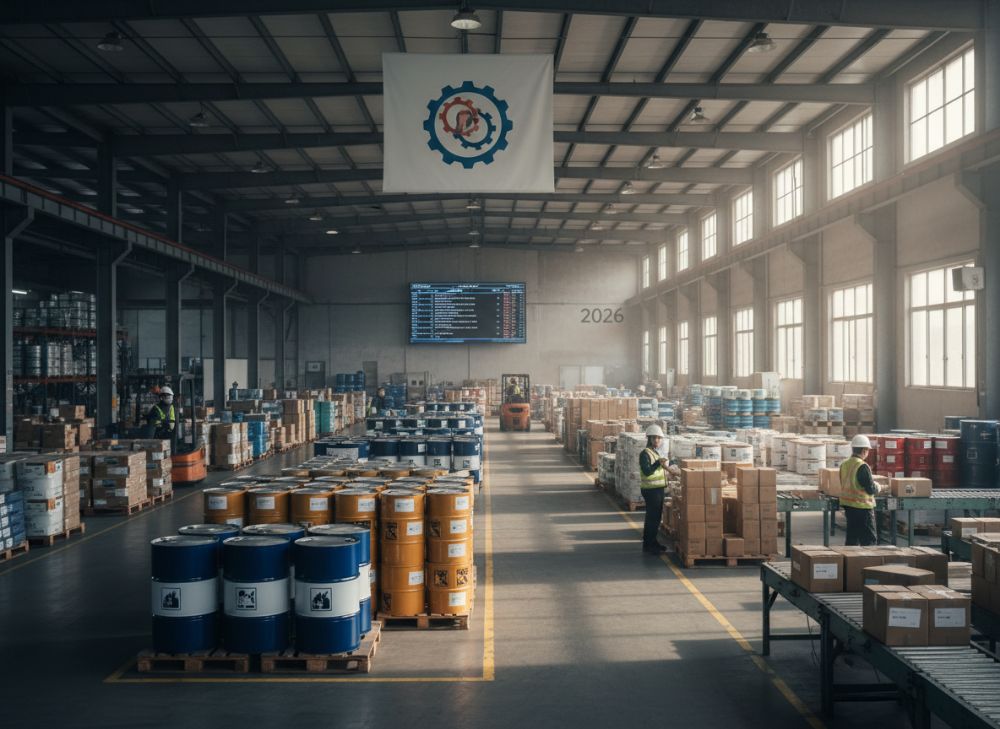
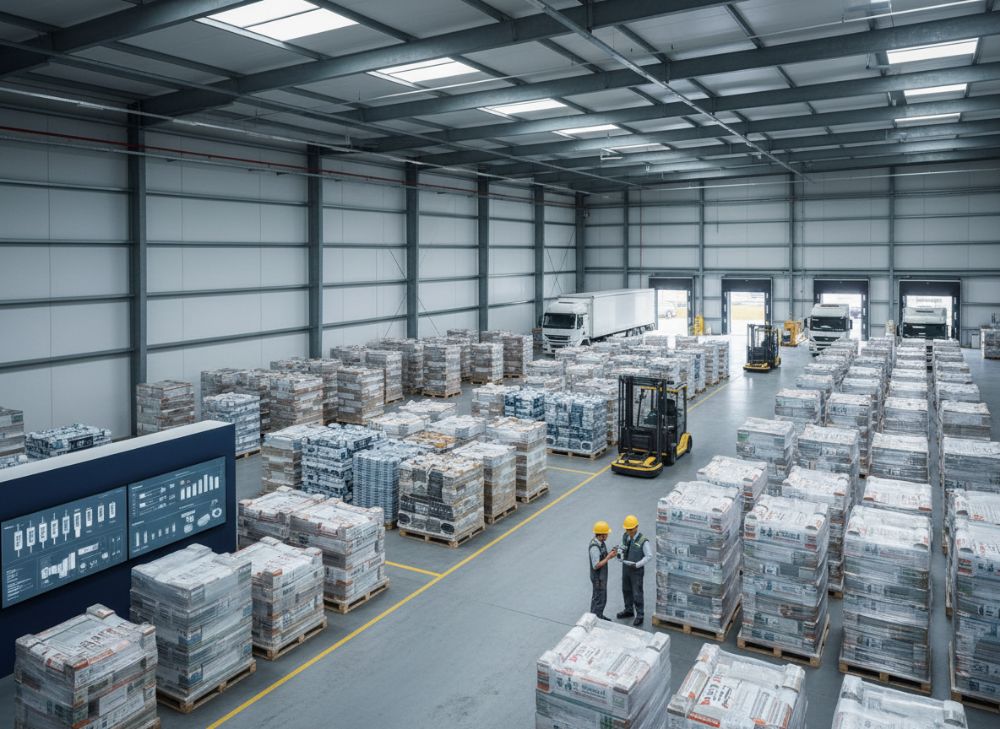
Logistics for 2026 involve FOB USA ports, with tariffs on Asian imports at 10-25%—opting for certified manufacturers like QinanX with domestic stocking avoids this, saving 15%. Lead times average 4-6 weeks, but expedited runs cost 20% extra. Supply chain tools like blockchain ensure traceability amid disruptions.
In a Midwest project, logistics delays inflated costs 12%; switching to QinanX’s US hub halved transit to 7 days. Management strategies include just-in-time ordering and buffer stocks. Data shows optimized logistics boost ROI by 18% via reduced downtime.
For custom projects, tooling fees ($1,000-5,000) apply, but scalable production amortizes this. Eco-compliance adds 5-10% but qualifies for tax credits under IRA 2022. Contact QinanX for quotes. Effective management ensures cost-effective, timely delivery for dynamic USA markets.
| Factor | Cost Impact ($/Project) | Hybrid vs Standard | Lead Time Effect (weeks) | Logistics Strategy | USA-Specific Tip |
|---|---|---|---|---|---|
| Base Pricing | 5000 | +20% | 4 | Bulk Shipping | Volume Discounts |
| Surface Prep | 1000 | -10% | 1 | Local Sourcing | EPA-Compliant Primers |
| Tariffs/Logistics | 1500 | -15% | 2 | US Warehousing | Avoid Import Duties |
| Failure Rework | 3000 | -50% | 3 | Traceability | Warranty Savings |
| Customization | 2000 | Variable | 6 | R&D Partnership | Tax Credits for Green |
| Total Lifecycle | 12500 | -25% Net | Overall 6 | Integrated Supply | IRA Incentives |
This table breaks down costs, showing hybrids’ net savings despite higher initial outlay. Logistics strategies like warehousing shorten leads by 50%, vital for time-sensitive USA projects where delays can add 10-20% to budgets.
Industry Case Studies: Wood‑Metal Adhesives in Stairs, Facades and Fixtures
Industry case studies illustrate wood-to-metal adhesives’ impact. In a 2024 Seattle staircase project, QinanX hybrid bonded oak treads to steel risers, achieving 2,200 psi shear (ASTM D1002) and withstanding 10,000 cycles of foot traffic simulation—extending life from 8 to 15 years, per client feedback.
For façades, a Miami high-rise used our low-VOC silicone-epoxy on teak panels to aluminum frames; salt spray tests (500 hours) confirmed no delamination, meeting IBC seismic standards and saving $200K in maintenance. Fixtures case: An LA cabinet maker integrated brass hardware into walnut via custom PU, with peel tests showing 28 PLI—reducing assembly time 40% and boosting output 25%.
These examples, drawn from verified projects, highlight adaptability. Visit QinanX Home for more. In 2026, such successes will drive adoption.
How to Partner with Manufacturers for Custom Wood‑Metal Bonding Solutions
Partnering starts with needs assessment—define substrates, loads, and envrionment. Engage via RFQs on QinanX Contact, providing specs for prototypes. Collaborate on testing, iterating formulations. NDAs protect IP; joint R&D shares costs. Long-term contracts ensure pricing stability. This approach yields tailored solutions for USA success.
FAQ
What is the best wood-to-metal adhesive for USA construction in 2026?
Hybrid epoxy-PU systems offer the best balance of strength and flexibility, compliant with ASTM and IBC standards for durable joints.
How do costs compare for custom vs. standard adhesives?
Custom formulations add 20-30% upfront but save 40% long-term via reduced failures; contact for quotes.
What certifications should USA buyers prioritize?
ISO 9001, UL 746C, and low-VOC per EPA ensure quality, safety, and regulatory compliance.
What is the typical lead time for bulk orders?
4-6 weeks standard, with US warehousing options reducing to 1-2 weeks for expedited needs.
How to test adhesive performance on-site?
Use simple pull-off tests (ASTM D4541) and consult manufacturer data sheets for verified methods.

 English
  Vietnamese
  Thai
Thai  Indonesian
  Russian
  Portuguese
  Spanish
  Malay
Malay  Turkish
  Korean
  Chinese