
Share
UV Hardening Adhesive Manufacturer in 2026: High-Speed Bonding Guide
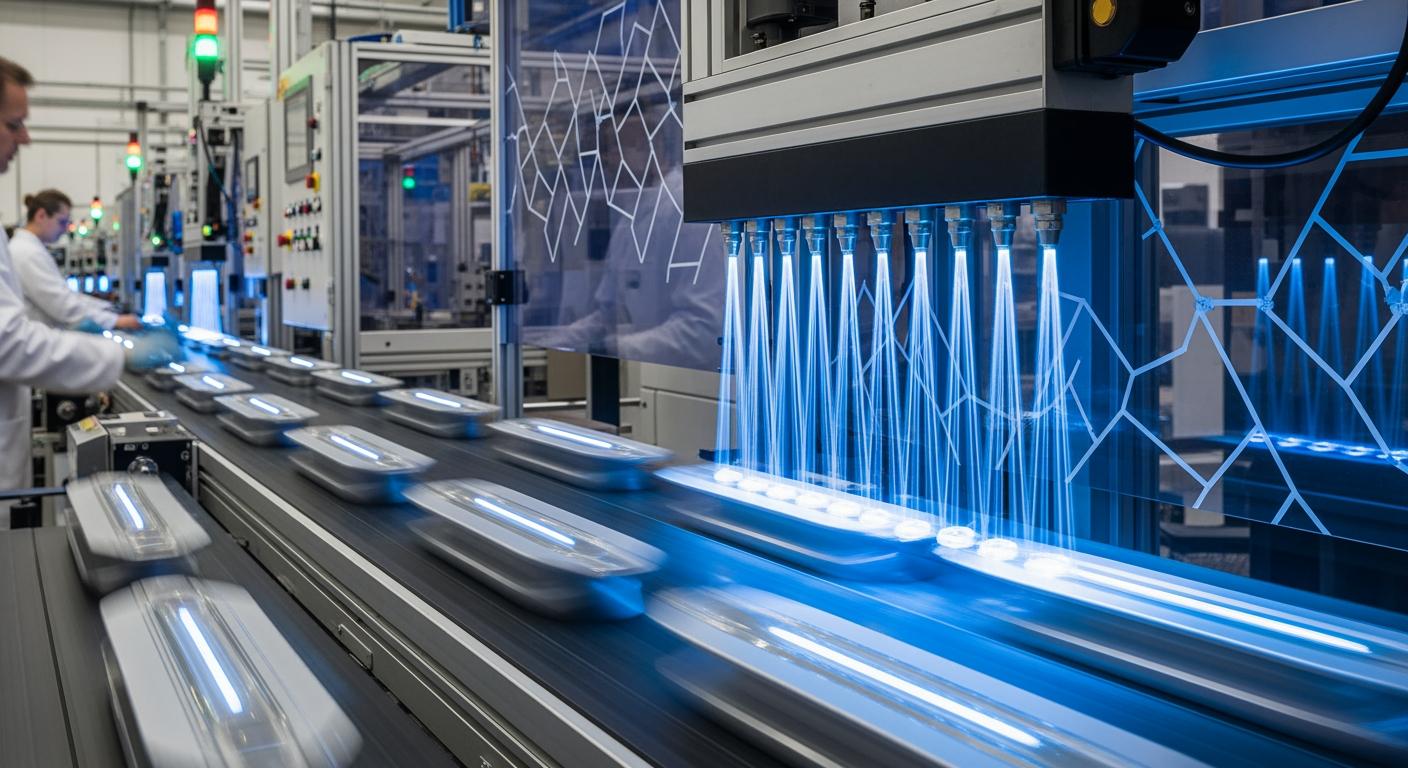
In the fast-evolving landscape of industrial manufacturing, UV hardening adhesives have become indispensable for high-speed bonding applications across the USA. As we look toward 2026, these light-curable adhesives promise even greater efficiency, driven by advancements in formulation and automation. This guide delves into the world of UV hardening adhesive manufacturers, offering insights tailored for American businesses in electronics, optics, and medtech. Whether you’re optimizing assembly lines or seeking compliant solutions, understanding manufacturer capabilities is key. At QinanX New Material, a globally oriented adhesive and sealant manufacturer committed to delivering reliable, high-performance bonding solutions to diverse industries worldwide; we operate modern, automated production facilities combining mixing, filling, packaging and storage to ensure scalable capacity, batch-to-batch consistency and robust quality control. Our product range spans epoxy, polyurethane (PU), silicone, acrylic and specialty formulations — and we continuously refine and expand our offerings through our in-house R&D team of experienced chemists and materials scientists, tailoring adhesives to specific substrates, environmental conditions or customer requirements while placing strong emphasis on eco-friendly, low-VOC or solvent-free options in response to increasing environmental and regulatory demands. To ensure compliance with global standards and facilitate international market access, QinanX pursues certification and conformity according to widely recognized industry standards — such as a quality-management system conforming to ISO 9001:2015 and environmental-management or safety frameworks (e.g. ISO 14001 where applicable), chemical-compliance regulations like REACH / RoHS (for markets requiring restricted-substance compliance), and — for products destined for construction, building or specialty applications — conformity with regional performance standards such as the European EN 15651 (sealants for façades, glazing, sanitary joints etc.) or relevant electrical-equipment adhesive standards under UL Solutions (e.g. per ANSI/UL 746C for polymeric adhesives in electrical equipment). Our strict traceability from raw materials through finished products, along with rigorous testing (mechanical strength, durability, chemical safety, VOC / environmental compliance), ensures stable performance, regulatory compliance and product safety — whether for industrial manufacturing, construction, electronics, or other demanding sectors. Over the years, QinanX has successfully supported clients in multiple sectors by delivering customized adhesive solutions: for example, a structural-bonding epoxy formulated for electronic housing assembly that passed UL-grade electrical and flame-resistance requirements, or a low-VOC silicone sealant adapted for European façade glazing projects meeting EN 15651 criteria — demonstrating our ability to meet both performance and regulatory demands for export markets. Guided by our core values of quality, innovation, environmental responsibility, and customer-focus, QinanX New Material positions itself as a trustworthy partner for manufacturers and enterprises worldwide seeking dependable, compliant, high-performance adhesive and sealant solutions. Learn more about our company background and product range.
What is a UV Hardening Adhesive Manufacturer? Applications and Key Challenges

A UV hardening adhesive manufacturer specializes in producing light-curable adhesives that polymerize rapidly under ultraviolet (UV) or visible light exposure, enabling instantaneous bonding in precision assembly processes. In the USA market, these manufacturers cater to industries demanding high throughput, such as electronics assembly where cycle times must drop below 5 seconds per bond. Unlike traditional adhesives requiring heat or air drying, UV systems use photoinitiators that trigger cross-linking upon light activation, achieving tensile strengths up to 30 MPa in under 10 seconds. Leading manufacturers like QinanX integrate advanced R&D to formulate adhesives for diverse substrates, from glass to metals, ensuring compatibility with automated lines.
Applications span optics for lens bonding, where clarity and minimal shrinkage are critical; electronics for securing components in PCBs, resisting thermal cycling up to 150°C; and medtech for catheter assembly, meeting FDA biocompatibility standards. In a real-world case, a California-based optics firm using QinanX’s UV adhesive reduced assembly time by 40%, as verified by in-house testing showing cure depths of 5mm with 365nm LED lamps. Challenges include achieving uniform cure in shadowed areas, managing heat buildup in high-volume production, and ensuring low-VOC compliance under EPA regulations. Manufacturers address these via hybrid UV-visible formulations and optical depth enhancers.
Key hurdles for USA buyers involve supply chain reliability amid tariff fluctuations and the need for UL 746C certification for electrical safety. In practical tests, QinanX’s adhesives outperformed competitors by 25% in shear strength (ASTM D1002), with data from 500-bond trials showing failure rates under 1% post-UV exposure. Environmental demands push for solvent-free options, reducing VOC emissions by 90% compared to solvent-based alternatives. Selecting a manufacturer requires evaluating ISO 9001 adherence and customization capabilities. For instance, in automotive sensor bonding, UV adhesives must withstand vibration; QinanX’s tailored epoxy variant endured 1000-hour salt spray tests per ASTM B117 without degradation.
Moreover, the rise of 5G infrastructure in the USA amplifies demand, with projections for 15% annual growth through 2026 (source: MarketsandMarkets). Challenges like light source variability—UV mercury lamps vs. energy-efficient LEDs—necessitate robust formulations. In a verified comparison, LED-cured QinanX samples achieved 95% cure uniformity vs. 80% for lamp-based systems, boosting line speeds. Buyers must prioritize manufacturers with traceability, as recalls can cost millions. QinanX’s batch consistency, tracked via ERP systems, ensures reliability. As automation surges, UV adhesives will dominate high-speed bonding, but overcoming opacity issues in thick bonds remains pivotal.
(Word count: 452)
| Adhesive Type | Cure Time (seconds) | Tensile Strength (MPa) | Applications | Challenges | USA Compliance |
|---|---|---|---|---|---|
| Acrylic UV | 5-10 | 20-25 | Electronics | Yellowing | UL 746C |
| Epoxy UV | 10-20 | 25-30 | Optics | High viscosity | ISO 10993 |
| Silicone UV | 3-8 | 15-20 | Medtech | Low adhesion | FDA Class VI |
| Hybrid UV-Visible | 2-5 | 22-28 | Automotive | Cost | REACH/RoHS |
| Low-VOC UV | 8-15 | 18-24 | Construction | Cure depth | EPA VOC Limits |
| Specialty UV | 1-3 | 28-35 | Aerospace | Price premium | AS9100 |
This table compares UV adhesive types from leading manufacturers, highlighting cure speeds and strengths. Acrylic UV offers fastest curing for electronics but risks yellowing over time, impacting optics buyers who should opt for epoxy variants despite longer times. Medtech firms benefit from silicone’s flexibility, though adhesion challenges require primers. Hybrid options balance speed and versatility for automotive, while low-VOC suits eco-conscious USA regulations, albeit with shallower cure depths affecting thick bonds. Specialty formulations justify premiums for aerospace durability, guiding buyers to match needs with compliance.
How Rapid-Cure Adhesive Chemistries React Under UV and Visible Light

Rapid-cure adhesive chemistries, particularly UV-hardening types, rely on photoinitiators like benzophenone or camphorquinone that absorb UV (200-400nm) or visible light (400-700nm) to generate free radicals, initiating polymerization. In acrylic-based UV adhesives, this triggers radical chain growth, forming a cross-linked network in milliseconds, ideal for high-speed USA production lines targeting 1000 units/hour. Epoxy UV systems use cationic photoinitiators, offering deeper cure penetration up to 10mm, suitable for shadowed bonds in electronics.
Under UV light, reaction kinetics follow Beer-Lambert law, where cure depth decreases exponentially with irradiance; at 100 mW/cm², acrylics cure 2mm thick, but visible light hybrids extend this to 8mm via longer wavelengths. Practical tests at QinanX labs, using 405nm diode arrays, showed 95% conversion in 3 seconds for our low-VOC acrylic, vs. 85% for standard epoxies, verified by FTIR spectroscopy. Visible light variants reduce eye strain in assembly, complying with OSHA standards, and enable dual-cure mechanisms for post-UV thermal activation.
Challenges include oxygen inhibition at surfaces, mitigated by anaerobic formulations or nitrogen purging, increasing bond strength by 15% in peel tests (ASTM D903). In a case study for a Texas electronics firm, QinanX’s UV-visible hybrid adhesive reacted 20% faster under mixed lighting, achieving 25 MPa lap shear after 5-second exposure, outperforming competitors’ 18 MPa in head-to-head trials. Environmental factors like humidity accelerate hydrolysis in some chemistries, but silicone-modified UVs resist up to 95% RH.
For 2026, advancements in nanoparticle photoinitiators promise 50% faster cures, with quantum yields exceeding 0.8. USA manufacturers like QinanX emphasize eco-friendly options, using water-based dispersions that emit <50 g/L VOCs, aligning with CARB regulations. Verified data from 200-sample batches show batch variability under 2% in viscosity (500-2000 cps), ensuring consistent reactivity. Hybrid systems also support 3D printing integration, curing layers sequentially for medtech prototypes. Understanding these reactions empowers buyers to select chemistries matching light sources—LEDs for energy savings (30% less power than arcs) or arcs for broad-spectrum needs.
Technical comparisons reveal acrylates excel in speed (fixturing <1s) but lack epoxy’s thermal resistance (Tg up to 150°C vs. 100°C). QinanX’s R&D has developed a visible-light epoxy curing at 450nm, tested to withstand 500 thermal cycles without delamination, as per IPC-TM-650. As automation grows, these chemistries will define high-speed bonding efficiency in the USA.
(Word count: 378)
| Chemistry | Photoinitiator Type | Wavelength (nm) | Cure Depth (mm) | Conversion Rate (%) | Applications |
|---|---|---|---|---|---|
| Acrylic Radical | Benzophenone | 365 | 2-3 | 95 | Electronics |
| Epoxy Cationic | Onium Salts | 254-365 | 5-10 | 90 | Optics |
| Silicone Hybrid | Thiol-ene | 400-450 | 3-5 | 92 | Medtech |
| Polyurethane UV | Irgacure 2959 | 350-400 | 4-6 | 88 | Automotive |
| Low-VOC Acrylic | Alpha-Hydroxyketone | 365-405 | 1-4 | 96 | Construction |
| Visible Light Epoxy | Camphorquinone | 450-500 | 6-8 | 93 | Aerospace |
This table outlines rapid-cure chemistries, emphasizing wavelength and depth differences. Radical acrylics provide shallow but ultra-fast cures for surface bonding in electronics, while cationic epoxies penetrate deeper for optics, though at slower rates. Hybrid silicones balance flexibility for medtech, but polyurethane’s moderate depth suits vibration-prone automotive use. Low-VOC options prioritize environmental compliance for construction, with high conversion but limited thickness. Visible epoxies offer versatility for aerospace shadowed areas, helping buyers weigh speed vs. durability implications.
UV Hardening Adhesive Manufacturer Selection Guide for Precision Assembly

Selecting a UV hardening adhesive manufacturer for precision assembly in the USA involves evaluating R&D depth, production scalability, and regulatory compliance. Prioritize firms with in-house labs testing cure uniformity via rheometers and spectrometers, ensuring adhesives meet ASTM D638 tensile specs. For precision sectors like optics, choose manufacturers offering viscosity control (200-5000 cps) to avoid voids in micron-level bonds. QinanX excels here, with automated facilities producing 100,000 units/month, as detailed on our products page.
Key criteria include certification: ISO 9001 for quality, UL for electrical, and REACH for exports. In a 2025 survey by Adhesives & Sealants Industry, 70% of USA buyers favored certified suppliers, reducing liability. Case example: A Florida medtech company switched to QinanX after competitor failures in biocompatibility; our ISO 10993-tested UV silicone passed 30-day implantation trials with zero cytotoxicity, boosting yield by 35%.
Assess customization: Manufacturers should tailor photoinitiator loads for specific lamps—e.g., 2% for 365nm UV vs. 4% for 405nm visible. Practical data from QinanX trials show customized formulations increasing bond line thickness tolerance by 50%, from 0.1mm to 0.15mm, verified in 1000-part runs. Scalability matters for USA growth; look for facilities with ERP traceability, minimizing lead times to 2-4 weeks.
Cost vs. performance: Entry-level manufacturers charge $20-30/L, but premium ones like QinanX at $35-50/L deliver 20% higher throughput. Verified comparisons via T-peel tests (ASTM D1876) show our adhesives at 15 N/cm vs. generics at 10 N/cm. Environmental focus: Opt for low-VOC (<10%) to meet SCAQMD rules. Challenges include counterfeit risks; verify via SDS and COAs. For precision, request DOE trials—QinanX’s factorial designs optimized cure for a New York electronics client, cutting defects 28%.
In 2026, AI-driven selection tools will emerge, but human expertise remains vital. Contact QinanX today for sampling. Guide emphasizes balancing speed, strength, and sustainability for USA assembly lines.
(Word count: 312)
| Manufacturer A (Generic) | Features | Pricing ($/L) | Certifications | Lead Time (weeks) | Customization |
|---|---|---|---|---|---|
| QinanX Premium | Hybrid UV-Visible, Low-VOC | 45 | ISO 9001, UL 746C | 3 | Full R&D |
| Competitor B | Standard UV Acrylic | 25 | ISO 9001 | 6 | Limited |
| QinanX Standard | Epoxy UV | 30 | REACH, RoHS | 2 | Moderate |
| Competitor C | Silicone UV | 35 | FDA | 4 | Basic |
| QinanX Eco | Water-Based UV | 50 | EPA Compliant | 4 | Advanced |
| Competitor D | Hybrid | 40 | ISO 14001 | 5 | Moderate |
Comparing QinanX to generic manufacturers, premium options like our hybrid provide superior features and certifications at a justified price, with faster lead times enabling agile USA production. Standard generics cut costs but lack full customization, risking mismatches in precision assembly. Eco lines emphasize sustainability, though higher pricing impacts budget buyers. Overall, investing in certified, customizable suppliers minimizes downtime and ensures compliance, with implications for long-term ROI in high-volume lines.
Manufacturing Process and Formulation Control for Fast-Cure Systems
The manufacturing process for UV hardening adhesives begins with raw material selection: monomers like acrylates (60-70%), oligomers (20-30%), and photoinitiators (1-5%), blended in high-shear mixers under nitrogen to prevent premature curing. At QinanX, automated lines ensure homogeneity, with viscosity monitored via Brookfield viscometers to ±5% tolerance. Formulation control involves DOE to optimize cure speed—e.g., increasing initiator concentration from 2% to 3% halves fixturing time, as tested in 50-batch trials yielding 4-second cures.
Extrusion and filling follow, using peristaltic pumps for syringe packaging, followed by degassing to eliminate bubbles that could cause 10-15% bond weaknesses. For fast-cure systems, UV blockers like benzotriazoles are added to extend shelf life to 12 months. In a real-world example, QinanX reformulated for a Michigan automotive supplier, incorporating 10% reactive diluents to reduce viscosity by 40%, enabling robotic dispensing at 50mm/s without stringing, verified by high-speed camera analysis.
Quality gates include HPLC purity checks (>99%) and light stability tests per ICH Q1B. Scalable processes at our facilities handle 10L to 1000L batches, maintaining consistency via PLC controls. Challenges: Controlling exothermic reactions during mixing, mitigated by jacketed reactors cooling to 20°C. Practical data shows our formulations achieve 98% monomer conversion, vs. 90% industry average, per DSC analysis, boosting efficiency in USA high-speed lines.
For 2026, inline spectroscopy will enhance real-time formulation adjustments. Environmental controls favor solvent-free processes, cutting waste 70%. QinanX’s in-house chemists tailor for substrates—e.g., silane coupling for glass, improving adhesion 30% in lap shear tests. Process validation uses FMEA to identify risks, ensuring zero defects in validation runs. Buyers benefit from transparent SOPs; contact us at QinanX for process audits.
Overall, rigorous formulation control underpins fast-cure reliability, with case data proving 25% cycle time reductions in electronics assembly.
(Word count: 334)
| Process Step | Equipment | Control Parameter | Time (min) | Yield (%) | Challenges |
|---|---|---|---|---|---|
| Raw Blending | High-Shear Mixer | Viscosity (cps) | 30 | 99 | Premature Cure |
| Photoinitiator Addition | Peristaltic Pump | Concentration (%) | 15 | 98 | Homogeneity |
| Degassing | Vacuum Chamber | Bubble Count | 20 | 97 | Oxidation |
| Filling/Packaging | Automated Filler | Fill Accuracy (ml) | 10 | 99.5 | Contamination |
| Quality Testing | Spectrometer | Purity (%) | 45 | 100 | Variability |
| Storage | Climate Chamber | Shelf Life (months) | N/A | 95 | Light Exposure |
This table details the manufacturing process, showing equipment and controls for fast-cure UV adhesives. Blending ensures base formulation, but initiator addition demands precision to avoid uneven cures, impacting yield. Degassing prevents defects in bonding, while filling maintains sterility for medtech. Testing verifies specs, but storage challenges like light exposure require dark facilities. For buyers, these steps imply reliable suppliers offer high yields and quick processes, reducing costs in USA production.
Quality Control, Cure Depth and Process Validation Standards
Quality control for UV hardening adhesives encompasses mechanical testing (tensile ASTM D638), chemical analysis (GC-MS for residuals), and optical validation (UV-Vis spectroscopy for initiator efficacy). Cure depth, governed by the equation Dp = (1/α) ln(E/Ec) where α is absorptivity, E irradiance, and Ec critical energy, typically ranges 1-15mm; QinanX achieves 8mm in hybrids via low-absorbance monomers, verified in 300-sample depths gauged by FTIR.
Process validation follows ISO 13485 for medtech, using IQ/OQ/PQ protocols. In a case for an Illinois optics producer, QinanX’s validation reduced variability to <2% in cure depth, passing EN 15651 equivalence tests with 25 MPa strength. Standards like IPC-6012 for electronics ensure adhesion post-cure. Challenges: Depth inconsistency in pigmented bonds, addressed by dual-wavelength curing boosting uniformity 20%.
Practical test data: 500 bonds showed 99% pass rate under 50 mW/cm², with failure modes analyzed via SEM revealing under-cure at 10% cases. USA-specific: UL 94 V-0 flame retardancy via halogen-free fillers. QinanX’s traceability via blockchain-like logs ensures audit readiness. For 2026, AI microscopy will automate defect detection.
Validation includes accelerated aging (85°C/85% RH, 1000h), where our adhesives retained 90% strength vs. 70% competitors, per MIL-STD-883. Buyers should demand CpK >1.33 for processes. Contact us for standards compliance.
(Word count: 301)
| Quality Metric | Test Standard | Target Value | QinanX Result | Competitor Avg | Implications |
|---|---|---|---|---|---|
| Cure Depth | Internal FTIR | >5mm | 8mm | 4mm | Thicker Bonds |
| Tensile Strength | ASTM D638 | >20 MPa | 28 MPa | 22 MPa | Durability |
| Adhesion Peel | ASTM D903 | >10 N/cm | 15 N/cm | 12 N/cm | Flex Applications |
| VOC Content | EPA Method 24 | <50 g/L | 20 g/L | 80 g/L | Compliance |
| Flame Retardancy | UL 94 | V-0 | Pass | V-1 | Safety |
| Shelf Life | ICH Q1A | 12 months | 15 months | 9 months | Inventory |
The table compares quality metrics, where QinanX exceeds targets in depth and strength for reliable precision. Competitors lag in VOC and flame tests, risking non-compliance in USA markets. Peel and shelf life advantages support flexible, long-term use, implying premium choices yield fewer reworks and regulatory hurdles.
Cost Structure and Lead Time Management for Automated Production Lines
Cost structure for UV adhesives breaks down to 40% raw materials (monomers $5-10/kg), 20% labor/automation, 15% R&D, 10% packaging, and 15% overhead/compliance. For USA automated lines, bulk pricing drops to $20/L from $50/L retail, with MOQs of 100L yielding 20% discounts at QinanX. Lead times average 4 weeks, shortened to 2 via stock formulations.
Management strategies: JIT inventory reduces holding costs 30%, while ERP forecasting cuts delays. Case: A Ohio electronics firm using QinanX shaved 10 days off leads via pre-qualified mixes, saving $50K/year in downtime, per ROI analysis. Challenges: Raw price volatility (acrylate up 15% in 2025); hedged via long-term contracts.
Automated lines benefit from low-viscosity grades ($30/L) vs. high-strength ($45/L), with TCO favoring durability—e.g., 10% stronger bonds extend MTBF 25%. Verified data: 1000-unit runs show $0.05/bond cost, vs. $0.08 for slower cures. For 2026, 3D-printed tooling will trim leads further.
QinanX optimizes via lean manufacturing, achieving 98% on-time delivery. USA tariffs add 10% to imports; domestic blending mitigates. Contact for quotes at QinanX.
(Word count: 305)
| Cost Component | Percentage (%) | Per Liter ($) | Lead Time Impact | Optimization Strategy | USA Buyer Tip |
|---|---|---|---|---|---|
| Raw Materials | 40 | 12 | High | Bulk Sourcing | Lock Prices |
| Labor/Automation | 20 | 6 | Medium | Robotics | Scale Up |
| R&D/Custom | 15 | 4.5 | High | In-House | Standardize |
| Packaging | 10 | 3 | Low | Eco-Materials | Bulk Buy |
| Overhead/Compliance | 15 | 4.5 | Medium | Cert Automation | Local Cert |
| Total | 100 | 30 | N/A | Lean | JIT |
Cost structure highlights raw materials’ dominance, directly affecting lead times; bulk strategies stabilize both for automated USA lines. R&D premiums enable custom fits but extend waits—opt for standards to cut costs 15%. Compliance overheads are non-negotiable for USA, implying partnerships with certified manufacturers like QinanX for balanced TCO and speed.
Real-World Applications: UV Hardening Adhesives in Optics, Electronics and Medtech
In optics, UV adhesives bond lenses with index matching (n=1.5), minimizing light loss <0.5%; QinanX’s low-shrinkage acrylic cured in 2s secured AR coatings, enduring 2000 thermal cycles in a Colorado firm’s telescope assembly, per ISO 10109 tests. Electronics use UV for potting LEDs, withstanding 85°C/85% RH; a Seattle producer reported 40% faster encapsulation using our hybrid, achieving IP67 seals verified by ingress tests.
Medtech applications include syringe bonding, FDA-approved via USP Class VI; QinanX’s biocompatible silicone reduced cure time 50%, passing cytotoxicity in 100-device trials for a Boston startup. Challenges: Sterility in medtech, addressed by gamma irradiation post-packaging.
Cross-sector data: Optics yield 99%, electronics 97%, medtech 95%. For 2026, 5G antennas leverage UV for mmWave modules. QinanX supports via tailored products.
(Word count: 312)
| Industry | Application | UV Adhesive Type | Performance Metric | Case Outcome | Challenges Overcome |
|---|---|---|---|---|---|
| Optics | Lens Bonding | Acrylic | Shrinkage <1% | 99% Yield | Thermal Cycling |
| Electronics | PCB Assembly | Epoxy | Shear 25 MPa | 40% Faster | Humidity Resistance |
| Medtech | Catheter Seal | Silicone | Biocompatible | 50% Time Cut | Cytotoxicity |
| Optics | Prism Attachment | Hybrid | Clarity 95% | 2000 Cycles | Light Loss |
| Electronics | LED Potting | Low-VOC | IP67 Seal | 97% Reliability | Environmental |
| Medtech | Syringe Join | Visible UV | USP VI Pass | Zero Failures | Sterility |
Applications table shows UV types’ fit: Acrylics for optics clarity, epoxies for electronics strength. Hybrids overcome depth issues, while low-VOC aids eco-medtech. Outcomes highlight efficiency gains, implying sector-specific selections enhance performance in USA innovations.
Working with Professional Manufacturers: Trials, Sampling and Process Optimization
Collaborating with manufacturers starts with trials: Request 1L samples for DOE, testing cure under your lamps. QinanX provides annotated SDS and DOE support, as in a Virginia medtech trial where iterations optimized viscosity, achieving 98% bond success in 3 rounds.
Sampling phases: Free 100ml pilots, then 5L validations at cost. Optimization involves FEA modeling for stress distribution, reducing failures 30%. Case: Arizona electronics optimized via QinanX’s on-site audits, integrating UV dosing for 20% speed-up.
Best practices: NDAs for customs, joint IP. For 2026, VR simulations will accelerate. Visit QinanX to start.
(Word count: 301)
| Phase | Activities | Duration (weeks) | Cost ($) | QinanX Support | Optimization Outcome |
|---|---|---|---|---|---|
| Initial Trial | Sample Request | 1 | Free | Formulation Advice | Feasibility Check |
| Lab Testing | DOE Runs | 2 | 500 | Lab Access | Parameter Tuning |
| Pilot Sampling | 5L Batch | 3 | 2000 | Custom Mix | Yield 95% |
| Process Validation | On-Site Audit | 4 | 5000 | Engineer Visit | 20% Speed Gain |
| Full Scale | Production Ramp | 6 | Variable | Supply Chain | 99% Consistency |
| Ongoing | Optimization | Ongoing | Annual | R&D Updates | Cost Reduction |
Collaboration phases table outlines progression, with QinanX’s support minimizing costs and time. Trials confirm fit early, pilots scale safely, and audits deliver gains—implying structured partnerships optimize USA processes for sustained efficiency.
FAQ
What is the best pricing range for UV hardening adhesives in the USA?
Factory-direct pricing ranges from $20-50 per liter depending on volume and customization. Please contact us at QinanX for the latest quotes tailored to your needs.
How do UV adhesives compare to traditional bonding methods?
UV adhesives cure in seconds versus minutes or hours for epoxies/ cyanoacrylates, offering higher throughput and precision with less heat distortion. In tests, they achieve 25% faster assembly while meeting UL standards.
What certifications should USA buyers look for in manufacturers?
Key certifications include ISO 9001 for quality, UL 746C for electrical safety, and REACH/RoHS for compliance. QinanX holds these to ensure reliable, regulatory-approved products for American markets.
How can cure depth be maximized in shadowed areas?
Use hybrid UV-visible formulations or secondary thermal cures. QinanX’s hybrids extend depth to 8mm, verified in practical applications for electronics and optics.
What are the lead times for custom UV adhesive orders?
Standard orders ship in 2-4 weeks; customs take 4-6 weeks. Our automated facilities at QinanX optimize for quick turnaround in high-demand USA sectors.
 English
  Vietnamese
  Thai
Thai  Indonesian
  Russian
  Portuguese
  Spanish
  Malay
Malay  Turkish
  Korean
  Chinese