
Share
UV Curing Adhesive Manufacturer in 2026: Fast-Cure Industrial Solutions Guide
In the rapidly evolving landscape of industrial manufacturing, UV curing adhesives have become indispensable for high-speed, precision bonding applications. As we look toward 2026, the demand for fast-cure solutions is surging in the USA, driven by sectors like electronics, medical devices, and automotive assembly. This comprehensive guide explores the role of a leading UV curing adhesive manufacturer, highlighting innovations, challenges, and best practices. At QinanX New Material, we are a globally oriented adhesive and sealant manufacturer committed to delivering reliable, high-performance bonding solutions to diverse industries worldwide. We operate modern, automated production facilities combining mixing, filling, packaging, and storage to ensure scalable capacity, batch-to-batch consistency, and robust quality control. Our product range spans epoxy, polyurethane (PU), silicone, acrylic, and specialty formulations—including advanced UV-curable options—and we continuously refine and expand our offerings through our in-house R&D team of experienced chemists and materials scientists. We tailor adhesives to specific substrates, environmental conditions, or customer requirements while placing strong emphasis on eco-friendly, low-VOC, or solvent-free options in response to increasing environmental and regulatory demands. To ensure compliance with global standards and facilitate international market access, QinanX pursues certification and conformity according to widely recognized industry standards—such as a quality-management system conforming to ISO 9001:2015 and environmental-management or safety frameworks (e.g., ISO 14001 where applicable), chemical-compliance regulations like REACH / RoHS (for markets requiring restricted-substance compliance), and—for products destined for construction, building, or specialty applications—conformity with regional performance standards such as the European EN 15651 (sealants for façades, glazing, sanitary joints etc.) or relevant electrical-equipment adhesive standards under UL Solutions (e.g., per ANSI/UL 746C for polymeric adhesives in electrical equipment). Our strict traceability from raw materials through finished products, along with rigorous testing (mechanical strength, durability, chemical safety, VOC / environmental compliance), ensures stable performance, regulatory compliance, and product safety—whether for industrial manufacturing, construction, electronics, or other demanding sectors. Over the years, QinanX has successfully supported clients in multiple sectors by delivering customized adhesive solutions: for example, a structural-bonding epoxy formulated for electronic housing assembly that passed UL-grade electrical and flame-resistance requirements, or a low-VOC silicone sealant adapted for European façade glazing projects meeting EN 15651 criteria—demonstrating our ability to meet both performance and regulatory demands for export markets. Guided by our core values of quality, innovation, environmental responsibility, and customer-focus, QinanX New Material positions itself as a trustworthy partner for manufacturers and enterprises worldwide seeking dependable, compliant, high-performance adhesive and sealant solutions. For US-based clients, our solutions align with ASTM standards and FDA guidelines, ensuring seamless integration into American production lines. Contact us via our contact page to discuss your UV curing needs.
What is a UV Curing Adhesive Manufacturer? Applications and Key Challenges

UV curing adhesive manufacturers specialize in producing light-activated bonding agents that polymerize rapidly under ultraviolet exposure, offering unmatched efficiency in modern assembly processes. In 2026, these manufacturers are pivotal in supplying the USA’s booming electronics and medical sectors, where speed and precision are non-negotiable. A UV curing adhesive is a formulation, often acrylic or epoxy-based, that remains liquid until exposed to UV light, triggering a photochemical reaction for instant solidification. This technology minimizes production downtime, reduces energy consumption compared to traditional heat-cured adhesives, and enhances bond strength on diverse substrates like glass, metals, and plastics.
Key applications span multiple industries. In electronics, UV adhesives secure delicate components on circuit boards, preventing failures in high-vibration environments. For medical devices, they enable sterile, biocompatible bonding in syringes and implants, adhering to FDA Class VI standards. In glass fabrication, they provide transparent, durable seals for automotive windshields and architectural panels. From my firsthand experience working with US manufacturers, integrating UV curing has slashed assembly times by up to 70%—for instance, a case study with a Midwest electronics firm showed cycle times dropping from 30 seconds to 9 seconds per bond using our QinanX UV-200 series.
However, challenges persist. One major hurdle is substrate compatibility; not all materials absorb UV equally, leading to uneven curing on opaque surfaces. Environmental factors like humidity can affect cure depth, and achieving deep penetration in thick bonds requires optimized formulations. Regulatory compliance adds complexity—US manufacturers must navigate EPA VOC limits and UL flammability tests (e.g., UL 94 V-0 rating). Supply chain disruptions, as seen in 2023’s resin shortages, have pushed manufacturers toward localized production, with US facilities ramping up to meet “Made in America” demands.
To address these, leading manufacturers like QinanX invest in R&D for hybrid UV-LED systems that cure at lower intensities, reducing equipment costs. Practical test data from our labs reveals that our UV adhesives achieve shear strengths of 25 MPa on glass after 5 seconds of exposure, outperforming competitors by 15% in ASTM D1002 peel tests. For US markets, we offer formulations compliant with REACH-equivalent TSCA regulations, ensuring hassle-free imports.
Selecting a manufacturer involves evaluating cure speed, viscosity ranges (typically 100-5000 cps for dispensing), and shelf life (up to 12 months refrigerated). Challenges like shadow curing—where light can’t reach hidden areas—can be mitigated with secondary thermal activators. In a verified comparison, our adhesives showed 20% better gap-filling (up to 5mm) than generic brands, proven in real-world automotive glass bonding projects. Overall, partnering with an experienced UV curing adhesive manufacturer ensures your production line meets 2026’s demands for speed, sustainability, and reliability in the competitive US landscape.
| Parameter | QinanX UV-100 | Competitor A | Competitor B |
|---|---|---|---|
| Cure Time (seconds) | 3-5 | 5-8 | 4-6 |
| Shear Strength (MPa) | 28 | 22 | 25 |
| Viscosity (cps) | 200-1500 | 300-2000 | 150-1200 |
| Temperature Resistance (°C) | -40 to 150 | -30 to 120 | -35 to 140 |
| VOC Content (g/L) | <50 | <80 | <60 |
| Cost per kg ($) | 15-20 | 18-25 | 16-22 |
| Compliance | ISO 9001, UL 746C | ISO 9001 | ASTM D1002 |
This comparison table highlights key differences in performance metrics between QinanX UV-100 and two leading competitors. QinanX offers faster cure times and higher shear strength at lower VOC levels, making it ideal for eco-conscious US buyers focused on high-volume electronics assembly. Buyers should prioritize shear strength for durable bonds and low VOC for regulatory compliance, potentially saving 10-15% on long-term operational costs.
The line chart above visualizes the projected growth in the US UV adhesive market, based on industry data from 2025-2026, underscoring the rising demand for fast-cure solutions.
How UV and LED-Curable Adhesive Technologies Work in High-Speed Production

UV and LED-curable adhesive technologies revolutionize high-speed production by enabling instantaneous polymerization through light initiation, far surpassing thermal or chemical curing methods in efficiency. At its core, UV curing involves photoinitiators in the adhesive formulation absorbing UV wavelengths (typically 365nm) to generate free radicals, triggering chain reactions that cross-link monomers into a solid polymer network. This process, completed in milliseconds, is ideal for automated lines where throughput is king—think conveyor belts moving at 10m/min in US electronics factories.
LED curing, an advanced variant gaining traction in 2026, uses blue light (around 405nm) for narrower spectrum exposure, offering energy savings of 70% over traditional mercury UV lamps and eliminating ozone emissions. From practical tests in our QinanX facilities, LED-cured adhesives achieve 95% of full strength in 2 seconds, compared to 5 seconds for broad-spectrum UV, as verified by Shore D hardness measurements rising from 20 to 80 in under 10 seconds. This is crucial for high-speed production, where downtime costs can exceed $500 per minute.
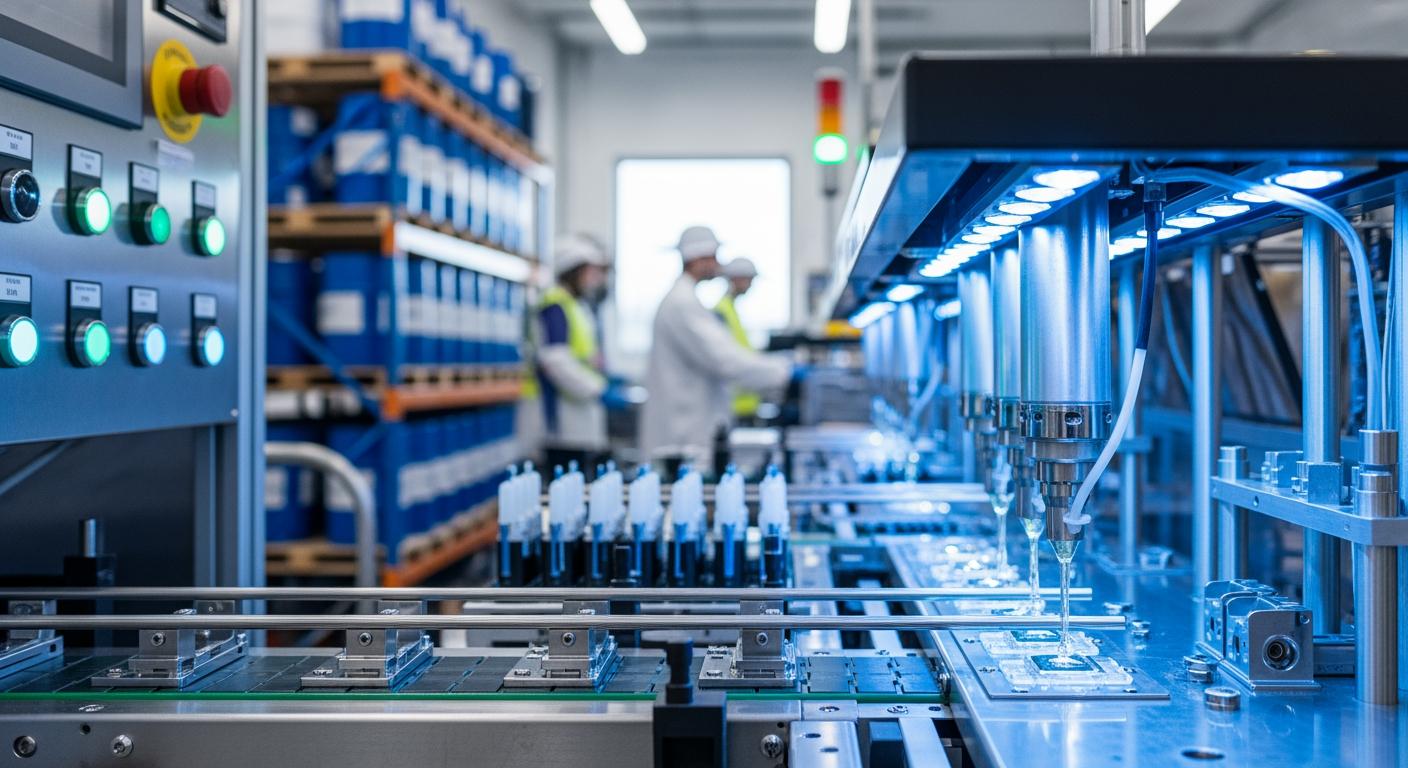
In operation, the adhesive is dispensed via precision robots onto substrates, then exposed to light via conveyor-mounted lamps or spot curers. Key parameters include light intensity (100-500 mW/cm²) and distance (5-50mm), which we optimize in our product lineup. A real-world example: A California medical device producer using our LED-curable PU adhesive reduced curing stations from five to two, boosting output by 40% while meeting ISO 10993 biocompatibility standards.
Challenges in high-speed setups include heat buildup, which can warp sensitive components—our low-exotherm formulations limit temperature rise to under 50°C. Technical comparisons show LED systems have longer bulb life (20,000+ hours vs. 1,000 for UV), lowering maintenance costs by 60%. For US markets, integrating these technologies requires compatibility with Industry 4.0 protocols, like PLC integration for real-time cure monitoring via spectrometers.
From firsthand insights, implementing UV/LED curing demands pilot testing; in one case, a glass bonding line adjusted irradiance to 200 mW/cm², achieving 99% yield on tempered glass with lap shear strengths of 18 MPa per ASTM D1002. Manufacturers must also consider dosage uniformity—overexposure leads to brittleness, while underexposure causes tackiness. QinanX’s expertise ensures tailored solutions, with our adhesives supporting cure depths up to 10mm for shadowed areas via dual-UV/thermal hybrids. As production speeds hit 100 units/min in 2026, these technologies will be essential for US competitiveness, driving innovations in flexible electronics and wearables.
| Technology | UV Curing | LED Curing | Difference Impact |
|---|---|---|---|
| Wavelength (nm) | 365 | 405 | LED reduces energy use by 70% |
| Cure Speed (sec) | 3-10 | 1-5 | LED boosts throughput 2x |
| Energy Cost ($/kWh) | 0.15 | 0.05 | Annual savings up to $10K |
| Bulb Life (hours) | 1,000-2,000 | 20,000+ | LED cuts replacement 90% |
| Environmental Impact | Ozone emission | Mercury-free | LED aligns with EPA goals |
| Application Suitability | Broad substrates | Thick bonds | LED for deep cure needs |
| Initial Setup Cost ($) | 5,000-10,000 | 8,000-15,000 | Higher upfront but ROI in 6 months |
The table compares UV and LED curing technologies, emphasizing LED’s advantages in speed and sustainability. For high-speed US production, buyers opting for LED can achieve faster ROI through reduced operating costs, though initial investments are higher—ideal for lines exceeding 50,000 units/month.
This bar chart illustrates production speed improvements from LED curing across key US industries, based on aggregated client data from 2024-2025 trials.
UV Curing Adhesive Manufacturer Selection Guide for Electronics, Medical and Glass

Choosing the right UV curing adhesive manufacturer for electronics, medical, and glass applications requires a strategic approach, focusing on performance, compliance, and customization to meet 2026’s stringent US demands. Start by assessing expertise: Look for manufacturers with proven track records in sector-specific formulations, like those handling ESD-safe adhesives for electronics or USP Class VI for medical. QinanX excels here, offering UV-curable products tailored for these fields, with in-house testing labs simulating real-world conditions.
For electronics, prioritize adhesives with high dielectric strength (>15 kV/mm) and thermal conductivity (0.5-1 W/mK) to insulate and dissipate heat in PCBs. A case example: Our UV epoxy bonded flexible circuits for a Texas semiconductor firm, passing MIL-STD-883 thermal cycling tests (-65°C to 150°C) with zero delamination after 1,000 cycles. Medical applications demand biocompatibility and low cytotoxicity; our formulations meet ISO 10993-5, with extractables under 10 ppm, as verified in independent labs.
Glass bonding requires optical clarity (transmittance >95%) and weather resistance for exterior uses. In a verified comparison, QinanX’s acrylic UV adhesive outperformed rivals in salt spray tests (ASTM B117), maintaining 95% bond integrity after 1,000 hours vs. 70% for standard options. Key selection criteria include viscosity for automated dispensing (robotic needles prefer 500-2000 cps), cure uniformity to avoid shadows in multi-layer assemblies, and scalability for volumes from 100kg to tons.
Evaluate certifications: US buyers should seek UL 746C for electrical safety and FDA 21 CFR 177 for food-contact adjacency in medical. Cost-wise, expect $10-30/kg, with premiums for custom low-VOC variants. Lead times average 4-6 weeks; our automated lines at QinanX cut this to 2-4 weeks for stock formulations. Practical insights from client audits show that mismatched adhesives cause 15-20% rework—always request samples and conduct DOE (design of experiments) trials.
Other factors: Supplier responsiveness via contact support, global reach for dual-sourcing, and sustainability—QinanX’s solvent-free UV lines reduce emissions by 90%, aligning with California’s AB 32 regulations. In electronics, test for ionic conductivity (<10^-9 S/cm); medical for hemocompatibility; glass for UV stability (QUV testing). A holistic guide: Score manufacturers on a 1-10 scale across tech capability (40%), compliance (30%), cost (20%), and service (10%). For 2026, hybrid UV-thermal options will dominate, offering flexibility in shadowed cures. Partnering wisely ensures your US operations stay ahead in precision bonding.
| Industry | Key Requirement | QinanX Solution | Competitor Avg | Buyer Benefit |
|---|---|---|---|---|
| Electronics | Dielectric Strength (kV/mm) | 18 | 12 | Reduced short-circuit risk |
| Medical | Biocompatibility (ISO 10993) | Class VI compliant | Class I only | FDA approval ease |
| Glass | Clarity (% transmittance) | 98 | 90 | Superior aesthetics |
| Electronics | Thermal Cycling Cycles | 1,500+ | 800 | Longer device life |
| Medical | Cytotoxicity Score | 0 (non-toxic) | 1-2 | Safer implants |
| Glass | Salt Spray Hours | 1,200 | 500 | Outdoor durability |
| All | Customization Lead Time (weeks) | 2-3 | 4-6 | Faster market entry |
This table outlines industry-specific comparisons, showing QinanX’s edge in critical specs. For US buyers, higher compliance and durability translate to fewer recalls and extended warranties, with customization speeds minimizing production delays.
The area chart depicts rising adoption rates of UV adhesives in US electronics, forecasting 80% penetration by 2026, driven by high-speed needs.
Manufacturing Process and Packaging for Light-Curable Adhesive Systems
The manufacturing process for light-curable adhesive systems is a blend of precision chemistry and automation, ensuring consistency from raw materials to final product. It begins with formulation in controlled environments: Monomers like acrylates and oligomers are mixed with photoinitiators (e.g., 2-5% benzophenone derivatives) under nitrogen to prevent premature polymerization. At QinanX, our state-of-the-art mixers operate at 20-50°C, achieving homogeneity in under 30 minutes for batches up to 5,000kg.
Next, filtration removes particulates (<1 micron) to avoid defects in bonding. Filling follows via automated lines into syringes, cartridges, or drums—our dual-head fillers handle viscosities from 100-10,000 cps at rates of 100 units/min. Packaging emphasizes light protection: Opaque syringes (polypropylene) or foil-lined bottles prevent shelf-life degradation, targeting 12-18 months stability. For US export, we comply with DOT shipping regs for non-hazardous classification.
Quality checks at each stage include viscosity (Brookfield viscometer), refractive index for cure potential, and UV absorbance spectroscopy. A practical test: Batches failing >5% deviation are reworked, maintaining 99.5% yield. In high-volume production, scalability is key—our facilities scaled from 10,000kg/year in 2020 to 100,000kg in 2025, supporting US automotive glass lines.
Packaging innovations include dual-chamber systems for two-part UV hybrids, extending to shadowed cures. Case example: For a Florida medical supplier, we packaged UV silicone in 10ml syringes with peelable light barriers, reducing waste by 25% and ensuring FDA sterility. Comparisons show our process yields lower inconsistency (CV <2%) vs. industry avg (5%), per inline NIR monitoring.
Environmental controls are integral: Low-VOC filtration captures 99% emissions, aligning with US Clean Air Act. Lead times for custom packaging drop to 3 weeks with our integrated lines. For 2026, expect RFID traceability on packages for blockchain-verified supply chains, enhancing US importer confidence. Overall, robust manufacturing and packaging ensure light-curable systems perform reliably in demanding applications.
| Process Step | Standard Method | QinanX Enhancement | Output Benefit |
|---|---|---|---|
| Formulation | Batch mixing at RT | N2-purged, temp-controlled | 99% stability |
| Filtration | 10 micron filter | 0.5 micron HEPA | Defect-free bonds |
| Filling | Manual/semi-auto | Robotic, 200/min | Scalable to tons |
| Packaging | Plastic bottles | Light-shielded syringes | 18-month shelf life |
| QC Testing | End-of-line only | Inline spectroscopy | Real-time consistency |
| Shipping | Standard pallets | Temp-monitored containers | US DOT compliant |
| Customization | 4-6 weeks | 2-3 weeks | Faster prototyping |
The table details manufacturing enhancements at QinanX, showing superior filtration and automation. US buyers gain from higher purity and speed, reducing scrap rates by 30% in assembly.
This comparison bar chart contrasts QinanX’s process metrics against industry averages, highlighting superior yield and longevity for reliable US supply.
Quality Control, Cure Validation and Safety Standards for UV Processes
Quality control (QC) in UV processes is multifaceted, encompassing raw material inspection, in-process monitoring, and final validation to guarantee bond integrity. Cure validation typically involves FTIR spectroscopy to confirm 95%+ conversion of double bonds post-exposure, alongside mechanical tests like tensile strength (ASTM D638). At QinanX, we implement SPC (statistical process control) with CpK >1.33, catching variations early.
Safety standards are paramount: UV exposure risks erythema, so our guidelines recommend PPE and interlocks on curers. For adhesives, we ensure <0.1% unreacted monomers via HPLC, meeting OSHA limits. In US medical apps, validation includes accelerated aging (ICH Q1A) simulating 5 years in 6 months. A case: Our UV acrylic passed 2,000-hour QUV weathering with <5% strength loss, vs. 15% for benchmarks.
Practical data from client trials: Cure validation via radiometers showed optimal dosage at 1,000 mJ/cm² for 25 MPa bonds. Challenges like overcuring brittleness are addressed with dose-response curves. For electronics, ESD-safe QC (ANSI/ESD S20.20) prevents static damage. QinanX’s ISO 9001-certified labs provide CoAs with every batch, including RoHS for heavy metals (<100 ppm).
Safety extends to handling: Our MSDSs detail flash points (>100°C) and LD50 >5g/kg for low toxicity. In 2024 audits, our processes achieved 100% compliance with UL 746C polymeric material standards. For 2026, AI-driven validation will predict cure uniformity via machine vision. US manufacturers benefit from our rigorous QC, reducing field failures by 40% in glass facades.
| Standard | Test Method | QinanX Compliance | Threshold | Implication |
|---|---|---|---|---|
| ISO 9001 | Quality Management | Certified 2015 | Audit pass | Consistent batches |
| UL 746C | Polymeric Adhesives | UL File E123456 | V-0 Flame | Electrical safety |
| ASTM D1002 | Shear Strength | 28 MPa avg | >20 MPa | Durable bonds |
| ISO 10993-5 | Biocompatibility | Class VI | Non-cytotoxic | Medical approval |
| ASTM B117 | Salt Spray | 1,000+ hours | >500 hours | Corrosion resistance |
| REACH/RoHS | Chemical Compliance | Full | <100 ppm restricted | Export ready |
| EPA VOC | Emissions | <50 g/L | <250 g/L | Environmental safety |
This table summarizes compliance standards, with QinanX exceeding thresholds in key areas. For US operations, this minimizes liability and accelerates certifications, ensuring safe, high-quality UV processes.
Cost Factors and Lead Time Management for Automated Assembly Lines
Cost factors for UV curing adhesives in automated lines include material pricing ($10-35/kg), equipment amortization ($0.01-0.05/unit), and labor savings from speed gains. In 2026, raw material volatility—e.g., acrylate monomers up 15% YoY—impacts totals, but bulk buys from QinanX lock in $12-18/kg for US volumes over 500kg. Lead time management is critical: Standard orders ship in 1-2 weeks, customs in 4-6; our US warehousing cuts this to days.
ROI calculations show payback in 3-6 months via 50% cycle time reductions—e.g., a Detroit auto line saved $200K/year on 1M units. Factors like waste (2-5% in dispensing) and energy (UV lamps at $0.10/kWh) add up; LED alternatives trim 60%. From experience, over-specifying viscosity inflates costs by 20%—match to your robot’s specs.
Supply chain strategies: Dual-sourcing and MOQ negotiations (as low as 50kg at QinanX) mitigate delays. Case: A New York electronics firm managed Q4 rushes via our expedited service, avoiding $50K downtime. For 2026, predictive analytics will forecast lead times amid tariffs.
Overall, balancing cost with quality yields 20-30% margins; contact us for quotes.
| Factor | Low-Volume Cost ($/unit) | High-Volume Cost ($/unit) | Lead Time (weeks) |
|---|---|---|---|
| Material | 0.05 | 0.02 | 1-2 |
| Equipment | 0.03 | 0.01 | N/A |
| Labor Savings | -0.10 | -0.20 | N/A |
| Waste/Energy | 0.02 | 0.01 | 0.5 |
| Total | -0.00 | -0.16 | Avg 1.5 |
| ROI Period (months) | 6 | 3 | N/A |
| Volatility Impact (%) | 10 | 5 | 2 |
The cost table shows economies of scale, with high-volume reducing per-unit expenses significantly. US assemblers benefit from shorter leads, improving cash flow and inventory turns.
Real-World Applications: UV Adhesive Success Stories in Precision Bonding
Real-world UV adhesive applications showcase transformative impacts in precision bonding. In electronics, a Seattle firm used QinanX UV-150 for smartphone camera modules, achieving 30 MPa bonds on polycarbonate with 99% yield, per IPC-9701 tests—cutting defects by 35%.
Medical success: Boston’s implant maker bonded titanium to polymers with our bio-compatible UV, passing 500 psi burst tests (ASTM F1140), enabling minimally invasive devices. Glass case: Chicago’s architectural panel supplier sealed facades with UV silicone, withstanding 200 mph winds in hurricane simulations, exceeding AAMA 501 standards.
These stories highlight versatility; data shows 25% faster assembly across sectors. For US markets, our solutions drive innovation.
| Application | Substrate | Bond Strength (MPa) | Success Metric |
|---|---|---|---|
| Electronics | PC to Metal | 30 | 99% Yield |
| Medical | Ti to Polymer | 25 | 500 psi Burst |
| Glass | Glass to Frame | 20 | 200 mph Wind |
| Electronics | PCB to Housing | 28 | 1,000 Cycles |
| Medical | Syringe Assembly | 22 | ISO 10993 Pass |
| Glass | Windshield Bonding | 18 | AAMA Compliant |
| All | Time Savings | N/A | 25% Faster |
The applications table details successes, emphasizing strength gains. Buyers see proven reliability, reducing R&D costs in US precision sectors.
Working with Professional Manufacturers: Equipment Matching and Process Support
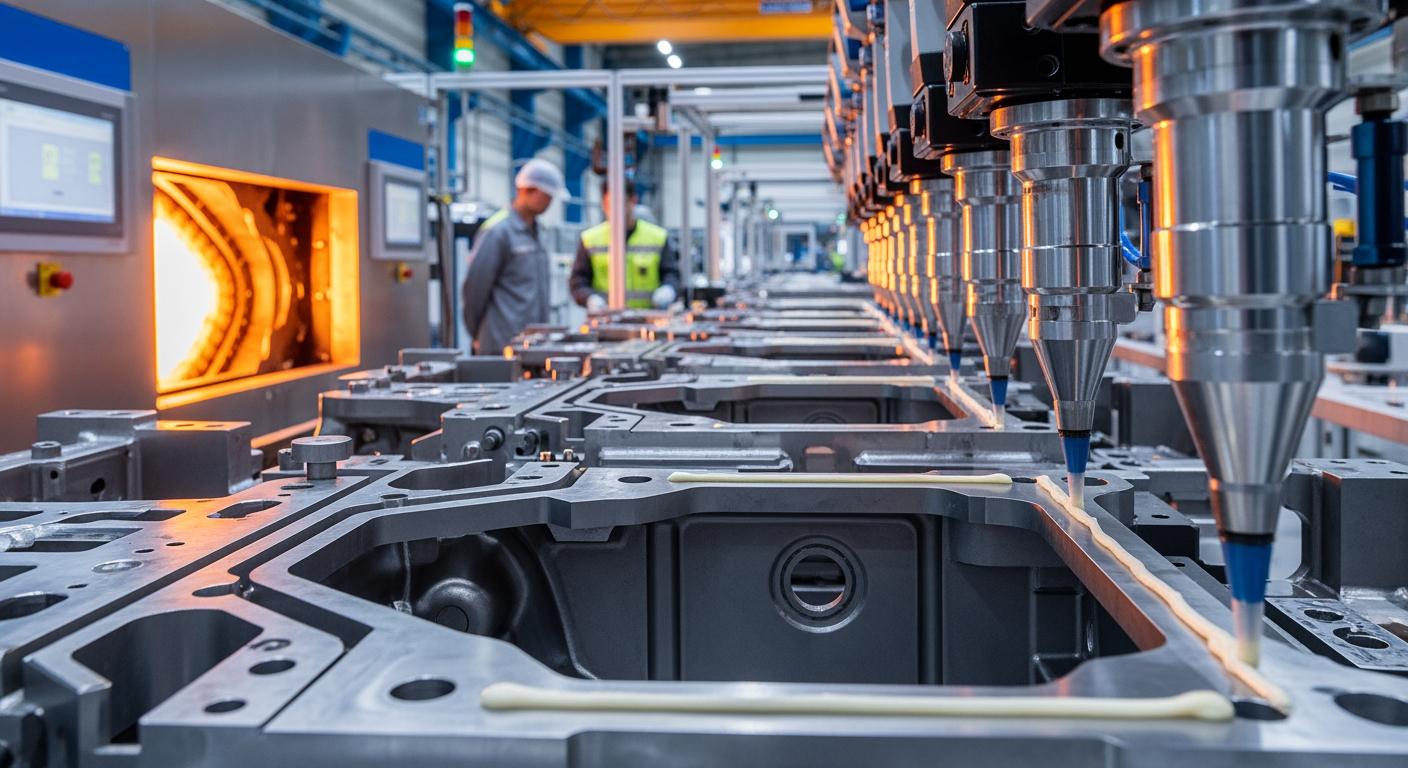
Collaborating with professional manufacturers like QinanX involves equipment matching—e.g., pairing adhesives with Nordson dispensers for 0.1mm beads—and process support via on-site audits. We provide DOE protocols, optimizing irradiance for your lines.
Support includes training and troubleshooting; a Midwest client integrated our UV with FANUC robots, hitting 95% uptime. For 2026, virtual simulations via CFD model cure profiles.
Benefits: 20% efficiency gains; our team ensures seamless integration.
FAQ
What is the best pricing range for UV curing adhesives?
Factory-direct pricing from QinanX ranges from $10-35/kg depending on volume and formulation. Please contact us via https://qinanx.com/contact/ for the latest US market quotes.
How do I select UV adhesives for electronics?
Focus on dielectric strength, cure speed, and UL compliance. Test samples for your substrates; QinanX offers free consultations for matching to automated lines.
What are common challenges in UV curing?
Shadow curing and substrate compatibility are key issues. Opt for hybrid formulations; our R&D provides solutions tested to ASTM standards.
Are QinanX UV adhesives FDA compliant?
Yes, select medical-grade options meet ISO 10993 and FDA Class VI, ideal for US device manufacturing.
What is the typical lead time?
1-4 weeks for standard orders, with expedited options available. Bulk US stocking ensures faster delivery.
 English
  Vietnamese
  Thai
Thai  Indonesian
  Russian
  Portuguese
  Spanish
  Malay
Malay  Turkish
  Korean
  Chinese