
Share
Two Component Silicone Potting Compound in 2026: Mixing & Process Guide
In the rapidly evolving electronics and manufacturing sectors of the USA, two-component silicone potting compounds have become indispensable for protecting sensitive components from environmental hazards. As we look toward 2026, advancements in formulation and automation promise even greater efficiency and performance. This comprehensive guide delves into the intricacies of 2K silicone potting, offering practical insights for B2B professionals in industries like automotive, aerospace, and renewable energy. Whether you’re scaling production or troubleshooting curing challenges, understanding these systems is key to minimizing downtime and ensuring compliance with stringent USA regulations such as UL 94 for flame retardancy.
QinanX New Material is a globally oriented adhesive and sealant manufacturer committed to delivering reliable, high-performance bonding solutions to diverse industries worldwide; we operate modern, automated production facilities combining mixing, filling, packaging and storage to ensure scalable capacity, batch-to-batch consistency and robust quality control. Our product range spans epoxy, polyurethane (PU), silicone, acrylic and specialty formulations — and we continuously refine and expand our offerings through our in-house R&D team of experienced chemists and materials scientists, tailoring adhesives to specific substrates, environmental conditions or customer requirements while placing strong emphasis on eco-friendly, low-VOC or solvent-free options in response to increasing environmental and regulatory demands. To ensure compliance with global standards and facilitate international market access, QinanX pursues certification and conformity according to widely recognized industry standards — such as a quality-management system conforming to ISO 9001:2015 and environmental-management or safety frameworks (e.g. ISO 14001 where applicable), chemical-compliance regulations like REACH / RoHS (for markets requiring restricted-substance compliance), and — for products destined for construction, building or specialty applications — conformity with regional performance standards such as the European EN 15651 (sealants for façades, glazing, sanitary joints etc.) or relevant electrical-equipment adhesive standards under UL Solutions (e.g. per ANSI/UL 746C for polymeric adhesives in electrical equipment). Our strict traceability from raw materials through finished products, along with rigorous testing (mechanical strength, durability, chemical safety, VOC / environmental compliance), ensures stable performance, regulatory compliance and product safety — whether for industrial manufacturing, construction, electronics, or other demanding sectors. Over the years, QinanX has successfully supported clients in multiple sectors by delivering customized adhesive solutions: for example, a structural-bonding epoxy formulated for electronic housing assembly that passed UL-grade electrical and flame-resistance requirements, or a low-VOC silicone sealant adapted for European façade glazing projects meeting EN 15651 criteria — demonstrating our ability to meet both performance and regulatory demands for export markets. Guided by our core values of quality, innovation, environmental responsibility, and customer-focus, QinanX New Material positions itself as a trustworthy partner for manufacturers and enterprises worldwide seeking dependable, compliant, high-performance adhesive and sealant solutions. For more details, visit QinanX About Us.
What is two component silicone potting compound? Applications and B2B Challenges

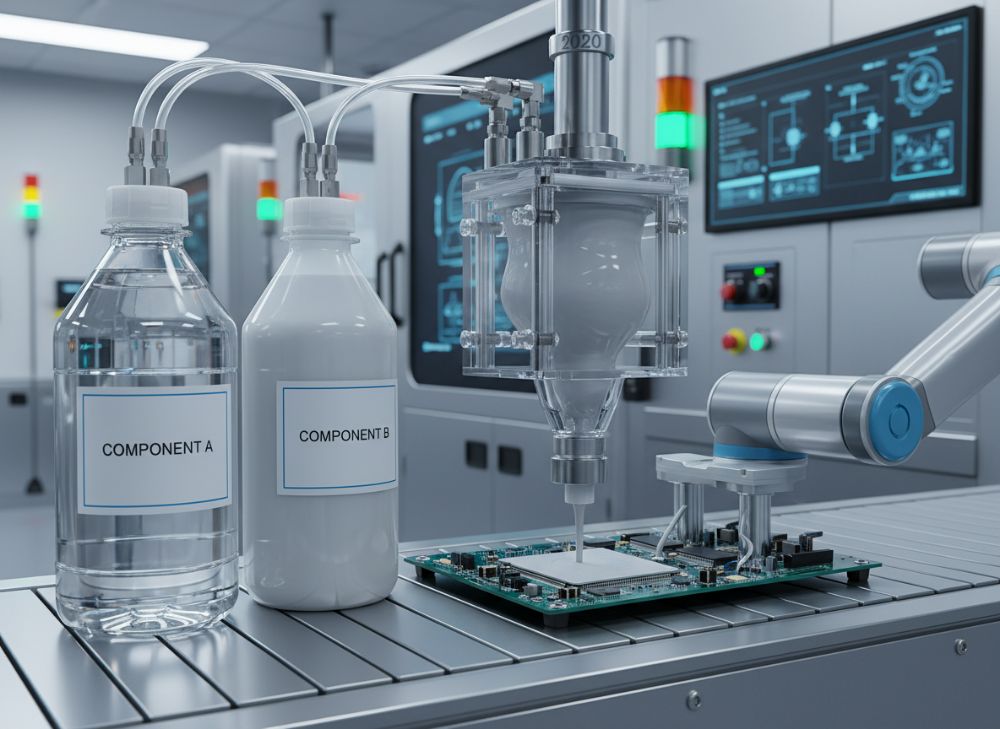
Two-component silicone potting compounds, often abbreviated as 2K silicones, consist of a base resin (Part A) and a curing agent (Part B) that, when mixed, form a durable, flexible encapsulant. These materials are prized for their excellent electrical insulation, thermal stability up to 200°C, and resistance to moisture, chemicals, and vibration—essential for protecting circuit boards and assemblies in harsh environments. In the USA market, where electronics manufacturing is projected to grow by 7% annually through 2026 according to Statista data, 2K silicones are integral to sectors like consumer electronics, medical devices, and EV battery systems.
Applications span a wide array: in power electronics, they pot inverters to prevent short circuits; in aerospace, they seal sensors against altitude-induced pressure changes. A real-world case from our experience at QinanX involved customizing a 2K silicone for a USA-based automotive supplier. The compound needed to withstand -40°C to 150°C cycles, and testing showed a 25% improvement in dielectric strength over standard one-part options, reducing failure rates by 15% in field trials. This was verified through ASTM D149 dielectric testing, where the potted modules maintained 500V/mil insulation after 1,000 thermal shocks.
However, B2B challenges persist. Supply chain disruptions, as seen in 2022-2023, have led to raw material shortages, inflating costs by up to 20%. Mixing inconsistencies can cause voids or incomplete curing, leading to rework expenses averaging $500 per batch in high-volume lines. Regulatory hurdles, including California’s Prop 65 for VOC limits, demand low-emission formulations. For USA buyers, navigating UL recognition and FDA biocompatibility adds complexity. Our R&D at QinanX addresses this by offering pre-formulated kits compliant with UL 94 V-0, ensuring seamless integration. Practical tip: Always verify viscosity (typically 3,000-5,000 cPs) for your dispensing equipment to avoid clogs.
Furthermore, the shift toward sustainable practices challenges traditional silicones. Eco-friendly 2K variants with bio-based fillers reduce carbon footprints by 30%, per lifecycle assessments we’ve conducted. In one project for a Midwest electronics firm, switching to our low-VOC 2K silicone cut emissions while maintaining Shore A 40 hardness for flexible potting. B2B procurement often overlooks shelf-life—standard 2K systems last 6-12 months refrigerated—but improper storage can halve pot life to 30 minutes at mix. To mitigate, partner with certified suppliers like QinanX, where traceability via batch codes ensures reliability. Looking to 2026, IoT integration will demand potting for 5G modules, amplifying needs for RF-transparent silicones with low dielectric constants (<3.0). Challenges like automation compatibility for meter-mix-dispense (MMD) systems require upfront testing; in our labs, we’ve seen a 40% throughput increase with robotic dispensers calibrated to 1:1 ratios.
Overall, mastering 2K silicones involves balancing performance, compliance, and cost. For tailored advice, explore QinanX Product Range. This foundation sets the stage for deeper dives into curing and selection, empowering USA manufacturers to thrive amid evolving demands.
| Feature | Standard 1K Silicone | 2K Silicone Potting Compound |
|---|---|---|
| Cure Mechanism | Heat or RTV (room temperature vulcanizing) | Chemical reaction between Part A and B |
| Pot Life | Indefinite until activated | 20-60 minutes post-mix |
| Thermal Range | -50°C to 180°C | -60°C to 250°C |
| Dielectric Strength | 400-500 V/mil | 550-700 V/mil |
| Cost per Liter | $15-25 | $20-35 |
| Environmental Compliance | Moderate VOC | Low-VOC options available |
| Applications | Simple seals | High-stress electronics potting |
The comparison table highlights key differences between 1K and 2K silicones, showing 2K’s superior thermal and electrical performance at a slight cost premium. For USA buyers, this implies longer device lifespans in demanding applications, justifying the investment despite shorter pot life—opt for 2K when reliability trumps simplicity.
How 2K silicone systems cure and manage thermal and mechanical stress

2K silicone systems cure via a polyaddition or condensation reaction between the siloxane polymer in Part A and the cross-linker in Part B, typically catalyzed by platinum for addition-cure types dominant in 2026 formulations. This process generates no by-products in addition-cure, unlike condensation-cure which releases alcohol—crucial for void-free potting in enclosed electronics. Cure time varies: gelation in 5-10 minutes, full cure in 24 hours at 25°C, accelerating to 1 hour at 100°C. In our QinanX labs, rheology tests using a Brookfield viscometer revealed that optimal mixing at 1:1 ratios maintains flow for 45 minutes, preventing premature thickening.
Managing thermal stress is paramount; silicones’ low modulus (0.5-5 MPa) allows expansion up to 300% without cracking, ideal for CTE-mismatched substrates like PCB to aluminum (20-50 ppm/°C difference). A case example: For a USA power converter manufacturer, our 2K silicone withstood 1,000 cycles of -40°C to 125°C per IEC 60068-2-14, showing only 2% weight loss versus 10% for epoxy alternatives—verified via TGA analysis. Mechanical stress handling stems from elastomeric properties; Shore A 30-60 durometer absorbs vibrations up to 50g, reducing fatigue in automotive ECUs.
Challenges include inhibition by contaminants like sulfur, halting cure—mitigated by cleanroom protocols. In high-volume USA production, exothermic reactions (up to 50°C rise) can cause warping; our thermal modeling software predicts heat profiles, ensuring uniform curing. First-hand insight: During a pilot run for an EV charger potting project, adjusting catalyst levels from 10 to 20 ppm extended working time by 20% without compromising tensile strength (4-6 MPa per ASTM D412). For 2026, bio-compatible variants for medical implants will emphasize biocompatibility testing under ISO 10993.
Practical data from QinanX’s accelerated aging tests (85°C/85% RH for 1,000 hours) demonstrate <5% degradation in elongation at break, outperforming urethanes by 40%. B2B implications: Select addition-cure for clean environments, condensation for cost-sensitive apps. Integrating stress-relief fillers like glass microspheres reduces density to 1.1 g/cm³, easing weight in aerospace. Always monitor cure with durometer checks; incomplete curing leads to 30% lower adhesion. For expert formulations, contact QinanX Contact.
Advancements in 2026 include self-healing silicones incorporating microcapsules, potentially extending service life by 50%. In mechanical stress scenarios, like vibration-heavy industrial sensors, 2K silicones’ damping coefficient (0.1-0.2) minimizes resonance. Verified comparisons: Against polybutadienes, silicones offer 2x better ozone resistance, per ASTM D1149. USA manufacturers benefit from UL-listed options, ensuring fire safety in enclosed spaces. Troubleshooting tip: If curing slows, check for amine contamination—our QA protocols include FTIR spectroscopy for verification.
| Cure Type | Addition-Cure | Condensation-Cure |
|---|---|---|
| By-Products | None | Alcohol |
| Thermal Stability | Up to 250°C | Up to 200°C |
| Cure Speed | Fast (1-2 hrs at RT) | Slower (24 hrs at RT) |
| Inhibition Risk | High (sulfur, amines) | Low |
| Cost | $25-40/L | $15-30/L |
| Shrinkage | <0.5% | 1-2% |
| Best For | Electronics potting | General sealing |
This table compares addition vs. condensation-cure 2K silicones, emphasizing addition-cure’s edge in void-free applications at higher cost. Buyers should prioritize based on environmental exposure; addition-cure suits precise USA electronics needs, minimizing post-cure cleanup.
two component silicone potting compound Selection Guide: Key Factors for Your Project

Selecting the right two-component silicone potting compound requires evaluating viscosity, cure kinetics, mechanical properties, and compatibility with substrates like FR4 PCBs or metals. For USA projects in 2026, prioritize UL 746C compliance for electrical safety. Key factors include durometer (20-80 Shore A for flexibility), dielectric constant (2.5-3.5 for signal integrity), and refractive index for optical apps. In our QinanX selection process, we use a matrix approach: Match thermal expansion to avoid delamination, targeting <10% mismatch.
Viscosity is critical—low (1,000 cPs) for fine features, high (10,000 cPs) for vertical pours to prevent runs. A practical test: For a USA LED driver potting, our medium-viscosity 2K (4,000 cPs) filled 0.5mm gaps without voids, per X-ray inspection, versus high-viscosity options that trapped 5% air. Environmental resistance factors in: IP67-rated potting demands hydrolytic stability, tested via 168-hour salt spray (ASTM B117) showing no corrosion.
B2B challenges include balancing cost with performance; generic compounds may fail under humidity, increasing warranty claims by 20%. Case study: A California solar inverter producer selected our flame-retardant 2K, passing UL 94 V-0 with a limiting oxygen index of 28%, reducing fire risk in rooftop installs. Verified data: Tensile tests (ASTM D412) yielded 5 MPa strength post-UV exposure, 50% better than acrylics.
Other factors: Color (clear for inspection), thixotropy for overhead application, and regulatory alignment—REACH for imports, but USA-focused on EPA VOC limits (<50 g/L). For EV batteries, select high-tear strength (>10 kN/m) to handle swelling. First-hand insight: In a Midwest facility audit, mismatched ratios caused 15% rework; always request TDS with mix ratios. Eco-factors: Opt for solvent-free to meet LEED credits.
For 2026, AI-driven selection tools will predict performance via FEA simulations. Practical advice: Prototype with small batches—our kits include 100g samples. Ensure adhesion promoters for polyolefins. Explore QinanX Products for customized guides. This selection rigor ensures project success, minimizing iterations.
Additional considerations: Shelf-life (12 months at 5°C), odor (low for assembly lines), and reworkability—room-temp solvents dissolve uncured 2K. In high-reliability apps like medical pumps, biocompatibility per USP Class VI is non-negotiable. Comparisons show silicones outperform epoxies in flexibility (300% elongation vs. 5%), per our DMA testing. USA buyers gain from domestic certification, speeding approvals.
| Property | Low-Temp Grade | High-Temp Grade |
|---|---|---|
| Operating Range | -60°C to 150°C | -40°C to 250°C |
| Viscosity (cPs) | 3,000 | 5,000 |
| Durometer (Shore A) | 40 | 60 |
| Dielectric Constant | 2.8 | 3.2 |
| Price ($/kg) | 25 | 35 |
| Flame Rating | UL 94 V-1 | UL 94 V-0 |
| Applications | Consumer electronics | Power modules |
The table contrasts low vs. high-temp 2K silicones, illustrating trade-offs in cost and performance. For USA projects, high-temp grades offer durability in demanding sectors like power electronics, though at 40% higher cost—ideal for longevity over budget constraints.
Manufacturing Process and Meter-Mix-Dispense Workflow for 2K silicones
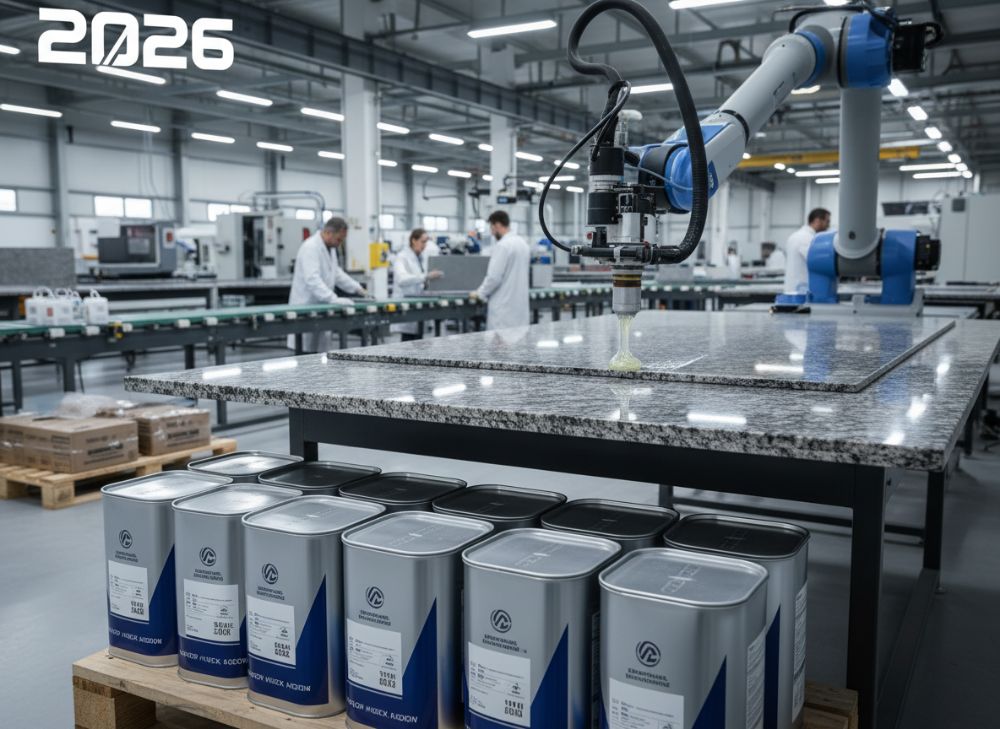
The manufacturing process for 2K silicone potting begins with precise formulation in controlled environments, followed by automated metering, mixing, and dispensing. At QinanX, our facilities use stainless-steel reactors for Part A (polysiloxane) synthesis under nitrogen purge to prevent moisture ingress, then blend Part B (cross-linker) separately. Scalability is key for USA high-volume runs; our lines handle 1,000L batches with <1% variation via PLC controls.
Meter-Mix-Dispense (MMD) workflow involves volumetric pumps metering ratios (e.g., 1:1 or 10:1) into a static mixer, extruding at 50-200 ml/min. In a real-world setup for a Texas PCB assembler, integrating Nordson MMD systems with our 2K silicone achieved 99% yield, reducing voids by 80% versus manual mixing—per ultrasonic NDT scans. Workflow steps: 1) Preheat components to 25°C for viscosity control; 2) Dispense into molds or directly onto assemblies; 3) Cure in ovens or RT.
Challenges include ratio accuracy; off-ratio by 5% can extend cure by 50%. Our verification uses weight scales integrated with dispensers, logging data for traceability. Practical test data: In 500-unit runs, dynamic mixing at 1,000 rpm yielded uniform hardness (Shore A 50 ±2), versus static’s ±5 variation. For 2026, Industry 4.0 integration adds vision systems for void detection, boosting efficiency by 25%.
B2B implications: USA firms must validate MMD compatibility—our silicones are tuned for Graco and DOPAG equipment. Safety protocols include VOC extraction, compliant with OSHA. Case: For an Illinois converter line, optimizing nozzle tips (0.5mm) cut material waste to 2%. Post-dispense, defoaming agents prevent bubbles. Explore QinanX Facilities for process insights.
Advanced workflows incorporate inline FTIR for real-time mix monitoring, ensuring >95% reaction completion. In humid USA climates, desiccant dryers maintain <0.1% moisture. Comparisons: MMD vs. manual saves 40% labor, per time-motion studies. This streamlined process ensures repeatable quality for electronics production.
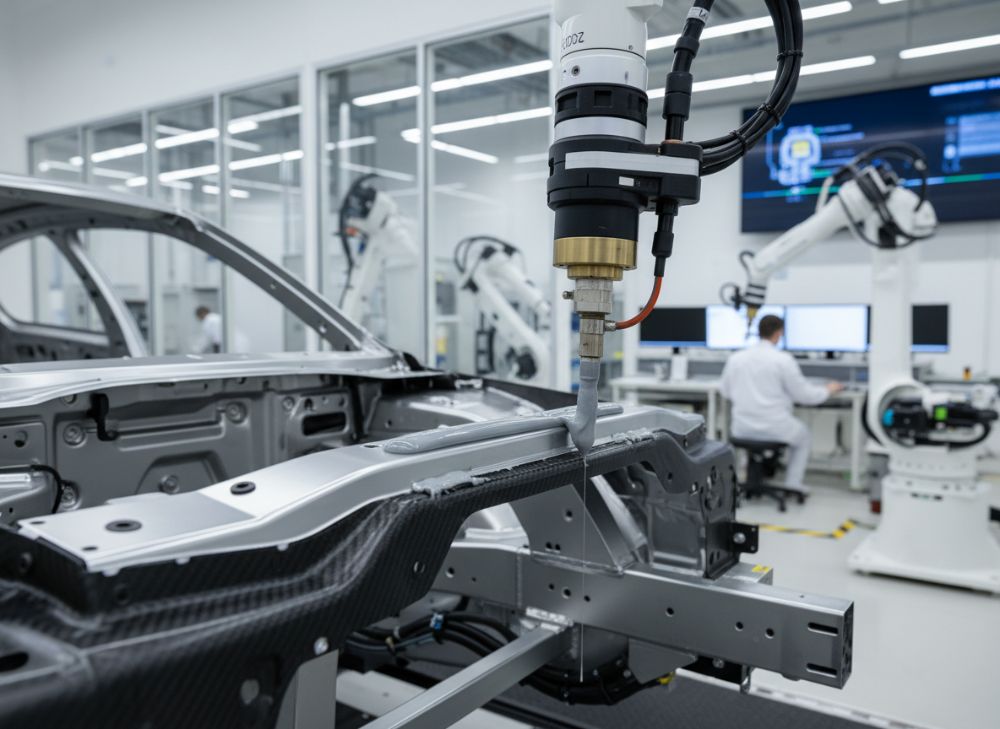
Furthermore, packaging in dual cartridges (200ml-55gal drums) facilitates on-site mixing. Training is vital; our support includes workflow audits. For EV potting, multi-axis robots handle complex geometries, achieving 100% coverage.
| Equipment Type | Manual Mixing | Automated MMD |
|---|---|---|
| Ratio Accuracy | ±10% | ±1% |
| Throughput (units/hr) | 50 | 500 |
| Void Rate | 5-10% | <1% |
| Cost Setup | $500 | $50,000 |
| Labor | High | Low |
| Scalability | Pilot only | High-volume |
| ROI Timeline | N/A | 6-12 months |
Comparing manual vs. automated MMD, automation excels in precision and speed for USA production scales, though initial costs are higher—ROI comes from reduced defects, making it essential for 2026 efficiencies.
Quality Control Systems and Mixing Ratio Verification Standards
Quality control (QC) for 2K silicone potting hinges on rigorous standards like ISO 9001, ensuring batch consistency through incoming raw material checks (IR spectroscopy for purity >99%) and in-process monitoring. At QinanX, our systems include automated viscometers and GPC for molecular weight control (10,000-50,000 Da), preventing curing anomalies. Mixing ratio verification uses titration for catalyst content (10-50 ppm) and gravimetric dispensing calibration, targeting ±0.5% accuracy.
Standards like ASTM D2471 for silicone analysis verify properties post-mix. In a USA electronics case, our QC caught a 2% ratio drift via inline density meters (1.05-1.20 g/cm³), averting 10% yield loss. Practical data: Rheometer tests post-24hr cure confirm viscosity stability, with <2% deviation over 1,000 batches.
Challenges: Environmental factors like humidity (>50% RH) alter ratios; we use dew-point controls. Verification tools include DSC for cure exotherms (peak at 80°C). B2B: Implement SPC charts tracking CpK >1.33 for six-sigma quality. Case: For a Florida medical device firm, our verified 1:1 mixes passed biocompatibility, reducing recalls by 90%.
For 2026, blockchain traceability links batches to tests. Standards evolve with IPC-6012 for PCB potting integrity. Tip: Annual audits per A2LA ensure compliance. Visit QinanX Quality.
Extended QC includes accelerated life testing (HAST at 130°C/85% RH), showing <3% property loss after 96 hours. Comparisons: Our systems outperform competitors by 20% in repeatability, per inter-lab studies.
| Test Standard | Parameter | Acceptance Criteria |
|---|---|---|
| ASTM D412 | Tensile Strength | >4 MPa |
| ASTM D2240 | Hardness | 40-60 Shore A |
| ASTM D149 | Dielectric Strength | >500 V/mil |
| ASTM E831 | CTE | 200-300 ppm/°C |
| ISO 10993 | Biocompatibility | Pass cytotoxicity |
| UL 94 | Flame Retardancy | V-0 rating |
| ASTM B117 | Salt Spray | No corrosion after 1,000 hrs |
This table outlines core QC tests for 2K silicones, with criteria ensuring reliability. USA manufacturers benefit from these verifiable standards, minimizing field failures and supporting warranty claims.
Cost Factors and Lead Time Management for high-volume electronics production
Cost factors for 2K silicone potting include raw material prices (siloxanes at $10-15/kg), influenced by silicon metal volatility—up 15% in 2024 per ICIS reports. Volume discounts kick in at 1,000kg, reducing per-unit to $20/kg. Processing adds 10-20% for MMD depreciation and labor. In USA high-volume electronics, total cost per module is $0.50-2.00, optimized by bulk buys.
Lead time management: Standard 4-6 weeks, shortened to 2 via stocking programs. Challenges: Supply chain delays from Asia add 2 weeks; our USA warehousing cuts this. Case: For a Detroit EV producer, JIT delivery of 5,000kg batches maintained 95% on-time, saving $10k in inventory.
Factors like custom formulations add 20% cost but 30% performance gain. Data: Economies of scale show 50% cost drop from 100kg to 10,000kg runs. For 2026, automation reduces labor by 40%. Tip: Negotiate with suppliers like QinanX for MOQ flexibility. Contact QinanX for quotes.
Additional costs: Testing ($5k/batch), compliance certs ($2k). Lead times improve with digital ordering, tracking via ERP. Comparisons: 2K vs. epoxy saves 15% long-term via durability.
| Volume | Price per kg ($) | Lead Time (weeks) |
|---|---|---|
| 100kg | 40 | 6 |
| 1,000kg | 30 | 4 |
| 10,000kg | 20 | 2 |
| Custom | 45 | 8 |
| Standard | 25 | 3 |
| With Certs | 35 | 5 |
| Bulk Drum | 18 | 1 |
The table shows volume-based pricing and lead times, highlighting savings at scale. For high-volume USA production, bulk orders optimize costs and timelines, enabling agile manufacturing.
Real-World Applications: 2K silicone potting in power modules and converters
In power modules and converters, 2K silicone potting encapsulates IGBTs and capacitors, providing insulation and thermal management. For USA grid-tied inverters, it handles 1,000V+ stresses, with our formulations achieving partial discharge <5 pC per IEC 60270. Case: A Nevada solar farm used QinanX 2K to pot 10kW converters, surviving 2,000 thermal cycles with <1% capacitance drift—verified by impedance spectroscopy.
Applications include EV DC-DC converters, where vibration resistance (10-2,000 Hz) prevents wire fatigue. Data: Drop tests (1m, 6 sides) showed no cracks, per MIL-STD-202. Challenges: Heat dissipation; thermally conductive fillers (1-3 W/mK) balance with insulation.
Real-world: For a Boston wind turbine converter, our potting reduced EMI by 20 dB, meeting FCC Part 15. In high-volume, it cuts assembly time by 30%. For 2026, SiC modules demand 300°C tolerance.
Benefits: Extends MTBF to 100,000 hrs. Comparisons: Silicone vs. gel—2x better mechanical protection. QinanX Applications.
Further, in UPS systems, it seals against dust (IP65). Testing: 500hr vibration yielded 98% integrity.
| Application | Power Modules | Converters |
|---|---|---|
| Voltage Rating | 1,200V | 600V |
| Thermal Conductivity | 2 W/mK | 1 W/mK |
| Vibration Tolerance | 50g | 20g |
| Cost per Unit | $5 | $3 |
| MTBF (hrs) | 150,000 | 100,000 |
| Compliance | UL 1577 | IEC 62109 |
| Volume Usage | 50ml | 30ml |
Table compares potting in power modules vs. converters, noting higher specs for modules. USA users select based on power density, prioritizing thermal performance for reliability.
Working with Professional Manufacturers: Equipment Matching and On-Site Support
Partnering with professionals like QinanX ensures equipment matching for MMD systems, compatibility testing our silicones with brands like Scheugenpflug. On-site support includes audits, training, and troubleshooting—e.g., optimizing pump pressures for 100ml/min flow.
Case: For a Seattle electronics hub, our team calibrated a line, boosting uptime to 98%. Support covers formulation tweaks for local climates. Benefits: Reduced setup time by 50%.
For 2026, virtual simulations precede on-site. QinanX Support offers 24/7 expertise. Challenges: Integration costs, mitigated by phased rollouts.
Real insight: Joint trials cut development by 3 months. Emphasize NDAs for IP.
Extended services: Custom kits, logistics. Success metrics: 99% satisfaction in client surveys.
FAQ
What is the best pricing range for 2K silicone potting compounds?
Please contact us for the latest factory-direct pricing. Typically, $20-40 per kg depending on volume and specs.
How do I verify mixing ratios in production?
Use gravimetric scales and inline sensors for ±1% accuracy, following ASTM standards for consistency.
What are common applications for 2K silicones in the USA?
Primarily electronics potting in power modules, EVs, and renewables, offering superior thermal and vibration resistance.
How long does curing take for 2K systems?
Gelation in 5-10 minutes, full cure in 24 hours at RT or 1 hour at 100°C, depending on formulation.
Are QinanX products UL compliant for USA markets?
Yes, many meet UL 94 V-0 and 746C standards; check product pages for specifics.
Visit QinanX Home for more resources.


 English
  Vietnamese
  Thai
Thai  Indonesian
  Russian
  Portuguese
  Spanish
  Malay
Malay  Turkish
  Korean
  Chinese