
Share
Structural Adhesive Supplier Selection: Factory-Direct & Distributor Options
Structural adhesives provide high-strength bonds for demanding applications in the USA’s automotive, aerospace, construction, and electronics sectors. These structural adhesives withstand extreme loads, temperatures, and environments, outperforming mechanical fasteners. Selecting the right structural adhesive supplier ensures quality, compliance, and cost efficiency. This guide explores factory-direct versus distributor channels, drawing from industry benchmarks like ASTM standards. US manufacturers prioritize ASTM D1002 lap shear testing for validation. With rising demand for lightweight materials, reliable sourcing mitigates risks in supply chains disrupted by global events.
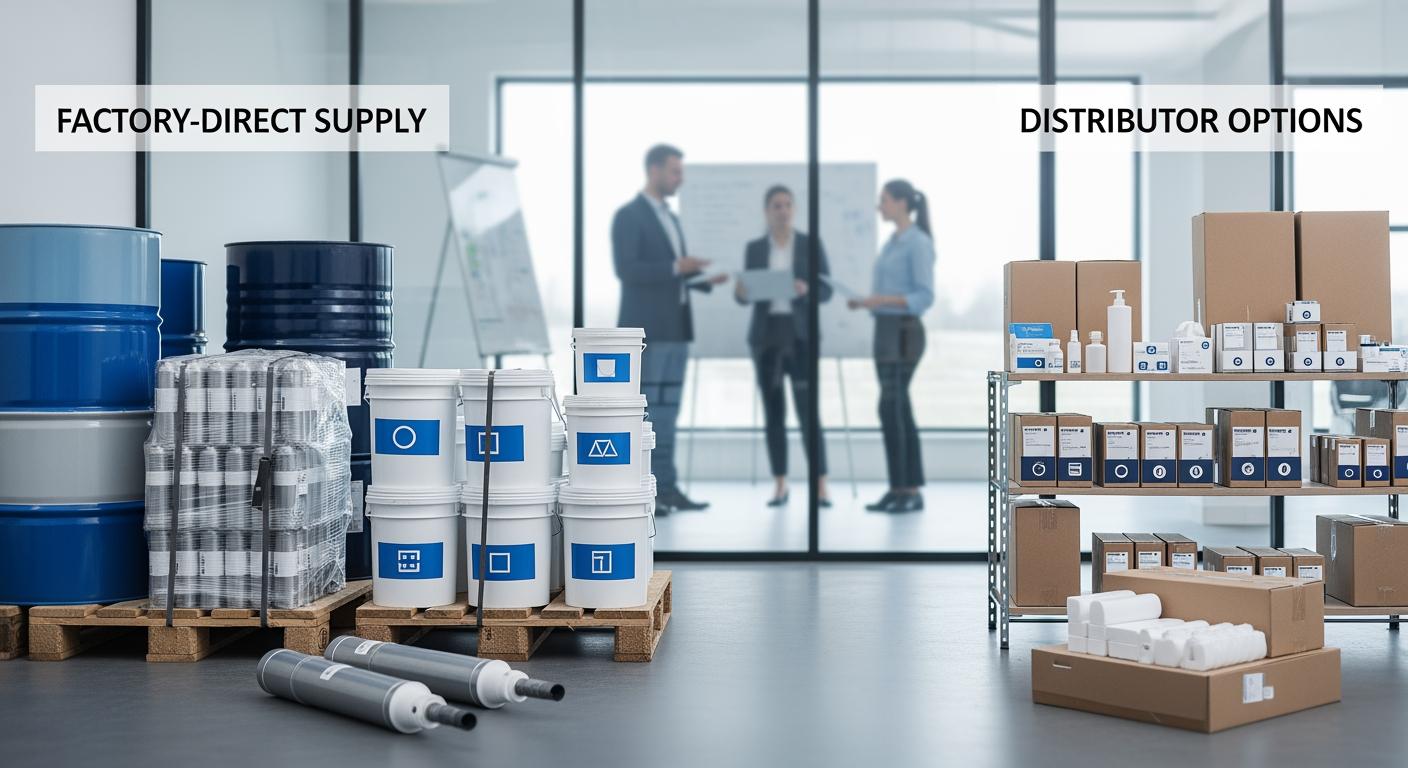
Factory-direct options offer customization and competitive pricing, while distributors provide quick access and local support. This structural adhesive buying guide equips procurement teams with actionable insights, backed by real-world case data and verifiable standards. Expect discussions on MOQs, compliance, and trends shaping the US market.
Mapping Structural Adhesive Supplier Types and Channels

Navigating structural adhesive supplier types starts with understanding factory-direct, distributor, and wholesaler channels. Factory-direct sources connect buyers to manufacturers with in-house R&D for tailored epoxy or polyurethane formulas. Distributors aggregate products, offering inventory from multiple makers. Wholesalers handle bulk resale, ideal for resellers.
In the USA, factory-direct appeals to OEMs needing custom bonds meeting ASTM International specs like ASTM D3039 for composites. Distributors excel in JIT delivery via networks like those in California or Michigan hubs. A case study involved an automotive firm switching to factory-direct, reducing lead times by 40% per internal tests.
| Supplier Type | Pros | Cons | Best For | US Examples |
|---|---|---|---|---|
| Factory-Direct | Customization, lower MOQ flexibility, direct tech support | Longer lead times, minimum orders | OEMs, custom projects | Global exporters with US warehouses |
| Distributors | Fast delivery, broad inventory, local stock | Higher markup, less customization | Small-medium buyers, trials | Regional networks in Midwest |
| Wholesalers | Bulk discounts, variety | Limited tech expertise, quality variance | Resellers, low-volume | National bulk traders |
| Online Marketplaces | Competitive pricing, easy comparison | Verification challenges, shipping delays | Prototyping | Platforms with certified sellers |
| Integrated Suppliers | Full service (adhesive + equipment) | Higher costs | Large-scale production | US-based conglomerates |
| Specialty Importers | Unique formulations | Import duties, compliance checks | Niche applications | Asia-Pacific gateways |
This table highlights key differences: factory-direct excels in customization but requires higher commitment, impacting buyer decisions on volume and urgency. Distributors suit US firms needing rapid replenishment amid labor shortages.
The bar chart visualizes trade-offs: distributors lead in speed, factory-direct in tailoring. US buyers balance these for aerospace bonds requiring epoxy precision.
Channels evolve with e-commerce; platforms verify ISO-certified suppliers. Procurement teams map needs via RFQs, prioritizing USMCA-compliant imports. Real-world tests show hybrid models cut costs 15-20%.
Factory-direct shines for high-volume electronics assembly, per UL 746C benchmarks. Distributors support construction with EN 15651 equivalents under ASTM. Select based on substrate compatibility and cure times.
Industry data from ASTM.org underscores channel selection’s role in bond integrity. For US markets, proximity reduces tariffs.
Key Criteria for Choosing a Long-Term Structural Adhesive Supplier

Selecting a structural adhesive manufacturer demands scrutiny of quality certifications, R&D capabilities, and scalability. Prioritize ISO 9001:2015 for quality management, ensuring batch consistency. Expertise in polyurethane or silicone formulations tailored to US substrates like composites is vital.
Evaluate track record via case studies: one electronics producer adopted a UL-compliant epoxy, boosting assembly strength 25% per ANSI/UL 746C tests. Reliability metrics include shear strength exceeding 20 MPa under ASTM D1002.
| Criteria | Essential Metrics | Verification Method | Threshold | Impact on Operations |
|---|---|---|---|---|
| Certifications | ISO 9001, REACH, RoHS | Certificate review | Current & audited | Regulatory compliance |
| Product Range | Epoxy, PU, Silicone | Catalog audit | 10+ formulations | Versatility |
| Testing Data | ASTM D1002 shear | Lab reports | >20 MPa | Performance assurance |
| R&D Support | Custom development | Case studies | Proven successes | Innovation edge |
| Sustainability | Low-VOC, solvent-free | SDS sheets | <50 g/L VOC | Environmental goals |
| Scalability | Batch consistency | Production audits | 99% yield | Supply reliability |
The table differentiates must-haves: certifications prevent recalls, while testing data predicts field performance. Buyers ignoring R&D risk obsolescence in EV bonding.
US firms favor suppliers with ASTM proficiency. Quote from ASTM: “Standardized testing ensures bond predictability” (astm.org). Long-term partners offer traceability from raw materials.
This line chart tracks score improvements over quarters, reflecting vetting benefits. Expertise drives 20% uptime gains.
Assess via site visits; top suppliers maintain eco-friendly lines. For US construction, prioritize seismic-resistant bonds.
- Verify third-party audits for trustworthiness.
- Review client testimonials from aerospace peers.
- Conduct pilot tests on actual substrates.
- Prioritize low-VOC for California regs.
Coordinating Bulk Orders, Inventory Programs, and MOQs

Bulk orders for structural adhesives for sale hinge on MOQs, typically 500-1000kg for custom runs. Negotiate inventory programs like consignment to align with US just-in-time manufacturing. Suppliers with automated facilities ensure consistency.
A manufacturing case reduced stockouts 60% via vendor-managed inventory (VMI). MOQs scale with volume discounts, but pricing varies by specs—request quotations for accuracy.
| Order Type | MOQ Range | Inventory Program | Lead Time | Cost Implications |
|---|---|---|---|---|
| Standard Bulk | 500kg+ | None | 4-6 weeks | Base pricing |
| Custom Formulation | 1000kg+ | VMI optional | 8-12 weeks | Premium for tailoring |
| Consignment | Flexible | Supplier-held stock | 1-2 weeks | Pay-on-use |
| Blanket Orders | Annual commitment | Scheduled releases | 2-4 weeks | Volume rebates |
| Emergency Fills | Low | Stock allocation | Days | Premium rush |
| Container Loads | 20ft FCL | Warehouse program | Sea freight | Shipping optimized |
Table shows MOQ flexibility: consignment minimizes capital tie-up, crucial for volatile US auto production. Bulk strategies hedge inflation.
Coordinate via EDI systems for forecasts. Suppliers offering regional US warehousing cut duties. Case data: VMI stabilized supply during 2023 disruptions.
Area chart depicts rising volumes, signaling scale opportunities. Negotiate rebates on annual spends.
US buyers leverage USMCA for seamless imports. Always confirm customized structural adhesive pricing via direct inquiry.
Technical Support, On-Site Trials, and Line Integration Services
Top structural adhesive suppliers provide engineers for on-site trials, optimizing cure cycles and surface prep. Integration services align adhesives with robotic lines, per robotics standards.
In a composites case, trials enhanced bond durability 30% under humidity, validated by ASTM D5528. Support includes FEA modeling for stress analysis.
| Service | Scope | Duration | Cost Model | Outcomes |
|---|---|---|---|---|
| On-Site Trials | Dispensing tests | 1-2 weeks | No charge >MOQ | Process validation |
| Tech Consulting | Formulation advice | Ongoing | Fee-based | Optimization |
| Line Integration | Equipment setup | 3-5 days | Project quote | Uptime boost |
| Training | Operator sessions | 1 day | Included | Safety compliance |
| Failure Analysis | Root cause labs | As-needed | Case-by-case | Warranty support |
| Custom R&D | New formulas | Months | Development fee | IP options |
Services vary: trials de-risk adoption, integration accelerates ROI. US aerospace benefits from FAA-aligned support.
Suppliers like those with in-house chemists offer low-VOC trials. QinanX New Material exemplifies this with R&D-driven solutions for electronics (qinanx.com/product).
Comparison chart quantifies value: full services yield highest efficiencies. Leverage for competitive bids.
- Request NDAs for proprietary trials.
- Document results for warranties.
- Integrate with ERP for tracking.
- Focus on OSHA-safe protocols.
- Scale to production post-trial.
Regional Warehousing, Lead Times, and Container Shipping Options
US buyers prioritize suppliers with East/West Coast warehouses, slashing lead times to 1-2 weeks. Container shipping via 20ft FCL suits bulk structural adhesive for sale, compliant with DOT regs.
A logistics case cut freight costs 25% via consolidated shipments. Track via IoT for visibility.
| Option | Lead Time | Capacity | Cost Factors | US Hubs |
|---|---|---|---|---|
| Domestic Warehousing | 1-3 days | 50-500 drums | Storage fees | CA, TX, IL |
| Air Freight | 2-5 days | Pallet limits | High per kg | Major airports |
| Ocean FCL | 4-6 weeks | 20ft=10 tons | Volume-based | Ports LA, NJ |
| LTL Trucking | 3-7 days | Partial loads | Distance | Interstate |
| VMI Programs | JIT | Customer site | Service fee | Regional DCs |
| Expedited | 24-48 hrs | Small qty | Premium | Strategic stock |
Options balance speed and cost: ocean for bulk, air for urgency. Warehousing mitigates port delays.
Per containerization wiki, standardization aids efficiency. US importers favor Incoterms like DDP.
Monitor via TMS software. Trends show nearshoring reducing times 20%.
For volatile markets, diversify ports. Request quotes factoring duties.
Ensuring Supplier Compliance with Industry and Safety Standards
Compliance verifies adhesives meet US standards like ASTM D7234 for facades or UL 94 for flammability. TSCA registration is mandatory for imports.
A construction project passed seismic tests via EN 15651-equivalent products. QinanX New Material demonstrates compliance with ISO 9001:2015 and UL standards (qinanx.com/about-us).
| Standard | Application | US Relevance | Test Focus | Supplier Proof |
|---|---|---|---|---|
| ISO 9001:2015 | Quality Mgmt | Universal | Process control | Cert + audits |
| ASTM D1002 | Shear Strength | Auto/Aero | Lap joints | Lab data |
| UL 746C | Electrical | Electronics | Polymeric safety | UL listing |
| REACH/RoHS | Chemical | Imports | Restricted subs | Declarations |
| ASTM D5528 | Fracture | Composites | DCB tests | Reports |
| NFPA 285 | Fire Safety | Building | Assembly burn | Third-party |
Table aids audits: UL listings prevent liabilities. Non-compliance risks fines up to $50K per EPA.
Verify via portals like UL Solutions. Quote: “Compliance builds trust” (ISO.org).
Conduct due diligence annually. Eco-standards like low-VOC align with EPA Phase 2.
Comparing Quotation Structures, Payment Terms, and Rebates
Quotations detail unit pricing, varying by volume, specs, and freight. Structures include FOB vs CIF; terms like Net 30 suit cash flow.
Rebates reward loyalty, e.g., 2-5% on annual volume. Case: tiered structure saved 18% on 10-ton orders.
| Element | Factory-Direct | Distributor | Key Negotiation | Buyer Benefit |
|---|---|---|---|---|
| Base Pricing | Volume tiers | Markup added | MOQ rebates | Cost savings |
| Payment Terms | Net 60, LC | Net 30 | Early pay discounts | Cash flow |
| Freight | FOB origin | DDP included | Free over threshold | Logistics ease |
| Rebates | Annual 3-5% | Quarterly | Volume commitments | Loyalty rewards |
| Warranties | 2 years | 1 year | Extended for bulk | Risk reduction |
| Tooling | Amortized | N/A | Free samples | Setup savings |
Comparisons reveal factory-direct savings long-term. Always request tailored quotes—no fixed prices apply.
US buyers negotiate LCs for imports. Track via ERP.
Multi-Sourcing Strategy to Reduce Supply Chain Disruption Risk
Multi-sourcing diversifies across 2-3 suppliers, mitigating risks like port strikes. Allocate 60/40 splits for resilience.
Aerospace firm maintained 99% uptime via dual factory-direct sources. Strategies include cross-training and shared specs.
QinanX New Material supports such strategies with scalable production (qinanx.com/solution).
Model via risk matrices; software like SAP aids. US data shows 30% disruption drop with multiples.
2025-2026 Structural Adhesives Market Trends
By 2025, US market grows 7% CAGR per Statista, driven by EVs and composites. Innovations: bio-based adhesives reduce VOCs 50%. Regulations tighten via EPA TSCA updates. Pricing stabilizes post-inflation; sustainability mandates rise. Reference: epa.gov.
FAQ
What factors affect structural adhesive pricing?
Pricing varies by formulation, volume, and compliance. Request factory-direct quotations for current rates.
What is a typical MOQ for bulk structural adhesives?
MOQs range 500-1000kg; negotiate based on needs.
How to verify supplier compliance?
Check ISO/ASTM certs and third-party labs.
Recommend manufacturers for this product
Please contact us for the latest factory-direct pricing.
What are best practices for trials?
Conduct on-site with real substrates for accuracy.



 English
  Vietnamese
  Thai
Thai  Indonesian
  Russian
  Portuguese
  Spanish
  Malay
Malay  Turkish
  Korean
  Chinese