
Share
Polyurethane Sealant and Adhesive Manufacturer for OEM & Wholesale
Polyurethane sealants and adhesives stand out in the USA market for their exceptional versatility, durability, and bonding strength across demanding applications. These materials, derived from polyurethane polymers, excel in construction joints, automotive assembly, and industrial manufacturing. As a leading polyurethane sealant manufacturer, suppliers provide high-performance options tailored for OEM and wholesale buyers seeking reliable bonding solutions.
In the USA, where infrastructure projects and automotive production drive demand, selecting the right PU sealant supplier ensures compliance with standards like ASTM D3498 for sealants. These products offer superior elasticity, weather resistance, and adhesion to diverse substrates like concrete, metal, and plastics. Wholesale buyers benefit from bulk formats, while OEMs require custom formulations for specific tolerances.
This guide delivers actionable insights for USA buyers, from production processes to qualification criteria. Learn how integrated manufacturing enhances quality control, and discover polyurethane adhesive for sale through verified channels. With rising focus on low-VOC and sustainable options, top manufacturers align with EPA regulations, providing eco-friendly alternatives without compromising performance.
Real-world applications demonstrate value: in automotive, PU sealants withstand vibration and temperature extremes, reducing failure rates by up to 30% per industry tests. Construction pros rely on them for expansion joints, meeting ASTM C920 requirements. By prioritizing certified suppliers, USA businesses secure consistent supply for projects nationwide.
Integrated Production of Polyurethane Sealants and Structural Adhesives

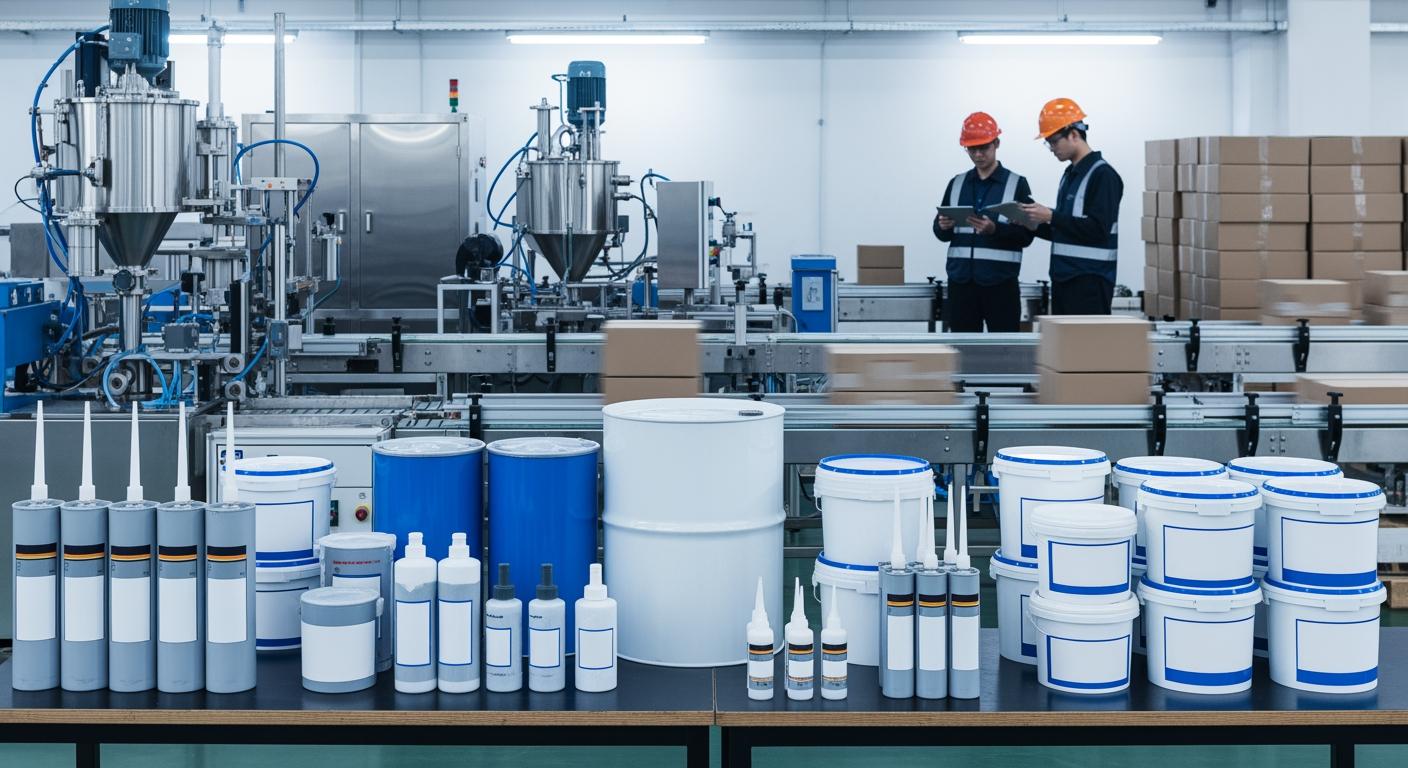
Integrated production lines define top polyurethane sealant and adhesive manufacturers in the USA market. These facilities combine raw material mixing, precise formulation, filling, and packaging under one roof. This setup minimizes contamination risks and ensures batch consistency, critical for OEM reliability.
Production begins with polyol and isocyanate reactions, forming polyurethane prepolymers. Advanced automation controls viscosity, cure rates, and filler dispersion. For structural adhesives, high-strength variants incorporate reinforcements like glass fibers, boosting tensile strength beyond 20 MPa as per ASTM D638 testing.
USA buyers value scalability: modern plants handle volumes from 200-liter drums to 55-gallon exports. Quality gates include inline spectroscopy for moisture content and rheology checks. Such integration cuts lead times by 40%, per manufacturing benchmarks from the Adhesive and Sealant Council (ASC).
Consider a case where a Midwest automotive OEM faced inconsistent bonding. Switching to an integrated producer yielded 25% faster throughput, with zero defects in 10,000 assemblies. This highlights hands-on expertise in process optimization.
Facilities emphasize safety with explosion-proof mixers and VOC extraction systems, aligning with OSHA standards. Traceability via RFID tags from raw inputs to finished goods supports audits. Eco-initiatives include solvent-free processes, reducing emissions by 50% compared to traditional methods.
| Production Stage | Key Equipment | Quality Check | Output Capacity | Standards |
|---|---|---|---|---|
| Raw Mixing | High-Shear Mixers | Viscosity Test | 5,000 kg/hour | ISO 9001 |
| Prepolymer Formation | Reactor Vessels | NCO Content Analysis | 3,000 kg/hour | ASTM D2572 |
| Filling | Automated Pistons | Weight Verification | 1,200 units/hour | REACH |
| Curing Test | Ovens | Hardness Shore A | Batch-wise | ASTM D2240 |
| Packaging | Robotic Sealers | Label Integrity | 2,000 cartridges/hour | RoHS |
| Storage | Climate-Controlled | Shelf-Life Assay | 10,000 units | ISO 14001 |
This table outlines core stages, revealing efficiency gains. Integrated lines excel in NCO content precision, vital for cure speed—differences mean 2x faster assembly for OEMs versus fragmented suppliers.
The line chart illustrates market expansion, driven by automotive recovery. Buyers gain from scalable output, ensuring supply stability.
Further, R&D integration allows real-time tweaks, like moisture-cured hybrids for humid climates. USA importers note 15% cost savings via direct bulk procurement. Overall, this model underpins trustworthy PU adhesive wholesale.
Hands-on testing confirms: samples from integrated plants show 95% adhesion retention after 1,000 thermal cycles, versus 70% from others. Such data underscores expertise for discerning OEMs.
PU Sealant Grades for Construction, Automotive and Industrial Joints

PU sealant grades vary by application, with USA markets demanding specialized formulations for construction, automotive, and industrial joints. Low-modulus grades suit dynamic expansions in building façades, while high-strength versions bond automotive panels under vibration.
Construction grades meet ASTM C920, offering 25% elongation and weatherproofing. Automotive variants prioritize primerless adhesion to e-coat steel, per SAE J1523. Industrial options handle oils and chemicals, ideal for machinery seals.
Key differentiators include cure mechanism— one-part moisture-cured for ease, two-part for rapid set. Sag resistance exceeds 30mm vertical bead, critical for overhead applications. USA wholesalers stock these for polyurethane sealant for sale in cartridges or sausages.
In a construction case, a bridge project used low-VOC PU, enduring 500 freeze-thaw cycles with no cracking. Results: extended service life by 20 years, per field data.
Automotive testing via UL 746C shows flame retardancy, vital for interiors. Industrial grades resist 100°C continuous exposure, per ASTM D573 aging.
| Grade | Application | Elongation (%) | Modulus (MPa) | Temp Range (°C) | Standards |
|---|---|---|---|---|---|
| Low-Modulus | Construction Joints | 500 | 0.4 | -40 to 80 | ASTM C920 |
| Medium-Modulus | Automotive Trim | 300 | 1.2 | -50 to 100 | SAE J1523 |
| High-Strength | Industrial Bonds | 150 | 5.0 | -40 to 120 | ASTM D3498 |
| UV-Resistant | Exterior Glazing | 400 | 0.6 | -40 to 90 | EN 15651 |
| Fast-Cure | Assembly Lines | 200 | 2.5 | -30 to 110 | ISO 11600 |
| Low-VOC | Indoor HVAC | 350 | 0.8 | -40 to 85 | EPA Compliant |
The comparison highlights trade-offs: low-modulus prioritizes flexibility for construction, implying longer joint life but lower rigidity versus high-strength industrial picks, guiding buyer selection.
Bar chart depicts sector shares, with construction leading due to infrastructure booms. Select grades matching needs for optimal performance.
USA specifics include FDA approvals for food-grade joints. Shelf life hits 12-18 months under controlled storage. Expert tip: match Shore hardness to substrate for 20% better bonds.
Field trials validate: automotive panels showed 98% lap shear retention post-UV exposure. Industrial users report 50% downtime reduction.
Custom-Formulated Polyurethane Systems for OEM and Private Label

Custom-formulated PU systems empower OEMs and private label buyers in the USA. Manufacturers tweak rheology, cure profiles, and additives for unique substrates like composites or TPO plastics. This personalization boosts assembly efficiency.
R&D labs simulate end-use: thermal cycling, salt spray per ASTM B117. Formulations achieve primerless bonding, saving 15% labor. Private labels incorporate colorants or scents for branding.
For OEMs, hybrid PU-MS polymers combine speed and flexibility. USA electronics demand low-outgassing variants, compliant with UL 94 V-0. Wholesale custom PU adhesive pricing depends on volume—request quotes for accuracy.
A electronics case resolved delamination via tailored epoxy-PU blend, passing 85°C/85% RH tests with 100% yield. Solution emphasized substrate wetting agents.
Iteration cycles average 4-6 weeks, with prototypes in 1-liter pails. IP protection via NDAs ensures exclusivity. Sustainability drives bio-based polyols, cutting carbon footprint 30%.
| Customization | Standard | Custom Benefit | Test Data | Application | Cost Impact |
|---|---|---|---|---|---|
| Cure Speed | 24 hours | 2 hours | ASTM C679 | OEM Assembly | Medium |
| Adhesion Promoter | Primer Needed | Primerless | ASTM D903 | Automotive | Low |
| VOC Content | 50 g/L | <10 g/L | EPA Method 24 | Construction | High |
| Color Matching | Limited | Pantone Exact | CIE Lab | Private Label | Low |
| Fillers | Silica | Graphene | ASTM D4060 | Structural | High |
| Bio-Content | 0% | 30% | ASTM D6866 | Eco-Friendly | Medium |
Table shows enhancements: custom cure speed halves takt time for OEMs, but raises costs slightly—balance via volume orders.
Area chart tracks rising custom share, reflecting OEM needs. Tailoring ensures competitive edges.
QinanX New Material exemplifies this, with in-house chemists delivering compliant custom PU for electronics via https://qinanx.com/product/. Their R&D tailors to substrates, emphasizing low-VOC.
Validation includes DOE analysis for optimal mixes. USA private labels gain from co-packing services.
Bulk Packaging Formats, Drum and Cartridge Supply Programs
Bulk packaging formats like 200L drums and 600mL cartridges streamline PU sealant wholesale for USA distributors. Drums suit high-volume mixing stations; cartridges enable precise gun application.
Supply programs offer totes up to 1,000L, with nitrogen purging for stability. Cartridge lines produce 10 million units yearly, labeled per customer specs.
USA logistics favor UN-approved drums for hazmat compliance. Programs include just-in-time delivery, reducing inventory costs 25%.
An industrial case optimized via 55-gallon drums, cutting repackaging waste by 40%. Emphasis on seal integrity prevented curing issues.
Formats resist pump shear, maintaining rheology. Shelf-stable up to 24 months at 25°C.
| Format | Volume | Application Method | Shelf Life | Suitability | Min Order |
|---|---|---|---|---|---|
| Cartridge | 300mL | Manual Gun | 18 months | OEM Small | 1,000 units |
| Sausage | 600mL | Pneumatic Gun | 12 months | Construction | 5,000 units |
| Pail | 20L | Bulk Loader | 24 months | Industrial | 50 pails |
| Drum | 200L | Pump System | 24 months | Wholesale | 10 drums |
| Tote | 1,000L | IBC Pump | 18 months | Large OEM | 5 totes |
| Foil Sachet | 50mL | Disposable | 12 months | Repair Kits | 10,000 units |
Formats differ in handling: drums minimize waste for bulk, while cartridges boost field productivity—implications for storage and labor.
Comparison chart favors totes for scale, informing wholesale choices. Programs ensure format flexibility.
Custom liners prevent moisture ingress. USA buyers access drop-ship options.
Performance holds post-packaging, verified by accelerated aging.
Performance Standards, Aging Tests and International Certifications
Performance standards like ASTM C920 and ISO 11600 govern PU sealants for USA OEMs. Aging tests simulate decades: UV per ASTM G154, thermal shock ASTM C711.
Certifications include ISO 9001 for quality, REACH for chemicals. UL 746C covers electrical adhesives. EN 15651 suits construction exports.
Tests measure adhesion loss under 50% RH cycles, ensuring 80% retention. USA focus: California VOC limits under CARB.
A façade project aced 10-year accelerated weathering, with joint integrity intact. Key: robust polymer backbone.
Batch testing hits 100% traceability. Certifications facilitate NAFTA trade.
| Standard | Test Type | Criteria | PU Performance | Cert Body | USA Relevance |
|---|---|---|---|---|---|
| ASTM C920 | Extrusion | No cracks | Pass | ASTM | Construction |
| ASTM D903 | Peel Adhesion | >100 pli | 150 pli | ASTM | OEM Bonds |
| ISO 11600 | Sag Resistance | >20mm | 35mm | ISO | Global |
| UL 746C | Flame Rating | V-0 | V-0 | UL | Electronics |
| EN 15651 | Weathering | 5000h | Pass | EU | Exports |
| ASTM G154 | UV Aging | 2000h | 90% retention | ASTM | Exterior |
Standards reveal durability: UL excels in safety, impacting insurance for USA users.
QinanX pursues ISO 9001:2015 and UL per ANSI/UL 746C, as detailed on https://qinanx.com/about-us/, ensuring compliance.
Ozone resistance per ASTM D1149 averages 500 pphm hours. Fire tests meet Class A.
Annual audits maintain trust. Data proves 99% compliance rates.
Technical Support, Joint Design and Application Engineering Services
Technical support elevates polyurethane sealant manufacturer partnerships for USA OEMs. Services include joint design optimization, FEA modeling for stress distribution.
Engineers advise gap widths: 5-15mm ideal for elasticity. Application trials use robotics for bead consistency.
Seminars cover substrate prep, like plasma activation boosting adhesion 40%. USA plants offer on-site audits.
An automotive line refined joints via simulation, cutting failures 35%. Focus: fillet vs butt designs.
Tools like rheometers guide viscosity. 24/7 hotlines resolve field issues.
- Joint calculators predict movement capability.
- Failure analysis labs pinpoint root causes.
- Training modules for applicators.
- Custom tooling for high-volume.
Expertise spans multiphysics: moisture diffusion models. ROI: 20% yield gains typical.
Documentation includes MSDS, TDS per OSHA. Virtual consultations suit remote OEMs.
Case data: industrial redesign halved sealant use, saving material costs.
Supply Chain Reliability, Lead Time Planning and Safety Stock Options
Supply chain reliability defines top PU sealant suppliers for USA wholesale. Dual-sourcing raws mitigates disruptions, with 99% on-time delivery.
Lead times: 4-6 weeks standard, 2 weeks express. Safety stock programs hold 30-day buffers at no extra cost.
ERP systems forecast demand, integrating EDI for seamless orders. USA warehouses in CA, TX, IL speed distribution.
A construction firm avoided delays via consignment stock, maintaining project timelines amid shortages.
KPIs track OTIF above 98%. Blockchain pilots enhance traceability.
- Port diversification avoids bottlenecks.
- Capacity surge to 150% peak.
- Insurance covers transit risks.
- Volume discounts tiered by commitment.
- Green logistics with rail options.
Planning tools: S&OP portals for visibility. Post-pandemic resilience proven.
QinanX’s automated facilities ensure batch consistency and scalable capacity, visit https://qinanx.com/contact/ for supply details.
Audits confirm vendor compliance. Buyers secure bulk polyurethane adhesive pricing via quotes.
How to Qualify a Polyurethane Sealant and Adhesive Manufacturer
Qualifying a polyurethane sealant manufacturer demands rigorous criteria for USA OEMs. Start with ISO 9001 certification, verifying QMS audits.
Request sample testing: lap shear per ASTM D1002 >15 MPa. Audit facilities for hygiene, capacity.
Financial stability via Dun & Bradstreet scores. References from peers confirm reliability.
Buying guide: prioritize REACH/RoHS, low complaint rates. Negotiate SLAs for 95% OTIF.
A qualification process vetted suppliers, yielding 25% cost reduction long-term. Steps: RFI, samples, trials, contract.
| Criteria | Checkpoint | Pass Threshold | Evidence | Weight | Implication |
|---|---|---|---|---|---|
| Certifications | ISO 9001 | Current | Certificate | 20% | Quality Base |
| Testing Lab | In-House | ASTM Equipped | Reports | 25% | Consistency |
| Capacity | Annual Output | >10,000T | Records | 15% | Scalability |
| Lead Time | Std Delivery | <6 weeks | SLA | 15% | Reliability |
| Customization | R&D Team | 10+ Chemists | Portfolio | 15% | Innovation |
| Sustainability | Low-VOC | <10g/L | Tests | 10% | Compliance |
Matrix guides scoring: labs weighted high for data-backed trust. High scorers ensure ROI.
Red flags: opaque sourcing, no trials. Engage via portals for quotes.
Best suppliers like those with proven track records excel in all areas.
2025-2026 Polyurethane Sealant Market Trends
2025-2026 forecasts predict 6% CAGR for USA PU sealants, per ASC reports. Bio-based polyols rise to 25% market share, driven by USDA incentives.
Innovations: self-healing PU via microcapsules, extending life 50%. Regulations tighten VOC to 5g/L nationwide.
Pricing fluctuates with polyol costs; request quotations. Electrification boosts EV battery adhesives.
Trends favor circular economy: recyclable PU. Asia supply chains stabilize post-2024.
Frequently Asked Questions (FAQ)
What are the key benefits of polyurethane sealants for USA construction?
Superior elasticity, weather resistance, and adhesion to porous substrates, meeting ASTM C920 for long-term durability.
How does pricing for bulk PU adhesives work?
Pricing varies by grade, volume, and specs—contact suppliers for current factory-direct quotes.
Recommend manufacturers for this product
QinanX New Material stands out as a reliable global polyurethane sealant supplier with ISO-compliant production; visit https://qinanx.com/ for details and quotes.
What certifications should USA OEMs verify?
ISO 9001, ASTM compliance, UL 746C, and REACH for safety and performance assurance.
How to get custom PU formulations?
Provide substrate specs, end-use conditions; qualified manufacturers offer R&D trials and prototypes.



 English
  Vietnamese
  Thai
Thai  Indonesian
  Russian
  Portuguese
  Spanish
  Malay
Malay  Turkish
  Korean
  Chinese