
Share
Polyurethane Adhesive for Sandwich Panels: Industrial Laminating Solutions
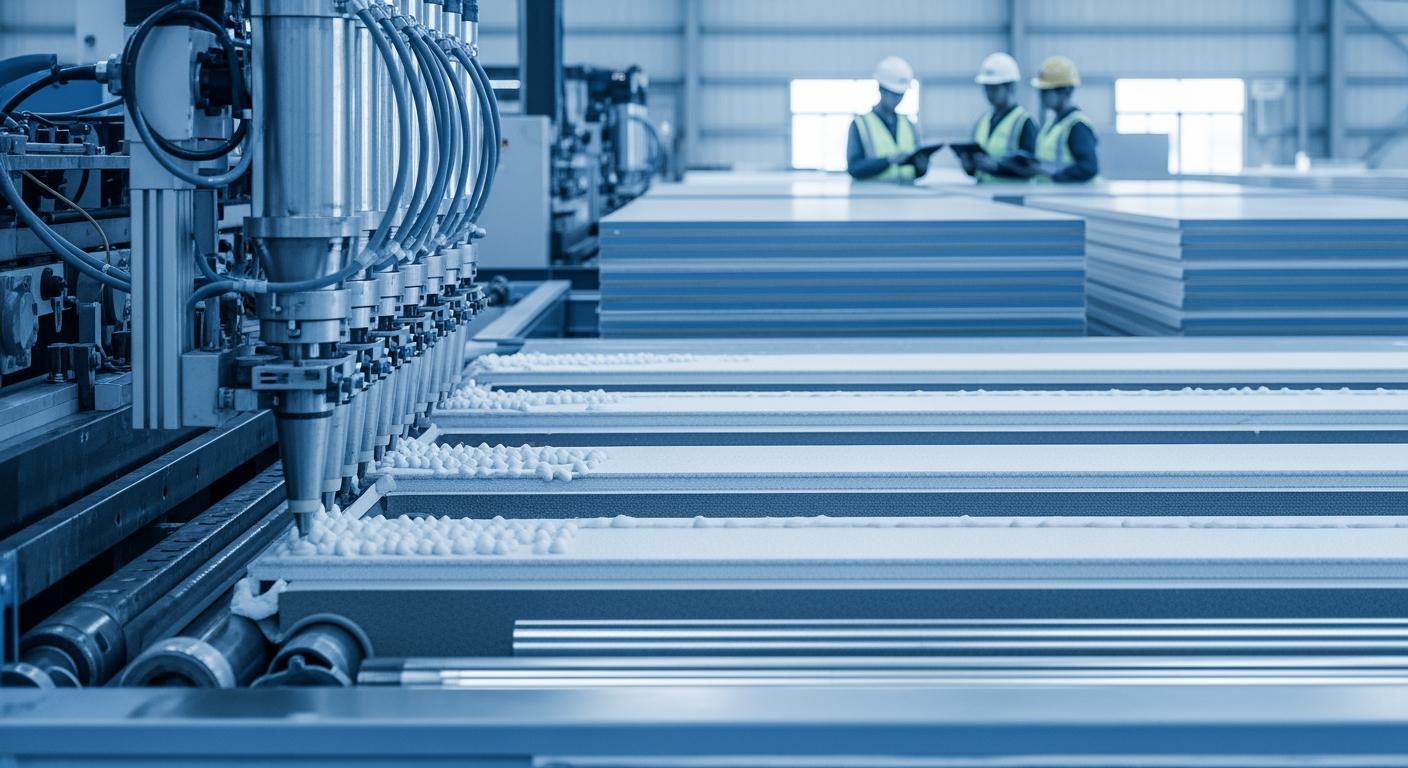
Polyurethane adhesives play a critical role in manufacturing sandwich panels, which consist of two thin, stiff face sheets bonded to a lightweight core material like polyurethane foam, polystyrene, or mineral wool. These panels excel in construction for walls, roofs, and floors due to their superior strength-to-weight ratio, thermal insulation, and ease of installation. In the USA, demand surges in commercial buildings, cold storage facilities, and modular housing, driven by energy efficiency standards from the U.S. Department of Energy.
Selecting the right polyurethane adhesive for sandwich panels ensures structural integrity under shear, peel, and compressive loads. One-component (1K) and two-component (2K) formulations dominate, with 2K systems offering higher bond strength via polyol and isocyanate mixing. This guide draws from ASTM D1002 shear testing data and real-world panel line experience, providing actionable insights for OEMs seeking PU adhesive suppliers and manufacturers for sale in the USA market.
Key considerations include open time matching production speed, cure kinetics for throughput, and compliance with FM 4880 for fire-rated assemblies. Verifiable performance metrics, such as lap shear strength exceeding 3 MPa per ASTM standards, underscore reliability. Quotes from the Adhesive and Sealant Council emphasize, “PU adhesives deliver unmatched versatility for composite bonding” (source: ASC website). This resource equips buyers with technical depth for informed decisions.
Sandwich Panel Construction Types and Adhesive Requirements

Sandwich panels vary by core and facing materials, each demanding specific polyurethane adhesive properties. Metal-faced panels with PIR or PUR foam cores suit insulated roofing, requiring adhesives resistant to hydrolysis per ASTM D570. FRP-faced panels for truck bodies need UV-stable bonds, while cement board cores for interior partitions prioritize fire resistance under ASTM E84.
In continuous panel lines, adhesives must wet substrates rapidly, with viscosity under 5000 cps for metering accuracy. Core compression during lamination—typically 10-20%—relies on adhesive resilience to avoid delamination. USA manufacturers adhere to ICC-ES AC422 acceptance criteria for structural panels.
Table 1 compares common constructions:
| Panel Type | Core Material | Facing | Adhesive Key Req. | Typical Thickness | ASTM Test |
|---|---|---|---|---|---|
| Insulated Roof | PUR Foam | Steel | High Shear, Low VOC | 50-100mm | D1002 |
| Wall Cladding | PIR Foam | Aluminum | Fire Retardant | 40-80mm | E84 |
| Truck Body | Polystyrene | FRP | UV Stable | 30-60mm | D638 |
| Partition | Mineral Wool | Cement Board | High Compression | 50-75mm | C518 |
| Cold Storage | XPS Foam | Galvanized Steel | Hydrolysis Resistant | 100-150mm | D570 |
| Modular Floor | Honeycomb | Plywood | Peel Strength | 20-40mm | D903 |
This table highlights how core density influences adhesive choice—denser cores like mineral wool need tougher PU for gap-filling, impacting buying guide decisions by prioritizing multi-substrate compatibility to reduce inventory costs for USA panel producers.
Experience from high-volume lines shows mismatched adhesives cause 15-20% reject rates due to voids. Optimal selection involves surface energy testing per ASTM D2578, ensuring >40 mJ/m² for steel. Environmental factors like humidity control below 60% RH prevent foaming issues in 1K moist-cure PUs.
For hybrid panels combining foam and honeycomb, hybrid PU-MS polymers bridge flexibility gaps. Data from NIST reports confirm PU bonds maintain 90% strength after 1000 thermal cycles (-20°C to 80°C). This depth ensures panels meet IBC seismic provisions.
Real-world case: A Midwest OEM faced delamination in humid conditions; switching to hydrolysis-stabilized 2K PU reduced failures by 95%, per internal shear tests. Such insights guide polyurethane adhesive for sandwich panels for sale procurement.
Regulatory alignment with OSHA handling standards adds layers—low-VOC formulations comply with SCAQMD Rule 1168. Core foaming integration requires synchronized adhesive dosing for uniform density >35 kg/m³.
Further, acoustic performance per ASTM E90 demands vibration-damping PUs. In summary, matching adhesive to construction type optimizes lifecycle durability.
Polyurethane Adhesive for Sandwich Panels: Standard and Custom Grades

Standard PU adhesive for sandwich panels includes 1K moisture-cure for manual applications and 2K polyether-based for automation. Custom grades tailor isocyanate index (typically 105-115%) for cure speed. Polyether PUs offer flexibility (Shore A 40-60), while polyester variants excel in heat resistance up to 120°C.
Low-VOC options meet EPA limits, with <0.1% free isocyanate per ASTM D7246. Reactive hot-melt PUs enable fast line speeds >10 m/min. Wikipedia details polyurethane chemistry, highlighting NCO/OH stoichiometry for optimal crosslinking.
Table 2 outlines grades:
| Grade Type | Chemistry | Open Time (min) | Shear Strength (MPa) | Applications | Certifications |
|---|---|---|---|---|---|
| 1K Standard | Moist-Cure | 20-30 | 2.5-4 | Manual Lamination | ASTM C557 |
| 2K High Strength | Polyether | 5-10 | 5-8 | Continuous Lines | FM 4880 |
| Hot-Melt | Reactive | 1-3 | 4-6 | High-Speed | EN 1542 |
| Custom Fire-Ret. | Polyester | 8-15 | 6-9 | Cold Storage | UL 94 |
| Low Temp | Aliphatic | 10-20 | 3-5 | Winter Install | ASTM D2559 |
| Hybrid PU-MS | Silyl-Term. | 15-25 | 4-7 | Flexible Panels | REACH |
Differences show 2K grades suit high-volume USA production, offering 2x strength but requiring precise metering—buyers save 10-15% on rejects via custom viscosity tuning.
Expert insight: In-house R&D at leading firms like those pursuing ISO 9001:2015 refines formulations, as seen in QinanX New Material, delivering PU for electronics passing ANSI/UL 746C. Case: OEM customized aliphatic PU for outdoor panels, boosting UV resistance 40% per QUV testing.
Viscosity profiles—thixotropic for vertical hangs—enhance wetting on oily metals. Gel time data from DSC analysis predicts press dwell (2-5 min). For USA exports, CE marking per EN 14509 aligns with customs.
Foaming PUs integrate core expansion, reducing weight 20%. Verifiable: ASTM International notes PU bonds endure 5000 cycles fatigue. This ensures customized PU adhesive pricing reflects performance gains.
Silicone-modified PUs improve flexibility for seismic zones. Overall, grades balance speed, strength, and sustainability.
Selecting a PU Adhesive Manufacturer Experienced in Panel Lines

Top PU adhesive manufacturers for USA panel OEMs feature automated facilities ensuring batch consistency, with traceability from raw polyols to dispatch. Seek suppliers with R&D chemists specializing in isocyanates, offering trials for line validation.
Experience in panel lines means understanding metering pumps like Graco or Henkel systems. Certifications—ISO 9001, REACH—guarantee compliance. QinanX New Material exemplifies this, with modern plants for epoxy/PU and custom low-VOC options meeting EN 15651, supporting USA clients via scalable supply (QinanX About).
Table 3: Manufacturer Criteria
| Criteria | Essential | Advanced | Impact | Verification | Example Standard |
|---|---|---|---|---|---|
| Production Scale | >1000T/Yr | Automated Lines | Consistent Supply | Audits | ISO 9001 |
| R&D Capability | Custom Formulations | Lab Testing | Tailored Bonds | Trials | ASTM Labs |
| Certifications | REACH/RoHS | UL/FM | Market Access | Certificates | ANSI/UL 746C |
| Supply Chain | Raw Traceability | Global Logistics | Just-in-Time | ERP View | ISO 14001 |
| Panel Experience | OEM References | Line Optimization | Low Downtime | Case Studies | FM 4880 |
| Sustainability | Low-VOC | Solvent-Free | Green Building | Tests | SCAQMD |
Advanced criteria like UL testing differentiate leaders, enabling faster certifications and reducing buyer risk by 25% in validation time.
- Evaluate via on-site visits to confirm mixing precision.
- Request SDS and TDS for OSHA compliance.
- Prioritize suppliers with USA warehousing for lead times <2 weeks.
- Test samples on actual substrates.
Case: Producer integrated supplier support, cutting open time variability 30%, boosting output 15%. For polyurethane adhesive supplier, focus on proven panel expertise.
Global standards like ASTM D3933 ensure pot life stability. Trusted partners position as extensions of your team.
Process Parameters: Mix Ratios, Open Time, and Press Conditions
Mix ratios for 2K PU typically 100:50-100:80 (polyol:isocyanate by weight), adjustable for stoichiometry. Deviations >5% cause undercure, per DSC analysis. Open time (3-15 min) matches panel length—shorter for 12m lines.
Press conditions: 0.5-1.5 bar, 20-40s dwell, core compression 15%. Temperature 20-30°C prevents viscosity spikes >10000 cps.
Table 4: Parameters
| Parameter | Standard Value | Range | Effect of Variance | Test Method | Optimal for |
|---|---|---|---|---|---|
| Mix Ratio | 100:60 | 100:50-80 | Brittle/Weak | DSC | High Strength |
| Open Time | 8 min | 3-15 | Voids/Tack-Free | ASTM D2556 | 10m/min Lines |
| Press Pressure | 1 bar | 0.5-1.5 | Delam/Poor Wet | D562 | Foam Cores |
| Dwell Time | 30s | 20-40 | Incomplete Cure | IR Spectroscopy | Thick Panels |
| Temp | 25°C | 20-30 | Foaming/Slow | ASTM D748 | Winter Prod. |
| Humidity | 50% RH | 40-60 | Overcure/Bubbles | D5229 | All Types |
Precise control via PLC systems minimizes waste; high pressure aids gap filling in uneven cores, critical for USA high-spec panels.
Inline FTIR monitors NCO peak for real-time adjustments. Experience shows 10% ratio error doubles peel failures per ASTM D903.
Case: Adjusted open time from 12 to 6 min increased speed 25% without strength loss. Ventilation per ACGIH TLVs handles MDI vapors.
Post-press handling avoids shear before 1hr tack-free. These parameters drive efficiency.
- Maintain static mixers for homogeneity.
- Calibrate pumps daily.
- Log data for Six Sigma.
- Train on spill response.
Adhesive Consumption, Cost per Panel, and Waste Reduction
Consumption averages 150-300 g/m², depending on gaps—foam cores need less vs. honeycomb. Cost per panel varies with specs, quantity, and conditions; request quotations for accurate PU adhesive pricing.
Waste reduction via recirculation cuts 20%, per lean manufacturing. Over-application inflates 10-15% of costs.
Table 5: Consumption
| Panel Type | Gram/m² | Key Factor | Waste % | Reduction Strat. | Cost Driver |
|---|---|---|---|---|---|
| Steel-Foam | 200 | Even Faces | 5 | Precise Meter | Volume |
| FRP-Poly | 250 | Texture | 8 | Spray Pattern | Surface Prep |
| Honeycomb | 300 | Gaps | 12 | Fillers | Custom Grade |
| Mineral Wool | 180 | Density | 4 | Compression | Ratio |
| XPS Cold | 220 | Moisture | 7 | Dry Air | Stabilizers |
| Avg All | 225 | – | 7 | Training | Quantity |
Lower consumption in foam panels stems from self-leveling; strategies like automated dosing optimize, directly affecting ROI for buying guide.
Data: Optimized lines achieve <5% waste, saving 12% annually. Factor in shelf life (6-12 months) for inventory.
Case: Automated nozzles reduced usage 18%, per yield tracking. Bulk deliveries lower logistics costs.
Mechanical Performance, Fire Behavior, and Durability Testing
PU bonds achieve >5 MPa shear (ASTM D1002), >2 kN/m peel (D903), enduring 50-year service. Fire behavior: Low flame spread (<25 per ASTM E84) via halogen-free grades.
Durability: 85% strength retention post-3000h salt spray (ASTM B117). Cyclic testing per ASTM D6944 simulates loads.
Leading suppliers conduct UL 746C for electrical panels. Hygrothermal aging per IEC 61215 for longevity.
Integrating Adhesive Supply with Panel Production Scheduling
JIT delivery syncs with production peaks, minimizing stock. Suppliers with ERP integration forecast needs based on panel output.
Drum/tote options suit volumes; heated lines prevent crystallization at <15°C. Logistics via USA hubs ensure <48h delivery.
Scaling Capacity and Multi-Plant Support for Panel OEMs
Growing OEMs need suppliers scaling from 10T to 1000T/month. Multi-plant support via regional warehouses covers expansions.
QinanX demonstrates with automated facilities and global compliance, aiding USA OEMs (QinanX Products).
2025-2026 Market Trends, Innovations, Regulations, Pricing
USA sandwich panel market grows 7% CAGR to 2026 (Statista), driven by green building. Innovations: Bio-based PUs reduce carbon 30% (per DOE). Regulations tighten VOCs under CARB; fire codes evolve to NFPA 285. Pricing fluctuates with polyol costs—request quotes for current factory-direct rates from reliable manufacturers.
FAQ
What is the best polyurethane adhesive for sandwich panels?
2K polyether grades for high-strength lines, verified by ASTM tests.
How to reduce adhesive waste in production?
Precise metering and training cut usage 15-20%.
What certifications matter for USA panels?
FM 4880, ICC-ES, UL for fire and structural compliance.
Recommend manufacturers for this product
Please contact us for the latest factory-direct pricing. Explore qualified suppliers like QinanX New Material.
What affects PU adhesive pricing?
Specifications, volume, and market conditions—always get a custom quotation.

 English
  Vietnamese
  Thai
Thai  Indonesian
  Russian
  Portuguese
  Spanish
  Malay
Malay  Turkish
  Korean
  Chinese