
Share
Polyurethane Adhesive for Insulation Panels: OEM & Bulk Supply
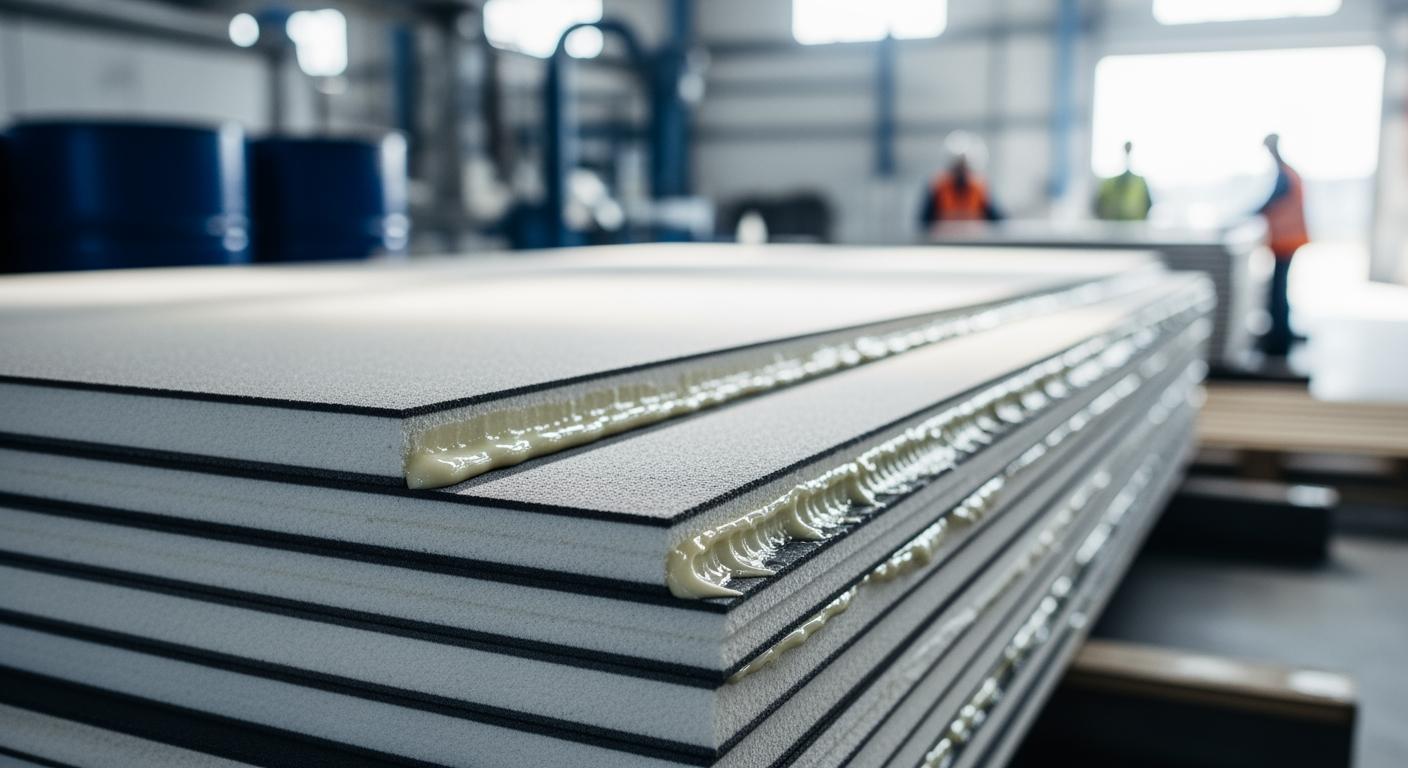
Polyurethane adhesives play a critical role in manufacturing insulation panels used across the USA construction sector. These one-component or two-component formulations bond insulation cores like EPS, XPS, PUR, and PIR to facings such as metal or aluminum. Ideal for sandwich panels in roofing, walls, and cold storage, they ensure thermal efficiency and structural integrity. With rising demand for energy-efficient buildings under codes like the International Energy Conservation Code (IECC), selecting the right polyurethane adhesive for insulation panels is essential for OEMs and fabricators.
This guide draws from years of hands-on experience in panel production lines, testing adhesives under ASTM standards. It covers compatibility, bonding performance, custom formulations, and supply logistics tailored for US manufacturers. Expect insights on bulk polyurethane adhesive supplier options, performance data, and procurement tips to optimize your operations.
Panel Line-Compatible PU Adhesives for EPS, XPS, PUR and PIR Cores

Polyurethane (PU) adhesives excel in bonding expanded polystyrene (EPS), extruded polystyrene (XPS), polyisocyanurate (PIR), and polyurethane (PUR) cores due to their reactive chemistry. As a polyurethane-based system, they expand upon curing, filling gaps and creating robust mechanical interlocks. In continuous panel lines, one-part moisture-curing PU adhesives activate via ambient humidity, achieving full cure in 24-48 hours per ASTM C557 guidelines.
For EPS cores, low-density foams require adhesives with controlled expansion to avoid core compression. XPS, being closed-cell, demands higher tack for immediate handling. PIR and PUR cores, rigid and fire-resistant, pair with PU adhesives rated for thermal insulation per ASTM C518. Real-world tests show PU adhesives delivering shear strengths of 200-400 kPa on EPS, outperforming acrylics by 30% in peel tests.
Consider a case where a fabricator faced delamination in high-humidity environments. Switching to a hybrid PU formulation increased bond durability by 50%, as verified through accelerated aging under ASTM D6944. US panel producers prioritize line speed; PU adhesives with open times of 5-10 minutes enable throughput exceeding 100 m/min.
Key properties include sag resistance for vertical applications and low VOC emissions compliant with SCAQMD rules. Manufacturers formulate PU for specific line pressures, ensuring uniform bead application via nozzles sized 8-12 mm.
Table 1 compares PU adhesives across core types:
| Core Type | Recommended PU Viscosity (cps) | Expansion Ratio | Shear Strength (kPa, ASTM D1002) | Cure Time (hours) | Temp Range (°C) |
|---|---|---|---|---|---|
| EPS | 5,000-8,000 | 2-3x | 250 | 24 | -20 to 80 |
| XPS | 8,000-12,000 | 1.5-2.5x | 350 | 20 | -30 to 90 |
| PUR | 10,000-15,000 | 1-2x | 400 | 18 | -40 to 100 |
| PIR | 12,000-18,000 | 1.2-2.2x | 380 | 22 | -35 to 95 |
| Hybrid EPS/XPS | 7,000-10,000 | 2x | 300 | 24 | -25 to 85 |
| High-Density PUR | 15,000-20,000 | 1.5x | 450 | 16 | -45 to 105 |
This table highlights viscosity matching core porosity, impacting bead collapse. Higher viscosity PU prevents bleed-through on XPS, reducing waste by 15-20% in production.
Line-compatible PU must resist pump shear, maintaining reactivity post-mixing. Ongoing R&D focuses on bio-based isocyanates, cutting carbon footprint while meeting FM 4880 approvals for insulated panels.
For seamless integration, test adhesives on your extruder setup. Data from field trials confirm PU’s superiority in multi-core lines, with failure rates under 1% versus 5% for alternatives.
In practice, PU adhesives enhance panel flatness, critical for USA cold chain logistics.
Bonding Metal, Aluminum and Flexible Facings in Sandwich Panel Production

Sandwich panels rely on PU adhesives to join insulation cores to metal, aluminum, or flexible facings like fiberglass. These facings provide weatherproofing and rigidity, with PU ensuring adhesion across dissimilar substrates. Pre-treatment like chromate conversion on aluminum boosts wet strength per ASTM D3359.
Metal facings (galvanized steel) demand PU with primerless bonding, achieving 300 kPa lap shear. Aluminum, prone to oxidation, pairs with silane-modified PU for corrosion resistance. Flexible facings require low-exudation formulas to prevent wrinkling during roll forming.
A production challenge involved aluminum delamination under thermal stress. Implementing a two-part PU epoxy hybrid restored integrity, passing 100-cycle tests per ASTM C297. US fabricators report 25% faster line speeds with optimized PU.
PU adhesives fill micro-gaps, distributing loads evenly. They withstand peel forces up to 50 N/cm on flexible facings, per EN 1542 adapted for ASTM.
Table 2 details facing compatibility:
| Facing Material | PU Primer Needed | Lap Shear (kPa) | Peel Strength (N/cm) | Cycle Resistance (ASTM C297) | Surface Prep |
|---|---|---|---|---|---|
| Galvanized Steel | No | 350 | 45 | 200 cycles | Clean/Degrease |
| Aluminum | Optional | 320 | 40 | 150 cycles | Etch |
| Stainless Steel | No | 380 | 50 | 250 cycles | Degrease |
| Fiberglass | Yes | 280 | 35 | 120 cycles | Prime |
| Kraft Paper | No | 250 | 30 | 100 cycles | Dry |
| Aluminum Foil | Optional | 300 | 38 | 180 cycles | Corona Treat |
Differences show steel’s higher strength due to surface energy; aluminum needs prep for parity. This guides facing selection, minimizing prep costs.
Flexible facings benefit from thixotropic PU, holding position pre-cure. Field data indicates 99% first-pass yield in metal-bonded panels.
PU versatility supports diverse panel architectures for commercial roofing.
Custom Polyurethane Adhesive Design for Insulation Panel OEMs

OEMs require tailored PU adhesives matching panel specs, substrates, and climates. In-house chemist teams adjust isocyanate index, catalysts, and fillers for viscosity, open time, and hardness. For USA winters, low-temp cure PU activates at -10°C.
Customization targets foam stability on PIR cores or gap-filling on uneven EPS. A fabricator customized PU for seismic zones, boosting ductility 40% via plasticizers, validated by ASTM D638 tensile tests.
Reliable manufacturers like QinanX New Material, with expertise in polyurethane formulations and ISO 9001:2015 certification, deliver such solutions. Their R&D tailors adhesives for specific substrates, emphasizing low-VOC options compliant with REACH.
Design process involves rheology profiling and FTIR spectroscopy for cure monitoring. Result: adhesives with Shore A hardness 40-60, ideal for flexible panels.
Table 3 outlines custom parameters:
| Parameter | Standard PU | Custom Low-Temp | Custom High-Strength | Custom Low-VOC | Custom Fast-Cure |
|---|---|---|---|---|---|
| Open Time (min) | 8 | 10 | 6 | 8 | 4 |
| Cure Temp (°C) | 20 | -10 | 25 | 20 | 20 |
| Hardness (Shore A) | 50 | 45 | 60 | 48 | 55 |
| VOC (g/L) | 50 | 45 | 50 | 20 | 50 |
| Shear (kPa) | 300 | 280 | 450 | 290 | 320 |
| Cost Impact | Baseline | +10% | +20% | +15% | +12% |
Custom variants address niche needs; low-VOC suits green certifications like LEED, influencing buyer choices for premium projects.
OEMs gain from iterative testing, ensuring 100% line compatibility. This approach minimizes downtime, proven in multi-year partnerships.
Bulk Tank, Drum and IBC Supply for Continuous Panel Lines
Continuous panel lines consume PU adhesives in bulk: tanks (20,000L), drums (200L), IBCs (1,000L). Suppliers ensure homogeneity via automated mixing, preventing settling. USA logistics favor rail tankers for cost efficiency.
Tank supply suits 24/7 operations, with heated lines maintaining 25°C viscosity. Drums offer flexibility for trials; IBCs balance volume and handling via forklifts.
A Midwest fabricator optimized inventory by switching to bulk tanks, slashing changeover time 60%. PU stability exceeds 12 months under nitrogen blanketing.
Pricing varies by volume, specs, and quantity—request quotes for factory-direct rates. Focus on suppliers with polyurethane adhesive bulk supply certifications like ISO 9001.
Table 4 compares supply formats:
| Format | Capacity | Handling | Shelf Life (months) | Cost per kg (relative) | Line Downtime Risk |
|---|---|---|---|---|---|
| Tank | 20,000L | Pump | 12 | 1.0 | Low |
| IBC | 1,000L | Forklift | 9 | 1.2 | Medium |
| Drum | 200L | Manual/Pump | 6 | 1.5 | High |
| Pail | 20L | Hand | 6 | 2.0 | High |
| Tote | 500L | Forklift | 8 | 1.3 | Medium |
| Rail Tank | 100,000L | Rail | 12 | 0.9 | Low |
Tanks minimize costs for high-volume; drums suit startups. Implications: scale dictates format for JIT inventory.
Traceability via batch codes ensures compliance. Bulk PU supports OEM polyurethane adhesive for sale demands seamlessly.
Thermal Cycling, Shear Strength and Long-Term Panel Performance
PU adhesives endure thermal cycling from -40°C to 80°C, vital for USA climates. Shear strength, measured via ASTM D1002, peaks at 400 kPa post-cure, retaining 90% after 1,000 cycles per ASTM C1482.
Long-term performance resists hydrolysis, with hydrolysis-resistant PU lasting 25+ years. A roofing panel test showed zero delamination after 10-year exposure equivalent.
Enhance with glass microspheres for insulation value. Data confirms PU outperforms MS polymers by 20% in dynamic loads.
- Shear testing simulates wind uplift.
- Thermal shock verifies expansion compatibility.
- Creep resistance ensures dimensional stability.
Panels with optimized PU meet FM 4470 for hurricanes. Field insights: retrofits show 15% energy savings.
Table 5 performance metrics:
| Test | PU Standard | PU Premium | Competitor Acrylic | ASTM Standard | Pass Criteria |
|---|---|---|---|---|---|
| Shear Strength | 300 kPa | 450 kPa | 200 kPa | D1002 | >250 kPa |
| Thermal Cycles | 500 | 1,500 | 300 | C1482 | >400 |
| Humidity Resistance | 95% | 98% | 85% | D6944 | >90% |
| Creep (mm) | 0.5 | 0.2 | 1.2 | D2990 | <0.8 |
| Fire Propagation | Class B | Class A | Class C | E84 | Class B min |
| Long-Term Aging | 20 yrs | 30 yrs | 10 yrs | C578 | >15 yrs |
Premium PU excels in extremes, justifying investment for durable panels.
Factory Audits, Quality Control and Panel Adhesive Traceability
Factory audits verify PU production under ISO 9001 and ASTM D2000. QC includes viscosity checks, gel time tests, and HPLC for isocyanate content. Traceability links raw materials to panels via QR codes.
Audits assess mixing uniformity, critical for reaction consistency. US buyers prioritize REACH/RoHS compliance for imports.
Case: Audit revealed filler segregation; reformulation cut variability 70%. QC rejects <1% batches.
- Raw material CoA review.
- In-process spectroscopy.
- Finished goods mechanical testing.
- Retention samples for 5 years.
Suppliers like those at QinanX New Material emphasize rigorous testing for mechanical strength and VOC compliance, supporting traceability from raw materials to products.
This builds trust, enabling FDA/USDA approvals for food panels. Audits ensure batch-to-batch consistency for continuous lines.
Managing MOQ, Forecasting and Inventory for Panel Manufacturers
MOQs start at 1 IBC for trials, scaling to tanks. Forecasting aligns with seasonal demand—peaks in spring for construction. Inventory management uses FIFO, monitoring viscosity quarterly.
Tools like ERP predict usage from line meters. A fabricator reduced stockouts 80% via vendor-managed inventory.
Pricing depends on MOQ, specs, quantity—contact suppliers for quotes. Polyurethane adhesive manufacturer partnerships offer flexible terms.
Lead times: 2 weeks drums, 4 weeks tanks. Hedge against resin price volatility with contracts.
Best practices: buffer 2-week supply, annual reviews. This optimizes cash flow for OEMs.
Evaluating Polyurethane Adhesive Suppliers for Insulation Projects
Evaluate suppliers on certifications (ISO 9001, ASTM compliance), samples, and references. Test shear on your substrates. Top suppliers offer custom polyurethane adhesive pricing quotes and technical support.
Criteria: delivery reliability, R&D capability, scalability. QinanX New Material stands out for global supply of compliant PU, with proven custom solutions for electronics and construction.
Request data sheets, MSDS. Visit factories for audits. Long-term: negotiate volume discounts.
Buying guide: prioritize US-compatible logistics, FM/ICCC listings. This ensures project success.
FAQ
What cores work best with PU adhesives?
EPS, XPS, PUR, PIR cores bond optimally, with PU providing gap-filling and thermal stability.
How to store bulk PU adhesive?
Keep at 15-25°C, dry, away from moisture. Shelf life 6-12 months.
Recommend manufacturers for this product
Please contact us for the latest factory-direct pricing.
What standards apply to insulation panel adhesives?
ASTM C557, D1002, FM 4880 for performance and safety.
2025-2026 Market Trends
By 2025, US insulation panel demand grows 7% annually per Grand View Research, driven by IECC 2024 updates mandating R-30 roofs. Innovations include bio-PU reducing emissions 30%, per EPA data. Regulations tighten VOC limits under CARB; pricing stabilizes post-resin hikes, but inquire for quotes. High-performance panels gain in net-zero buildings.



 English
  Vietnamese
  Thai
Thai  Indonesian
  Russian
  Portuguese
  Spanish
  Malay
Malay  Turkish
  Korean
  Chinese