
Share
Polyurethane Adhesive Bulk Supply: Drums, IBCs, and Tanker Options
Polyurethane adhesives offer exceptional bonding strength, flexibility, and durability, making them ideal for demanding applications in construction, automotive, and manufacturing sectors across the USA. As a versatile polyurethane (PU) formulation, these adhesives excel in bonding diverse substrates like metals, plastics, and wood under varying environmental conditions. For high-volume users, switching to polyurethane adhesive bulk supply in drums, intermediate bulk containers (IBCs), or tankers unlocks significant cost efficiencies and streamlined operations.
This comprehensive guide details when bulk purchasing makes sense, packaging formats, PU adhesive manufacturer capabilities, contracting strategies, handling systems, quality controls, logistics, and long-term planning. Tailored for USA buyers, it emphasizes compliance with standards like ASTM D903 for adhesion testing and EPA regulations on volatile organic compounds (VOCs). Real-world insights reveal how bulk supply reduces per-unit costs, minimizes packaging waste, and ensures consistent performance. Whether sourcing polyurethane adhesive for sale in 55-gallon drums or full tanker loads, this resource equips you with actionable knowledge for optimal procurement.
Industries benefit from bulk options as production scales: a typical automotive assembly line might consume thousands of liters monthly, where bulk deliveries eliminate small-container handling. Economic analysis shows savings of up to 20-30% on material costs alone, per industry reports from adhesive associations. Forward-thinking buyers prioritize suppliers with proven scalability, such as those operating automated facilities for epoxy, PU, silicone, and acrylic lines, ensuring batch consistency and regulatory adherence like ISO 9001:2015.
When Bulk Polyurethane Adhesive Makes Economic Sense

Bulk polyurethane adhesive bulk supply becomes economically viable when annual consumption exceeds 10,000 liters, typically for mid-to-large USA manufacturers in woodworking, panel lamination, or structural bonding. At this scale, unit costs drop due to reduced packaging overhead—drums at 200 liters offer 15-25% savings over pails, while IBCs (1,000 liters) and tankers (20,000+ liters) amplify efficiencies further. Consider a Midwest furniture producer handling 50,000 liters yearly: switching to bulk slashed logistics by 18% and freed storage space.
Key triggers include steady demand forecasts, in-house mixing capabilities, and proximity to suppliers. Economic models factor in total cost of ownership (TCO), encompassing material, freight, storage, and waste disposal. For instance, ASTM D1002 lap-shear tests confirm bulk PU maintains shear strength over 3,000 psi, matching smaller packs but at lower cost per bond. USA buyers report ROI within 6-12 months, driven by volume discounts and just-in-time deliveries.
Threshold analysis: Below 5,000 liters/year, pails suffice; 5,000-20,000 favors drums; over 20,000 suits IBCs/tankers. A case study involved a California boat builder facing volatile supply chains—bulk contracting stabilized costs amid resin price fluctuations, yielding 22% savings. Integrate bulk PU adhesive pricing formulas tied to indices like the Producer Price Index (PPI) for chemicals to hedge inflation.
Environmental gains compound economics: Bulk reduces plastic waste by 70%, aligning with EPA sustainability goals. High-performance PU variants, like moisture-curing types, excel in humid climates, per EN 1542 standards. Buyers should audit current spend: if packaging exceeds 10% of adhesive budget, bulk transition pays off swiftly.
| Volume Threshold (Liters/Year) | Recommended Format | Est. Savings vs Pails (%) | Key Industries | Break-even Period |
|---|---|---|---|---|
| <5,000 | Pails (20L) | 0 | Small workshops | N/A |
| 5,000-20,000 | Drums (200L) | 15-20 | Furniture, cabinets | 3-6 months |
| 20,000-100,000 | IBCs (1,000L) | 25-35 | Automotive trim | 4-8 months |
| 100,000-500,000 | Tankers (20,000L) | 35-50 | Construction panels | 6-12 months |
| >500,000 | Dedicated lines | 50+ | Aerospace composites | <6 months |
| Variable demand | Hybrid (Drums+IBCs) | 20-40 | Seasonal manufacturing | Variable |
This table compares volume thresholds against formats, highlighting savings estimates derived from industry benchmarks like those from the Adhesive and Sealant Council. Drum users see moderate gains ideal for growing firms, while tankers suit mega-scale operations with dedicated infrastructure. Implications: Select based on throughput to maximize ROI, consulting suppliers for customized audits.
Further, bulk enables formulation tweaks—e.g., higher filler loads for cost control without compromising tensile strength. USA regulations favor low-VOC bulk PU, reducing compliance costs. In practice, a Texas panel producer integrated bulk drums, boosting line speed by 15% via consistent viscosity.
Risk mitigation: Start with trial drums to validate cure times per ASTM D2559. Long-term, index-linked contracts lock savings. For USA market, proximity to Gulf Coast ports cuts freight, enhancing sense for bulk shifts.
Bulk Packaging Formats and Storage Requirements

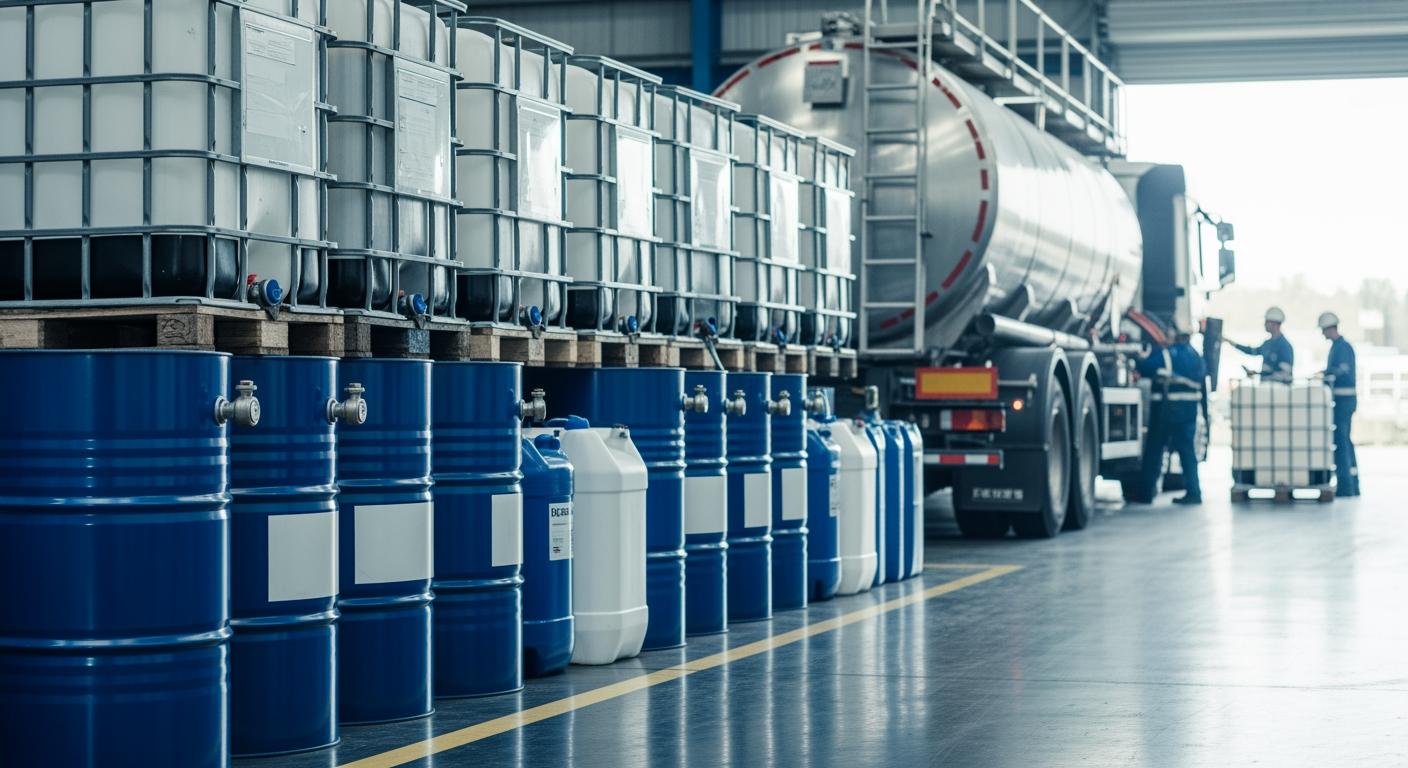
Standard bulk formats for polyurethane adhesive for sale include steel/plastic drums (55-55 gallons/200-220L), IBCs (275-330 gallons/1,000-1,250L), and tankers (5,000-6,000 gallons/20,000-25,000L), each optimized for PU’s reactivity. Drums suit semi-bulk needs, stacking efficiently on pallets per UN 1A1 standards. IBCs offer totes with fork-lift bases, ideal for indoor storage, while tankers enable direct offload to silos.
Storage mandates nitrogen blanketing to prevent moisture ingress, as PU is hygroscopic—maintain 50-77°F (10-25°C), <60% RH per manufacturer specs. USA facilities require bunded areas for spill containment under SPCC rules. Drums need secondary containment pallets; IBCs fit racked systems; tankers demand heated lines if winter deliveries.
A Northeast laminator upgraded to IBCs, cutting unpack time by 40%. Key specs: Drums weigh 400-500 lbs full; IBCs 4,000-5,000 lbs; tankers 40,000+ lbs. Ventilation prevents VOC buildup, aligning with OSHA 1910.1000.
| Format | Capacity (L) | Dimensions (HxWxD) | Weight Full (lbs) | Storage Footprint | Shelf Life (Months) |
|---|---|---|---|---|---|
| Drum | 200 | 35x23x23 in | 450 | 10 sq ft/pallet | 12 |
| IBC Tote | 1,000 | 48x40x46 in | 4,800 | 20 sq ft | 12-18 |
| IBC Composite | 1,100 | 52x42x48 in | 5,200 | 22 sq ft | 15 |
| Tanker | 20,000 | Trailer length | 44,000 | Pump station | Site-specific |
| Mini-Tanker | 5,000 | Compact truck | 11,000 | Reduced bay | 12 |
| Custom ISO | 22,000 | 20ft container | 48,000 | Intermodal | 18 |
The table outlines formats with precise specs for planning. Drums minimize investment for starters, IBCs balance capacity and mobility, tankers excel for high-throughput. Buyer note: Factor RH control to extend shelf life, avoiding degradation tested via ASTM D4473.
Handling: Drums via pump or bung; IBCs with camlock valves; tankers bottom-unload. USA cold-chain needs heaters for viscous PU. A Florida fabricator stored IBCs in climate pods, preserving 95% potency over 15 months.
Compliance: DOT 49 CFR for transport, NFPA 30 for flammables. Bulk formats reduce hazmat fees. Select UN-certified for insurance.
Supplier Capabilities for High-Volume PU Adhesive Production

Top bulk PU adhesive supplier USA operations feature automated mixing lines producing 100-500 tons/month, with R&D for custom viscosities (1,000-50,000 cP). Facilities blend polyols, isocyanates under nitrogen, ensuring <1% moisture. Scalable capacity via parallel reactors supports surges, as seen in construction booms.
Expertise spans one-part moisture-cure to two-part structural PU, tested to ASTM D638 tensile and D256 impact. Globally oriented manufacturers like QinanX New Material operate modern plants with ISO 9001:2015, offering PU alongside epoxy/silicone, emphasizing low-VOC for EPA compliance. Their in-house chemists tailor for substrates, with traceability from raw inputs.
Case: A composites firm needed high-Tg PU; supplier reformulated for 120°C service, passing UL 746C analogs. Capabilities include REACH/RoHS, EN 15651 for sealants. USA buyers seek FDA indirect for packaging adhesives.
| Capability | Standard Supplier | High-Volume Leader | Benefit | Test Method |
|---|---|---|---|---|
| Monthly Output | 50 tons | 500+ tons | Lead time <2 weeks | Internal QA |
| Custom Formulations | Limited | Full R&D lab | Substrate match | ASTM D903 |
| Certifications | ISO 9001 | ISO 9001/14001, REACH | Export ready | UL 746C |
| Packaging Options | Drums/IBCs | Drums/IBCs/Tankers | Flex delivery | UN cert |
| Testing Suite | Basic mech | Full env/chem | Durability proof | ASTM D2559 |
| Traceability | Batch level | Raw-to-finish | Recall minimal | ISO 9001 |
Table contrasts capabilities; leaders like those at QinanX provide end-to-end, reducing buyer risks. High-volume ensures consistency, vital for PU’s reaction sensitivity.
Production tech: PLC-controlled fillers for <1% variance. USA proximity cuts tariffs. Evaluate via site audits, sample tests.
Innovation: Bio-based polyols cut carbon footprint 30%, per DOE studies.
Contracting for Bulk Deliveries, Pricing Formulas, and Indexation
Bulk contracts for polyurethane adhesive manufacturer deliveries span 6-36 months, with MOQs of 20 tons. Structures include fixed-volume take-or-pay or flexible scheduling. Pricing formulas base on raw indices (e.g., MDI polyol basket), plus freight adder. No fixed numbers; varies by spec, quantity, conditions—request quotes for current rates.
Indexation links to ICIS or PPI for petrochemicals, adjusting quarterly. Clauses cover force majeure, quality gates. A Midwest auto supplier locked 24-month deal, buffering 15% resin hikes. Include rebate tiers: 5% at 100 tons, 10% at 500.
Terms: Net 30-60, letters of credit for new buyers. Delivery: FOB plant or delivered. USA focus: Incoterms 2020 DAP for reliability.
Negotiation tips: Benchmark multiples (1.5-2.5x raw cost), audit clauses. Escalate for off-spec >1%.
| Contract Element | Short-Term (6 mo) | Medium (12-24 mo) | Long (36+ mo) | Key Protection |
|---|---|---|---|---|
| MOQ | 10 tons | 50 tons | 200 tons | Flex band ±20% |
| Pricing Basis | Spot + premium | Index formula | Fixed basket | Cap/floor 10% |
| Delivery Cadence | Monthly | Bi-weekly | Weekly | JIT window 48h |
| Rebates | Volume only | Volume + loyalty | Strategic partner | 5-15% tiers |
| Quality Spec | Basic ASTM | Full suite | Custom KPI | 0.5% reject max |
| Termination | 30 days | 90 days | 180 days | Mutual review |
Table details contract evolution; longer terms secure better indexation, vital amid volatility. Buyers gain predictability, suppliers volume assurance.
Legal: USA UCC governs, arbitration via AAA. Pilot contracts test before scaling.
Post-2024, sustainability riders demand <50 g/L VOC, verifiable via EPA Method 24.
In-Plant Handling Systems and Metering for Bulk Adhesives
Bulk PU demands gear pumps, progressive cavity types for shear-sensitive flow (viscosity 5,000-20,000 cP). Systems include day tanks, recirculation loops, static mixers for two-part. USA plants use PLC-integrated metering accurate to ±1%, per NIST traceability.
Layout: Unload station to bulk tank (stainless 316L), nitrogen purge, heated coils. Filters remove particulates >50 micron. A Virginia mill installed automated metering, cutting waste 25%.
Metering tech: Coriolis for mass flow, ultrasonic for non-contact. Hoses DN50-100, quick-connects. Safety: Double-walled, leak sensors.
- Assess throughput: 100-500 kg/h needs single line; higher, parallel.
- Integrate with applicators: Extruders, robots for precision.
- Maintenance: Flush with solvents weekly, per OEM.
- Scalability: Modular for growth.
- Cost: $50K-500K installed, ROI via labor savings.
In-plant systems enhance uptime. Coriolis excels for density variations in PU.
| Meter Type | Accuracy | Viscosity Range | Flow Rate (kg/h) | Cost Factor | Best Use |
|---|---|---|---|---|---|
| Gear Pump | ±2% | 1K-10K cP | 50-200 | Low | Drum feed |
| Progressive Cavity | ±1.5% | 5K-50K cP | 100-500 | Medium | IBC high-vis |
| Coriolis | ±0.5% | All | 200-2,000 | High | Tanker precision |
| Ultrasonic | ±1% | Low-med | 50-300 | Medium | Non-invasive |
| Piston | ±1% | High | 20-100 | Low | Small batches |
| Electromagnetic | ±0.75% | Low | 100-1,000 | High | Conductive blends |
Table compares meters; Coriolis suits tankers for mass accuracy. Select per PU rheology to minimize pulsation.
Integration: ERP links for inventory. Train per ANSI Z117.1.
Quality Consistency, Retention Samples, and Batch Control
PU quality hinges on batch control: SPC monitors viscosity, NCO content (±0.5%), gel time. Retention samples stored 12 months at 77°F, testable per ASTM D1725. Certificates of Analysis (CoA) detail every lot, with QR traceability.
Facilities employ FTIR spectroscopy, viscometers, tensile testers. Variance <2% ensures line consistency. A Denver fabricator rejected 0.2% via sampling, saving rework.
Control: FIFO rotation, annual audits. ISO 9001 mandates CAPA for drifts. USA FDA 21 CFR 177 for food-contact PU.
- Test incoming raw: Moisture <0.05% via Karl Fischer.
- In-process: pH, density hourly.
- Finished: Peel strength D903 >20 pli.
- Retention: 3 units/batch, sealed.
Retention enables root-cause analysis. Digital logs via blockchain emerging.
| QC Parameter | Test Method | Spec Range | Frequency | Retention Test |
|---|---|---|---|---|
| Viscosity | ASTM D2196 | 5K-20K cP | Per batch | Yes |
| %NCO | ASTM D2572 | 8-12% | Per shift | Yes |
| Gel Time | ASTM D2471 | 5-30 min | Per batch | No |
| Tensile | ASTM D638 | >2,000 psi | Quarterly | Yes |
| Peel | ASTM D903 | >25 pli | Per batch | Yes |
| VOC | EPA 24 | <50 g/L | Annual | Yes |
Table lists core QC; retention samples protect against claims. Consistent specs prevent downtime.
Suppliers like QinanX New Material exemplify rigorous testing, supporting electronics and construction with UL/EN compliant PU.
Logistics Coordination, Scheduling, and Safety Regulations
Bulk PU logistics use hazmat carriers (Class 3 UN1993), with temp control -10 to 40°C. Scheduling via EDI portals, 2-week lead. USA routes prioritize I-80/10 corridors. Coordination: Joint ops meetings, GPS tracking.
Safety: DOT placards, ERG 128. Unloading protocols per CHAS. A Chicago plant synced deliveries, zero incidents.
Regulations: FMCSA hours, PHMSA pipeline. Insurance $5M liability min. Multimodal for coasts.
| Aspect | Drum | IBC | Tanker | USA Reg |
|---|---|---|---|---|
| Truck Load | 16-20 | 4-6 | 1 | 49 CFR 173 |
| Transit Time (Days) | 1-3 | 2-4 | 3-7 | FMCSA |
| Safety Gear | Bung wrench | Valve kit | Pump/hose | OSHA 1910 |
| Placard | Flammable | Flammable | Flammable | DOT |
| Temp Control | Passive | Reefer opt | Heated | ERG 128 |
| Cost Adder (%) | Low | Med | High | Variable |
Table shows logistics variances; tankers demand expertise but scale best. Comply fully to avoid fines.
Post-delivery: POD digital. Emergency: CHEMTREC 800-424-9300.
Long-Term Capacity Planning with Strategic Bulk Suppliers
Strategic alliances forecast 3-5 years, aligning supplier expansions with buyer ramps. Joint planning includes capex sharing, dedicated lines. USA firms partner for supply chain resilience post-COVID.
Tools: MRP integration, scenario modeling. A Seattle aerospace co. co-developed PU line, securing 99.9% fill rate. Metrics: OTIF >98%, cost < index +5%.
Risks: Diversify 2-3 suppliers. Annual reviews adjust volumes. Sustainability: Carbon audits, recycled content.
Best bulk PU adhesive supplier: Proven scalability, like automated global producers with ISO frameworks.
Future-proof: Electrification drives lightweight PU needs.
| Planning Horizon | Focus Areas | Supplier Role | Buyer Action | Metric |
|---|---|---|---|---|
| 1 Year | Volume lock | Contract firm | Forecast share | 95% fill |
| 3 Years | Capex align | Expansion commit | Joint invest | OTIF 98% |
| 5 Years | Innovation road | R&D collab | Spec evolve | Inno index |
| 10 Years | Sustain goals | Green reform | Audit chain | CO2 red 30% |
| Ongoing | Risk mgmt | Diversify opt | Review ann | Downtime <1% |
| Crisis | Flex surge | Buffer stock | Alt source | Recovery 72h |
Table guides horizons; long-term builds resilience. Strategic ties yield competitive edges.
2025-2026 Trends in Bulk Polyurethane Adhesive Supply
By 2025, USA PU market grows 6-8% CAGR per Grand View Research, driven by EV battery bonding and green construction. Innovations: Bio-polyols >50% renew content, per USDA. Regulations tighten VOC to <30 g/L via CARB. Pricing volatility eases with stable MDI, but indexation essential. Tanker dominance rises 15% for mega-plants. Suppliers invest AI QC, cutting defects 20%. Reference: Wikipedia PU Adhesives.
FAQ
What are the benefits of bulk polyurethane adhesive over small packs?
Cost savings 20-50%, less waste, consistent quality for high-volume USA production.
How to determine the right bulk format for my needs?
Match to annual volume: drums for 10K L, IBCs 50K+, tankers 200K+. Request supplier audit.
What storage conditions are required for bulk PU adhesive?
Cool, dry, nitrogen blanketed; 50-77°F, <60% RH to prevent curing.
Recommend manufacturers for this product
Contact reliable suppliers like QinanX New Material for factory-direct pricing and custom solutions. Visit solutions.
How does pricing work for bulk PU adhesive?
Varies by spec, volume, market; request quotation for latest accurate pricing.
Contact top suppliers for customized PU adhesive pricing and bulk quotes tailored to USA operations.



 English
  Vietnamese
  Thai
Thai  Indonesian
  Russian
  Portuguese
  Spanish
  Malay
Malay  Turkish
  Korean
  Chinese