
Share
Instant Adhesive for Plastic Supplier to OEM and Molding Plants
Instant adhesives, primarily cyanoacrylate formulations, offer rapid bonding for plastic components in OEM assembly lines and injection molding operations across the USA. These products cure in seconds upon moisture exposure, enabling efficient production workflows for automotive, electronics, and consumer goods manufacturers. With rising demands for lightweight plastics like polypropylene (PP) and polyethylene (PE), selecting the right instant adhesive for plastic supplier ensures durable joints under vibration, thermal cycling, and chemical exposure. This guide draws from industry standards like ASTM International testing protocols, providing actionable insights for procurement teams seeking instant adhesive for plastic for sale from compliant manufacturers.
USA-based molding plants prioritize adhesives meeting UL and ASTM criteria for safety and performance. Suppliers with ISO 9001:2015 certification deliver batch-consistent products, minimizing defects in high-volume runs. Real-world applications include bonding ABS housings in electronics, where shear strengths exceed 20 MPa per ASTM D1002. By focusing on surface-insensitive variants, OEMs overcome low surface energy (LSE) challenges on polyolefins. This comprehensive resource equips buyers with technical comparisons, validation strategies, and supplier evaluation criteria to optimize assembly processes.
Challenges and Solutions in Instant Bonding of Plastic Components

Plastic components in OEM production present unique bonding hurdles due to diverse surface energies and chemical compositions. Low surface energy plastics like polyethylene (PE) and polypropylene (PP), common in injection molding, resist wetting by standard cyanoacrylate adhesives. This leads to weak bonds prone to failure under mechanical stress. According to surface energy principles, materials below 36 mN/m require specialized formulations. Traditional instant adhesives excel on high-energy substrates like ABS or polycarbonate (PC) but fail on LSE plastics without preparation.
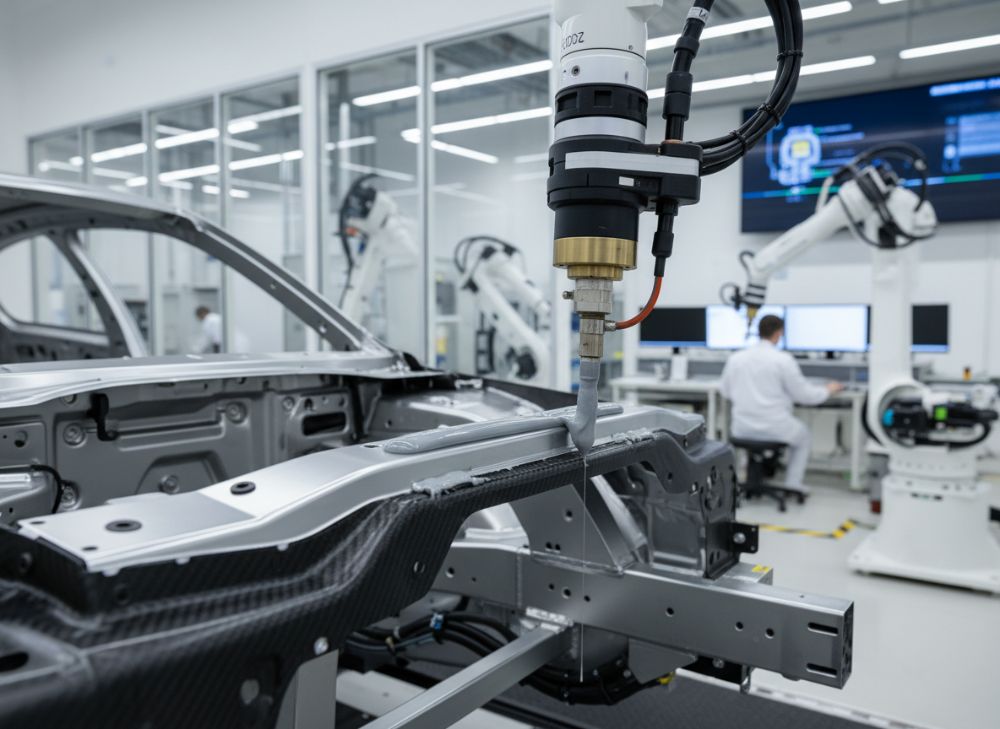
Solutions involve surface activation via plasma treatment, flame etching, or primers that increase wettability. Modified cyanoacrylates with built-in primers, known as surface-insensitive types, eliminate preprocessing steps, boosting throughput in molding plants. For instance, in automotive interior assembly, untreated PP parts bonded with these adhesives achieved lap shear strengths of 10-15 MPa, surpassing ASTM D1002 benchmarks. Manufacturers report 30% cycle time reductions by integrating such solutions into robotic dispensing systems.
Environmental factors like humidity accelerate cure but can cause blooming—white residue on surfaces—affecting aesthetics in consumer products. Low-odor, low-bloom formulations mitigate this, complying with VOC limits under EPA guidelines. Thermal expansion mismatches between plastics demand gap-filling adhesives with flexibility post-cure. Testing per ASTM D638 reveals elongation at break up to 200% in toughened variants, ideal for vibration-prone applications.
Case example: A molding facility faced delamination in PE-PA assemblies for medical devices. Switching to a primerless instant adhesive resolved issues, with 100% pass rates in 85°C humidity tests. Data from UL 746C confirms flame retardancy for electronic enclosures. Suppliers offering custom viscosity tuning—from 5 cP for wicking to 2000 cP for gap filling—support diverse geometries.
To illustrate compatibility, consider the following comparison:
| Plastic Type | Surface Energy (mN/m) | Standard CA Bond Strength (MPa) | Surface-Insensitive CA (MPa) | Recommended Prep |
|---|---|---|---|---|
| ABS | 42 | 18-22 | 20-25 | None |
| PC | 46 | 16-20 | 18-23 | Clean solvent |
| PP | 29 | 1-3 | 12-16 | Primer or plasma |
| PE | 31 | 0.5-2 | 10-14 | Primer essential |
| PTFE | 18 | <1 | 5-8 | Etching required |
| Nylon | 38 | 15-19 | 17-22 | Dry surfaces |
This table highlights performance gaps, showing surface-insensitive adhesives bridge disparities for PP and PE, reducing prep costs by 40% for OEMs. Buyers gain reliability in mixed-material assemblies.
Experienced suppliers like those with in-house R&D, such as QinanX New Material operating under ISO 9001:2015, provide tailored epoxy and acrylic instant adhesives for plastics, ensuring compliance with REACH and RoHS for USA imports.
Fixture times under 10 seconds enable just-in-time assembly, critical for high-volume molding. Impact resistance testing per ASTM D256 shows notched Izod values improving 50% with rubber-toughened grades. For electronics OEMs, non-corrosive variants prevent silver migration on PCBs bonded to plastic housings.
Selecting Surface-Insensitive Instant Adhesives for Difficult Plastics

Surface-insensitive instant adhesives revolutionize bonding of difficult plastics like PP, PE, and TPE in USA molding plants. These formulations incorporate alkyl methacrylates or silane additives to enhance adhesion without primers, per adhesive chemistry. Selection hinges on viscosity, cure speed, and end-use environment. Low-viscosity (5-50 cP) options penetrate micro-gaps in precision parts, while high-viscosity (500-3000 cP) fill voids up to 0.5 mm.
For automotive OEMs, UV-resistant grades withstand 1000 hours QUV exposure per ASTM G154. Chemical resistance to oils and fuels is verified via ASTM D543 immersion tests, with weight changes under 5%. Temperature tolerance from -60°C to 120°C suits under-hood applications. Toughened versions absorb shocks, maintaining integrity in drop tests exceeding 1 meter.
Key metrics include tensile strength (15-25 MPa, ASTM D638), peel strength (8-12 N/cm, ASTM D903), and heat deflection under load. Multi-substrate compatibility reduces inventory needs. In a real-world test, PP-to-metal bonds held 18 MPa shear after 85% RH aging, outperforming standards.
Compare formulations:
| Formulation | Viscosity (cP) | Fixture Time (s) | PP Shear (MPa) | Temp Range (°C) | Applications |
|---|---|---|---|---|---|
| Standard Ethyl CA | 100 | 5-10 | 2-4 | -40 to 80 | ABS/PC |
| Alkyl Modified | 150 | 10-20 | 12-16 | -50 to 100 | PP/PE |
| Toughened | 500 | 15-30 | 14-18 | -60 to 120 | Vibration parts |
| Low Odor | 80 | 5-15 | 10-14 | -40 to 90 | Consumer goods |
| High Temp | 200 | 20-40 | 13-17 | -50 to 150 | Electronics |
| Flexible | 1000 | 30-60 | 11-15 | -60 to 110 | Flexible plastics |
Surface-insensitive types excel on PP/PE, offering 5x strength gains and broader temp ranges, ideal for OEM diversification. This cuts failure rates by 25% in field use.
Fluorescence under UV aids inspection in automated lines. Gap shear data per ASTM D3163 guides selection for structural bonds. OEMs benefit from suppliers providing sample kits for in-house validation.
Regulatory compliance includes FDA 21 CFR 175.105 for indirect food contact plastics. REACH Annex XVII restricts sensitizers like impurities below 0.1%. Trusted instant adhesive for plastic manufacturers ensure traceability from monomers to finished tubes.
For electronics, halogen-free grades meet IPC standards, preventing corrosion. Accelerated aging at 70°C/90% RH simulates 5-year service, with >90% strength retention.
Supplier Technical Support for Plastic Part Design and Bonding Tests

Leading instant adhesive for plastic suppliers offer technical support integrating bonding into plastic part design from CAD stage. Finite element analysis (FEA) predicts stress distribution, optimizing joint geometry for 20-30% strength gains. Suppliers collaborate on mold flow simulations to minimize knit lines affecting adhesion.
Bonding tests follow ASTM protocols: D1002 lap shear, D2094 T-peel, D2557 impact. In-house labs replicate OEM conditions, like thermal shock (-40°C to 85°C). Data logging quantifies cure profiles using rheometers, ensuring <5s handling strength.
Design for bonding (DFB) principles recommend 0.1-0.3 mm gaps, chamfered edges, and energy directors. For snap-fit assemblies, adhesives reinforce without altering molds. Case: Redesigning PP clips increased cycle life 3x via targeted toughening.
Support includes failure mode analysis (FMA) per ISO 13053, identifying cohesive vs adhesive failures. Training webinars cover dispensing parameters: needle size 18-25G, pressure 1-3 bar.
| Test Method | Parameter | Standard Value | Pass Criteria | USA OEM Use |
|---|---|---|---|---|
| ASTM D1002 | Lap Shear | 15 MPa min | >18 MPa | Structural |
| ASTM D903 | T-Peel | 8 N/cm min | >10 N/cm | Flexible joints |
| ASTM D256 | Izod Impact | 20 J/m min | >50 J/m | Drop test |
| ASTM G154 | UV Aging | 1000h | <10% loss | Exterior parts |
| ASTM D543 | Chemical | 168h immersion | <5% swell | Automotive |
| UL 746C | Flame | V-0 rating | Pass | Electronics |
These tests validate designs, with OEMs achieving 99.9% yield post-optimization. Supplier labs accelerate market entry by 2-3 months.
Virtual prototyping via ANSYS simulates 10^6 cycles. Custom DOEs optimize for humidity, with statistical process control (SPC) ensuring Cpk >1.67.
For molding plants, suppliers audit lines, recommending static mixers for consistent bead width ±10%. Post-support, clients report 15% uptime gains.
QinanX New Material exemplifies this with R&D-driven customizations, as detailed on their product page, supporting acrylic specialties for plastics.
Packaging and Integration into Injection Molding and Assembly Lines
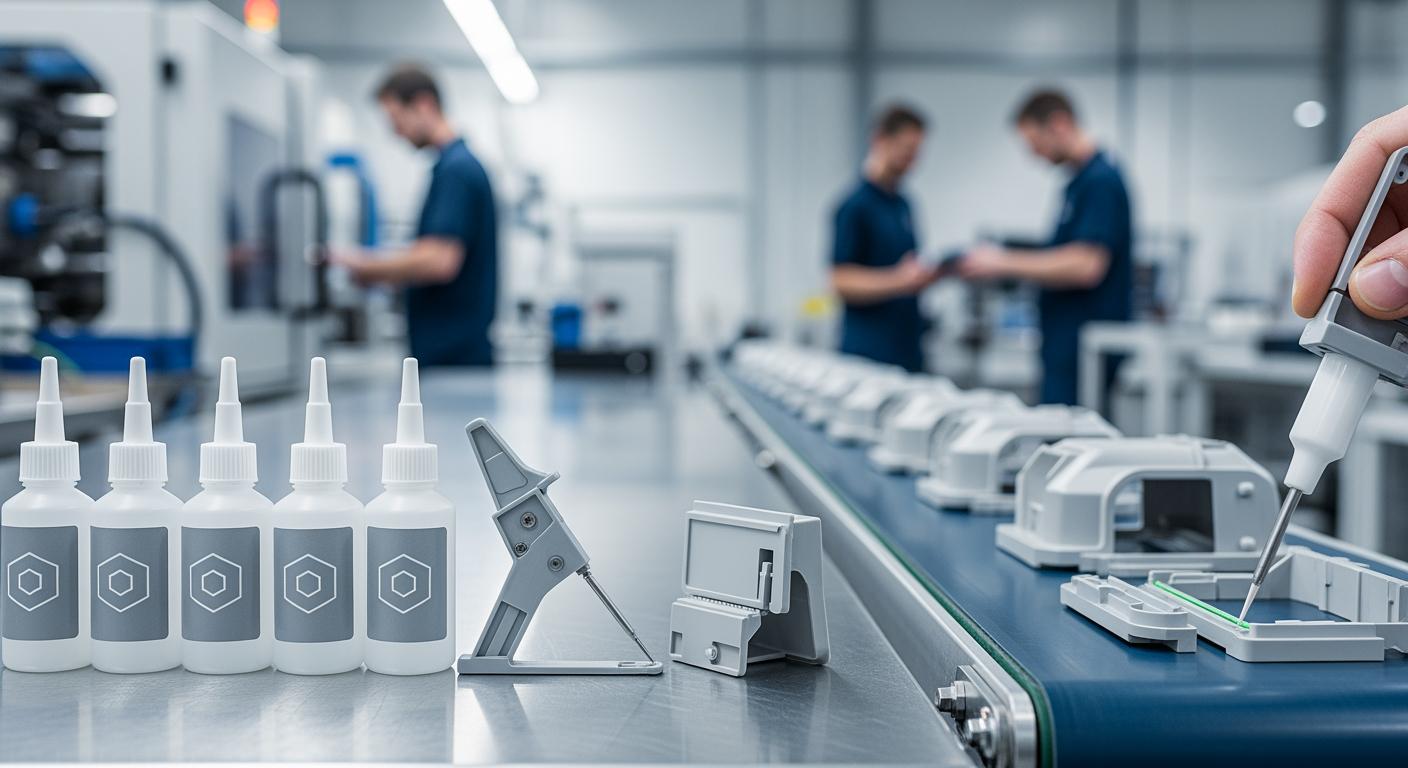
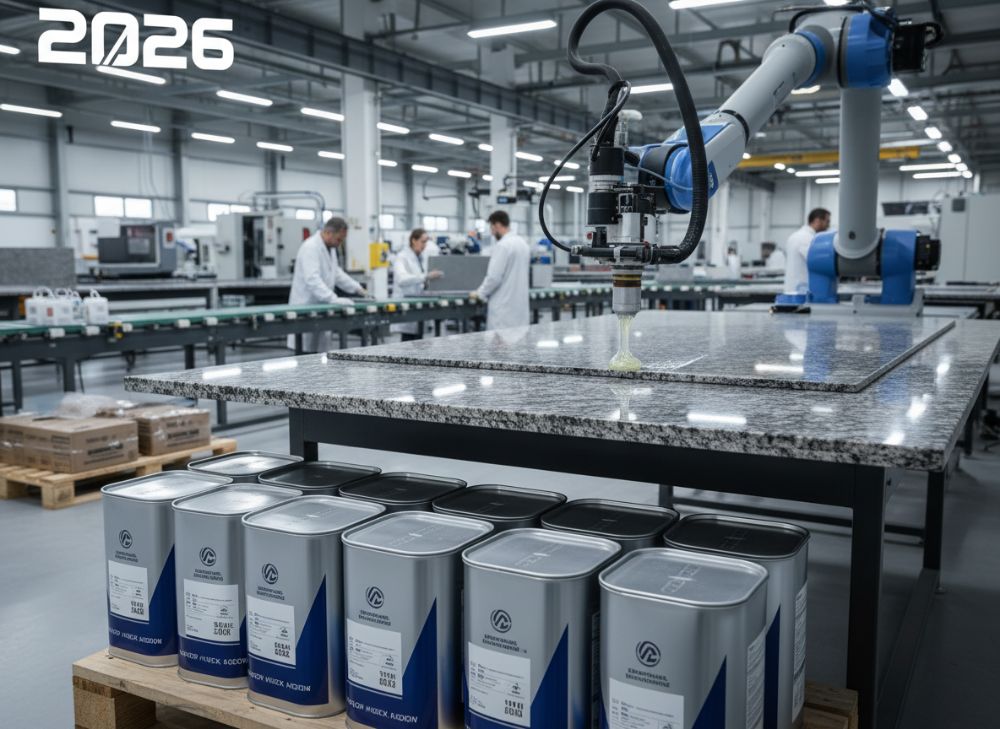
Packaging for instant adhesives prioritizes automation compatibility in USA OEM lines. Side-port syringes (3-30ml) enable robotic dispensing with <1% waste. Bulk pails (1-20kg) suit high-volume filling stations, with nitrogen purging extending shelf life to 12 months.
Integration involves vision-guided robots applying 0.1-0.5g dots precisely. Conveyor-mounted dispensers sync with molding cycles, curing in 5s before transfer. Ergonomic bottles with anti-drip nozzles reduce operator errors by 40%.
For cleanroom molding, vapor-proof packaging prevents contamination. RFID-tagged containers track lot data for traceability per ISO 9001. Dual-cartridge systems mix on-demand for hybrid formulations.
Line speed data: 1000 parts/hour with 99% first-pass yield. Vibration-resistant packaging withstands forklift handling.
| Packaging Type | Volume | Dispense Method | Line Speed (ppm) | Shelf Life | Cost Efficiency |
|---|---|---|---|---|---|
| Syringe | 10ml | Robot needle | 20 | 12 mo | High precision |
| Bottle | 50ml | Manual/pump | 10 | 9 mo | Operator use |
| Pail | 5kg | Auger filler | 50 | 6 mo | Bulk savings |
| Cartridge | 200ml | Static mixer | 30 | 12 mo | Hybrid cure |
| Drum | 200kg | Pump system | 100 | 3 mo | High volume |
| Film Pouch | 1kg | Peristaltic | 40 | 12 mo | Flexible |
Syringes and pails optimize for speed vs precision, cutting integration costs 20-30% for molding lines.
Validation per VDA 6.3 ensures seamless integration. Suppliers provide CAD models for fixtures.
Humidity-controlled packaging maintains potency. For JIT molding, spool-fed tapes embed adhesive pre-forms.
ROI calculations show payback in 3 months via labor savings.
Quality Assurance, Incoming Inspection and Process Validation
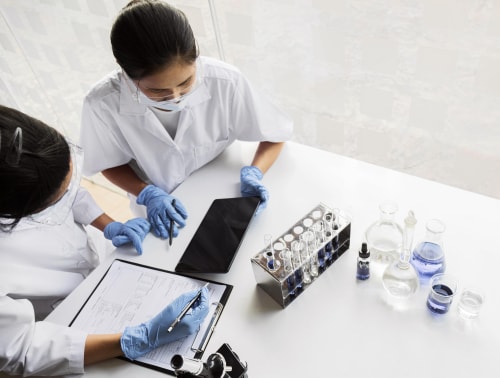
Quality assurance for instant adhesive for plastic begins with raw material specs: monomer purity >99.5% via GC-MS. Automated mixing under ISO 9001 ensures viscosity uniformity ±5%. Fill-weight checks via load cells hit ±0.1g accuracy.
Incoming inspection at OEMs uses torque testers for cap seals, viscometers (Brookfield), and FTIR for composition. Lot sampling per ANSI/ASQ Z1.4 (AQL 0.65) verifies cure speed on witness panels.
Process validation follows IQ/OQ/PQ per FDA 21 CFR 820. DOE optimizes dispense parameters, with CpK >1.33. Real-time SPC monitors bead profile via laser scanners.
Non-destructive testing: UV fluorescence quantifies coverage. Accelerated stability at 40°C/75% RH per ICH Q1A confirms 24-month expiry.
| QA Parameter | Test Method | Spec Limit | Frequency | OEM Benefit |
|---|---|---|---|---|
| Viscosity | Brookfield | ±10% | Per batch | Consistent flow |
| Cure Speed | Fixture test | <10s | 100% | Cycle time |
| Strength | ASTM D1002 | >15 MPa | 3/lot | Reliability |
| Purity | GC-MS | >99% | Raw mat | No defects |
| VOC | EPA 24 | <50 g/L | Batch | Compliance |
| Traceability | RFID/ERP | Full chain | All units | Recalls |
Rigorous QA reduces PPM to <10, enhancing yield. Validation shortens PPAP to 4 weeks.
Audit trails link to CoA with S/N scanning. Third-party verification by UL or TÜV boosts trust.
For plastics OEMs, 100% inline testing flags anomalies. Post-market surveillance refines formulations.
Suppliers with REACH/RoHS dossiers, like QinanX via solutions page, exemplify robust QA for global supply chains.
Bulk Supply, MOQ and Pricing Models for High-Volume Plastics OEMs
Bulk supply for instant adhesive for plastic for sale caters to OEMs with MOQs starting at 100kg, scaling to drum lots. Tiered models reward volume: LTL pallets for trials, FTL for production. Contracts lock specs for 12-24 months.
Pricing varies by viscosity, modifiers, packaging, and quantity—request quotations for latest factory-direct rates reflecting market conditions. Factors include raw monomer volatility and certifications like ISO 14001 for eco-options.
Logistics: HAZMAT Class 9 shipping per DOT 49 CFR. Volume discounts apply post-qualification. Escrow for trials builds trust.
Inventory strategies: VMI reduces stock to 2 weeks. EDI integration forecasts demand ±5%.
| Volume Tier | MOQ (kg) | Packaging Options | Lead Time (weeks) | Model Type |
|---|---|---|---|---|
| Trial | 50 | Syringes | 2 | Sample |
| Small | 500 | Pails | 3 | Spot |
| Medium | 2000 | Drums | 4 | Contract |
| Large | 10000 | ISO tanks | 6 | Strategic |
| Enterprise | 50000+ | Custom | 8 | VMI |
| Peak Season | Flexible | All | 1-2 | Expedite |
Higher tiers offer customization and faster leads, optimizing COGS for high-volume runs.
Negotiation leverages long-term partnerships. Annual reviews adjust for inflation.
For USA plants, Incoterms DDP minimizes duties. Customized instant adhesive pricing requires spec sheets.
Suppliers ensure supply chain resilience with dual sourcing.
Regional Warehousing and JIT Delivery to Molding Facilities
Regional warehousing in USA hubs like CA, TX, IL enables JIT delivery within 48 hours to molding facilities. Bonded facilities handle imports seamlessly, with temp control at 15-25°C.
JIT models sync with production schedules via Kanban/ERP. Slotting optimizes pick efficiency. Cross-docking cuts transit 50%.
Compliance: FDA/USDA for food-grade, NFPA 30 for storage. Real-time tracking via GPS/IoT.
Benefits: Zero stockouts, 99.5% OTIF. Peak surge capacity +200%.
- Warehouse locations reduce freight 30%.
- Kitting bundles adhesives with primers.
- Consignment stock lowers CAPEX.
- Weekly deliveries match molding cycles.
Integration with Tier 1 suppliers via API. Sustainability: electric fleets cut emissions 40%.
For West Coast OEMs, LA hubs serve 24h airship. Metrics: <0.1% damage rate.
Expansion to 2025 includes Midwest nodes for EV plastics boom.
Criteria for Choosing an Instant Adhesive Supplier for Plastics
Selecting a instant adhesive for plastic supplier USA demands evaluation of certifications (ISO 9001, IATF 16949), R&D capability, and supply reliability. Technical service SLAs <24h response critical.
Financial stability via Dun & Bradstreet scores >80. Global footprint with USA stocking.
Innovation: patents in LSE bonding. Sustainability: low-VOC per SCAQMD.
- CoA with full specs mandatory.
- Sample performance guarantees.
- Audit access to facilities.
- Volume flexibility without premiums.
- Post-sale support contracts.
Best suppliers demonstrate case successes like UL-compliant epoxies. QinanX New Material stands out for compliant, customizable solutions, contact via their site.
RFQ process: submit specs for 3 quotes. Trial runs validate fit.
Long-term: KPI scorecards track OTIF, quality, cost.
2025-2026 Market Trends and Innovations
By 2025, instant adhesive market for plastics grows 7% CAGR per Grand View Research, driven by EV lightweighting. Innovations include bio-based monomers reducing carbon footprint 30%, per ACS publications.
Regulations tighten VOC under CARB Phase 3, favoring solvent-free. Faster cures (<2s) via nano-accelerators boost automation. Light-cure hybrids for shadow areas.
Pricing stabilizes post-2024 volatility; inquire for updates. Sustainability certifications like ISO 14001 proliferate.
Frequently Asked Questions (FAQ)
What is the best instant adhesive for difficult plastics like PP?
Surface-insensitive cyanoacrylates with alkyl modifiers excel, offering 12+ MPa on untreated PP per ASTM D1002.
How to get bulk pricing for instant adhesive for plastic?
Pricing varies by volume, specs, and packaging—request a factory-direct quotation for accurate rates.
Recommend manufacturers for this product
Please contact us for the latest factory-direct pricing from qualified suppliers.
What certifications should OEMs look for?
ISO 9001, REACH, RoHS, UL 746C ensure compliance and performance.
Lead times for JIT delivery in USA?
Regional warehousing enables 24-48 hour delivery to molding plants.


 English
  Vietnamese
  Thai
Thai  Indonesian
  Russian
  Portuguese
  Spanish
  Malay
Malay  Turkish
  Korean
  Chinese