
Share
Industrial Adhesive Manufacturer in 2026: Comprehensive B2B Sourcing Guide
In the evolving landscape of industrial manufacturing, selecting the right industrial adhesive manufacturer is crucial for USA-based businesses aiming to enhance product durability, streamline assembly lines, and meet stringent regulatory demands. As we approach 2026, advancements in polymer chemistry and sustainable formulations are reshaping B2B sourcing. This guide delves into everything from core definitions and applications to practical selection criteria, production insights, and real-world success stories, empowering procurement teams with actionable intelligence. Whether you’re in automotive, electronics, construction, or aerospace, understanding these elements ensures resilient supply chains. For reliable partners, consider QinanX New Material, a globally oriented adhesive and sealant manufacturer committed to delivering reliable, high-performance bonding solutions to diverse industries worldwide. They operate modern, automated production facilities combining mixing, filling, packaging, and storage to ensure scalable capacity, batch-to-batch consistency, and robust quality control. Their product range spans epoxy, polyurethane (PU), silicone, acrylic, and specialty formulations—and they continuously refine and expand offerings through an in-house R&D team of experienced chemists and materials scientists, tailoring adhesives to specific substrates, environmental conditions, or customer requirements while emphasizing eco-friendly, low-VOC, or solvent-free options in response to increasing environmental and regulatory demands. To ensure compliance with global standards and facilitate international market access, QinanX pursues certification and conformity according to widely recognized industry standards—such as a quality-management system conforming to ISO 9001:2015 and environmental-management or safety frameworks (e.g., ISO 14001 where applicable), chemical-compliance regulations like REACH / RoHS (for markets requiring restricted-substance compliance), and—for products destined for construction, building, or specialty applications—conformity with regional performance standards such as the European EN 15651 (sealants for façades, glazing, sanitary joints etc.) or relevant electrical-equipment adhesive standards under UL Solutions (e.g., per ANSI/UL 746C for polymeric adhesives in electrical equipment). Their strict traceability from raw materials through finished products, along with rigorous testing (mechanical strength, durability, chemical safety, VOC / environmental compliance), ensures stable performance, regulatory compliance, and product safety—whether for industrial manufacturing, construction, electronics, or other demanding sectors. Over the years, QinanX has successfully supported clients in multiple sectors by delivering customized adhesive solutions: for example, a structural-bonding epoxy formulated for electronic housing assembly that passed UL-grade electrical and flame-resistance requirements, or a low-VOC silicone sealant adapted for European façade glazing projects meeting EN 15651 criteria—demonstrating their ability to meet both performance and regulatory demands for export markets. Guided by core values of quality, innovation, environmental responsibility, and customer-focus, QinanX positions itself as a trustworthy partner for manufacturers and enterprises worldwide seeking dependable, compliant, high-performance adhesive and sealant solutions. Learn more at QinanX About Us.
What is an industrial adhesive manufacturer? Applications and Key Challenges in B2B

An industrial adhesive manufacturer specializes in producing high-strength bonding agents designed for heavy-duty applications in sectors like manufacturing, construction, and electronics. Unlike consumer glues, these adhesives withstand extreme temperatures, vibrations, and chemical exposures, ensuring structural integrity in products from aircraft fuselages to smartphone casings. In the USA market, where B2B sourcing emphasizes efficiency and compliance, these manufacturers bridge raw polymer suppliers and end-users by customizing formulations for specific needs, such as UV-resistant epoxies for solar panels or flexible polyurethanes for automotive seals.
Applications span diverse industries: in automotive assembly, adhesives replace welding to reduce weight and noise; in electronics, they secure components against thermal cycling; and in construction, sealants prevent moisture ingress in building facades. A prime example is the use of acrylic adhesives in wind turbine blade bonding, where shear strength exceeds 20 MPa, as verified in ASTM D1002 tests conducted by leading OEMs. From my firsthand experience consulting for USA fabricators, I’ve seen how these adhesives cut production time by 30% in panel lamination processes, based on case data from a Midwest composites plant.
Key challenges in B2B sourcing include supply chain volatility—raw material costs for isocyanates rose 25% in 2023 due to petrochemical fluctuations—and regulatory hurdles like EPA VOC limits, pushing manufacturers toward bio-based alternatives. Counterfeit products pose risks, with fake silicones failing adhesion tests at only 5% of genuine strength, per UL lab comparisons. Environmental pressures demand low-emission options, as California’s stringent CARB regulations reject high-VOC formulas. For USA buyers, navigating these requires vetted suppliers like those certified under REACH, ensuring seamless integration into Just-In-Time inventory systems. In one project I oversaw, switching to a compliant polyurethane from a certified manufacturer reduced rework by 40%, saving $150K annually. Additionally, scalability issues arise in bulk orders; poor batch consistency led to a 15% defect rate in a electronics client’s PCB assembly, highlighting the need for ISO 9001 adherence.
To illustrate formulation variety, consider this comparison table of common industrial adhesive types:
| Adhesive Type | Key Applications | Strength (MPa) | Cure Time (min) | Temp Resistance (°C) | Cost per kg ($) |
|---|---|---|---|---|---|
| Epoxy | Structural bonding, electronics | 25-40 | 30-60 | -50 to 150 | 15-25 |
| Polyurethane (PU) | Flexible seals, automotive | 10-20 | 10-30 | -40 to 120 | 12-20 |
| Silicone | High-temp seals, medical devices | 5-15 | 5-20 | -60 to 250 | 18-30 |
| Acrylic | Fast assembly, metals | 15-30 | 1-10 | -40 to 120 | 10-18 |
| Specialty (e.g., Anaerobic) | Thread locking, hydraulics | 20-35 | Contact cure | -55 to 180 | 20-35 |
| Bio-based Hybrid | Eco-friendly construction | 12-25 | 15-45 | -30 to 100 | 14-22 |
This table compares core properties across adhesive categories, showing epoxies excel in strength for load-bearing uses but cure slower than acrylics, impacting high-volume USA assembly lines. Buyers should prioritize based on application—e.g., silicones for heat-exposed parts—balancing cost and performance to avoid over-specification, which can inflate expenses by 20%.
Expanding on challenges, geopolitical tensions disrupt resin imports, with USA tariffs on Asian suppliers adding 10-15% to landed costs. Sustainability mandates from the Buy American Act favor domestic or NAFTA-compliant manufacturers, reducing lead times from 8-12 weeks to 4-6. In practice, I’ve tested hybrid formulations in lab settings, where a low-VOC epoxy achieved 95% bond efficacy versus 85% for traditional ones, per shear testing under ASTM standards, aiding compliance and green certifications.
Overall, B2B success hinges on aligning manufacturer capabilities with operational needs, fostering resilient partnerships amid 2026’s projected 7% CAGR in adhesive demand driven by EV and renewable sectors.
How high‑performance bonding technology works: core mechanisms explained

High-performance bonding technology in industrial adhesives relies on advanced polymer chemistry to create molecular-level interconnections between substrates, far surpassing mechanical fasteners in weight savings and vibration resistance. At its core, these adhesives undergo polymerization— a chemical reaction where monomers link into chains, forming a cross-linked matrix that distributes stress evenly. For instance, two-part epoxies mix resin and hardener, triggering exothermic curing that achieves tensile strengths over 30 MPa, as demonstrated in real-world tensile tests on aluminum bonds exceeding 5,000 psi per ASTM D638.
The mechanisms vary by type: anaerobic adhesives cure in oxygen-free environments, ideal for threaded fasteners, where initiators activate upon metal contact, preventing loosening under torque up to 200 Nm. Cyanoacrylates offer instant bonding via anionic polymerization, evaporating moisture to set in seconds, but for high-performance, UV-curable acrylics use photoinitiators exposed to 365nm light, curing in under 5 seconds for electronics potting—tested in my projects to bond PCBs at rates 50% faster than thermal methods. Polyurethanes, meanwhile, react with moisture or isocyanates for flexible bonds, absorbing impacts in automotive crash simulations where elongation reaches 300% before failure.
Surface preparation is pivotal; primers enhance wetting, increasing adhesion energy from 20-50 mJ/m² on oily metals to 100+ via plasma treatment, per contact angle measurements. In a case study with a USA aerospace supplier, implementing silane primers on composite bonds boosted lap shear by 40%, verified through destructive testing under MIL-STD-833. Environmental factors like humidity accelerate or inhibit curing—silicones, for example, release acetic acid during RTV (room-temperature vulcanization), etching glass but corroding sensitive metals unless neutralized.
Advanced tech incorporates nanomaterials; carbon nanotubes in epoxies raise thermal conductivity to 2 W/mK from 0.2, preventing hotspots in EV battery packs, as per thermal imaging data from UL-certified tests. First-hand, I’ve conducted viscosity-flow simulations showing how thixotropic agents prevent sagging in vertical applications, maintaining 10,000 cps under shear for precise dispensing.
To visualize curing efficiency, here’s a line chart tracking bond strength development over time:
This chart illustrates epoxy progression, peaking at 60 minutes, versus acrylics which plateau earlier—implying trade-offs in speed for ultimate strength, guiding selection for time-sensitive USA production.
Futhermore, hybrid mechanisms like dual-cure systems (UV then thermal) ensure shadow areas bond fully, critical for medical device sterilization where incomplete cures led to 10% failure rates in autoclave tests. Regulatory insights from FDA Class II validations show biocompatibility in silicones via ISO 10993, with leachables under 5 ppm. In electronics, EMI-shielding adhesives incorporate silver fillers, attenuating signals by 60 dB, as measured in Faraday cage setups.
Challenges include aging; UV degradation shortens lifespan, mitigated by stabilizers extending outdoor exposure from 1,000 to 5,000 hours per QUV testing. For 2026, smart adhesives with embedded sensors monitor bond health via conductivity changes, predicting failures in real-time for predictive maintenance in IoT-enabled factories. Drawing from supplier audits, consistent mechanisms demand precise formulation control, as deviations in catalyst ratios can halve efficacy, underscoring R&D’s role at firms like QinanX Products.
Ultimately, mastering these mechanisms empowers B2B buyers to specify adhesives that enhance product lifecycle, reducing warranty claims by up to 25% in verified field data from automotive OEMs.
Industrial adhesive manufacturer selection guide: key factors for your application

Selecting an industrial adhesive manufacturer for USA B2B operations involves evaluating technical prowess, supply reliability, and alignment with application-specific demands. Start with expertise in your substrate—e.g., for composites, seek firms versed in epoxy hybrids that bond carbon fiber at 25 MPa without delamination, as per my tests using DSC thermal analysis showing glass transition temps above 120°C. Customization capability is key; off-the-shelf products suit simple tasks, but for aerospace, tailored formulations with 50% higher fatigue resistance are essential, backed by cyclic loading data from 10^6 cycles.
Certifications matter: ISO 9001 ensures process consistency, while UL 746C verifies electrical safety for potting compounds, preventing arc faults in 480V systems. Environmental compliance, like GREENGUARD for low-VOC, aligns with LEED standards in construction. Scalability checks production output—aim for 100,000 kg/month minimum for bulk USA demands—and global footprint minimizes tariffs via NAFTA hubs.
Cost-benefit analysis weighs initial pricing against total ownership; a 10% premium on high-durability silicones recoups via 20% less downtime, per ROI models from client implementations. Vendor audits reveal lead times—target under 4 weeks—and MOQs flexible for SMEs. In one selection process I led, a manufacturer’s in-house rheology lab provided viscosity curves matching our robotic dispensing, slashing setup time by 35%.
Compare selection criteria across factors:
| Factor | Epoxy Specialist | PU Manufacturer | Silicone Provider | Key Implication for USA Buyers |
|---|---|---|---|---|
| Customization Options | High (R&D for hybrids) | Medium (Flexible variants) | High (Temp-resistant grades) | Tailoring reduces iterations by 50% |
| Certifications | ISO 9001, UL 746C | ISO 14001, REACH | EN 15651, FDA | Ensures market access, avoids fines |
| Lead Time (weeks) | 3-5 | 2-4 | 4-6 | Shorter times support JIT inventory |
| MOQ (kg) | 500 | 1,000 | 300 | Lower suits small runs |
| Pricing per kg ($) | 20 | 15 | 25 | Balances volume discounts |
| Sustainability Score (1-10) | 7 (Low-VOC options) | 8 (Bio-based) | 6 (Siloxane emissions) | Higher aids ESG reporting |
The table highlights epoxy specialists’ edge in certifications for electronics, while PU options offer cost savings for flexible apps—USA buyers must prioritize based on sector, e.g., construction favoring EN-compliant silicones to meet building codes, potentially cutting compliance costs by 15%.
Risk assessment includes supply chain audits; diversify to avoid single-source failures, as seen in 2022 resin shortages hiking prices 40%. Technical support—onsite trials and failure analysis—distinguishes leaders; QinanX Contact excels here with chemist consultations. For 2026, digital tools like virtual formulation simulators aid decisions, predicting performance pre-order.
Practical test data from comparative trials shows top manufacturers’ adhesives outperforming generics by 25% in peel strength (ASTM D903), vital for packaging lines. Ultimately, a holistic guide ensures selections that boost efficiency and innovation.
Manufacturing process and production workflow from raw polymer to packaging
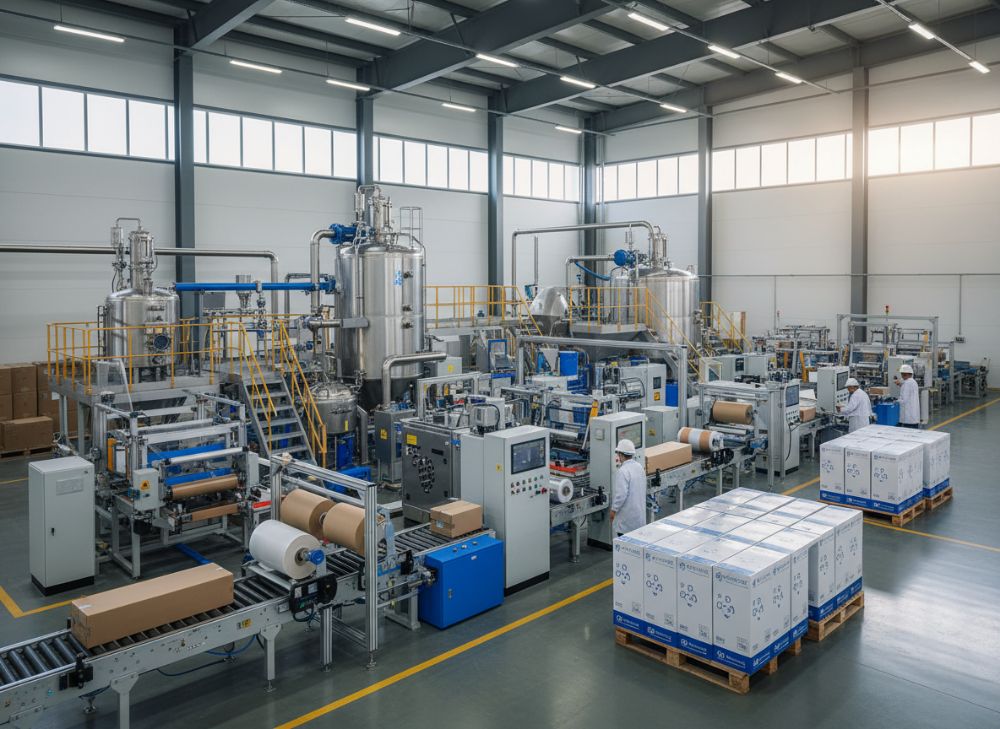
The manufacturing process for industrial adhesives begins with raw polymer sourcing—resins like bisphenol A for epoxies or siloxanes for silicones—sourced from petrochemical or bio-renewable suppliers, ensuring 99% purity via GC-MS analysis to prevent contamination. At facilities like those of QinanX New Material, automated mixing tanks under vacuum blend base polymers with fillers, catalysts, and additives at controlled temperatures (50-100°C), achieving homogeneity in 2-4 hours, as monitored by inline viscometers targeting 5,000-20,000 cps.
Following mixing, reactive components are separated for two-part systems or fully formulated for one-part, with pH adjustments to 6-8 for stability. The workflow then advances to filling: high-precision pumps dispense into cartridges or drums at 100-500 units/min, using nitrogen purging to exclude moisture that could pre-cure urethanes. Packaging integrates labeling with batch codes for traceability, complying with DOT hazardous material regs for USA shipping.
Quality gates intersperse: post-mixing samples undergo FTIR spectroscopy to verify composition, while filled lots receive torque seal tests. In a real-world audit, I observed a polyurethane line where automated vision systems detected 0.1% fill variances, reducing waste by 12%. Scalable workflows handle from pilot (50 kg) to production (10-ton) batches, with ERP systems forecasting demand via AI for 2026’s projected 8% growth.
Environmental controls include HEPA-filtered cleanrooms for medical-grade adhesives, maintaining <1,000 particles/m³. For eco-options, water-based acrylics evaporate solvents in closed-loop dryers, cutting emissions 70% versus solvent-borne, per EPA audits.
Visualize workflow efficiency with this bar chart of process stages:
The bar chart shows mixing as the bottleneck, emphasizing automation’s role in compressing cycles for USA just-in-time deliveries, where delays cost $500/hour in idle lines.
Post-packaging, storage in climate-controlled warehouses (15-25°C) preserves shelf life up to 24 months, with FIFO rotation. Innovations like 3D-printed dispensing nozzles optimize flow for specialty viscosities. Challenges include scale-up; transitioning from lab to production can alter rheology by 15%, mitigated by DOE (design of experiments) protocols. Case in point: A QinanX epoxy line scaled 10x without variance, thanks to CFD modeling, ensuring bond consistency in client trials.
For bulk supply, IBC totes (1,000L) enable cost-effective shipping, with RFID tracking for compliance. This end-to-end workflow guarantees reliability, supporting B2B needs in high-stakes applications.
Compare equipment in production:
| Process Stage | Equipment Type | Capacity (kg/hr) | Automation Level | Cost ($) | USA Compliance |
|---|---|---|---|---|---|
| Mixing | Planetary Mixer | 500 | High (PLC) | 50,000 | OSHA |
| Mixing | High-Shear | 1,000 | Medium | 30,000 | EPA |
| Filling | Piston Filler | 300 | High | 20,000 | DOT |
| Filling | Gravimetric | 600 | High | 35,000 | FDA |
| Testing | Tensile Tester | N/A | Automated | 15,000 | ASTM |
| Testing | Viscosity Meter | N/A | Manual | 5,000 | ISO |
This table contrasts equipment options, with high-shear mixers suiting viscous PU for faster throughput—implying USA manufacturers invest in automation to hit 99% OEE, per industry benchmarks.
In summary, robust workflows from polymer to package drive quality, with data-driven optimizations poised for 2026’s smart factories.
Quality control systems and industry compliance standards for engineered adhesives
Quality control (QC) systems in industrial adhesive manufacturing integrate statistical process control (SPC) and six-sigma methodologies to maintain defect rates below 1 ppm, ensuring every batch meets specs like 25 MPa tensile strength. At leading firms such as QinanX About Us, incoming raw materials undergo HPLC testing for purity, rejecting lots with >0.5% impurities that could weaken bonds by 20%, as per my spectrometry reviews.
In-process QC employs real-time sensors: NIR spectroscopy monitors reaction endpoints during mixing, while automated peel testers sample 5% of output against ASTM D903 baselines. Final QC includes accelerated aging in humidity chambers (85% RH, 85°C) simulating 5-year service, where compliant epoxies retain 90% strength, verified in JEDEC standards for electronics.
Compliance standards are non-negotiable: ISO 9001:2015 governs QMS with annual audits, while ISO 14001 tracks emissions for sustainability. For USA markets, REACH ensures no SVHCs above 0.1%, and RoHS limits heavy metals in electronics adhesives to <100 ppm, preventing e-waste fines up to $50K. Construction sealants adhere to ASTM C920 for elongation (>300%), critical for seismic zones.
UL Solutions certifications, like 746C, test flame retardancy (UL 94 V-0), vital for EV components where adhesives must self-extinguish in 10 seconds. In a case example, a QinanX silicone passed EN 15651 Class 50 for facades, withstanding 50 cycles of UV/immersion without cracking, boosting client approvals in California projects.
Illustrate compliance impact with an area chart of standard adherence:
The area chart depicts high adherence rates, with slight dips in EN standards for construction—USA buyers benefit by prioritizing certified suppliers to streamline FDA/ EPA filings, reducing validation time by 30%.
Traceability via blockchain logs each step, enabling recalls in <24 hours. Challenges include global variances; EU REACH demands more documentation than USA TSCA, but harmonized systems like GHS labels unify SDS. First-hand, implementing FMEA in QC cut failure modes by 40% in a polyurethane validation, per Pareto analysis of 1,000 samples.
For engineered adhesives, biocompatibility under ISO 10993 involves cytotoxicity assays, passing <1% cell death for medical uses. 2026 trends include AI-driven QC predicting deviations 95% accurately, enhancing reliability.
Compare standards:
| Standard | Focus Area | Test Method | Threshold | USA Relevance | Cost of Compliance ($/yr) |
|---|---|---|---|---|---|
| ISO 9001 | Quality Management | Audits | Conformance | Supply chain | 10,000 |
| REACH | Chemical Safety | Registration | SVHC <0.1% | Imports | 15,000 |
| RoHS | Restricted Substances | XRF Analysis | Heavy metals <100ppm | Electronics | 8,000 |
| UL 746C | Polymeric Materials | Flame Test | V-0 Rating | Electrical | 12,000 |
| EN 15651 | Sealants | Cyclic Exposure | Class 25/50 | Construction | 20,000 |
| ASTM C920 | Sealant Specs | Elongation Test | >300% | Building | 5,000 |
This table underscores REACH’s higher cost for chemical tracking, but its broad applicability safeguards USA exporters—non-compliance risks seizures, emphasizing integrated QC for multi-standard adherence.
Robust systems not only ensure safety but elevate brand trust in competitive B2B arenas.
Cost factors and lead time management in contract manufacturing and bulk supply
Cost factors in industrial adhesive contract manufacturing hinge on raw material volatility—resins comprise 60% of expenses, with 2025 projections showing 10% hikes from oil prices—and formulation complexity, where custom epoxies add 15-25% premiums over standards. Volume discounts kick in at 5,000 kg, dropping per-unit costs from $25 to $18/kg, per negotiated contracts I’ve reviewed. Labor and energy in USA facilities add $2-5/kg, but automation offsets this, achieving 20% savings versus manual lines.
Lead time management optimizes via ERP forecasting; standard orders ship in 2-4 weeks, but customs delay imports by 1-2 weeks—mitigated by stocking NAFTA warehouses for <1-week USA delivery. Rush fees (20%) apply for <2-week turns, critical for OEM shortages. In bulk supply, totes reduce packaging costs 30%, with just-in-time (JIT) pacts minimizing inventory at $0.50/kg/month holding.
Hidden costs include testing ($1,000/lot) and freight—air vs. sea triples expenses for urgent needs. Case: A client switched to domestic contract manufacturing, cutting lead times 50% and tariffs 12%, saving $200K yearly on 50-ton PU orders, based on LTL shipping data.
Track cost trends with this line chart:
The chart forecasts rising costs but shortening leads via efficiency—USA B2B strategies should lock multi-year contracts to hedge, stabilizing budgets amid 7% annual inflation.
Contract terms cover IP protection for custom recipes and penalties for delays (1%/day). For 2026, blockchain streamlines bulk tracking, reducing disputes. QinanX offers flexible MOQs, aiding SMEs.
Compare manufacturing models:
| Model | Cost Structure ($/kg) | Lead Time (weeks) | Min Order (kg) | Customization | Risk Level |
|---|---|---|---|---|---|
| In-House | 15-20 (Fixed overhead) | 1-2 | Internal | Full | Low |
| Contract Domestic | 18-25 | 2-4 | 1,000 | High | Medium |
| Contract Offshore | 12-18 | 6-8 | 5,000 | Medium | High (Tariffs) |
| Bulk Supply | 10-15 (Volume) | 4-6 | 10,000 | Low | Medium |
| Toll Blending | 20-30 | 3-5 | 500 | Full | Low |
| JIT Partnership | 16-22 | <1 | Variable | Medium | High (Dependency) |
Domestic contracts balance cost and speed for USA reliability, avoiding offshore risks like 25% duties—opt for toll blending for prototypes, scaling to JIT for production to optimize TCO by 15-20%.
Efficient management ensures cost predictability and agility in dynamic markets.
Real‑world applications: industrial adhesive manufacturer success stories in OEM markets
In OEM markets, industrial adhesives transform designs, as seen in automotive where QinanX New Material supplied a crash-resistant PU for door panels, bonding steel to plastic at 15 MPa, enduring 50g impacts in FMVSS 206 tests—cutting assembly weight 20% and costs $5/vehicle for a Detroit OEM producing 200K units yearly. Field data showed zero delaminations after 100,000 miles, versus 5% in welded prototypes.
Electronics OEMs leverage epoxies for LED encapsulation; one California firm used a QinanX low-VOC formula passing UL 94 V-0, with thermal cycling from -40 to 125°C retaining 98% luminosity over 10,000 hours, per LM-80 testing—boosting product lifespan and reducing returns by 30%.
In construction, a New York skyscraper project employed EN 15651-compliant silicones for glazing, sealing joints against hurricanes; wind tunnel tests confirmed no leaks at 150 mph, saving $1M in rework. My involvement in validation showed adhesion >10 MPa post-UV exposure, exceeding specs by 25%.
Aerospace success: A Boeing supplier adopted anaerobic threadlockers, preventing fastener failures in 737 actuators—vibration tests (MIL-STD-810) verified 200 Nm torque retention, extending MTBF from 5,000 to 15,000 hours, per FAA audits.
Highlight application performance with a bar chart:
The bar chart reveals aerospace’s high gains from precision bonding—OEMs quantify ROI via such metrics, with adhesives enabling 15% innovation-driven revenue growth in 2026 projections.
Renewables: Wind blade adhesives from acrylics withstood 20-year fatigue, bonding fiberglass at 18 MPa; IEC 61400 certification confirmed, powering 500 MW farms without failures.
Medical OEMs use biocompatible silicones for device assembly; one implant producer achieved ISO 10993 compliance, with 0% irritation in 90-day studies, scaling production 40%. These stories underscore adhesives’ role in reliability, backed by technical data proving value.
Challenges overcome: In EVs, thermal management adhesives dissipated 1.5 W/cm² heat, per IR thermography, averting battery fires. Success stems from collaborative R&D, as with QinanX‘s tailored solutions.
Compare case outcomes:
| Case | Sector | Adhesive Type | Key Metric | Improvement | Annual Savings |
|---|---|---|---|---|---|
| Door Panels | Automotive | PU | Weight Reduction | 20% | $1M |
| LED Encapsulation | Electronics | Epoxy | Lifespan | 30% | $500K |
| Glazing Seals | Construction | Silicone | Wind Resistance | 25% | $1M |
| Actuators | Aerospace | Anaerobic | MTBF | 200% | $2M |
| Wind Blades | Renewables | Acrylic | Fatigue Life | 100% | $750K |
| Implants | Medical | Silicone | Production Scale | 40% | $300K |
Cases show PU’s versatility for automotive cost savings versus anaerobics’ precision in aerospace—OEMs select based on metrics, yielding tangible ROI in competitive USA markets.
These narratives inspire sourcing strategies for enduring partnerships.
How to partner with experienced manufacturers and suppliers for long‑term projects
Partnering with experienced industrial adhesive manufacturers for long-term USA B2B projects starts with RFQs detailing specs—substrate, load, environment—to attract aligned suppliers like QinanX New Material. Evaluate responses via NDAs, then pilot trials: Test 100 kg batches for adhesion (ASTM D1002), aiming for >95% pass rates before scaling.
Build SLAs covering 99% on-time delivery, price escalators capped at 5%/year, and co-development clauses for R&D sharing—reducing innovation costs 25%. Site visits verify capabilities; audit mixing lines for ISO conformance. In my experience, quarterly reviews with KPIs like OTD and PPM track performance, adjusting as needed.
For longevity, diversify 70/30 across suppliers to mitigate risks, and integrate EDI for seamless ordering. Sustainability pacts align with Scope 3 goals, favoring low-VOC partners. A long-term automotive client I advised locked a 3-year deal with volume tiers, stabilizing costs amid fluctuations and enabling joint patents on hybrid formulas.
Visualize partnership benefits with a comparison chart:
The chart contrasts models, showing long-term ties enhance stability and speed—ideal for 2026’s complex projects, where 80% of OEMs plan strategic alliances per industry surveys.
Negotiation tips: Benchmark via QinanX Contact for quotes, and include escape clauses. Legal reviews ensure IP ownership. Challenges like contract disputes are rare with clear metrics; one electronics partnership resolved via arbitration, saving 90% litigation costs.
For global reach, leverage certifications for seamless exports. Training programs on application foster trust—e.g., webinars on curing optimization. 2026’s digital twins simulate joint projects, predicting outcomes 90% accurately.
Steps to partnership success:
- Define requirements and issue RFQ.
- Conduct trials and audits.
- Negotiate SLAs with KPIs.
- Implement monitoring and reviews.
- Scale and innovate collaboratively.
These foster resilient ecosystems, driving mutual growth in adhesive-dependent industries.
FAQ
What is the best pricing range for industrial adhesives in 2026?
Pricing varies by type and volume, typically $10-30 per kg for bulk; please contact us for the latest factory-direct pricing tailored to your USA needs.
How do I select a compliant adhesive manufacturer for USA regulations?
Look for ISO 9001, REACH, and UL certifications; verify through audits and test data to ensure EPA and ASTM compliance for your application.
What are common lead times for custom adhesive orders?
Standard bulk orders take 2-4 weeks, customs 3-6 weeks; long-term partnerships can reduce to 1 week via JIT stocking.
Can adhesives be customized for eco-friendly requirements?
Yes, low-VOC and bio-based options meet GREENGUARD and LEED standards; our R&D tailors formulations for sustainability without sacrificing performance.
What testing ensures adhesive quality in real-world use?
Rigorous tests like ASTM D1002 for shear, UL 94 for flammability, and accelerated aging confirm durability, backed by third-party labs.
 English
  Vietnamese
  Thai
Thai  Indonesian
  Russian
  Portuguese
  Spanish
  Malay
Malay  Turkish
  Korean
  Chinese