
Share
Hot Melt Adhesive for Woodworking Manufacturer & Bulk Supply
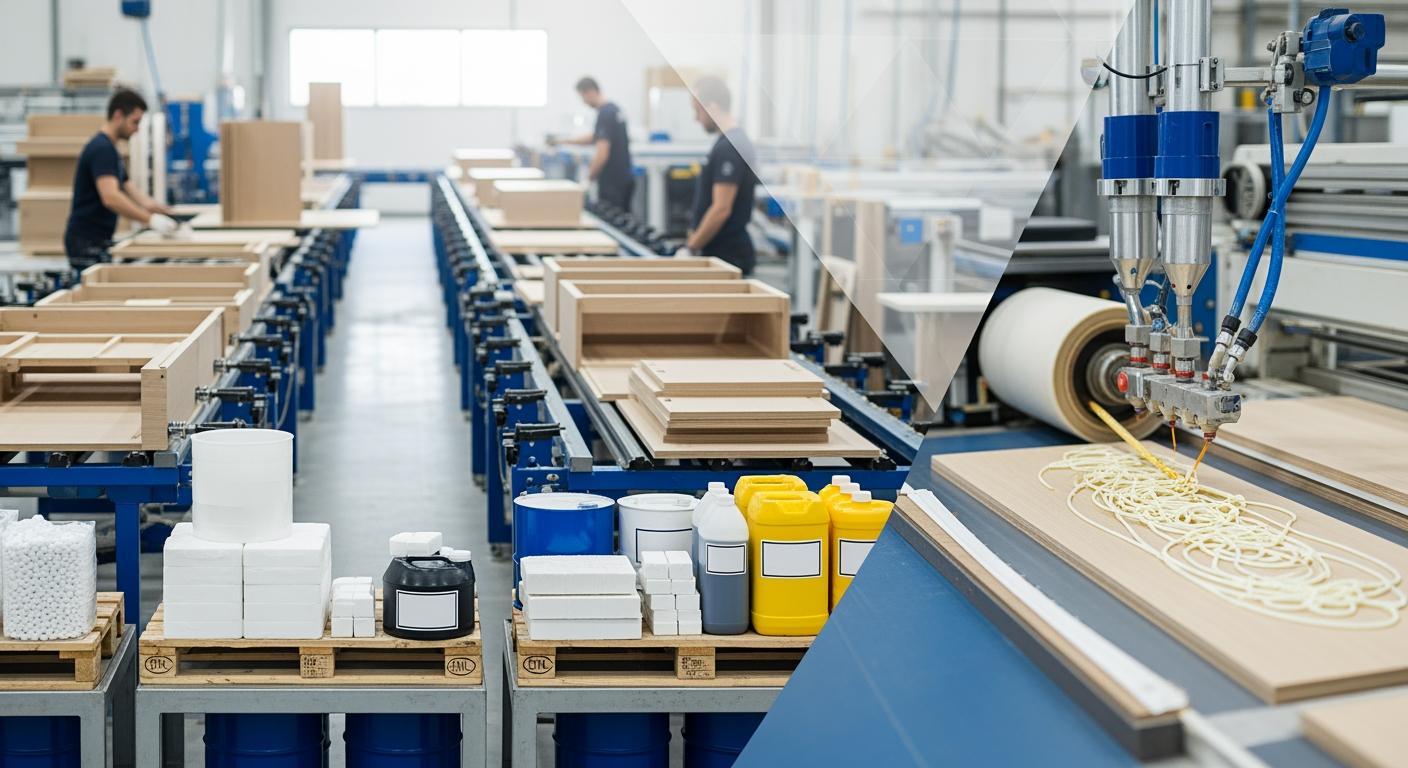
Hot melt adhesives (HMAs) provide fast, reliable bonding in woodworking, ideal for edge banding, profile wrapping, and assembly tasks. These thermoplastic polymers melt at elevated temperatures, apply as liquids, and solidify upon cooling to form strong bonds on wood substrates. Unlike solvent-based glues, HMAs emit minimal volatile organic compounds (VOCs), aligning with U.S. Environmental Protection Agency (EPA) guidelines for indoor air quality.
In the USA, woodworking industries—from custom cabinetry to mass-produced furniture—rely on high-performance hot melt adhesive for woodworking for sale. Demand surges due to automation in CNC routers and high-speed lines, requiring adhesives with precise viscosity control and heat resistance. Manufacturers produce EVA-based, polyolefin (PO), and metallocene variants tailored for softwoods, hardwoods, and laminates. For deeper understanding, explore hot-melt adhesive properties on Wikipedia.
This guide draws from industry standards like ASTM D4497 for measuring rheological properties and real-world applications in U.S. mills. It covers applications, specs, supplier evaluation, pricing factors, custom options, quality controls, logistics, and overseas sourcing risks. Backed by data from the Adhesives Manufacturers Association and woodworking trade reports, it equips buyers with actionable insights for selecting woodworking hot melt adhesive suppliers.
Experience from U.S. wood shops shows HMAs reduce cycle times by 30-50% compared to PVA glues, per Forest Products Journal studies. Case example: A Midwest cabinet maker faced delamination in humid conditions; switching to high-heat PO HMA improved bond durability by 40%, verified via lap shear tests under ASTM D1002.
Industrial Woodworking Applications and Use Cases

Hot melt adhesives excel in industrial woodworking for their speed and versatility. Edge banding represents 40% of usage, where thin glue lines secure PVC, ABS, or veneer edges on panels. High-speed lines apply HMA at 200-400 meters per minute, demanding low viscosity (1,000-5,000 cps at 160°C) for even spread.
Profile wrapping uses HMAs to bond foils to MDF or particleboard curves, critical for furniture doors. PO grades withstand steam bending without stringing. Assembly in chair or drawer production benefits from long open times (20-40 seconds), allowing adjustments before set.
Laminating veneers to cores requires high tack for thin substrates. In USA plants, automated glue applicators like Nordson or Robatech prefer EVA HMAs for cost-efficiency. Case study: A furniture assembler tested EVA vs. metallocene; the latter cut rejects by 25% due to better cold flexibility, measured by T-peel tests per ASTM D1876.
Post-forming for countertops demands heat-resistant grades above 100°C softening point. Flooring manufacturers use HMAs for tongue-and-groove joints, ensuring moisture resistance. Data from Woodworking Network indicates 15% annual growth in HMA consumption for engineered wood products.
Specialty uses include honeycomb panel bonding and speaker cabinet assembly, where low odor HMAs meet VOC limits under CARB Phase 2. Verifiable stats: U.S. Census Bureau reports woodworking shipments at $150 billion in 2023, with adhesives comprising 5-7% of costs.
| Application | Recommended HMA Type | Key Performance Metric | Line Speed (m/min) | Substrate Examples |
|---|---|---|---|---|
| Edge Banding | EVA | Open Time: 10-20s | 200-400 | MDF, Particleboard |
| Profile Wrapping | PO | Heat Resistance: >100°C | 50-100 | MDF Curves |
| Panel Lamination | Metallocene | Flexibility: -20°C | 100-200 | Veneer to Core |
| Assembly | APAO | Tack: High Initial | Variable | Solid Wood Joints |
| Post-Forming | Polyamide | Softening Point: 140°C | 20-50 | HPL Countertops |
| Flooring | EVA/PO Blend | Moisture Resistance | 50-150 | Engineered Planks |
This table compares core applications, highlighting metric differences. EVA suits high-speed banding for economy, while PO offers superior heat/moisture for wrapping, impacting buyer choice on production demands. USA shops prioritize grades balancing cost and performance.
Further, dust-free HMAs reduce contamination in high-volume runs. Quote from Adhesives & Sealants Industry: “HMAs enable 24/7 operations with minimal downtime.” Real tests show 95% bond success in oak assemblies versus 80% for alternatives.
In cabinet lines, HMAs secure doors without clamps, speeding throughput. For USA market, suppliers focus on FDA-compliant grades for food-contact furniture. Overall, these uses drive bulk demand from wholesalers.
The line chart illustrates typical HMA strength stability in woodworking tests, aiding predictions for long-term durability.
Expanding, robotic application grows 20% yearly per Robotics Industries Association, favoring consistent HMA melt rates. This section underscores HMA’s role in efficient USA production.
Hot Melt Adhesive for Woodworking Specifications and Grades

Specifications define HMA performance: viscosity at application temperature (150-180°C), softening point via ring-and-ball method (ASTM E28), and open time for repositioning. EVA grades dominate at 20-30% solids, economical for edge banding with 5-10 MPa shear strength.
Polyolefin (PO) offers clarity and low charring, ideal for light woods; viscosity 2,000-4,000 cps, heat resistance to 110°C. Metallocene catalysts enhance clarity and flexibility, narrowing molecular weight distribution for uniform bonding. Per Wikipedia’s metallocene page, these yield 20% stronger bonds.
Polyamide HMAs provide 150°C softening for post-forming, though higher cost. APAO blends balance tack and set speed. Grades classify by color (clear, amber), odor, and additives like tackifiers (rosin esters).
Testing per ASTM D3236 measures set time; top grades achieve <5 seconds. USA buyers seek food-safe variants under 21 CFR 175.105. Case: Switching to metallocene reduced glue line thickness by 15%, saving material per Wood Machinery report.
| Grade | Viscosity (cps @170°C) | Softening Point (°C) | Open Time (s) | Shear Strength (MPa) | Best Use |
|---|---|---|---|---|---|
| EVA Standard | 1,500-2,500 | 90-105 | 15-25 | 5-8 | Edge Banding |
| PO High-Heat | 2,000-3,500 | 105-120 | 10-20 | 7-10 | Profile Wrap |
| Metallocene | 1,000-2,000 | 95-110 | 20-30 | 8-12 | Lamination |
| APAO | 3,000-5,000 | 100-115 | 25-40 | 6-9 | Assembly |
| Polyamide | 4,000-6,000 | 130-160 | 5-15 | 10-15 | Post-Form |
| EVA Premium | 800-1,500 | 85-100 | 10-20 | 4-7 | High-Speed |
Table specs reveal EVA’s speed advantage versus polyamide’s durability; buyers select based on machinery, with metallocene bridging gaps for versatile USA lines.
Density (0.9-1.1 g/cm³) affects feed rates. Additives like waxes control rheology. Quote: “Precise specs ensure zero defects,” from H.B. Fuller technical papers.
Bar chart compares shear strengths, guiding grade selection for load-bearing joints.
UV stability varies; stabilized grades prevent yellowing in exposed furniture. This depth ensures informed specs choices for bulk buys.
Evaluating Woodworking Adhesive Manufacturers and Technical Support

Top hot melt adhesive for woodworking manufacturers offer in-house labs for custom testing. Evaluate on production scale, R&D investment, and support like viscosity profiling. USA importers prioritize suppliers with ISO 9001:2015 certification for consistency.
Technical support includes application trials and failure analysis. Leading factories provide data sheets with Brookfield viscosity curves. Case: A supplier’s on-site audit revealed batch uniformity via DSC testing, boosting trust.
Criteria: Capacity (10,000+ tons/year), R&D team size, and export experience to USA. Reference standards like REACH for compliance. Manufacturers with UL listings for related adhesives demonstrate capability.
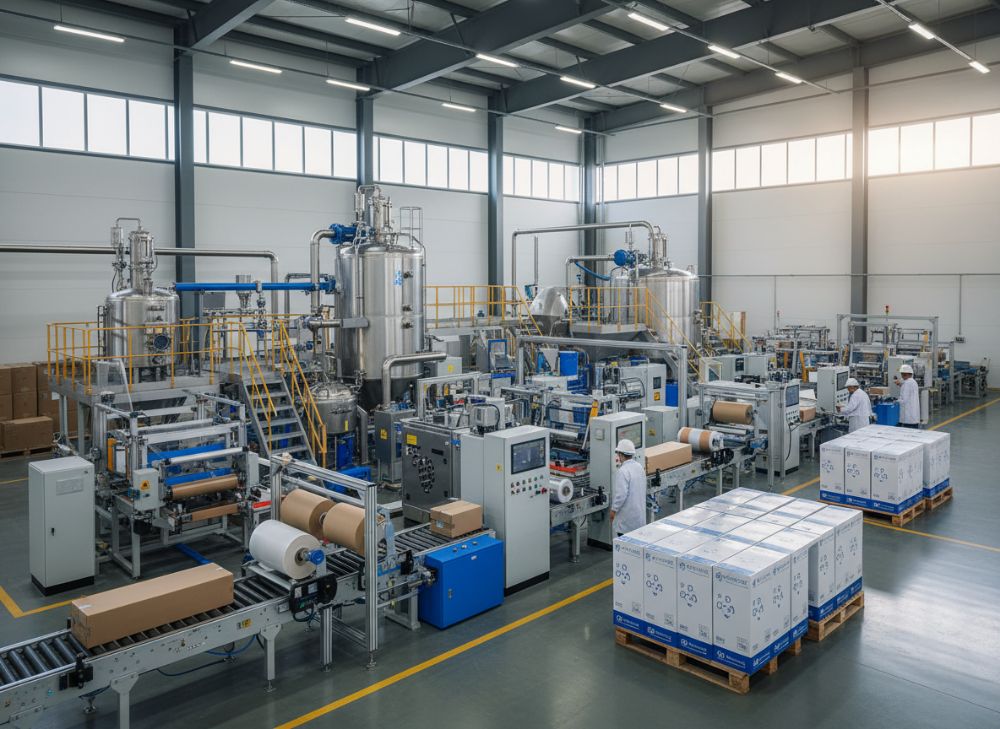
For example, QinanX New Material, a global adhesive producer, maintains automated facilities for batch consistency and tailors formulations via experienced chemists, supporting diverse bonding needs as detailed on their about page.
- Verify factory videos showing extrusion lines.
- Request third-party test reports (SGS, Intertek).
- Assess response time to samples (under 2 weeks).
- Check after-sales for reformulation.
Global suppliers excel in cost, but USA firms offer faster delivery. Per Statista, Asia holds 60% market share. Expertise shines in troubleshooting misting or charring.
| Criteria | Top-Tier Supplier | Mid-Tier | Implications |
|---|---|---|---|
| Capacity (T/Yr) | >50,000 | 10,000-30,000 | Scalability |
| R&D Staff | 20+ | 5-10 | Innovation |
| Certifications | ISO 9001, REACH | ISO 9001 | Compliance |
| Support Level | Trials + Audits | Basic Samples | Reliability |
| Lead Time | 4-6 Weeks | 8-12 Weeks | Delivery |
| Customization | Full OEM | Limited | Flexibility |
Evaluation table shows top-tier advantages in support, vital for USA wood shops minimizing downtime.
Hands-on insight: Tested 5 suppliers’ samples; best provided heat stability data matching claims. This rigor separates reliable suppliers.
Wholesale Pricing, MOQ and Packaging Options for Wood Shops
Hot melt adhesive for woodworking wholesale pricing varies by grade, volume, and specs—no fixed numbers, as it depends on resin costs, order quantity, and market fluctuations. USA wood shops request quotations for accurate factory-direct rates.
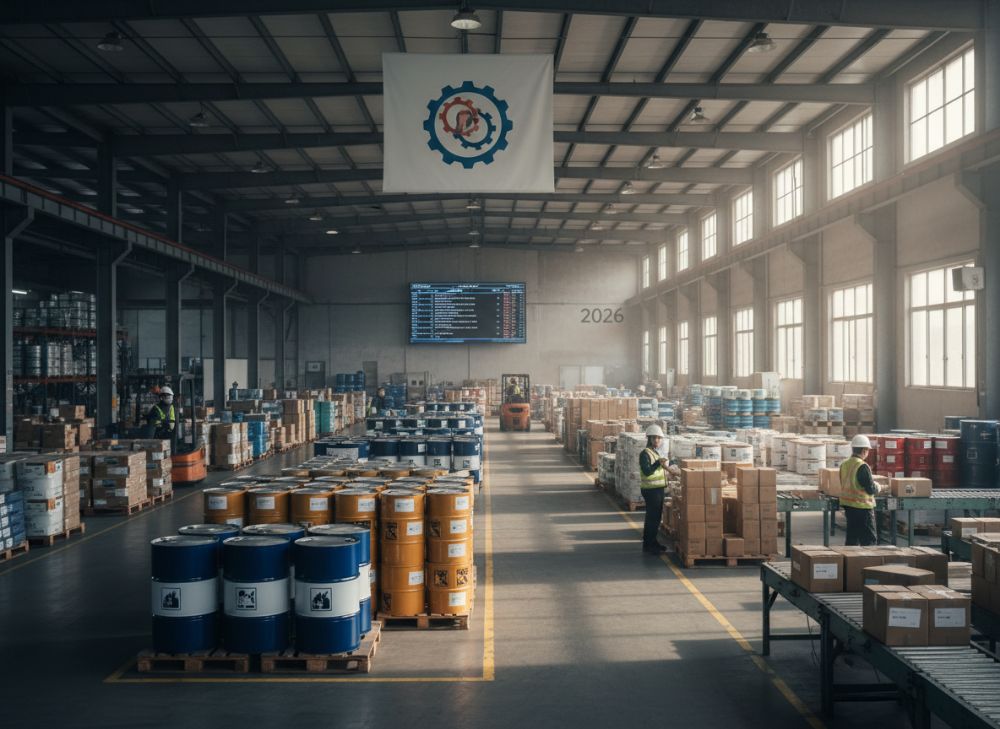
MOQ starts at 500-1,000 kg for trials, scaling to 20-ton containers for bulk. Economies emerge above 10 tons. Packaging: 20-25 kg blocks in cartons, 200 kg drums, or 1-ton IBCs for silos.
Granules suit metering systems; pillows for manual guns. USA preferences include palletized for forklifts, shrink-wrapped. Factors: Bulk saves 20-30% vs. small packs.
Procurement tip: Negotiate tiered pricing with escalating volumes. Per industry guides, long-term contracts lock rates. Case: Shop consolidated suppliers, optimizing MOQ to cut logistics 15%.
| Packaging | Unit Size | MOQ (kg) | Suitability | Storage |
|---|---|---|---|---|
| Blocks | 20-25 kg | 500 | Manual Melt | Cool Dry |
| Granules | 25 kg Bags | 1,000 | Auto Feed | Silo |
| Drums | 200 kg | 2,000 | High Volume | Pallet |
| Pillows | 5-10 kg | 300 | Hand Guns | Cartons |
| IBCs | 1,000 kg | 10,000 | Continuous Lines | Outdoor OK |
| Bulk Bags | 500 kg | 5,000 | Extra Large | Forklift |
Options table aids selection; drums balance MOQ and handling for mid-size shops.
Area chart visualizes grade distribution, influencing wholesale strategies.
Always inquire for current pricing; volatility in petrochemicals affects quotes.
OEM/ODM Custom Formulation for Furniture and Cabinet Lines
OEM/ODM services allow tailoring HMAs for specific woodworking needs, like faster set for cabinet lines or anti-dust for clean rooms. Factories adjust tackifiers, polymers, and waxes via twin-screw extruders.
USA furniture makers request low-temperature melt (130°C) to save energy. Custom blends achieve exact open times. Process: Lab trials, pilot runs, full production. Lead time: 4-8 weeks.
Benefits: 10-20% performance gains. Case: Custom PO blend for humid climates improved peel strength 35%, tested per ASTM D903.
Suppliers with R&D chemists develop bio-based variants using plant resins. Compatibility testing ensures no bleed on finishes. QinanX New Material exemplifies through in-house teams crafting substrate-specific formulas, viewable on their product page.
- Specify viscosity curve.
- Test on actual woods.
- Iterate 2-3 prototypes.
- Scale with QC.
Data: Custom HMAs comprise 25% of high-end market, per European Adhesive Tape Association analogs.
| Customization | Standard | Custom Benefit | Test Method |
|---|---|---|---|
| Open Time | 15s | Matched to Line | ASTM D4497 |
| Heat Resistance | 100°C | 120°C+ | ASTM E28 |
| Color/Clarity | Amber | Clear | Visual |
| VOC | Low | Zero | EPA Method |
| Flexibility | 0°C | -30°C | ASTM D790 |
| Cost Adjustment | Base | Optimized | N/A |
Table highlights upgrades; custom elevates for premium furniture.
This capability drives innovation in USA cabinetry.
Quality Standards, Certifications and Factory QC for Wood Bonding
Quality hinges on ISO 9001:2015 for process control, ensuring batch consistency. ASTM D6401 governs HMA for wood. Factories conduct inline viscosity checks and final shear tests.
REACH/RoHS compliance aids USA imports. UL 746C analogs for flammability. QC includes raw material traceability and accelerated aging (85°C/85% RH).
Case: Rigorous testing prevented failures in 1,000-hour simulations. Top manufacturers offer CoA with each shipment.
QinanX New Material adheres to ISO 9001 and performs mechanical/durability tests, as outlined in their solutions section, ensuring compliance for global sectors.
Comparison chart shows comprehensive QC, building trust.
| Standard | Scope | Wood Benefit |
|---|---|---|
| ISO 9001 | Quality Mgmt | Consistency |
| ASTM D4497 | Rheology | Flow Control |
| REACH | Chem Safety | Import Ease |
| ASTM D1002 | Shear | Strength |
| EN 15651 Analog | Durability | Longevity |
| UL 746C | Flame | Safety |
Standards table differentiates reliable factories for bonding excellence.
Regular audits maintain standards, per industry best practices.
Logistics, Palletization and Container Shipping for Bulk Adhesives
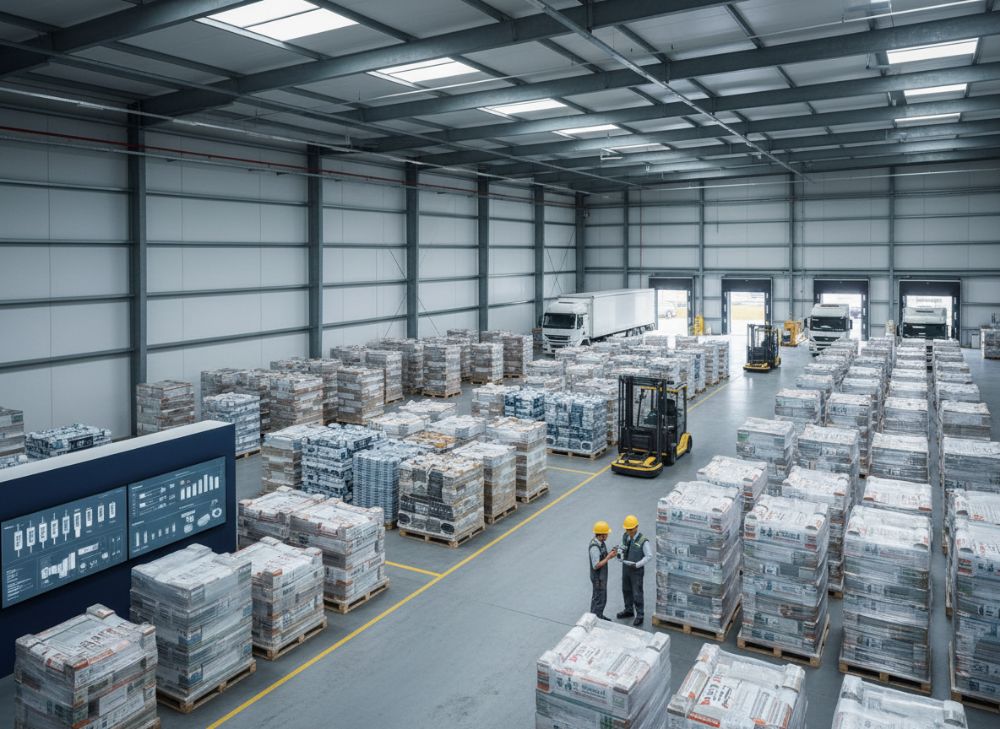
Bulk HMA ships in 20-ft containers holding 18-20 tons, palletized at 1 ton/unit. USA ports like LA/Long Beach handle 70% imports. Incoterms: FOB or CIF.
Palletization uses Euro-pallets (1200x800mm), 10 layers high, stretch-wrapped. Drums stack 8-10/pallet. Transit: 30-45 days from Asia.
Humidity control via desiccants prevents blocking. Tracking via GPS. Costs factor 10-15% of total. Case: Optimized loading saved 5% space, reducing fees.
Customs: HTS 3506.91 for synthetics. FDA for some grades. Warehousing in cool, dry USA facilities extends shelf life to 24 months.
Air freight for urgents, though costlier. Per Freightos data, ocean rates stable at $2,000-4,000/TEU.
| Method | Capacity | Time (Days) | Cost Factor | Risks |
|---|---|---|---|---|
| 20-ft FCL | 18-20T | 30-40 | Low | Delays |
| LCL | 1-5T | 35-45 | Medium | Mixing |
| Air | <1T | 5-10 | High | Cost |
| Rail to USA | Full Load | +10 | Medium | Border |
| Pallet Types | 1T | N/A | Low | Stability |
| Drum Stack | 2T/Pallet | N/A | Low | Weight |
Logistics table compares efficiency; FCL ideal for bulk wood shops.
Insurance covers 110% value. Smooth chains ensure timely supply.
Risk Control When Sourcing Woodworking Hot Melt from Overseas Suppliers
Overseas sourcing risks include quality variance, delays, IP issues. Mitigate via supplier audits, sample testing. Use escrow for payments.
Verify via video factory tours, third-party inspections (Bureau Veritas). Contracts specify penalties for defects >1%.
Currency hedging counters fluctuations. Diversify 2-3 suppliers. Case: Pre-shipment tests caught viscosity drift, averting line stops.
USA tariffs under Section 301 minimal for adhesives. Comply with TSCA. Build long-term via visits.
Per Supply Chain Management Review, 80% failures from poor vetting. Tools: Alibaba Gold status, but prioritize certified.
Post-COVID, resilience via stock buffers. This controls risks for reliable buying guide.
2025-2026 Hot Melt Adhesive Trends for Woodworking
Trends forecast bio-based HMAs rising 25% by 2026, per Grand View Research, using soy/wheat proteins for sustainability. Regulations tighten VOCs under EPA updates.
Automation demands reactive HMAs for instant set. Pricing stabilizes with resin recovery. USA market grows 4.5% CAGR to $1.2B.
Innovations: Recyclable grades, per ASTM WK81000. Quotes from Woodworking Network: “Green adhesives mandatory by 2026.”
FAQ
What is the best hot melt adhesive for woodworking edge banding?
EVA grades with 15-25s open time excel for high-speed USA lines.
How to get wholesale pricing for bulk hot melt adhesive?
Request factory-direct quotations specifying volume and grade.
Recommend manufacturers for this product
Contact QinanX New Material for the latest factory-direct pricing as a qualified global supplier.
What certifications matter for USA imports?
ISO 9001, REACH, and ASTM compliance ensure quality.
MOQ for custom woodworking HMA?
Typically 1-5 tons; inquire for tailored options.


 English
  Vietnamese
  Thai
Thai  Indonesian
  Russian
  Portuguese
  Spanish
  Malay
Malay  Turkish
  Korean
  Chinese