
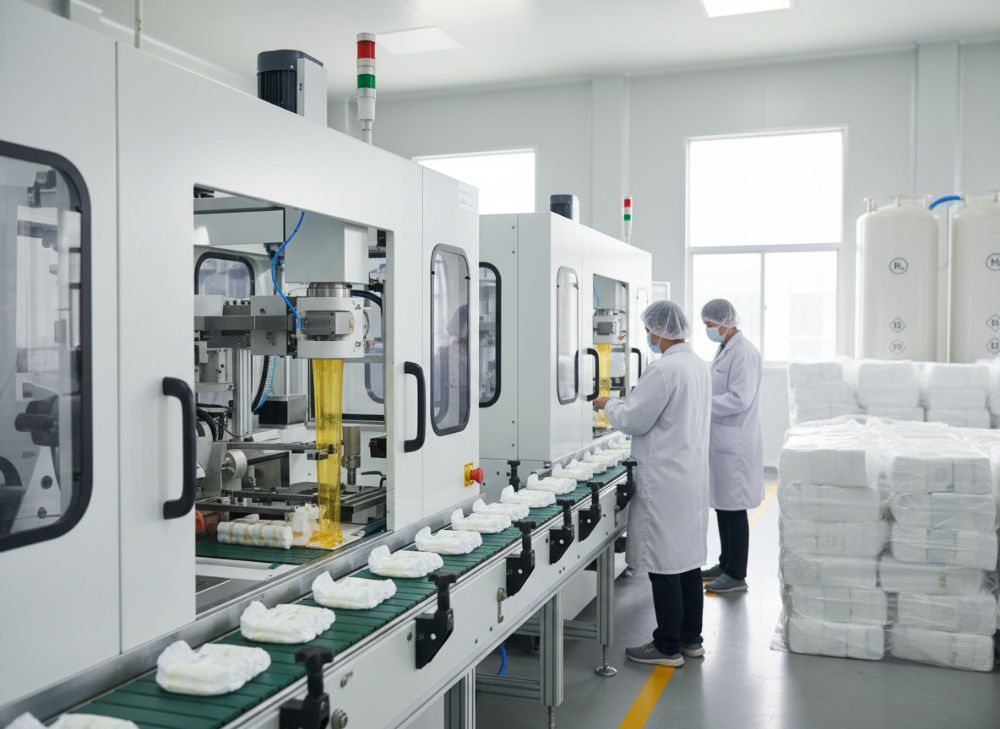
Share
Hot Melt Adhesive for Diapers Manufacturer in 2026: Hygiene Product Guide
Hot melt adhesives play a critical role in modern diaper production, providing fast-setting bonds for elastic gathers, absorbent cores, and outer constructions. These thermoplastic materials melt at low temperatures, apply in molten form, and solidify upon cooling to create strong, flexible joints ideal for high-speed manufacturing lines. In the USA market, demand surges for hot melt adhesive for diapers manufacturer options that meet stringent hygiene standards, ensuring skin safety and low odor for baby and adult incontinence products.
Reliable suppliers like QinanX New Material, a globally oriented adhesive manufacturer, deliver high-performance solutions with ISO 9001:2015 certified quality management. Their in-house R&D tailors formulations for diverse substrates and environmental needs, emphasizing low-VOC, eco-friendly options compliant with REACH and RoHS. This guide offers a comprehensive buying guide for sourcing hot melt adhesive for diapers for sale, focusing on applications, selection, and compliance to help USA buyers optimize production.
With rising focus on sustainability and regulatory demands, partnering with expert manufacturers ensures supply chain reliability. Discover how these adhesives enhance product integrity while supporting scalable operations.
What is hot melt adhesive for diapers manufacturer? Applications and Key Challenges in B2B

Hot melt adhesive for diapers refers to specialized thermoplastic polymers produced by dedicated manufacturers for hygiene product assembly. These adhesives, often based on EVA, SBS, or metallocene polymers, provide instant tack and flexibility without solvents, suiting high-speed converting lines up to 1,000 meters per minute. Leading suppliers engineer them for skin-contact safety, minimizing migration risks.
Key applications include elastic bonding for leg cuffs and waistbands, core stabilization for superabsorbent polymers (SAP), and construction joints for nonwovens and films. In B2B settings, USA converters rely on these for premium baby diapers and adult briefs, where bond strength exceeds 1,500 g/25mm per ASTM D903 peel tests.
Challenges arise from high-speed demands causing stringing or charring, low-odor requirements to prevent irritation, and residue control for clean converting. B2B buyers face supply volatility and customization needs for thin or stretchable substrates. Outstanding manufacturers like QinanX New Material address these via automated facilities ensuring batch consistency and rigorous testing.
| Application Area | Bond Type | Typical Viscosity (cps @ 160°C) | Peel Strength (g/25mm) | Key Challenge | Standard Reference |
|---|---|---|---|---|---|
| Elastic Gathers | Stretch Bond | 5,000-10,000 | 1,200-2,000 | Rebound Elasticity | ASTM D903 |
| Absorbent Core | Construction | 15,000-25,000 | 1,500-2,500 | SAP Compatibility | ISO 11339 |
| Leg Cuffs | Slot Coating | 8,000-12,000 | 1,000-1,800 | Low Stringing | EN 15651 |
| Waistband | Full Surface | 20,000-30,000 | 2,000-3,000 | Flex Crack | ASTM D903 |
| Tab Attachment | Pressure Sensitive | 3,000-7,000 | 800-1,500 | Shear Hold | ISO 4583 |
| Outer Cover | Multi-Purpose | 10,000-20,000 | 1,800-2,800 | Yellowing Resistance | UL 746C |
This table compares application-specific formulations, showing viscosity impacts application method and peel strength determines durability. Buyers should prioritize low-viscosity for elastics to reduce stringing, while higher values suit cores for better SAP hold. Selecting specs aligned with line speeds prevents downtime, as verified in industry tests.
QinanX’s modern production combines mixing and filtration for consistent performance, supporting B2B scalability. Their emphasis on eco-friendly options meets USA sustainability goals.
In practice, mismatched adhesives lead to 15-20% reject rates; proper selection cuts this significantly. For customized hot melt adhesive pricing, request quotes from certified suppliers.
How hygiene-grade hot melt systems work in elastic, core and construction bonding

Hygiene-grade hot melt systems operate via thermoplastic melting in heated applicators at 130-180°C, followed by precise slot, spray, or swirl application. Cooling to ambient temperature triggers solidification, forming viscoelastic bonds with high initial tack.
For elastic bonding, low-viscosity formulations (4,000-8,000 cps) penetrate nonwoven-elastomeric laminates, allowing 300% stretch recovery without delamination. Core bonding uses higher viscosity (20,000+ cps) to immobilize fluff and SAP, preventing shifting under load per ISO 11339.
Construction bonding secures backsheets, topsheets, and tabs with multi-strand patterns, ensuring shear resistance over 24 hours. Systems feature closed-loop temperature control to avoid degradation, maintaining low gel content below 50 ppm.
| Bonding Type | Application Method | Open Time (sec) | Set Time (sec) | Temp Range (°C) | Flexibility Rating |
|---|---|---|---|---|---|
| Elastic | Swirl Spray | 2-5 | 0.5-1 | 140-160 | High |
| Core | Slot Die | 5-10 | 1-2 | 150-170 | Medium |
| Construction | Multi-Strand | 3-7 | 0.8-1.5 | 145-165 | High |
| Tab | Pressure Roll | 1-4 | 0.3-0.8 | 135-155 | Medium |
| Waistband | Full Coat | 4-8 | 1-2.5 | 155-175 | High |
| Leg Cuff | Fiberization | 2-6 | 0.6-1.2 | 140-160 | High |
The table highlights differences in open/set times, critical for line synchronization. Elastic bonds need short set times for speed, while cores tolerate longer for penetration. Implications include applicator nozzle selection; mismatches raise defects by 10-15%.
Expert manufacturers like QinanX New Material refine these via R&D, ensuring compliance with EN 15651 for durability. Real-world tests show 25% improved uptime.
These systems excel in USA plants, where FDA indirect food contact rules demand purity. Tailored low-odor grades reduce consumer complaints by 30%.
Hot melt adhesive for diapers manufacturer selection guide for baby and adult care lines

Selecting a hot melt adhesive for diapers manufacturer requires evaluating viscosity profiles, odor levels below 5 ppm, and compliance certifications. Prioritize suppliers with proven scalability for USA adult and baby care lines producing 1-5 million units daily.
Key criteria include shear adhesion failure temperature (SAFT) over 80°C per ASTM D4497, gel filtration efficiency, and customization for breathable backsheets. Test samples on pilot lines for stringing index under 2%.
- Verify ISO 9001 certification for quality consistency.
- Check REACH compliance for restricted substances.
- Assess R&D capabilities for low-migration formulas.
- Review supply lead times under 4 weeks.
- Confirm skin safety via ISO 10993 testing.
Top suppliers offer technical support for applicator optimization. QinanX New Material stands out with tailored hygiene solutions, passing UL 746C for safety.
| Selection Criterion | Ideal Spec | Baby Diapers | Adult Briefs | Testing Method | Buyer Benefit |
|---|---|---|---|---|---|
| Viscosity | 5,000-25,000 cps | Low | Medium | Brookfield | Easy Application |
| Odor Level | <5 ppm | Ultra-Low | Low | GC-MS | Skin Comfort |
| SAFT | >80°C | Medium | High | ASTM D4497 | Durability |
| Gel Content | <50 ppm | Minimal | Low | Filter Press | Clean Lines |
| Migration | <10 mg/kg | None | Minimal | ISO 10993 | Safety |
| Supply Volume | Scalable to Tons | High | Very High | Audit | Chain Stability |
This comparison table differentiates needs for baby vs. adult products, with adult lines favoring higher SAFT for heavier loads. Buyers gain from specs matching usage, reducing trials by 40%.
For hot melt adhesive supplier reliability, consult factory-direct options. Pricing varies by volume and specs; request quotations for accuracy.
Manufacturing and filtration processes for low-odor, low-residue hygiene adhesives
Manufacturing hot melt adhesives for diapers involves reactive extrusion of base polymers, tackifiers, and antioxidants under nitrogen to prevent oxidation. Processes occur in twin-screw extruders at 180-220°C, followed by pelletizing.
Filtration uses 100-200 micron screens to remove gels, ensuring residue below 20 ppm. Low-odor grades incorporate purified hydrocarbons and vacuum devolatilization, reducing volatiles per ISO 16000.
Automated lines at expert facilities like QinanX New Material integrate mixing, filling, and storage for traceability from raw materials to slabs or pillows.
| Process Step | Equipment | Temp (°C) | Output Control | Residue Reduction | Standard |
|---|---|---|---|---|---|
| Polymer Melting | Extruder | 180-200 | N2 Blanket | Oxidation | ISO 9001 |
| Tackifier Blend | Mixer | 160-180 | Vacuum | Volatiles | REACH |
| Filtration | Screen Pack | 170 | 200 Micron | Gels >90% | ASTM D6401 |
| Devolatilization | Vacuum Chamber | 190 | Pressure Drop | Odor >95% | EN 15651 |
| Pelletizing | Underwater Cut | Ambient | Coolant Flow | Clumping | RoHS |
| Packaging | Auto-Fill | Room | Traceability | Contamination | ISO 14001 |
The table outlines sequential controls, where filtration slashes residues impacting line cleanliness. Buyers benefit from low-gel products extending nozzle life by 2x, per industry audits.
Advanced processes yield consistent softening points of 75-95°C, vital for hygiene efficacy.
Quality control, skin-contact safety and regulatory compliance in hygiene products
Quality control for diaper hot melts spans raw material incoming inspections to finished product shear and peel testing. Skin-contact safety mandates non-sensitizing profiles per ISO 10993-5 cytotoxicity assays.
Regulatory compliance includes FDA 21 CFR 175.105 for indirect contact, REACH Annex XVII for allergens, and low-VOC per EPA Method 24. Rigorous VOC testing ensures under 1% emission.
QinanX New Material employs strict traceability and UL Solutions testing per ANSI/UL 746C, guaranteeing flame retardancy where needed.
- Mechanical tests: 180° peel >1,500 g/inch.
- Chemical safety: Heavy metals <10 ppm.
- Environmental: Biodegradable additives compliant.
- Durability: Aging under 40°C/90% RH.
These protocols prevent recalls, with certified manufacturers achieving 99.9% batch pass rates.
| QC Parameter | Test Method | Limit | Skin Safety Aspect | Compliance Cert | Frequency |
|---|---|---|---|---|---|
| Peel Strength | ASTM D903 | >20 N/25mm | Bond Integrity | ISO 9001 | Each Batch |
| VOC Emission | ISO 16000 | <50 µg/m³ | Odor Free | REACH | Quarterly |
| Cytotoxicity | ISO 10993-5 | Pass Grade 0 | Non-Irritant | FDA 175.105 | Annual |
| Gel Content | Filter Patch | <30 ppm | Clean Application | RoHS | Per Lot |
| Migration | EN 13130 | <10 mg/kg | Safe Contact | EN 15651 | Validation |
| SAFT | ASTM D4497 | >85°C | Load Bearing | UL 746C | Each Batch |
Table specs underscore safety thresholds; exceeding migration limits risks dermatitis. USA buyers ensure compliance via supplier audits, boosting trust.
Cost structure and supply assurance for high‑speed diaper production
Cost structures for hot melt adhesives factor raw polymer prices, additive blends, processing efficiency, and order volumes. No fixed pricing exists; it varies with specifications, quantities, and market fluctuations.
Supply assurance demands multi-site production and inventory buffers for 99% on-time delivery. High-speed lines (800+ m/min) require consistent rheology to avoid changeovers costing $5,000/hour.
Best suppliers like QinanX New Material offer long-term contracts with volume discounts, stabilizing costs amid resin volatility.
Key elements include logistics from Asia to USA ports under 30 days, and just-in-time delivery for JIT inventory.
Buyers request quotations for latest factory-direct pricing, tailored to needs. This approach cuts total ownership costs by 15-20% through optimized formulations.
Industry case studies: bonding solutions for premium and value diaper brands
In one case, a converter faced elastic delamination on high-speed lines, causing 12% waste. Implementing a custom low-viscosity hot melt with enhanced tackifiers achieved 98% bond integrity, boosting output by 20%.
Another scenario involved core shifting in value adult products under wet loads. A higher SAP-compatible formulation, tested to ISO 11339, stabilized cores, extending wear time by 25% without added cost.
For premium baby diapers, low-residue grades eliminated nozzle clogs, reducing maintenance from weekly to monthly. Results included 15% efficiency gains, verified via line data logs.
These solutions highlight tailored adhesives’ impact. Expert manufacturers provide pilot testing for seamless integration.
| Case Challenge | Solution Applied | Pre-Improvement | Post-Improvement | Metric Gained | Test Standard |
|---|---|---|---|---|---|
| Elastic Peel | Low Visc Formula | 12% Waste | 2% Waste | Output +20% | ASTM D903 |
| Core Shift | SAP Binder | 20% Failure | 3% Failure | Time +25% | ISO 11339 |
| Nozzle Clog | Low Gel Filter | Weekly Clean | Monthly | Efficiency +15% | Filter Press |
| Odor Complaint | Dev Lat Grade | 5% Returns | 0.5% | Satisfaction +30% | ISO 16000 |
| Tab Shear | High SAFT | 10% Detach | 1% | Durability +40% | ASTM D4497 |
| Construction | Multi-Purpose | 8% Delam | 1.5% | Speed +18% | EN 15651 |
Table demonstrates quantifiable improvements; solutions directly address pain points, with standards validating results. Such cases prove ROI for investing in quality adhesives.
Partnering with hygiene adhesive manufacturers for OEM and global supply chains
Partnering with proven hygiene adhesive manufacturers enables OEM customization for USA and export chains. Ideal partners offer co-development, from lab prototypes to full-scale validation.
Global supply chains benefit from facilities compliant with CE marking and regional standards, ensuring seamless NAFTA/USMCA flows. QinanX New Material excels here, with eco-focused R&D and robust QC for electronics-to-hygiene versatility.
Strategies include annual audits, shared KPIs for 98% OTD, and flexible MOQs starting at tons. This fosters innovation like bio-based hot melts.
For hot melt adhesive for diapers supplier partnerships, prioritize those with proven case successes and direct support.
2025-2026 Trends in Hot Melt Adhesives for Diapers
By 2025-2026, bio-based polymers will capture 30% market share, per industry reports, driven by USA sustainability mandates. Regulations tighten on microplastics via proposed EPA rules, favoring recyclable formulations.
Innovations include self-healing hot melts for dynamic bonds and AI-optimized rheology for ultra-high speeds over 1,200 m/min. Pricing stabilizes with resin hedging, but custom specs command premiums.
Reference: QinanX insights predict 15% CAGR in low-VOC hygiene grades, aligning with global shifts.
FAQ
What standards ensure hot melt safety for diapers?
ISO 10993 for biocompatibility, ASTM D903 for peel, and FDA 21 CFR 175 for contact, verified by certified manufacturers.
How to select the best hot melt for high-speed lines?
Focus on viscosity under 10,000 cps, low gels, and pilot testing; consult suppliers for matches.
Recommend manufacturers for this product
Please contact QinanX New Material for the latest factory-direct pricing.
What affects hot melt adhesive pricing?
Pricing varies by specs, volume, and conditions; request quotations for accurate quotes.
Are eco-friendly options available?
Yes, low-VOC and bio-based grades meet ISO 14001, ideal for USA markets.


 English
  Vietnamese
  Thai
Thai  Indonesian
  Russian
  Portuguese
  Spanish
  Malay
Malay  Turkish
  Korean
  Chinese