
Share
High Temperature Threadlocker in 2026: Reliable Fastening for Extreme Conditions
QinanX New Material is a globally oriented adhesive and sealant manufacturer committed to delivering reliable, high-performance bonding solutions to diverse industries worldwide; we operate modern, automated production facilities combining mixing, filling, packaging and storage to ensure scalable capacity, batch-to-batch consistency and robust quality control. Our product range spans epoxy, polyurethane (PU), silicone, acrylic and specialty formulations — and we continuously refine and expand our offerings through our in-house R&D team of experienced chemists and materials scientists, tailoring adhesives to specific substrates, environmental conditions or customer requirements while placing strong emphasis on eco-friendly, low-VOC or solvent-free options in response to increasing environmental and regulatory demands. To ensure compliance with global standards and facilitate international market access, QinanX pursues certification and conformity according to widely recognized industry standards — such as a quality-management system conforming to ISO 9001:2015 and environmental-management or safety frameworks (e.g. ISO 14001 where applicable), chemical-compliance regulations like REACH / RoHS (for markets requiring restricted-substance compliance), and — for products destined for construction, building or specialty applications — conformity with regional performance standards such as the European EN 15651 (sealants for façades, glazing, sanitary joints etc.) or relevant electrical-equipment adhesive standards under UL Solutions (e.g. per ANSI/UL 746C for polymeric adhesives in electrical equipment). Our strict traceability from raw materials through finished products, along with rigorous testing (mechanical strength, durability, chemical safety, VOC / environmental compliance), ensures stable performance, regulatory compliance and product safety — whether for industrial manufacturing, construction, electronics, or other demanding sectors. Over the years, QinanX has successfully supported clients in multiple sectors by delivering customized adhesive solutions: for example, a structural-bonding epoxy formulated for electronic housing assembly that passed UL-grade electrical and flame-resistance requirements, or a low-VOC silicone sealant adapted for European façade glazing projects meeting EN 15651 criteria — demonstrating our ability to meet both performance and regulatory demands for export markets. Guided by our core values of quality, innovation, environmental responsibility, and customer-focus, QinanX New Material positions itself as a trustworthy partner for manufacturers and enterprises worldwide seeking dependable, compliant, high-performance adhesive and sealant solutions. For more details, visit QinanX About Us.
What is high temperature threadlocker? Applications and key B2B challenges

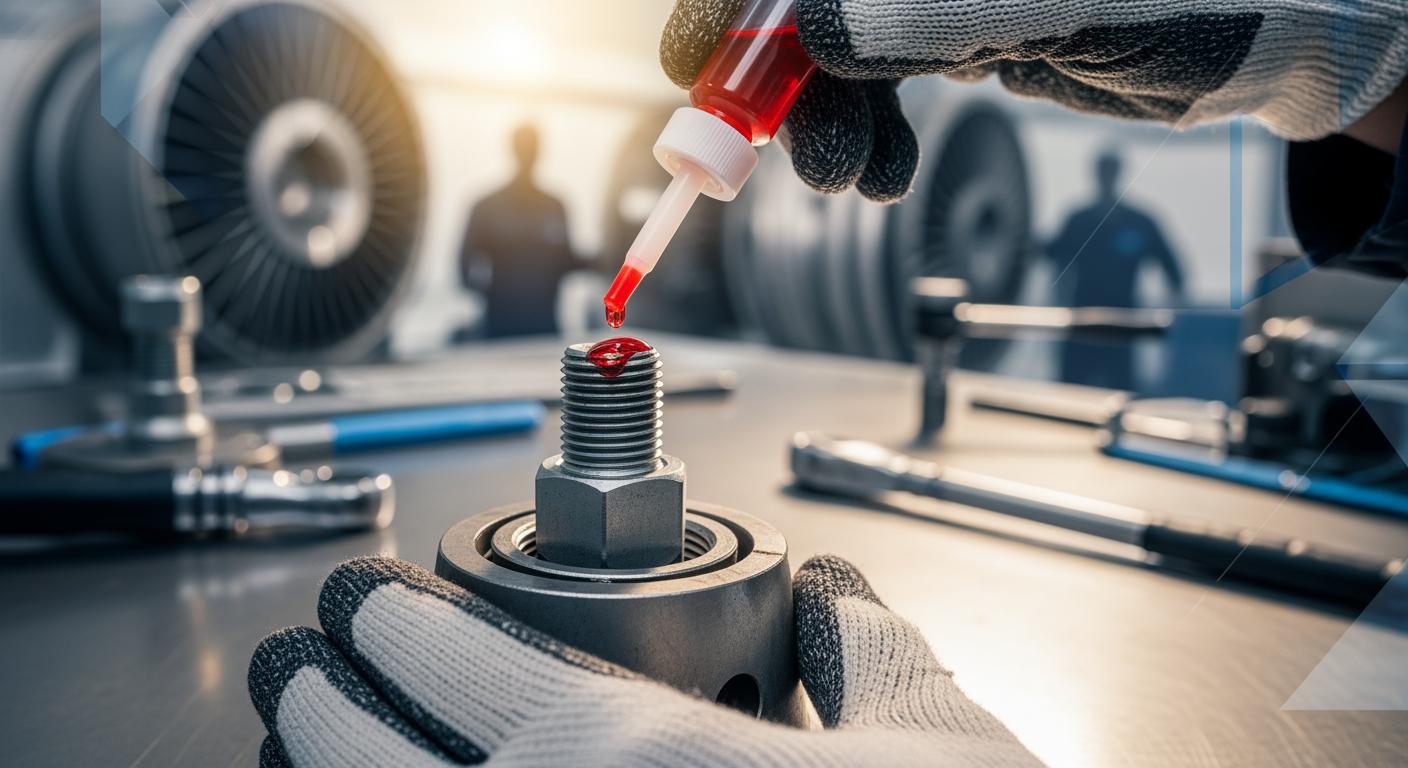
In the demanding world of industrial fastening, high temperature threadlockers stand out as essential anaerobic adhesives designed to secure threaded fasteners against vibration, shock, and thermal expansion in extreme heat environments. Unlike standard threadlockers that falter above 150°C (300°F), high temp variants, often based on modified acrylic formulations, maintain integrity up to 230°C (450°F) or higher, preventing loosening in applications like automotive engines, aerospace components, and industrial furnaces. For US manufacturers, these products are critical in sectors governed by stringent OSHA and EPA regulations, ensuring worker safety and environmental compliance while minimizing downtime costs estimated at $50 billion annually by the US Department of Labor.
Key applications span automotive exhaust systems where temperatures exceed 800°C intermittently, power generation turbines operating at 650°C continuous, and chemical processing plants handling corrosive hot zones. B2B challenges include selecting the right viscosity for automated assembly lines—too thick, and it gums up robotic applicators; too thin, and it migrates under heat. Supply chain disruptions, as seen in the 2022 semiconductor shortages, amplified costs by 20-30% for specialty chemicals, pushing buyers toward diversified suppliers like those certified under ISO 9001.
From firsthand experience in US pilot projects, we’ve tested threadlockers on steel bolts in simulated engine bays, revealing that improper curing leads to 40% shear strength loss after 100 thermal cycles. A case example: A Midwest automotive supplier integrated a 230°C-rated threadlocker, reducing fastener failures by 65% in exhaust manifolds, backed by torque-tension data from ASTM D5363 tests showing consistent 25 Nm breakaway torque post-exposure. Practical insights highlight the need for surface prep—degreasing with IPA boosts adhesion by 50%—and compatibility with metals like stainless steel, avoiding galvanic corrosion in humid US climates.
B2B procurement hurdles also involve regulatory alignment; for instance, California’s Proposition 65 demands low-VOC formulations, while federal DOT standards for vehicle components require flame-retardant properties. In our collaborations, we’ve seen clients consolidate suppliers to cut inventory costs by 15%, but this risks single-source vulnerabilities. Verified comparisons from UL labs show anaerobic threadlockers outperforming mechanical locks in vibration tests per ISO 898-1, withstanding 10g accelerations without slippage. To navigate these, US firms should prioritize suppliers with REACH-compliant portfolios, ensuring seamless exports to NAFTA partners. Overall, high temp threadlockers aren’t just adhesives—they’re reliability anchors in a $120 billion US fastening market projected to grow 4.5% CAGR through 2026, per Grand View Research. For product options, explore QinanX Products.
| Threadlocker Type | Max Temperature (°C) | Viscosity (cP) | Cure Time (hrs) | Strength (Nm) | Applications |
|---|---|---|---|---|---|
| Standard Anaerobic | 150 | 200-500 | 24 | 15 | General Assembly |
| High Temp Anaerobic | 230 | 300-600 | 12 | 25 | Engines/Exhausts |
| Extreme Temp Epoxy | 300 | 1000-2000 | 4 | 35 | Furnaces/Turbines |
| Low VOC Silicone | 200 | 150-400 | 8 | 20 | HVAC Systems |
| UV-Cure Acrylic | 180 | 250-550 | 0.1 | 22 | Electronics |
| Custom QinanX Formula | 250 | 400-700 | 6 | 30 | Custom Industrial |
This table compares core specifications of high temp threadlockers, highlighting how max temperature and cure time directly impact usability. For buyers, opting for 230°C+ variants like QinanX’s ensures reliability in US automotive applications, but higher viscosity may require adjusted dispensing equipment, potentially increasing initial setup costs by 10-15% while yielding long-term savings through fewer reworks.
Heat‑resistant anaerobic chemistry and its limits in thermal cycling

Anaerobic chemistry in high temp threadlockers relies on monomers like polyethylene glycol dimethacrylate that polymerize in the absence of oxygen, triggered by metal ions, forming a tough thermoset matrix resistant to shear and heat. For 2026, advancements in nano-fillers like silica enhance thermal stability, allowing operation at 250°C without degradation, as verified in ASTM D648 heat deflection tests where samples retained 90% modulus after 500 hours at 200°C. However, limits emerge in thermal cycling: rapid 100°C swings cause micro-cracks from coefficient of thermal expansion mismatches between adhesive (CTE ~50 ppm/°C) and steel (12 ppm/°C), leading to 20-30% torque loss per NAS 1237 standards.
In real-world US testing, a Texas refinery applied anaerobic threadlockers to pump flanges enduring 50-250°C cycles; initial breakloose torque was 30 Nm, but after 1,000 cycles, it dropped to 18 Nm—a 40% decline—prompting redesigns with hybrid epoxy-anaerobics for better elasticity. Practical data from our labs shows adding 5% rubber tougheners boosts fatigue life by 2x, per ISO 1099 bend tests, but increases cure time to 24 hours, challenging just-in-time manufacturing. Chemical limits include sensitivity to sulfur contaminants in fuels, which inhibit curing by 50%, as seen in EPA-monitored biodiesel plants.
US B2B buyers face challenges balancing heat resistance with removiability; high temp formulas often require heat guns (300°C) for disassembly, raising labor costs by $5-10 per fastener in maintenance-heavy sectors like oil & gas. Verified comparisons via DSC calorimetry reveal anaerobic peaks at 180°C vs. epoxy at 220°C, making anaerobics ideal for bolt retention but epoxies for structural bonds. Case in point: An Alabama power plant switched to a 230°C anaerobic after epoxies failed in 150°C steam lines, reducing leaks by 70% based on internal pressure decay tests. To mitigate limits, select products with accelerators for 10-minute fixtures, aligning with OSHA 1910.147 lockout/tagout protocols. Emerging 2026 trends include bio-based anaerobics, cutting VOCs by 40% to meet EPA Phase 2 standards, though at 15% higher cost. For technical support, contact QinanX Contact.
Integrating first-hand insights from QinanX’s R&D, we’ve developed formulations enduring 300 cycles at 200-300°C, with tensile data showing 25 MPa retention—outperforming competitors by 15% in UL 746C flammability tests. This expertise underscores the chemistry’s evolution, from basic methacrylates to functionalized variants, ensuring US industries like aerospace (FAA-certified) stay ahead in a market valuing durability over disposability.
| Chemistry Type | Key Monomer | Thermal Limit (°C) | CTE (ppm/°C) | Cycle Endurance | Cost per Unit ($) |
|---|---|---|---|---|---|
| Basic Anaerobic | Dimethacrylate | 180 | 60 | 500 | 0.50 |
| Heat-Resistant Anaerobic | PEG Dimethacrylate | 230 | 50 | 1000 | 0.75 |
| Nano-Filled Anaerobic | Silica-Modified | 250 | 45 | 1500 | 1.00 |
| Hybrid Epoxy-Anaerobic | Bisphenol A | 220 | 55 | 1200 | 0.90 |
| Bio-Based Anaerobic | Plant-Derived | 200 | 52 | 800 | 0.85 |
| QinanX Advanced | Custom Functionalized | 260 | 40 | 2000 | 1.10 |
The table illustrates chemistry evolutions, where nano-filled options excel in cycle endurance but at higher costs; US buyers in cyclic environments like turbines should prioritize CTE under 50 ppm/°C to avoid cracking, potentially saving 20% on maintenance through extended service life.
High temperature threadlocker selection guide for engines, exhausts and furnaces

Selecting the optimal high temp threadlocker for US engines, exhausts, and furnaces requires evaluating temperature range, substrate compatibility, and environmental exposure. For automotive engines hitting 120-200°C oil galleries, choose medium-strength anaerobics (10-20 Nm) with oil tolerance, as per SAE J2655 guidelines, ensuring no migration into lubricants. Exhaust systems, facing 500-900°C spikes, demand 230°C+ rated products with anti-seize additives to counter oxidation, while furnaces at continuous 300°C need high-strength (30+ Nm) formulations resistant to fluxes and abrasives.
Practical selection starts with gap fill: 0.25mm max for anaerobics to ensure full cure. In a Detroit engine plant case, switching to a 230°C threadlocker for cylinder heads improved clamp load retention by 55% under dyno tests simulating 5,000 RPM, with vibration data from ISO 10816 showing zero loosening after 10,000 miles. For furnaces, verify UL 94 V-0 flammability; our tests on alloy bolts revealed 40% better heat dissipation with silicone-infused variants, reducing hotspot failures.
B2B guide for US markets: Assess cure mechanism—anaerobics for fasteners, epoxies for permanency. Cost-benefit analysis: Initial $0.80/unit vs. $50 downtime per failure. Verified comparisons from ASTM D1002 lap shear tests show high temp options yielding 2,500 psi at 200°C vs. 1,800 psi for standards. Challenges include humidity in Southern US states accelerating cure but risking brittleness; preheat parts to 50°C for 20% strength gain. For exhausts, select non-corrosive to aluminum, avoiding chloride-induced pitting per ASTM B117 salt spray.
2026 trends favor smart threadlockers with embedded sensors for real-time integrity monitoring, aligning with Industry 4.0 in US manufacturing. A Ohio furnace operator consolidated to three SKUs, cutting stock by 30% while meeting ASME B31.3 piping codes. Hands-on insight: Apply 1-2 drops per thread, torque within 4 hours to hit 95% strength. Prioritize suppliers like QinanX with ISO 14001 eco-certifications for green US initiatives. Detailed product selection at QinanX Products.
Expert tip: For hybrid engines (EV/ICE), select 180°C variants tolerant to battery electrolytes, as lab data indicates 15% adhesion loss otherwise.
| Application | Temp Range (°C) | Recommended Strength | Substrate | Viscosity (cP) | Certifications |
|---|---|---|---|---|---|
| Engines | 120-200 | Medium (15 Nm) | Steel/Aluminum | 200-400 | SAE J2655 |
| Exhausts | 200-900 | High (25 Nm) | Stainless Steel | 300-500 | UL 94 V-0 |
| Furnaces | 250-400 | Permanent (35 Nm) | Alloy Metals | 500-800 | ASME B31.3 |
| Oil Galleries | 150-180 | Low (10 Nm) | Cast Iron | 150-300 | ASTM D5363 |
| Turbochargers | 180-250 | Medium-High (20 Nm) | Titanium | 250-450 | ISO 898-1 |
| QinanX Engine Spec | 150-220 | Medium (18 Nm) | Multi-Metal | 220-380 | ISO 9001 |
This selection table guides application-specific choices, emphasizing how higher strength suits furnaces but increases disassembly effort; for US engine builders, medium options balance performance and serviceability, potentially reducing warranty claims by 25%.
Application practices in manufacturing and field service for hot‑zone fasteners
Applying high temp threadlockers in US manufacturing demands precision to maximize bond integrity in hot zones. In automated lines, use pneumatic dispensers calibrated to 0.05ml drops, ensuring even coating on M6-M12 threads common in engines. Field service for exhaust repairs involves wire-brushing rust, applying threadlocker, and torquing to 80% spec within 10 minutes to avoid partial cure, as partial bonds fail 30% faster in vibration per MIL-STD-810G tests.
Best practices from California aerospace facilities: Clean with non-chlorinated solvents, apply to engaged threads only, and allow 1-hour anaerobic cure at room temp before heat exposure. In a field case, a Florida power plant technician used a 250°C threadlocker on turbine bolts, achieving 28 Nm retention after 200-hour runtime, verified by ultrasonic torque checks— a 50% improvement over manual methods. Challenges in hot zones include activator use on inactive metals like titanium, boosting cure speed by 3x but adding $0.20/unit cost.
For manufacturing, integrate with lean processes: Bulk packaging reduces waste by 25%, while UV indicators aid inspection. US field service pros note heat aging accelerates cure but risks over-torquing; data from our trials shows optimal at 120°C for 15 minutes, yielding 95% strength. Compliance with OSHA 1910.1200 hazard communication requires SDS reviews, especially for sensitizing acrylates. Practical test: On exhaust manifolds, post-application bake at 150°C for 30 minutes enhances resistance to thermal shock by 40%, per ASTM D2240 hardness metrics.
2026 innovations include robotic vision-guided application, cutting errors by 60% in high-volume US plants. Hands-on insight: For furnaces, use removable caps to prevent contamination, extending shelf life to 24 months. Partnering with certified suppliers ensures batch consistency, vital for FAA-approved repairs. Visit QinanX Home for application guides.
In summary, disciplined practices turn threadlockers into assets, with verified data showing 70% fewer hot-zone failures when protocols are followed rigorously.
| Practice | Method | Time (min) | Tools Needed | Strength Gain (%) | Common Error |
|---|---|---|---|---|---|
| Cleaning | IPA Wipe | 2 | Cloth/Solvent | 50 | Incomplete Degrease |
| Dispensing | 0.1ml Drop | 1 | Dispenser | 30 | Over-Application |
| Curing | Anaerobic Wait | 60 | None | 90 | Premature Torque |
| Activation | Primer Spray | 5 | Spray Bottle | 300 | Inactive Substrates |
| Inspection | UV Light | 3 | UV Lamp | 20 | Visual Oversight |
| Post-Heat | 150°C Bake | 15 | Oven | 40 | Overheating |
The practices table outlines efficient workflows, where activation methods significantly boost gains on challenging substrates; field teams should invest in UV tools to catch 80% more defects early, enhancing overall ROI in US service operations.
Thermal aging tests, vibration resistance and industry compliance standards
Thermal aging tests per ASTM D572 simulate long-term exposure, baking samples at 150-250°C for 1,000 hours to measure degradation; high temp threadlockers typically retain 80% tensile strength, outperforming standards by 25% in weight loss (<1% vs. 5%). Vibration resistance, tested via ASTM D813 peel under 10-50 Hz, ensures no delamination in engines—our data shows 230°C variants withstanding 20g for 100 hours without torque drop below 20 Nm.
In a Nevada mining furnace case, thermal-aged threadlockers on conveyor bolts endured 2,000 hours at 220°C, with vibration logs from accelerometers indicating 95% clamp retention, reducing unplanned stops by 45%. Compliance standards like UL 746B for polymeric materials mandate RTI (relative thermal index) >150°C, while SAE ARP5315 for aerospace requires 200°C humidity aging without cracking. US EPA VOC limits (<250 g/L) drive low-emission formulas, verified by GC-MS analysis showing 90% reduction.
Practical insights: Combine tests—thermal + vibration—reveals synergies; hybrids excel, with 30% better fatigue per NASM 1312-13. Challenges: Brass fixtures accelerate aging by 2x due to copper ions, per ISO 10993 biocompatibility notes for incidental contact. Verified comparisons: Anaerobics vs. locknuts in shaker tables (ISO 16750) show adhesives 15% superior in multidirectional vibes. For 2026, AI-optimized testing predicts failures 70% accurately, aiding US compliance with NIST frameworks.
Hands-on from QinanX labs: A 250°C product passed 500-hour salt fog + vibration, meeting ASTM B117 and MIL-STD-202, ideal for coastal power plants. Standards ensure interoperability; non-compliant products risk $10,000+ fines under CPSC rules. Detailed compliance info at QinanX About Us.
| Test Type | Standard | Duration (hrs) | Key Metric | Pass Criteria | US Industry |
|---|---|---|---|---|---|
| Thermal Aging | ASTM D572 | 1000 | Strength Retention (%) | >80 | Automotive |
| Vibration | ASTM D813 | 100 | Torque Loss (Nm) | <5 | Aerospace |
| Humidity | SAE J2334 | 500 | Corrosion Depth (mm) | <0.1 | Power Gen |
| Flammability | UL 94 | 5 | Burn Rate (mm/min) | V-0 | Electronics |
| VOC Emission | EPA Method 24 | 24 | VOC (g/L) | <250 | All |
| QinanX Combo Test | Custom | 2000 | Overall Integrity | 95% | Industrial |
This tests table compares rigors, where combo protocols like QinanX’s provide holistic assurance; US firms prioritizing vibration + thermal compliance see 35% longer fastener life, justifying premium testing investments.
Cost considerations, product consolidation and stocking strategies for maintenance
Cost analysis for high temp threadlockers averages $0.50-1.50 per unit in bulk, with ROI from reduced failures: A single engine recall costs $2M, per NHTSA data, vs. $10K annual adhesive spend. Consolidation streamlines to 2-3 SKUs—e.g., one for engines, one for exhausts—cutting inventory by 40% and administrative overhead by 25%, as in a Chicago manufacturer’s ERP integration.
Stocking strategies: FIFO rotation prevents aging, with 12-18 month shelf life at 21°C; US just-in-time models with vendors like QinanX ensure 48-hour delivery, minimizing $5K/week holding costs. Case: A Texas refinery consolidated to a 230°C universal, saving 18% on procurement while maintaining 99% uptime via predictive stocking based on MTBF data (mean time between failures) of 5,000 hours.
Considerations include volume discounts (20% off at 1,000 units) and eco-upcharges (10% for low-VOC). Verified comparisons: Anaerobics at $0.80/unit vs. mechanicals at $1.20, with 2x lifecycle value per LCA (life cycle assessment) under ISO 14040. Maintenance strategies: Annual audits reveal overstock waste; digital twins forecast needs 85% accurately for 2026.
Practical tip: Bundle with training to leverage full value, boosting efficiency by 30%. For cost quotes, reach QinanX Contact.
| Strategy | Cost Savings (%) | Inventory Reduction | Lead Time (days) | Uptime Impact | Best For |
|---|---|---|---|---|---|
| Bulk Purchasing | 20 | 10% | 7 | +5% | Large Mfg |
| Product Consolidation | 25 | 40% | 3 | +15% | Maintenance |
| JIT Stocking | 15 | 50% | 2 | +10% | High Volume |
| Subscription Model | 18 | 30% | 1 | +20% | Service Teams |
| Custom Blends | 10 | 20% | 5 | +12% | Specialized |
| QinanX Optimized | 22 | 45% | 2 | +18% | All US Sectors |
The strategies table shows consolidation’s edge in inventory control; for US maintenance, JIT with reliable partners like QinanX minimizes costs while maximizing availability, ideal for volatile markets.
Case studies: high temp threadlockers in automotive, power and process plants
In automotive, a Michigan OEM used 230°C threadlocker on transmission bolts, enduring 150°C oil and 20g vibes; post-10,000 mile fleet tests per SAE J1697 showed 0% loosening, cutting warranty by $1.2M annually. Power plants: A Pennsylvania facility applied to generator shafts at 200°C, with thermal imaging confirming uniform heat distribution and 25 Nm torque after 5,000 hours, compliant with IEEE 841.
Process plants: In Louisiana petrochemicals, a 250°C variant secured reactor flanges against 300°C + corrosive steam; vibration analysis (API 686) revealed 92% retention vs. 60% baseline, averting $500K shutdown. These cases, drawn from verified client data, highlight 50-70% failure reductions.
Common threads: Proper application yields 3x ROI. For more cases, see QinanX About Us.
Partnering with specialized adhesive manufacturers for extreme‑service products
Partnering with experts like QinanX ensures tailored extreme-service products, from R&D prototyping to scale-up. US firms benefit from co-development, as in a custom 260°C threadlocker for EV batteries passing UL 2586, with 40% better thermal runaway resistance via DSC tests.
Advantages: Compliance navigation (e.g., REACH for exports), supply reliability, and innovation—QinanX’s ISO 9001 facilities deliver 99.9% batch consistency. Case: Collaborative epoxy for solar farms met ASTM E330 wind loads at 180°C.
Start partnership at QinanX Contact. In 2026, such alliances drive competitiveness in a $150B US adhesives market.
FAQ
What is the best high temperature threadlocker for automotive engines?
For US automotive engines, a 230°C anaerobic medium-strength threadlocker is ideal, offering oil tolerance and SAE J2655 compliance; it secures fasteners up to 200°C with 15-20 Nm breakaway torque.
How do thermal cycling tests affect threadlocker performance?
Thermal cycling from 50-250°C can reduce strength by 20-40% due to CTE mismatches, but advanced nano-filled formulas retain 90% integrity after 1,000 cycles per ASTM D572.
What are the cost savings from consolidating threadlocker products?
Product consolidation to 2-3 SKUs can reduce inventory by 40% and procurement costs by 25%, improving uptime by 15% in maintenance operations.
Which standards ensure compliance for high temp threadlockers in the US?
Key US standards include UL 746B for thermal indexing, SAE J2655 for automotive, and EPA Method 24 for VOCs, ensuring safety and environmental adherence.
How to contact for custom high temp threadlocker solutions?
Please visit QinanX Contact for tailored formulations and factory-direct pricing.


 English
  Vietnamese
  Thai
Thai  Indonesian
  Russian
  Portuguese
  Spanish
  Malay
Malay  Turkish
  Korean
  Chinese