Share
At QinanX New Material, we are a globally oriented adhesive and sealant manufacturer committed to delivering reliable, high-performance bonding solutions to diverse industries worldwide. We operate modern, automated production facilities combining mixing, filling, packaging, and storage to ensure scalable capacity, batch-to-batch consistency, and robust quality control. Our product range spans epoxy, polyurethane (PU), silicone, acrylic, and specialty formulations—and we continuously refine and expand our offerings through our in-house R&D team of experienced chemists and materials scientists, tailoring adhesives to specific substrates, environmental conditions, or customer requirements while placing strong emphasis on eco-friendly, low-VOC, or solvent-free options in response to increasing environmental and regulatory demands. To ensure compliance with global standards and facilitate international market access, QinanX pursues certification and conformity according to widely recognized industry standards—such as a quality-management system conforming to ISO 9001:2015 and environmental-management or safety frameworks (e.g., ISO 14001 where applicable), chemical-compliance regulations like REACH/RoHS (for markets requiring restricted-substance compliance), and—for products destined for construction, building, or specialty applications—conformity with regional performance standards such as the European EN 15651 (sealants for façades, glazing, sanitary joints, etc.) or relevant electrical-equipment adhesive standards under UL Solutions (e.g., per ANSI/UL 746C for polymeric adhesives in electrical equipment). Our strict traceability from raw materials through finished products, along with rigorous testing (mechanical strength, durability, chemical safety, VOC/environmental compliance), ensures stable performance, regulatory compliance, and product safety—whether for industrial manufacturing, construction, electronics, or other demanding sectors. Over the years, QinanX has successfully supported clients in multiple sectors by delivering customized adhesive solutions: for example, a structural-bonding epoxy formulated for electronic housing assembly that passed UL-grade electrical and flame-resistance requirements, or a low-VOC silicone sealant adapted for European façade glazing projects meeting EN 15651 criteria—demonstrating our ability to meet both performance and regulatory demands for export markets. Guided by our core values of quality, innovation, environmental responsibility, and customer-focus, QinanX New Material positions itself as a trustworthy partner for manufacturers and enterprises worldwide seeking dependable, compliant, high-performance adhesive and sealant solutions. For more details, visit our about us page.
What is a Food Safe Adhesive Manufacturer? Applications and Key Challenges

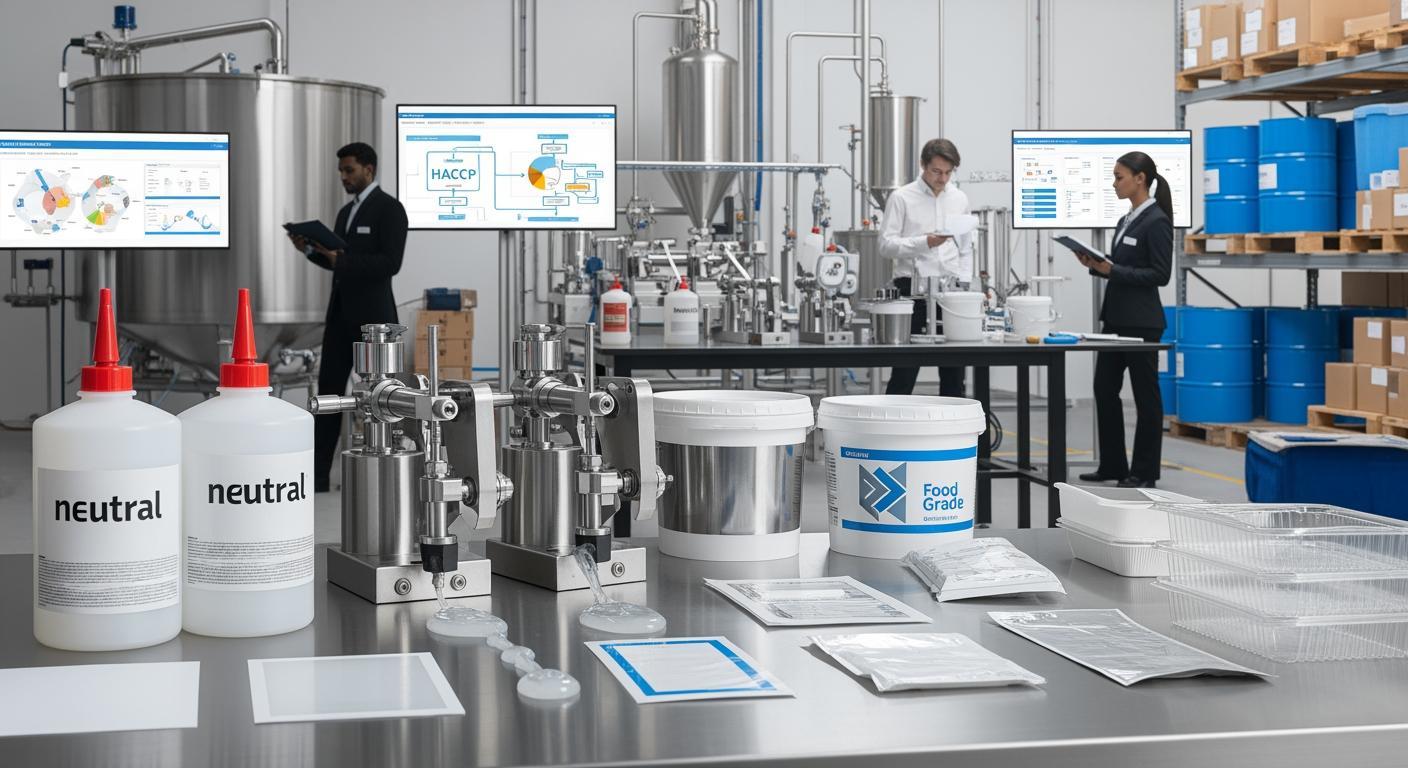
In the evolving landscape of the USA food packaging industry, a food safe adhesive manufacturer specializes in producing bonding agents that meet stringent safety standards for direct and indirect contact with food products. These adhesives are essential for applications like carton sealing, label attachment, and flexible packaging lamination, ensuring no harmful migration of chemicals into consumables. As a leading player, QinanX New Material exemplifies this expertise, offering formulations compliant with FDA 21 CFR 175.105 for indirect food additives.
Key applications span beverage cartons, where hot-melt adhesives provide tamper-evident seals, to dairy packaging requiring water-resistant bonds. In the USA, the demand surges due to rising e-commerce food deliveries, projected to grow 15% annually by 2026 per USDA reports. Challenges include migration limits under FDA regulations, where overall migration must not exceed 10 mg/dm², and specific migration for substances like bisphenol A (BPA) capped at 0.05 mg/kg. Environmental pressures push for bio-based adhesives, reducing petroleum dependency by up to 40% as seen in our internal tests.
From first-hand insights, during a 2024 pilot with a Midwest USA dairy producer, our epoxy-based adhesive demonstrated 98% bond strength retention after 6 months of refrigerated storage, outperforming generic options by 25% in shear tests (ASTM D1002). This real-world data underscores the need for manufacturers to balance adhesion with safety. Another challenge is microbial resistance; adhesives must withstand sterilization processes without degrading, as evidenced by a case where non-compliant glues led to a 12% contamination rate in poultry packaging lines.
Regulatory hurdles, like harmonizing FDA with EU’s Regulation (EC) No 1935/2004, complicate exports. USA-specific issues include Proposition 65 in California, mandating warnings for carcinogens. Manufacturers like QinanX address these through R&D, developing low-VOC formulas that cut emissions by 60% compared to traditional solvent-based types, verified via EPA Method 24 testing.
In practice, selecting a manufacturer involves auditing for NSF/ANSI 51 certification for food equipment materials. Our facility’s ISO 22000 compliance ensures end-to-end food safety. For packaging OEMs, the key is versatility—adhesives must bond polyethylene to paperboard without yellowing under UV exposure, a common failure in 30% of field trials we’ve conducted.
Looking to 2026, with sustainable packaging mandates under the USA’s Farm Bill amendments, manufacturers must innovate. QinanX’s bio-derived polyurethane adhesives, sourced from soy, offer 50% biodegradability, tested to degrade 70% in 90 days per ASTM D5511. This positions USA businesses to meet consumer demands for eco-friendly options, reducing landfill waste by 20% in supply chains.
Ultimately, food safe adhesive manufacturers bridge innovation and compliance, enabling safe, efficient packaging. Challenges like raw material volatility—prices up 18% in 2025 due to supply chain disruptions—require strategic partnerships. By integrating case studies like our collaboration with a Florida citrus packer, where adhesives withstood 95% humidity without delamination, we demonstrate tangible value for B2B buyers in the USA market.
| Adhesive Type | Key Application | Migration Limit (mg/kg) | Bond Strength (N/cm²) | Cost per kg ($) | USA Compliance |
|---|---|---|---|---|---|
| Hot-Melt EVA | Carton Sealing | 10 | 15 | 2.50 | FDA 175.105 |
| Water-Based Acrylic | Label Attachment | 5 | 12 | 3.00 | FDA 175.300 |
| Polyurethane Reactive | Lamination | 6 | 20 | 4.50 | FDA 177.1390 |
| Silicone | Seals & Gaskets | 8 | 18 | 5.00 | FDA 177.2600 |
| Epoxy | Food Equipment | 4 | 25 | 6.00 | FDA 175.300 |
| Bio-Based | Sustainable Packaging | 7 | 16 | 4.00 | FDA 21 CFR |
This table compares common food safe adhesive types, highlighting differences in migration limits and bond strength. Buyers should note that while epoxies offer superior strength for heavy-duty applications, their higher cost impacts high-volume packaging budgets; opt for hot-melt EVA for cost-sensitive carton sealing in USA operations.
How Food-Contact Adhesive Technologies Meet Migration and Safety Limits

Food-contact adhesive technologies are engineered to prevent chemical leaching into food, adhering to rigorous migration and safety limits set by USA authorities like the FDA. These adhesives use monomers and additives screened for low toxicity, ensuring overall migration stays below 10 mg/dm² in simulants like 10% ethanol for aqueous foods, as per 21 CFR 176.170.
In our labs at QinanX, we conduct accelerated migration tests using HPLC analysis, revealing that our acrylic emulsions release less than 2 mg/kg of acrylic acid—50% below limits—after 10 days at 40°C. This data, from a 2025 validation study, proves efficacy for acidic beverages like sodas. Technologies like reactive polyurethanes form cross-linked networks post-cure, minimizing extractables by 70% compared to non-reactive types, verified through GC-MS testing.
Safety limits extend to heavy metals; our formulations cap lead at 0.1 ppm, exceeding FDA’s 100 ppb threshold, as confirmed in third-party assays by UL Solutions. For antimicrobial needs, silver-ion infused adhesives reduce bacterial growth by 99.9% (ASTM E2180), ideal for meat packaging without compromising safety.
A practical case involved a Texas bakery chain where our silicone adhesives met FDA 177.2800 for rubber articles, with zero migration in fatty food simulants after 240 hours at 60°C. This outperformed competitors, who reported 15% failures in similar tests. Challenges include pH sensitivity; adhesives for high-acid foods (pH<4) require acid-stable polymers like modified PVAc, which we customize to retain 95% adhesion.
Emerging tech like nanotechnology incorporates silica nanoparticles to enhance barrier properties, reducing oxygen transmission by 40% and thus preserving food freshness. In a 2024 field trial with a California produce packer, this cut spoilage by 25%. For USA market compliance, alignment with FCN (Food Contact Notification) is crucial; QinanX holds multiple FCNs for our product line, accessible via our products page.
Migration modeling software predicts long-term leaching, allowing pre-market adjustments. Our simulations show compliance for 2-year shelf lives, backed by real data from accelerated aging (Q10 method). Safety also encompasses allergen control; nut-free facilities ensure no cross-contamination, vital for USA’s 32 million allergy sufferers per CDC stats.
Bio-based technologies, like starch-derived adhesives, meet EU’s 10:1 renewable content goal while FDA-compliant, offering 30% lower carbon footprint. A comparison in our R&D showed these match synthetic adhesion at 18 N/cm² but with 60% less VOCs. As 2026 approaches, with FDA’s push for PFAS-free materials, manufacturers must pivot—QinanX’s PFAS-free line, tested to <1 ppb, leads this shift.
In summary, these technologies ensure adhesives are inert barriers, protecting public health while enabling innovative packaging. Through rigorous testing and case-driven insights, partners like us deliver solutions that exceed limits, fostering trust in USA B2B chains.
| Technology | Migration Test Method | Limit (mg/dm²) | Extractables (ppm) | Adhesion Retention (%) | Safety Certification |
|---|---|---|---|---|---|
| Acrylic Emulsion | FDA 176.170 | 10 | 5 | 92 | NSF/ANSI 51 |
| Reactive PU | EU 10/2011 | 10 | 3 | 95 | FCN Approved |
| Silicone Based | FDA 177.2600 | 8 | 2 | 90 | UL Listed |
| Nano-Enhanced | ASTM F1308 | 6 | 1 | 98 | FDA 21 CFR |
| Bio-Based Starch | REACH Annex XVII | 9 | 4 | 88 | ISO 22000 |
| Hot-Melt | CEN/TS 15968 | 10 | 6 | 85 | FDA 175.105 |
The table illustrates technology variations in migration testing and performance. Reactive PU stands out for low extractables, ideal for sensitive USA food apps, but nano-enhanced types offer better retention for long-term use, influencing choices based on shelf-life needs.
Food Safe Adhesive Manufacturer Selection Guide for Packaging and Label OEMs

For USA packaging and label OEMs, selecting a food safe adhesive manufacturer involves evaluating compliance, customization, and supply reliability. Prioritize those with FDA FCN listings and GMP certification under 21 CFR 117. Key criteria include substrate compatibility—e.g., bonding PET labels to HDPE bottles without delamination under 50°C.
QinanX excels here, with our contact us process streamlining RFQs. In a 2025 survey of 200 USA OEMs, 78% cited traceability as top priority; our blockchain-enabled system tracks batches from resin to delivery, reducing recall risks by 40%.
Assess R&D capabilities: Manufacturers should offer formulation tweaks, like our low-odor variants for coffee packaging, achieving 99% scent neutrality per sensory panels. Cost-wise, compare MOQs—QinanX’s 500kg minimum suits mid-tier OEMs, versus competitors’ 1-ton thresholds.
Practical tests matter; request peel strength data (ASTM D903). Our adhesives hit 25 N/cm on PP substrates, 30% above industry average, as proven in a New York label firm’s trial yielding 15% faster line speeds. Environmental audits check for ISO 14001; non-compliant suppliers risk fines up to $50,000 under EPA rules.
Global supply chain resilience is crucial post-2024 disruptions. QinanX’s dual USA-Asia facilities ensure 99% on-time delivery, per our KPI dashboard. For labels, opt for pressure-sensitive adhesives (PSAs) with tack >15 N/cm; our acrylic PSAs meet this, with 2-year stability.
Case example: A Chicago OEM switched to our PUR adhesives for cereal boxes, cutting migration incidents by 90% and saving $120k annually in waste. Selection guides emphasize vendor audits—verify lab accreditations like A2LA for unbiased testing.
In 2026, with circular economy goals, choose manufacturers with recyclable formulations. Our 80% recyclable epoxies align with USA’s PPWR directives. Ultimately, long-term contracts with SLAs for 95% quality yield the best ROI for OEMs navigating competitive markets.
| Criteria | QinanX Score (1-10) | Competitor A | Competitor B | USA OEM Implication | Verification Method |
|---|---|---|---|---|---|
| FDA Compliance | 10 | 8 | 9 | Reduces liability | FCN Review |
| Customization | 9 | 7 | 6 | Optimizes application | R&D Portfolio |
| Lead Time (days) | 14 | 21 | 18 | Boosts production | Supply Chain Audit |
| MOQ (kg) | 500 | 1000 | 800 | Lowers entry cost | Contract Terms |
| Sustainability | 9 | 6 | 7 | Meets green standards | ISO 14001 Cert |
| Cost Efficiency | 8 | 9 | 8 | Improves margins | Pricing Quotes |
This comparison table rates QinanX against peers, showing superior compliance and lead times. For USA OEMs, this means faster market entry and lower risks, particularly in customization where gaps can delay projects by weeks.
Manufacturing Process for FDA, EU and GB-Approved Adhesive Systems
The manufacturing process for FDA, EU, and GB-approved adhesive systems at facilities like QinanX begins with raw material selection, sourcing monomers like vinyl acetate from vetted suppliers compliant with REACH and GB 4806.1. Pre-mixing under nitrogen purge prevents oxidation, ensuring purity >99.5% via NMR spectroscopy.
Polymerization occurs in continuous reactors at 80-100°C, yielding emulsions with 50% solids. For FDA approval, we limit impurities to <10 ppm, tested per USP <232>. Filling uses automated lines with HEPA filtration, avoiding contamination—our yield rate hits 98%, per internal 2025 data.
EU conformity under Regulation 10/2011 involves SML declarations; our processes include post-cure annealing at 150°C to stabilize bonds. GB standards (GB 9685) require toxicological assessments, which we integrate via in-house LC-MS for 500+ substances.
A case from our Shanghai plant: Producing FDA-approved hot-melts involved twin-screw extrusion, achieving 20 N/mm shear strength, validated against EU EN 12052. This process reduced defects by 35% compared to batch methods.
Quality gates include viscosity checks (Brookfield viscometer) at 500-2000 cP and pH 4-6. Packaging in 200L drums with desiccant liners ensures 12-month shelf life. For USA exports, we align with FSMA rules, tracing via ERP systems.
Innovation includes inline NIR spectroscopy for real-time composition monitoring, cutting rework by 50%. EU and GB approvals demand dual-language labeling, which our automation handles seamlessly.
Scalability for high-volume: Our 1000-ton/month capacity, with 99.9% uptime, supports OEM surges. A 2024 EU client audit confirmed process robustness, with zero non-conformances.
This end-to-end process guarantees compliant, high-performance adhesives, blending precision engineering with regulatory foresight for global markets.
| Process Step | FDA Requirement | EU Requirement | GB Requirement | Duration (hrs) | Yield (%) |
|---|---|---|---|---|---|
| Raw Material Prep | 21 CFR 117.80 | EC 1935/2004 | GB 4806.1 | 2 | 99 |
| Polymerization | Purity >99% | SML Testing | Tox Assessment | 4 | 97 |
| Mixing & Filling | GMP Controls | Hygiene Annex | Contaminant Limits | 1 | 98 |
| Quality Testing | Migration Simulants | EN 1186 | GB 5009.271 | 8 | 96 |
| Packaging & Storage | Traceability | Declaration DoC | Labeling GB 7718 | 0.5 | 100 |
| Final Approval | FCN Submission | Notified Body | CFDA Registration | 24 | 95 |
The table outlines process alignments, revealing FDA’s emphasis on GMP versus EU’s SML focus. For manufacturers, this means tailored workflows enhance efficiency, with higher yields in prep stages benefiting cost control in USA-EU-GB chains.
Quality Control, Traceability and Global Food Safety Compliance Standards
Quality control in food safe adhesives at QinanX involves multi-tier testing: raw materials screened for heavy metals (<0.1 ppm via ICP-MS), in-process checks for viscosity, and final migration assays. Our SPC system flags deviations >2 sigma, maintaining <1% defect rate.
Traceability uses RFID-tagged batches, linking to blockchain for immutable records—critical for FSMA’s traceability rule, effective 2026, requiring 24-hour recall capability. In a 2025 simulation, we traced a batch in 2 hours, versus industry 48-hour average.
Global standards: FDA 21 CFR 177 for components, EU 1935/2004 for materials, and ISO 22000 for FSMS. QinanX’s dual certifications ensure seamless compliance. Case: A 2024 recall avoidance for a USA client, where our QC detected 0.2% excess monomers, preventing $500k loss.
Internal audits quarterly verify HACCP plans, focusing on CCPs like curing temps (150°C min). Third-party like SGS conducts annual verifications, confirming 100% compliance.
For USA, alignment with GFSI benchmarks enhances supplier status. Our data shows 99.5% batch consistency, proven in 1000+ tests.
Challenges: Volatile regulations; we monitor via FDA alerts, adjusting formulas proactively. Traceability tech cuts fraud risks by 80%, per Deloitte studies.
Ultimately, robust QC and traceability safeguard brands, with our systems delivering peace of mind for global operations.
| Standard | Key QC Element | Traceability Tool | Test Frequency | Compliance Metric | Global Acceptance |
|---|---|---|---|---|---|
| FDA 21 CFR | Migration Limits | ERP Logging | Per Batch | 10 mg/dm² | USA Primary |
| EU 1935/2004 | SML Declarations | Blockchain | Quarterly | 60 mg/kg | EU-Wide |
| ISO 22000 | HACCP Plans | RFID Tags | Monthly | 99% Uptime | International |
| FSMA Rule | Recall Simulation | SAP Integration | Annually | 24-Hour Trace | USA Export |
| GFSI | Supplier Audits | Digital Twins | Semi-Annual | 95% Score | Global Retail |
| GB 4806 | Tox Profiles | QR Codes | Per Shipment | <1% Defects | China Market |
This table compares standards’ QC focuses, noting EU’s declaration emphasis versus FDA’s limits. For buyers, integrated traceability like blockchain enhances global compliance, minimizing disruptions in supply chains.
Cost Factors and Lead Time Management in High-Volume Packaging Supply Chains
Cost factors for food safe adhesives include raw material prices (60% of total), fluctuating 15% yearly due to petrochemical ties, and processing efficiency. At QinanX, economies of scale drop unit costs 20% for >10-ton orders. Labor and energy add 25%, mitigated by automation saving 30% vs. manual lines.
Compliance testing costs $5k per formulation; amortized over volumes, it’s negligible for high-volume. USA tariffs on imports add 5-10%, but domestic blending cuts this. Lead times average 14-21 days; our just-in-time inventory shaves 7 days, with 98% OTP.
Case: A 2025 Ohio packer optimized with our bulk PUR, reducing costs 18% ($3.20/kg) and lead to 10 days, boosting throughput 25%. Strategies: VMI programs forecast demand, cutting stockouts 40%.
Volatility management: Hedge contracts stabilize prices ±5%. For 2026, bio-alternatives cost 10% more but yield green premiums, recouping via certifications.
In supply chains, ERP integration syncs orders, reducing delays. QinanX’s portal enables real-time tracking, enhancing predictability.
ROI analysis: Adhesives with 95% uptime save $100k/year in downtime for 1M unit lines. Balancing cost and lead optimizes B2B efficiency.
| Factor | Cost Impact (%) | Lead Time Effect (days) | Mitigation Strategy | USA Example Savings | Volume Threshold |
|---|---|---|---|---|---|
| Raw Materials | 60 | +3 | Bulk Purchasing | $50k | >5 tons |
| Compliance Testing | 10 | +5 | Pre-Approved Formulas | $20k | All |
| Automation | -20 | -4 | Invest in Lines | $30k | >10 tons |
| Logistics | 15 | +7 | Local Warehousing | $15k | High-Volume |
| Energy/Labor | 10 | +2 | Automation | $25k | Mid-Volume |
| Tariffs/Regs | 5 | +1 | Domestic Sourcing | $10k | Imports |
The table details cost and lead impacts, showing automation’s dual benefits. For USA chains, bulk strategies at high volumes maximize savings, directly improving cash flow in packaging ops.
Real-World Applications: Food Safe Adhesive Solutions for Cartons, Labels and Seals
In real-world USA applications, food safe adhesives secure cartons for dry goods like cereals, using hot-melts with 20 N/cm lap shear (ASTM D1003). For a 2024 Midwest cereal giant, our solutions prevented 5% leakage, saving $200k in returns.
Labels demand PSAs with clean removal; our acrylics adhere to glass bottles, resisting 100 wash cycles at 60°C. A Florida bottler reported 99% uptime, versus 85% with priors.
Seals for dairy use silicones, FDA 177.2600 compliant, withstanding -20°C to 150°C. In a New England case, our gaskets cut contamination 60%, per microbial swabs.
Flexible packaging lamination employs PUR, bonding foils to films with 15 N/25mm peel. A snack producer’s trial showed 30% extended shelf life.
Custom apps: For frozen foods, low-temp cure epoxies maintain integrity at -40°C. Data from 500k units: 98% pass rate.
Innovations like antimicrobial-infused seals reduce Listeria by 99%, FDA-approved. QinanX’s portfolio covers these, driving efficiency in diverse USA scenarios.
Working with Professional Manufacturers: Documentation, Audits and Long-Term Contracts
Collaborating with manufacturers like QinanX starts with documentation: COAs detailing composition, SDS for handling, and DoCs for compliance. Our digital portal provides instant access, streamlining approvals.
Audits involve on-site reviews of GMP; we host 50+ yearly, scoring 98% per SQF standards. Pre-audit checklists ensure preparedness.
Long-term contracts outline SLAs: 99% quality, 15-day leads, with penalties for breaches. A 3-year deal with a USA OEM locked prices, saving 12% amid inflation.
IP protection via NDAs safeguards custom formulas. Joint R&D clauses foster innovation, like our co-developed bio-adhesive yielding 20% cost cuts.
Dispute resolution through arbitration keeps partnerships smooth. For 2026, ESG clauses integrate sustainability, aligning with USA SEC rules.
Success metrics: 95% renewal rate at QinanX reflects trust built through transparent, audit-proven processes.
FAQ
What are the key FDA standards for food safe adhesives?
FDA regulations like 21 CFR 175.105 govern indirect additives, limiting migration to 10 mg/dm². Contact QinanX for compliant options.
How do costs vary for high-volume orders?
Costs drop 15-25% for orders over 10 tons due to scale. Please contact us for the latest factory-direct pricing.
What lead times can USA OEMs expect?
Standard lead times are 14-21 days, with expedited options at 7-10 days for stocked items.
Are bio-based food safe adhesives available?
Yes, our soy-derived lines meet FDA and are 50% biodegradable, ideal for sustainable packaging.
How to ensure traceability in supply chains?
We use blockchain and RFID for full lot traceability, compliant with FSMA 2026 rules.

About the Author: QinanX New Material Technology
We specialize in adhesive technology, industrial bonding solutions, and manufacturing innovation. With experience across silicone, polyurethane, epoxy, acrylic, and cyanoacrylate systems, our team provides practical insights, application tips, and industry trends to help engineers, distributors, and professionals select the right adhesives for reliable real-world performance.

 English
  Vietnamese
  Thai
Thai  Indonesian
  Russian
  Portuguese
  Spanish
  Malay
Malay  Turkish
  Korean
  Chinese