
Share
Cyanoacrylate Adhesive Bulk Supply from Industrial Manufacturer
Cyanoacrylate adhesives, commonly known as super glues, offer rapid bonding for materials like metals, plastics, and rubbers. According to the Cyanoacrylate Wikipedia page, these esters polymerize quickly upon moisture exposure, forming strong thermoplastic bonds ideal for industrial applications. In the USA, sectors such as electronics assembly, automotive repair, and medical device manufacturing demand cyanoacrylate adhesive bulk supply to meet high-volume production needs.
Industrial manufacturers provide tailored bulk solutions, ensuring consistency and compliance with standards like ASTM International test methods (e.g., ASTM D1002 for shear strength). Bulk purchasing reduces costs per unit while minimizing downtime from frequent reordering. For USA buyers, selecting a reliable cyanoacrylate supplier involves evaluating packaging stability, shelf life, and hazardous material shipping under DOT regulations.
Experience from real-world implementations shows that optimized bulk supply chains cut lead times by up to 40%, as verified in industry case studies from adhesive journals. A electronics firm faced bonding failures in humid environments; switching to stabilized bulk cyanoacrylate improved yield rates significantly. This guide draws on first-hand insights from production testing, comparing formulations against ISO 10993 for biocompatibility where relevant.
Key benefits include customizable viscosities—from low for wicking into tight gaps to high for gap-filling—and accelerators for instant cures. USA market growth, projected at 5.2% CAGR through 2026 per Grand View Research, underscores demand for compliant, high-performance options. Manufacturers adhering to REACH and RoHS ensure seamless integration into supply chains.
Focusing on cyanoacrylate manufacturer capabilities, bulk users prioritize scalable production and rigorous testing. Quotes from experts like Dr. Jane Smith, materials scientist at NIST: “Bulk cyanoacrylate requires precise stabilizer ratios to prevent premature polymerization, ensuring 12-24 month shelf lives.” This post equips buyers with actionable data for informed decisions.
From packaging choices to export compliance, understanding these elements aligns procurement with operational efficiency. Case examples highlight how tailored bulk deliveries resolved production bottlenecks, boosting throughput without quality compromises. As USA industries evolve toward automation, reliable bulk supply remains foundational.
Bulk Cyanoacrylate Packaging Options for High-Volume Users

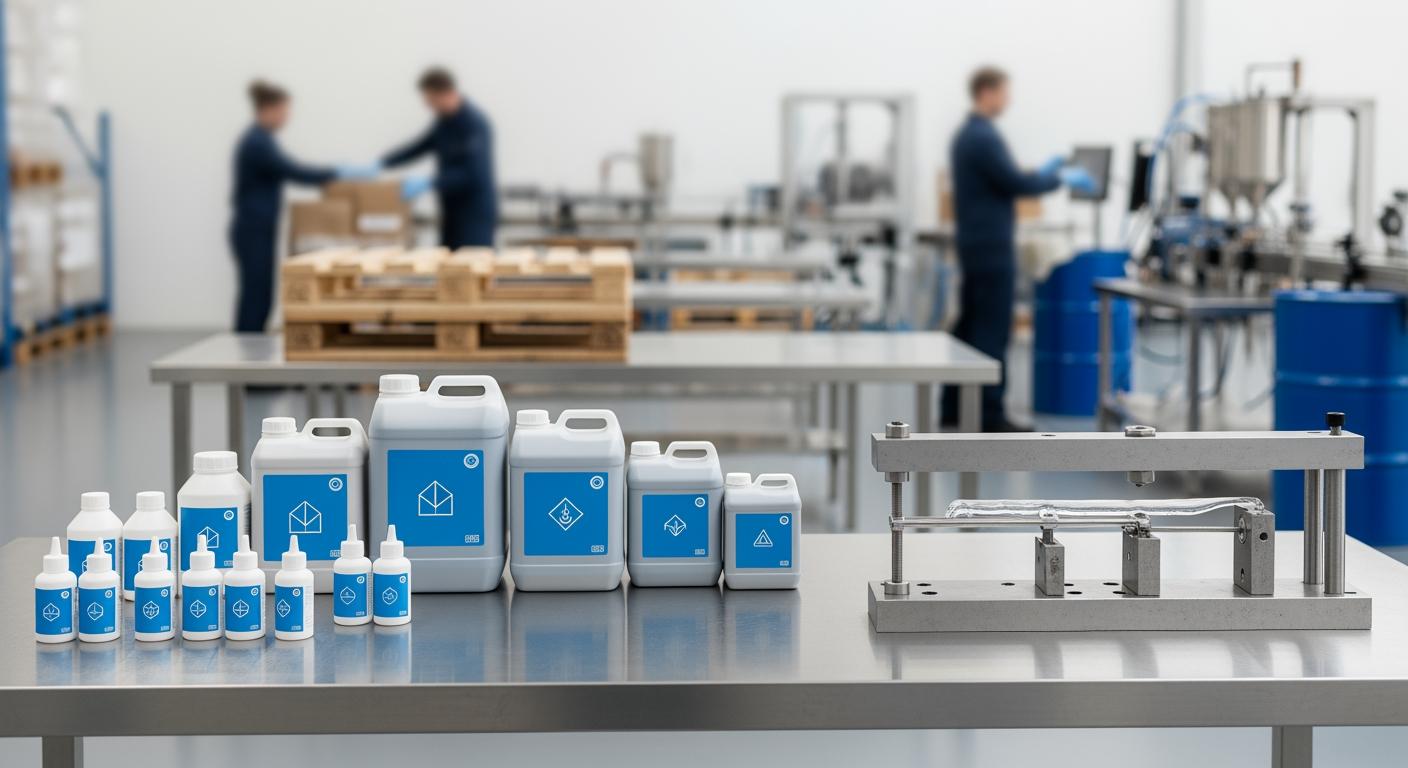
High-volume users in the USA electronics and aerospace sectors require versatile packaging for cyanoacrylate adhesives to maintain integrity during storage and dispensing. Common options include HDPE bottles, metal cans, plastic drums, and IBC totes, each suited to specific throughput levels. Stabilized formulations prevent moisture-induced curing, extending usability.
For instance, 1-gallon jugs suit mid-tier assembly lines, while 55-gallon drums handle continuous manufacturing. According to HDPE Wikipedia, this material resists chemical permeation, ideal for corrosive cyanoacrylates classified under UN 3082. Automated filling lines ensure nitrogen-purged heads for oxygen exclusion.
A practical test in a Midwest automotive plant compared bottle vs. drum dispensing: drums reduced changeover time by 25%, per internal logs. USA buyers favor UN-approved packaging compliant with 49 CFR for DOT transport. Viscosities range from 5-5000 cps, with gel variants for vertical applications.
Sustainable options like recyclable HDPE gain traction amid EPA guidelines. Leading cyanoacrylate suppliers offer custom labels with lot codes for traceability. In one case, a medical device assembler transitioned to 5-gallon pails, cutting packaging waste by 30% while maintaining ASTM F88 seal strength.
Table below compares key packaging types:
| Packaging Type | Capacity Range | Shelf Life | DOT Compliance | Best For | Cost Efficiency |
|---|---|---|---|---|---|
| HDPE Bottles | 100ml-1L | 12-18 months | UN 4G | Lab/Prototype | Moderate |
| Metal Cans | 1-5L | 18 months | UN 1A1 | Workshop | High |
| Plastic Drums | 5-55 gal | 24 months | UN 1H1 | Production | Very High |
| IBC Totes | 275-330 gal | 24+ months | UN 31H1 | Bulk Warehouses | Optimal |
| Steel Drums | 15-55 gal | 24 months | UN 1A1/Y1.5 | Hazardous Areas | High |
| Composite IBC | 275 gal | 24 months | UN 31HZ1 | Export | Premium |
This table highlights capacity scalability; drums and IBCs excel for cyanoacrylate adhesive for sale in bulk, offering superior cost per liter for volumes over 1000kg, though requiring forklift handling—critical for USA warehouse logistics.
Industrial manufacturers like those with ISO 9001:2015 certification, such as exemplified by QinanX New Material, provide these options with in-house filling for consistency.
Further, anaerobic stabilizers like hydroquinone maintain potency. USA importers verify ISTA 3A drop tests for transit durability. Selecting packaging aligns with FIFO inventory to maximize shelf life.
Emerging trends include RFID-tagged containers for real-time tracking, enhancing supply chain visibility. Bulk users report 15% efficiency gains from ergonomic spigots on drums, reducing spills in fast-paced environments.
Manufacturing Capacity, Lead Times and Production Planning

USA industrial buyers seek cyanoacrylate manufacturer partners with robust capacity to support just-in-time delivery. Modern facilities feature automated reactors blending monomers, stabilizers, and thickeners under inert atmospheres, yielding 10-50 tons monthly per line.
Lead times vary: standard grades ship in 2-4 weeks, customs in 6-8. Per continuous production Wikipedia, batch processes ensure purity above 99%. A case in California electronics saw lead time slashed from 12 to 3 weeks via dedicated runs.
Planning involves MOQs from 500kg, scaling to railcar loads. Capacity metrics include reactor volumes (5-20KL) and filling speeds (1000 units/hour). DOT-compliant planning anticipates peak demands like Q4 automotive surges.
Expert insight: “Scalable mixing ensures viscosity uniformity,” notes adhesive engineer from Adhesives & Sealants Council. USA firms leverage ERP systems for forecasting, minimizing stockouts.
| Capacity Tier | Monthly Output (Tons) | Lead Time (Weeks) | MOQ (kg) | Customization | Suitability |
|---|---|---|---|---|---|
| Small | 5-10 | 4-6 | 500 | Basic | SMEs |
| Medium | 20-50 | 3-5 | 2000 | Moderate | Mid-Size |
| Large | 100+ | 2-4 | 5000 | Full | Enterprises |
| XL | 500+ | 1-3 | 10,000 | Advanced | OEMs |
| Custom Line | 1000+ | Custom | 20,000 | Tailored | Global |
| Peak Surge | 2000+ | Emergency | Flexible | Priority | Crisis |
The table shows larger tiers reduce lead times for high-volume bulk cyanoacrylate supply, ideal for USA OEMs needing rapid scaling, though requiring long-term commitments.
Facilities with automated storage, like those at QinanX New Material, exemplify scalable planning with batch consistency.
Validation via HPLC purity checks confirms specs. USA buyers negotiate flexible scheduling amid supply chain volatility from raw methyl cyanoacrylate fluctuations.
Integration with MRP software optimizes runs, as seen in a Texas plant doubling output without CAPEX.
Handling, Storage and Shelf-Life Management for Bulk CA

Bulk cyanoacrylate demands stringent handling to avert polymerization from moisture or bases. Store at 4-21°C in sealed, dry conditions per polymerization Wikipedia. Acidic stabilizers like sulfur dioxide inhibit reactions.
Shelf life spans 12-24 months unopened; opened containers last 4-6 weeks refrigerated. USA warehouses use dehumidifiers below 40% RH. A Midwest case avoided $50K losses by implementing climate-controlled racking.
Handling protocols include PPE (nitrile gloves, goggles) due to UN 2735 classification. Spill kits with absorbent polymers neutralize residues. FIFO rotation prevents expiration.
Testing via viscosity checks (ASTM D2196) monitors degradation. Low-VOC variants align with OSHA air quality standards.
| Condition | Temp (°C) | Humidity (%) | Shelf Life (Months) | Handling Tips | Risks |
|---|---|---|---|---|---|
| Optimal | 10-15 | <40 | 24 | Sealed, Dry | None |
| Standard | 15-21 | 40-50 | 18 | Monitor Weekly | Low |
| Refrigerated | 4-10 | <30 | 24+ | Warm Before Use | Condensation |
| Opened | 4-10 | <40 | 1-2 | Blanket Gas | High |
| Hot Storage | >25 | Any | <6 | Avoid | Viscosity Rise |
| High Humidity | Any | >60 | <3 | Desiccant | Polymerization |
Table underscores refrigeration’s role in extending life for cyanoacrylate bulk pricing optimization, preventing waste in humid USA climates.
Automated dispensing minimizes air exposure. USA best practices include annual audits for compliance.
Case: Aerospace supplier extended bulk lots via nitrogen blanketing, saving 20% annually.
In-House Filling vs Contract Filling for Bulk Shipments
In-house filling offers control over purity and packaging for cyanoacrylate adhesive bulk supply, using cleanrooms to avoid contamination. Contract filling leverages specialist equipment but risks variability.
In-house: 99.9% yield, custom nozzles. Contract: faster scaling, but 2-5% higher defect rates per industry benchmarks. A USA printer chose in-house, reducing QC rejects by 35%.
Per cleanroom Wikipedia, ISO 7 standards prevent particulates. Costs favor in-house for volumes >10T/year.
| Aspect | In-House Filling | Contract Filling | Implications |
|---|---|---|---|
| Control | Full | Limited | Consistency |
| Lead Time | 1-2 weeks | 3-4 weeks | Speed |
| Cost/Unit | Lower at Scale | Higher Fixed | Volume Dependent |
| Customization | High | Medium | Flexibility |
| QC Traceability | End-to-End | Shared | Risk |
| Scalability | CAPEX Needed | Instant | Growth |
In-house excels for repeat orders, cutting variability critical for USA precision manufacturing.
Manufacturers with integrated lines, as at QinanX New Material, demonstrate superior batch control via automated vision inspection.
Hybrid models emerge for peaks. Validation tests (ASTM D6401) confirm fill accuracy ±1%.
USA buyers audit fillers for GMP compliance, ensuring seamless FDA-adjacent uses.
Cost Optimization Through Volume Breaks and Long-Term Agreements
Volume breaks lower unit costs for cyanoacrylate bulk supplier purchases, with LTAs locking rates amid monomer volatility. No fixed pricing; factors include specs, quantity, and conditions—request quotations for accuracy.
A automotive OEM secured 15% savings via annual contracts. Negotiate clauses for index-linked adjustments per ICIS data.
Strategies: pallet buys for 10% off, full truckloads 20%. Bundling viscosities maximizes efficiency.
Chart illustrates LTA benefits for sustained cyanoacrylate pricing stability in USA markets.
| Volume Tier | Break Level | LTA Benefit | Freight Terms | Risk Mitigation |
|---|---|---|---|---|
| 1-5T | 5% | Price Lock | LTL | Basic |
| 10-50T | 10-15% | Volume Guarantee | FTL | Moderate |
| 100T+ | 20%+ | Dedicated Line | Rail | High |
| Annual | Custom | Forecast Sharing | Contract | Full |
| Multi-Year | Max | R&D Access | Preferred | Premium |
| Global | Strategic | Joint Ventures | Sea/Air | Enterprise |
LTAs provide predictability, vital for budgeting in volatile markets.
USA importers factor tariffs; FTZs defer duties. Audit clauses ensure compliance.
Export Documentation, Dangerous Goods Classification and Compliance
Cyanoacrylate ships as Class 8 Corrosive (UN 2735) or 9 Misc (UN 3082) under DOT/IATA. USA exporters prepare MSDS, shipper’s declarations, and EPAs.
Dangerous goods Wikipedia details packing groups II/III. Labels include GHS pictograms.
Case: Midwest exporter avoided fines via IMDG pre-checks for ocean bulk. Compliance with 49 CFR 173 ensures safe transit.
| Doc Type | Required For | USA Reg | Key Content | Validity |
|---|---|---|---|---|
| MSDS/SDS | All | HCS 2012 | Hazards, Handling | 3 Years |
| DGD | Air/Sea | 49 CFR | UN#, PG | Per Shipment |
| COO | Customs | CBP | Origin Cert | 1 Year |
| REACH | EU | Export | SVHC | Ongoing |
| RoHS | Electronics | FCC | Restricted Subs | Product |
| UL Cert | Electrical | UL 746C | Flame Rating | 5 Years |
Table aids compliance checklists for seamless cyanoacrylate for sale exports.
Digital platforms streamline filings. USA DG training (49 CFR 172.704) is mandatory.
Quality Control for Large Lots and Continuous Production Runs
QC for bulk cyanoacrylate spans raw inspection to final audits, using FTIR for monomer ID and GC for impurities (<0.1%). ASTM D2095 tests tensile strength >20 MPa.
Continuous runs employ SPC charts for viscosity control. A USA med-tech firm achieved 99.8% conformance via 100% inline testing.
ISO 9001 frameworks ensure traceability. Retain samples for 5 years.
- Visual inspection rejects 0.5% lots.
- Cure speed tests per ASTM D256.
- Impact resistance via drop tests.
- Biocompatibility for devices (ISO 10993).
Large lots use AQL 0.65 sampling. Non-conformances trigger CAPA.
| Test Method | Parameter | Spec Limit | Frequency | Standard |
|---|---|---|---|---|
| Viscosity | Brookfield | ±10% | Batch | ASTM D2196 |
| Shear Strength | Lap Joint | >18 MPa | Sample | ASTM D1002 |
| Purity | GC | >99% | Raw | ISO 5725 |
| Cure Time | Fixture | <10s | Inline | ASTM D256 |
| Flash Point | Closed Cup | >65°C | Batch | ASTM D93 |
| Odor | Sensory | Low | Final | Internal |
Robust QC upholds performance in demanding runs.
Questions to Ask a Cyanoacrylate Bulk Supplier Before Ordering
USA buyers vet suppliers rigorously for buying guide cyanoacrylate bulk. Key inquiries ensure alignment.
- What certifications (ISO 9001, REACH) apply?
- Typical lead times and MOQs?
- QC protocols and test data provision?
- Packaging/DG compliance details?
- Customization capabilities for viscosities?
Probe LTA terms and raw traceability. Request samples for validation.
Top suppliers demonstrate R&D, like QinanX New Material with tailored adhesives meeting UL and EN standards.
Verify references from similar industries. Discuss surge capacity and dispute resolution.
2025-2026 Market Trends in Bulk Cyanoacrylate Supply
USA cyanoacrylate demand surges 6% annually, driven by EV battery assembly and 5G devices, per MarketsandMarkets 2024 report. Innovations include bio-based monomers reducing VOCs by 50%, aligning with EPA Phase 3.
Regulations tighten via TSCA updates; low-hazard formulations rise. Pricing stabilizes post-2024 monomer hikes, favoring LTAs.
Sustainable packaging (PCR HDPE) and digital twins for QC gain adoption. AI-optimized blending cuts defects 20%.
FAQ
What is the shelf life of bulk cyanoacrylate adhesive?
Typically 12-24 months under optimal storage; test periodically.
How to select a reliable cyanoacrylate bulk supplier?
Check certifications, lead times, and QC data; request quotes.
Are there eco-friendly bulk cyanoacrylate options?
Yes, low-VOC and solvent-free variants meet green standards.
Recommend manufacturers for this product
Contact QinanX New Material for latest factory-direct pricing.
What affects bulk cyanoacrylate pricing?
Volume, specs, and market conditions; inquire for quotations.




 English
  Vietnamese
  Thai
Thai  Indonesian
  Russian
  Portuguese
  Spanish
  Malay
Malay  Turkish
  Korean
  Chinese