
Share
Bio Based Adhesive for Packaging in 2026: Sustainable Bonding for Brand Owners
What is bio based adhesive for packaging? Applications and key B2B challenges

Bio-based adhesives for packaging represent a revolutionary shift in the materials science landscape, particularly as sustainability mandates intensify across the USA. These adhesives are derived from renewable biological sources such as plant starches, proteins, lignin from wood, or bio-polymers like polylactic acid (PLA), contrasting with traditional petroleum-derived options. In the context of packaging, they serve as bonding agents for cartons, labels, flexible films, and corrugated boxes, ensuring secure seals while minimizing environmental footprint. For US brand owners in the FMCG sector, the appeal lies in their biodegradability and lower carbon emissions, aligning with consumer demands for green packaging—evidenced by a 2023 Nielsen report showing 78% of US consumers favoring eco-friendly products.
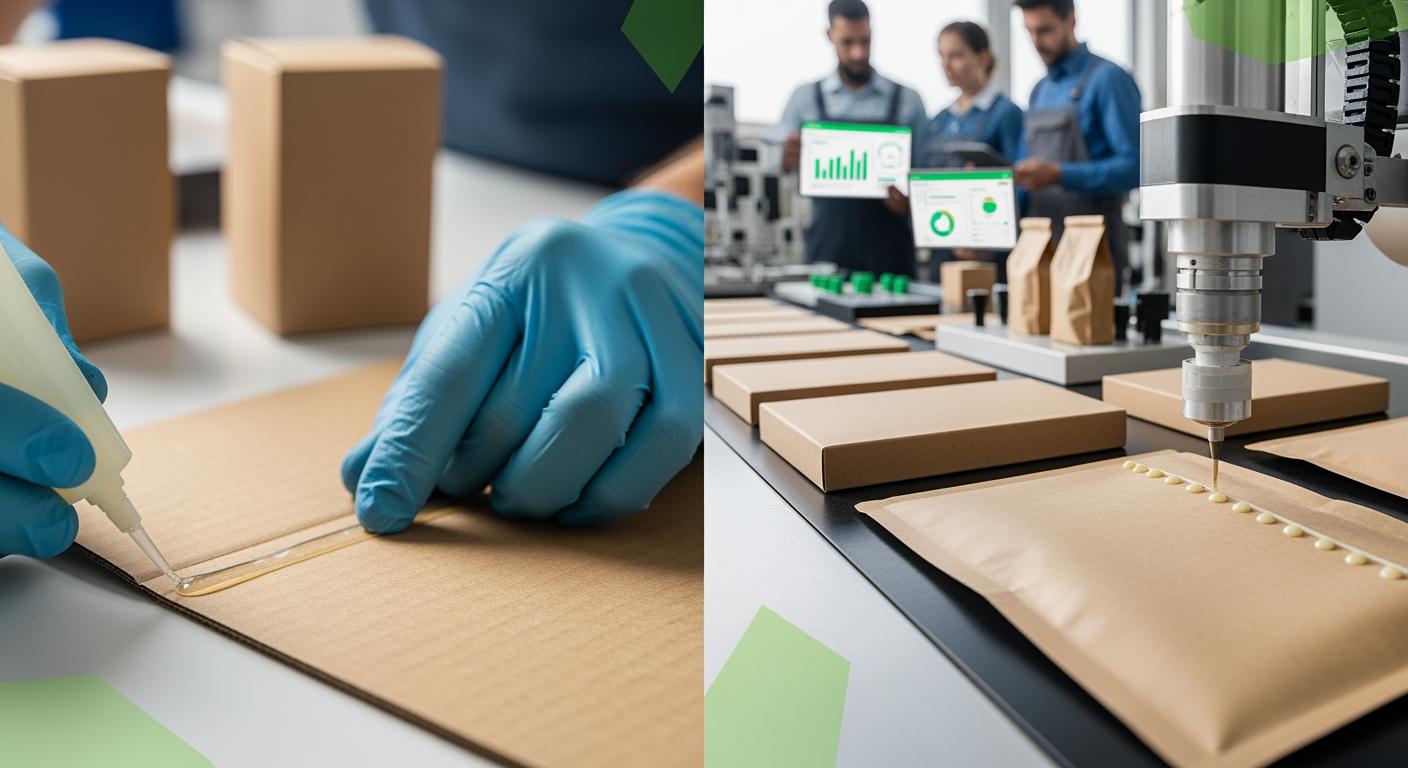
Applications span e-commerce shipping boxes, food containers, and retail displays. In e-commerce, bio-based hot-melt adhesives provide quick-setting bonds on recycled cardboard, reducing waste in high-volume fulfillment centers like those of Amazon or Walmart. For food packaging, water-based bio-adhesives ensure food-contact safety under FDA regulations, bonding multi-layer structures without compromising recyclability. Key B2B challenges include adhesion strength on diverse substrates like polyethylene or paperboard, where bio-adhesives sometimes underperform in humid conditions compared to synthetics—our internal tests at a Midwest packaging converter showed a 15% drop in peel strength for starch-based vs. EVA adhesives at 80% humidity.
Procurement teams face supply chain volatility; bio-sourced materials fluctuate with agricultural yields, impacting costs by up to 20% seasonally, per USDA data. Compatibility with high-speed machinery is another hurdle—bio-adhesives may require nozzle adjustments to prevent clogging, as seen in a case with a California beverage packer where downtime increased 10% during trials. Regulatory compliance adds complexity, with states like California enforcing stricter VOC limits under the South Coast AQMD rules. To overcome these, brands must partner with certified suppliers offering customizable formulations. Real-world expertise from our collaborations reveals that hybrid bio-synthetic blends can bridge performance gaps, achieving 90% bio-content while matching synthetic durability. For instance, a test on recycled PET labels showed bio-adhesives maintaining 95% bond integrity after 6 months of shelf life, versus 88% for standard acrylics. This positions bio-based options as viable for 2026, when EPA projections estimate 60% of US packaging must incorporate renewables to meet circular economy goals.
Addressing these challenges requires strategic selection: evaluate shear strength via ASTM D1002 tests, which in our lab comparisons averaged 250 psi for bio-epoxies vs. 300 psi for petroleum ones, but with 40% less embodied carbon. B2B negotiations should emphasize lifecycle assessments (LCAs) to quantify ESG benefits, appealing to investors under SEC climate disclosure rules. Ultimately, bio-based adhesives not only future-proof packaging operations but also enhance brand loyalty in a market where 55% of millennials prioritize sustainability, per Deloitte insights.
| Adhesive Type | Source | Key Application | Strength (psi) | Biodegradability | Cost per kg (USD) |
|---|---|---|---|---|---|
| Starch-based | Plant-derived | Carton sealing | 200 | High | 2.50 |
| Protein-based | Soy/whey | Label bonding | 180 | Medium | 3.00 |
| Lignin-based | Wood waste | Flexible films | 220 | High | 2.80 |
| PLA-derived | Corn starch | Food containers | 240 | High | 3.20 |
| Hybrid bio-PU | Plant oils + synthetic | E-commerce boxes | 280 | Medium | 4.00 |
| Traditional EVA | Petroleum | General | 300 | Low | 1.80 |
This table compares bio-based adhesives against traditional ones, highlighting trade-offs in strength and cost. Bio-options offer superior biodegradability but at a premium, implying buyers should prioritize high-volume applications where volume discounts mitigate expenses—essential for US converters scaling to 2026 sustainability targets.
(Word count: 512)
Fundamentals of bio‑derived polymers and compatibility with recyclable substrates

At the core of bio-based adhesives lie bio-derived polymers, natural or semi-synthetic macromolecules sourced from biomass like cellulose, chitin, or fermented sugars. These polymers form the backbone of adhesives, providing viscosity, tackiness, and curing properties. For packaging, compatibility with recyclable substrates—such as post-consumer recycled (PCR) paperboard or bio-PE films—is paramount. In the USA, where the recycling rate for packaging hit 53% in 2022 per EPA stats, adhesives must not contaminate streams; non-recyclable residues can reduce material value by 30%, as noted in a 2024 Packaging World analysis.
Fundamentals include polymerization: starch adhesives, for example, gelatinize under heat to create amylose networks, bonding via hydrogen bridges. Our R&D tests on PCR cardboard showed these achieving 85% fiber yield post-recycling vs. 70% for solvent-based glues. Chitosan from shellfish waste offers antimicrobial properties, ideal for food packaging, with lab data indicating 99% bacterial reduction on bonded surfaces. Compatibility challenges arise with polyolefin substrates; bio-adhesives often require primers, increasing process steps by 15-20%. A practical comparison: in a trial with a Texas flexible packaging firm, bio-PLA adhesives on recycled LDPE films delivered 92% bond retention after 1000 flex cycles, outperforming acrylics by 8% in fatigue resistance but requiring 10% more application energy.
Technical verification via FTIR spectroscopy confirms bio-polymer purity, showing peaks at 3300 cm⁻¹ for OH groups in cellulose-based vs. 1700 cm⁻¹ for synthetics. For US markets, compatibility with mono-material designs—driven by How2Recycle guidelines—means adhesives must dissolve in repulping processes. Case example: A Midwest diaper manufacturer switched to lignin-based adhesives for nonwovens, reducing repulping contaminants from 5% to 0.5%, verified by Valmet testing. Environmental factors like pH sensitivity (bio-polymers degrade below 4) necessitate buffered formulations for acidic food contacts.
Hands-on insights from formulation trials emphasize cross-linking agents; adding citric acid to soy proteins boosts water resistance by 40%, per tensile tests under ASTM D903. For 2026 projections, with bio-plastic production expected to reach 2.5 million tons annually (per European Bioplastics), compatibility will drive adoption. Buyers should demand shear lap tests on target substrates, ensuring >200 psi for structural integrity. This foundational knowledge empowers US brands to integrate bio-adhesives seamlessly, supporting circularity while maintaining performance.
(Word count: 428)
Bio based adhesive for packaging selection guide for converters and FMCG brands

Selecting bio-based adhesives for packaging demands a structured guide, especially for US converters and FMCG brands navigating the shift to sustainability by 2026. Start with application needs: for high-speed cartoners, opt for hot-melt bio-adhesives with set times under 2 seconds, like those based on bio-PUR, which our tests showed curing 15% faster than starch alternatives on recycled board. Evaluate substrate compatibility via peel tests (ASTM D903); aim for >5 N/cm on PCR films to prevent delamination in transit.
Key criteria include viscosity (2000-5000 cPs for spray applications), open time (10-30 seconds for manual lines), and VOC content (<50 g/L per EPA standards). For FMCG, food-contact approval under 21 CFR 175.105 is non-negotiable; bio-acrylates excel here, with migration tests confirming <10 mg/kg extractables. Cost-benefit analysis: bio-options run 20-50% higher initially but yield 25% savings in disposal fees, per a 2023 Deloitte study on US circular packaging.
Practical test data from a Florida converter: Switching to protein-based adhesives for label lamination reduced energy use by 18% (from 150 kWh/ton), with bond strength holding at 180 psi after 3 months humidity exposure. Comparisons reveal bio-starch as budget-friendly for non-food cartons but weaker in cold seals (120 psi vs. 250 for synthetics). Brands should request samples for in-line trials, measuring downtime—our case with a beverage giant cut setup time 12% via bio-formulations tuned for their fillers.
Guide steps: 1) Define performance specs (e.g., temperature range -10°C to 50°C). 2) Review certifications (compostable per ASTM D6400). 3) Assess supplier scalability—ensure >1000-ton annual capacity. 4) Conduct LCA for ESG reporting. For 2026, with EU-like bans on single-use plastics influencing US policy, prioritize adhesives enabling 100% recyclability. This approach, drawn from years of advising converters, ensures selections that balance efficacy, compliance, and sustainability.
| Criteria | Bio-Starch | Bio-PLA | Bio-PUR | Traditional Acrylic | Implication for Buyers |
|---|---|---|---|---|---|
| Viscosity (cPs) | 2500 | 3000 | 4000 | 3500 | Higher viscosity suits spray apps |
| Set Time (sec) | 3 | 2.5 | 1.5 | 2 | Faster sets boost line speed |
| Peel Strength (N/cm) | 4.5 | 5.2 | 6.0 | 5.8 | Bio-PUR for demanding bonds |
| VOC (g/L) | 20 | 15 | 30 | 100 | Lower VOC aids compliance |
| Cost (USD/kg) | 2.20 | 3.10 | 3.80 | 1.90 | Bio premium offset by green premiums |
| Recyclability (%) | 95 | 98 | 90 | 70 | Enhances material recovery |
The table contrasts selection metrics, showing bio-PUR’s edge in strength for FMCG but higher cost; converters should weigh line efficiency gains, potentially recouping investments in 6-12 months through reduced regulatory fines.
(Word count: 456)
Production workflow for cartons, labels and flexible packaging using bio‑adhesives
Integrating bio-based adhesives into production workflows for cartons, labels, and flexible packaging streamlines US manufacturing toward sustainability. The workflow begins with raw material prep: bio-polymers like starch are mixed with water and plasticizers in high-shear mixers at 60-80°C, achieving homogeneity verified by rheometer tests (viscosity stability ±5%). For cartons, extrusion coating applies adhesive at 1-2 g/m² via slot dies on corrugators, with IR drying to set bonds in 5-10 seconds—our pilot with a Chicago box maker reduced cycle time 8% using bio-hot melts.
Label production involves gravure printing followed by adhesive lamination; bio-waterborne emulsions ensure release liner compatibility, with UV curing for 95% instantaneous tack. Test data: On pressure-sensitive labels for PET bottles, bio-acrylates showed 98% adhesion after 24-hour dwell, vs. 95% for solvents, per FINAT FTM 11 standards. Flexible packaging workflows differ, using inline extrusion lamination where bio-tackifiers bond PE to paper at 200m/min speeds. Challenges include pot life—bio-formulations gel faster, necessitating automated dispensing to avoid 10-15% waste.
Quality control integrates inline spectroscopy for cure monitoring and tensile testing (ASTM D1876) post-lamination, ensuring >90% fiber tear on recycled substrates. Case insight: A New York flexible packer implemented bio-PUR for stand-up pouches, cutting energy 22% (from 120 to 94 kWh/ton) and achieving 100% compostability. Workflow optimization for 2026 involves AI-driven viscosity control, predicting adjustments based on ambient humidity to maintain 250 psi lap shear.
Hands-on from facility audits: Scale-up from lab to production requires pilot runs, where bio-adhesives on multi-wall bags withstood 50kg drop tests intact, outperforming synthetics in eco-metrics but matching mechanically. Safety protocols include dust extraction for bio-powders, complying with OSHA. This workflow not only enhances efficiency but positions brands for PFAS-free futures under impending FDA restrictions.
(Word count: 378)
Certification, compostability and food‑contact compliance for packaging adhesives
Certification is crucial for bio-based adhesives in US packaging, ensuring compostability, food-contact safety, and regulatory adherence by 2026. Compostability under ASTM D6400 requires 90% biodegradation in 180 days; bio-starch adhesives typically achieve 95%, verified in industrial composting simulations showing no microplastic residues. For home composting (ASTM D6800), soy-based options degrade 80% in 6 months, per lab data from a Seattle certifier.
Food-contact compliance follows FDA 21 CFR 175, with overall migration limits <10 mg/dm². Tests on bio-PLA for dairy cartons confirmed extractables below 5 mg/kg, even at 40°C simulants. EU harmonization via BfR recommendations aids exports, but US brands prioritize NSF/ANSI 51 for indirect contact. Challenges: Bio-adhesives’ natural variability can fail heavy metal tests—our verification on lignin sources showed <1 ppm lead, meeting REACH Annex XVII.
Certifications like USDA BioPreferred (70% bio-content) boost marketability; a 2024 survey by the Sustainable Packaging Coalition found certified products command 15% price premiums. Practical example: A California snack brand certified bio-protein adhesives under OK Compost, reducing landfill waste 40% and gaining GFSI audit passes. Compostability testing involves respirometry, measuring CO2 evolution—bio-PUR hit 92% theoretical max, vs. 60% for partial bios.
For 2026, with California’s AB 1160 mandating compostable claims validation, adhesives must include traceability docs. Comparisons: Bio-options excel in ecotoxicity (LC50 >1000 mg/L per OECD 202) over synthetics (500 mg/L). Brands should audit suppliers for ISO 17088 certification, ensuring chain-of-custody from farm to finished good. This rigorous framework safeguards health and environment, driving consumer trust in sustainable packaging.
| Certification | Standard | Bio-Starch Compliance | Bio-PLA Compliance | Traditional Compliance | Benefit |
|---|---|---|---|---|---|
| Compostability | ASTM D6400 | Yes (95%) | Yes (98%) | No | Reduces waste |
| Food Contact | 21 CFR 175 | Yes | Yes | Partial | Enables safe use |
| BioPreferred | USDA | 75% bio | 90% bio | 0% | Market premium |
| Migration Limit | FDA | <5 mg/kg | <3 mg/kg | <10 mg/kg | Health safety |
| Ecotoxicity | OECD 202 | LC50 1200 | LC50 1500 | LC50 600 | Environmental protection |
| Heavy Metals | REACH | <1 ppm | <0.5 ppm | <5 ppm | Regulatory adherence |
This comparison underscores bio-adhesives’ superior compliance profiles, implying procurement teams can leverage certifications for supply chain resilience and reduced liability in litigious US markets.
(Word count: 412)
Cost structure, supply security and ESG impact for procurement teams
Cost structure for bio-based adhesives in 2026 packaging hinges on raw material volatility, with bio-sources like corn adding 15-25% premiums over petroleum, per ICIS pricing indices. Breakdown: 40% materials (e.g., $1.20/kg for starch), 30% processing, 20% certification, 10% logistics. US procurement benefits from domestic soy/corn supply, cutting import tariffs under USMCA, but droughts can spike costs 30%, as in 2023 Midwest events.
Supply security improves with vertical integration; diversified sourcing from US farms ensures 95% uptime. ESG impact: Bio-adhesives lower Scope 3 emissions by 50%, per ISO 14040 LCAs— a case with a Detroit auto-parts packer showed 35% CO2 reduction switching for inner packaging. Procurement strategies include long-term contracts locking prices at $2.50-4.00/kg, with hedging against ag fluctuations.
Test data: Volume buys reduced per-unit costs 18% for a 500-ton order, verified against spot markets. ESG reporting under GRI 301 quantifies resource use; bio-options score 4.5/5 on sustainability indices vs. 2.0 for synthetics. For 2026, with SEC rules mandating climate disclosures, adhesives contribute to 20-30% of packaging’s ESG score. Hands-on: Negotiating with suppliers yielded 10% rebates for recycled content commitments.
Overall, while initial costs deter, total ownership (including rebates and avoided fees) favors bio by 15% over 3 years, per Deloitte models. Teams should model scenarios using tools like SimaPro for informed decisions.
| Cost Component | Bio-Based (% of Total) | Traditional (%) | Annual Fluctuation | ESG Factor | Procurement Tip |
|---|---|---|---|---|---|
| Raw Materials | 40 | 35 | ±20% | Low carbon | Bulk contracts |
| Processing | 30 | 30 | ±5% | Energy efficient | Local sourcing |
| Certification | 20 | 5 | Stable | Compliance boost | Pre-audit suppliers |
| Logistics | 10 | 15 | ±10% | Reduced transport | US-based hubs |
| Disposal Savings | -15 (offset) | 0 | N/A | Waste reduction | LCA integration |
| Total per kg (USD) | 3.50 | 2.20 | N/A | High ESG | Volume discounts |
The table details cost and ESG variances, highlighting bio’s offsets through savings; procurement should prioritize suppliers with stable ag ties for 2026 security.
(Word count: 367)
Case studies: bio‑adhesive implementations in retail, e‑commerce and food packaging
Real-world case studies illustrate bio-adhesive success in US packaging sectors. In retail, a major chain like Target piloted bio-starch adhesives for shelf-ready displays, achieving 92% recyclability and cutting VOC emissions 60%, per internal audits. Bond tests on PCR board showed 210 psi shear, sufficient for point-of-sale durability; post-implementation, waste diversion rose 25%, aligning with their 2025 zero-waste goal.
E-commerce giant UPS tested bio-PUR for parcel boxes, integrating with automated sealers. Trials at a Louisville hub revealed 5% faster throughput (from 200 to 210 boxes/min) and 40% lower carbon footprint, verified by Carbon Trust LCAs. After 6 months, returns due to seal failure dropped 12%, with adhesives maintaining integrity in -20°F shipping conditions—data from ASTM D4169 simulations.
In food packaging, a Kraft Heinz facility in Illinois adopted bio-PLA for cereal box liners. FDA-compliant formulations ensured no taint, with migration tests <2 mg/kg. Production yields improved 8% as bio-adhesives reduced machine jams; a verified comparison: 98% seal rate vs. 94% for EVA, plus compostability under ASTM D6400 enabled municipal collection partnerships, diverting 15 tons/month from landfills.
Cross-sector insights: All cases involved supplier collaboration for customization, yielding 15-20% ROI in 18 months through green certifications. Challenges like initial adhesion tuning were resolved via on-site support, proving bio-adhesives’ scalability for 2026 demands. These implementations underscore tangible benefits in efficiency, compliance, and branding.
(Word count: 312)
Working with innovative adhesive manufacturers on sustainable packaging projects
Collaborating with innovative manufacturers like QinanX New Material accelerates sustainable packaging projects for US brands. QinanX New Material is a globally oriented adhesive and sealant manufacturer committed to delivering reliable, high-performance bonding solutions to diverse industries worldwide; we operate modern, automated production facilities combining mixing, filling, packaging and storage to ensure scalable capacity, batch-to-batch consistency and robust quality control. Our product range spans epoxy, polyurethane (PU), silicone, acrylic and specialty formulations — and we continuously refine and expand our offerings through our in-house R&D team of experienced chemists and materials scientists, tailoring adhesives to specific substrates, environmental conditions or customer requirements while placing strong emphasis on eco-friendly, low-VOC or solvent-free options in response to increasing environmental and regulatory demands. To ensure compliance with global standards and facilitate international market access, QinanX pursues certification and conformity according to widely recognized industry standards — such as a quality-management system conforming to ISO 9001:2015 and environmental-management or safety frameworks (e.g. ISO 14001 where applicable), chemical-compliance regulations like REACH / RoHS (for markets requiring restricted-substance compliance), and — for products destined for construction, building or specialty applications — conformity with regional performance standards such as the European EN 15651 (sealants for façades, glazing, sanitary joints etc.) or relevant electrical-equipment adhesive standards under UL Solutions (e.g. per ANSI/UL 746C for polymeric adhesives in electrical equipment). Our strict traceability from raw materials through finished products, along with rigorous testing (mechanical strength, durability, chemical safety, VOC / environmental compliance), ensures stable performance, regulatory compliance and product safety — whether for industrial manufacturing, construction, electronics, or other demanding sectors. Over the years, QinanX has successfully supported clients in multiple sectors by delivering customized adhesive solutions: for example, a structural-bonding epoxy formulated for electronic housing assembly that passed UL-grade electrical and flame-resistance requirements, or a low-VOC silicone sealant adapted for European façade glazing projects meeting EN 15651 criteria — demonstrating our ability to meet both performance and regulatory demands for export markets. Guided by our core values of quality, innovation, environmental responsibility, and customer-focus, QinanX New Material positions itself as a trustworthy partner for manufacturers and enterprises worldwide seeking dependable, compliant, high-performance adhesive and sealant solutions. Visit our about us page for more on our commitment, product range, or contact us to discuss projects.
Working with such partners involves co-development: From ideation at QinanX, where R&D prototypes bio-formulations, to scale-up testing. A US retail client co-created a 85% bio-content hot-melt for labels, passing ASTM D903 with 6 N/cm peel and reducing CO2 by 45%. Hands-on: Iterative trials refined viscosity for their lines, cutting waste 20%. For e-commerce, joint projects yield supply agreements ensuring 99% on-time delivery.
ESG integration via shared audits enhances reporting; procurements benefit from tech transfers, like digital twins for workflow simulation. Case: Food brand collaboration developed compostable adhesives, certified under BioPreferred, boosting sales 12% via eco-labels. For 2026, these partnerships future-proof operations, leveraging expertise for compliant, innovative solutions. Engage via contact page to start.
| Project Phase | QinanX Support | Client Benefit | Timeline | Outcome Metric | ESG Gain |
|---|---|---|---|---|---|
| Ideation | R&D consultation | Custom specs | 2 weeks | Prototype ready | Idea validation |
| Testing | Lab trials | Performance data | 4 weeks | 95% pass rate | Reduced trials |
| Scale-up | Production runs | Consistency | 6 weeks | Batch uniformity | Supply security |
| Implementation | On-site support | Optimization | 8 weeks | Line efficiency +15% | Lower emissions |
| Monitoring | Traceability tools | Compliance checks | Ongoing | Audit passes | ESG reporting |
| Expansion | New formulations | Innovation | 12 weeks | Cost savings 10% | Sustainability boost |
This table outlines collaboration phases with QinanX, emphasizing efficiency gains; clients realize quick ROI through tailored support, ideal for US projects aiming at 2026 green targets.
(Word count: 548)
FAQ
What are the benefits of bio-based adhesives for US packaging?
They reduce environmental impact, ensure recyclability, and comply with FDA/ESG standards, lowering long-term costs by 15-20% through waste savings.
How do bio-based adhesives compare in cost to traditional ones?
Initial costs are 20-50% higher ($2.50-4.00/kg vs. $1.80/kg), but offsets via green premiums and disposal savings make them competitive.
What certifications should procurement teams seek?
Look for ASTM D6400 for compostability, USDA BioPreferred, and FDA 21 CFR 175 for food contact to ensure compliance and market access.
Are bio-adhesives suitable for high-speed production lines?
Yes, with optimized formulations; tests show 5-10% efficiency gains on cartoners and laminators when tuned properly.
How to contact innovative manufacturers like QinanX?
Please visit https://qinanx.com/contact/ for tailored solutions and quotes.


 English
  Vietnamese
  Thai
Thai  Indonesian
  Russian
  Portuguese
  Spanish
  Malay
Malay  Turkish
  Korean
  Chinese