
Share
Structural Adhesive for Bus Body Manufacturing: OEM-Focused Solutions
Structural adhesives revolutionize bus body manufacturing by enabling lightweight designs, enhanced durability, and cost-efficient assembly for US OEMs. These high-strength bonding agents replace traditional welding and riveting, reducing weight by up to 40% according to adhesive bonding principles documented on Wikipedia. In the competitive US transit and school bus sectors, where Federal Motor Vehicle Safety Standards (FMVSS) demand superior crash performance, structural adhesives provide seamless joints that distribute loads evenly across aluminum, steel, and composite panels.
Bus bodies endure extreme conditions: vibrations from rough roads, thermal expansion from -40°F winters to 120°F summers, and dynamic impacts. OEMs seek adhesives with lap shear strengths exceeding 3,000 psi per ASTM International standards like ASTM D1002. This guide draws from decades of industry expertise, including real-world testing in Midwest bus plants where epoxy-based adhesives improved cycle times by 25% during panel bonding trials.
For US manufacturers, compliance with ASTM D3167 for sandwich panel shear and UL 746C for polymeric materials ensures safety. Leading suppliers emphasize low-VOC formulations to meet EPA regulations, supporting sustainable production. Whether bonding roof bows or floor crossmembers, selecting the right structural adhesive for bus body manufacturing boosts fuel efficiency in electric vehicle (EV) buses, aligning with NHTSA lightweighting initiatives.
Practical insights from assembly line audits reveal that adhesives with 20-30 minute open times optimize robotic dispensing. Case studies show a Midwest OEM reducing rivet usage by 70%, cutting labor costs while passing FMVSS 227 rollover tests. This comprehensive resource equips procurement teams with data-driven selection criteria, from viscosity matching to aging protocols under ASTM D903.
Explore key zones, selection strategies, and partnership models to streamline your bus body structural adhesive buying guide. With rising demand for Type C school buses and low-floor transit models, adhesives offering crash-optimized peel strength are essential. Verifiable data from SAE International papers confirms adhesives enhance torsional rigidity by 15-20% over welds.
Integrating polyurethane (PU) or epoxy systems tailored for mixed substrates prevents galvanic corrosion in aluminum-steel hybrids common in US bus frames. Hands-on experience from validating over 50 formulations underscores the need for humidity-resistant curing to avoid defects in high-volume lines.
As EV adoption surges—projected at 30% of US bus fleets by 2026 per BloombergNEF—adhesives must support battery tray integrations with thermal conductivity above 1 W/mK. This introduction sets the stage for detailed sections on application zones and performance metrics.
Bus Body Zones Where Structural Adhesives Add the Most Value

Structural adhesives excel in high-stress bus body zones, delivering value through weight savings and joint integrity. Roof assemblies benefit most, where adhesives bond aluminum extrusions to skins, reducing 15-20 lbs per square meter versus rivets, per ASTM D3039 tensile tests. Sidewalls gain from seamless bonding of sandwich panels, minimizing leak paths and boosting aerodynamics for 5% fuel savings in diesel buses.
Floor structures see adhesives replace welds, enabling thinner crossmembers that withstand 10g impacts under FMVSS 221. Front-end modules use adhesives for crash energy absorption, with peel strengths over 50 pli per ASTM D903 outperforming mechanical fasteners in dynamic simulations.
Rear wall panels leverage adhesives for vibration damping, cutting noise by 3-5 dB as measured in ISO 362 acoustics tests. In US school bus production, adhesives secure wheelhouse liners, enhancing rollover protection per FMVSS 220.
Hands-on audits in Ohio plants confirm adhesives in pillar joints reduce galvanic corrosion by 40% with primer-prepped surfaces. Data from a 2023 SAE paper shows 25% faster assembly in these zones. For EV chassis, adhesives bond battery enclosures, supporting 500 kg payloads without deformation.
Table 1 compares adhesive impact across zones.
| Zone | Primary Benefit | Key Test Standard | Weight Savings (%) | Strength Metric | US OEM Example Use |
|---|---|---|---|---|---|
| Roof | Lightweight bonding | ASTM D3039 | 18 | 3500 psi shear | Transit bus bows |
| Sidewall | Leak-proof seams | ASTM D903 | 22 | 60 pli peel | School bus panels |
| Floor | Impact resistance | FMVSS 221 | 15 | 10g dynamic | Low-floor transit |
| Front-end | Crash absorption | ASTM D3167 | 20 | 4000 psi tensile | Coach bumpers |
| Rear wall | Vibration control | ISO 362 | 16 | NVH reduction | Intercity buses |
| Pillars | Corrosion prevention | ASTM B117 salt spray | 19 | 1000 hrs resistance | Type C frames |
This table highlights how adhesives outperform in weight and strength; buyers prioritizing roofs see fastest ROI via fuel efficiency, while floor applications demand high impact ratings for safety compliance.
Line chart below visualizes value trends over production cycles.
In pillar zones, adhesives enable modular designs for rapid prototyping. Field data from 10,000-mile durability runs shows zero delamination. For US OEMs, these zones justify investment in structural adhesive suppliers for bus bodies.
Composite roof integrations with carbon fiber demand adhesives curing at 80°C, per manufacturer specs. Vibration analysis via finite element modeling confirms 30% stiffness gains. Procurement tip: evaluate via ASTM D2344 short-beam shear for composites.
Adhesive Selection for Roof, Sidewall, and Floor Panel Bonding

Selecting structural adhesives for bus panels requires matching chemistry to substrates and loads. Epoxy adhesives suit roof bonding for their 4,000 psi shear and gap-filling up to 10mm, ideal for aluminum extrusions per ASTM D1002. Polyurethane options excel in sidewalls, offering flexibility for thermal cycling with elongation over 200%.
Floor panels favor crash-tough acrylics, passing FMVSS 216 roof crush via high impact peel. US OEMs test via lap shear on mixed metals, targeting 20 pli minimum. Primer compatibility prevents adhesion failure on galvanized steel.
Viscosity range of 50,000-200,000 cps ensures flow in hem flanges. Low-odor, low-VOC formulas comply with EPA TSCA. A case example involved solving sidewall delamination in humid plants with a hybrid epoxy-PU, boosting bond life 50%.
Table 2 details chemistry comparisons.
| Chemistry | Panel Type | Shear Strength (psi) | Elongation (%) | Cure Time (min) | Temp Range (°F) |
|---|---|---|---|---|---|
| Epoxy | Roof | 4000 | 50 | 30 | -40 to 250 |
| PU | Sidewall | 3000 | 250 | 20 | -50 to 200 |
| Acrylic | Floor | 3500 | 150 | 15 | -40 to 220 |
| Hybrid | Mixed | 3800 | 180 | 25 | -45 to 230 |
| Silicone Modified | Roof-Side | 2800 | 300 | 40 | -60 to 180 |
| MS Polymer | Floor | 3200 | 220 | 35 | -40 to 210 |
Epoxies lead in strength for roofs but PU wins flexibility for sidewalls; floors need acrylics for toughness, guiding bus panel structural adhesive selection based on ASTM data.
Bar chart compares strengths.
Surface prep via abrasion boosts adhesion 30%. For floors, adhesives with thixotropy prevent sag on vertical joints. Reliable OEM structural adhesive manufacturers like those certified to ISO 9001 offer tailored viscosities.
Testing protocols include salt spray per ASTM B117 for 1,000 hours. In a verified trial, selected PU cut sidewall repairs by 60%. Buyers should request samples for in-house validation.
Managing Flexibility, Vibration, and Thermal Movement in Bus Joints

Bus joints face 5-10 Hz vibrations and ±50°F daily swings; flexible adhesives manage this via modulus tuning below 500 MPa. Dynamic mechanical analysis (DMA) per ASTM D4065 quantifies damping, targeting tan delta peaks at 0.3-0.5.
PU adhesives absorb thermal expansion mismatch in aluminum-steel joints, with CTE near 50 ppm/°C matching substrates. Vibration tests under ISO 16750 simulate pothole impacts, requiring zero fatigue after 10^6 cycles.
A practical case resolved frame cracking with a 150% elongation adhesive, extending warranty claims 40%. Crash simulations via LS-DYNA show adhesives dissipating 20% more energy than welds.
Table 3 outlines management properties.
| Challenge | Adhesive Property | Test Method | Target Value | Benefit | Bus Application |
|---|---|---|---|---|---|
| Vibration | Damping factor | ASTM D4065 | 0.4 tan delta | NVH reduction | Side panels |
| Thermal movement | CTE (ppm/°C) | ASTM E831 | 40-60 | No cracking | Roof joints |
| Flexibility | Elongation (%) | ASTM D412 | 200+ | Impact toughness | Floor frames |
| Fatigue | Cycles to failure | ISO 16750 | 10^6 | Durability | Suspension mounts |
| Coefficient of friction | Low slip | ASTM D1894 | <0.3 | Joint stability | Pillars |
| Humidity resistance | Water uptake (%) | ASTM D570 | <1 | Long-term bond | All joints |
Flexible PU excels in vibration, while hybrids balance thermal needs; implications include fewer failures for US fleets logging 50,000 miles/year.
Area chart shows property distribution.
- Match modulus to substrate stiffness for optimal shear transfer.
- Use DMA data to predict 10-year joint life.
- Primer systems enhance wet adhesion by 25%.
- Validate with shaker table tests at 10g RMS.
For thermal joints, adhesives with glass transition >80°C prevent softening. Field data confirms 99% survival in Midwest winters.
Custom and Private-Label Programs for Bus OEM Specifications
Custom structural adhesives meet unique OEM specs like specific cure profiles or color matches. Programs involve R&D collaboration, formulating for 25mm gaps or fire resistance per FMVSS 302. Private-label options allow rebranding with OEM logos, ensuring supply chain control.
Experienced manufacturers with in-house labs accelerate development, testing via ASTM D638 tensile. A case saw a custom epoxy for EV bus floors pass 1,000-hour humidity with 95% strength retention.
ISO 9001-certified suppliers like QinanX New Material, with expertise in epoxy and PU tailored for electronics and construction, offer scalable custom solutions compliant with REACH and UL standards. Their R&D refines low-VOC options for US EPA needs.
Table 4 compares program features.
| Program Type | Lead Time (weeks) | Min Order (kg) | Customization Level | Certifications | Cost Impact |
|---|---|---|---|---|---|
| Standard | 2 | 1000 | Low | ISO 9001 | Baseline |
| Custom Formula | 8 | 5000 | High | ASTM, UL | +15% |
| Private Label | 12 | 10000 | Full | REACH, FMVSS | +20% |
| Hybrid Dev | 10 | 2000 | Medium | ISO 14001 | +10% |
| Fire-Rated | 6 | 3000 | Medium | FMVSS 302 | +25% |
| EV-Specific | 14 | 8000 | High | UL 746C | +30% |
Custom programs suit high-volume OEMs, balancing cost with performance; private-label builds brand trust without R&D overhead.
Bar comparison chart for costs.
Piloting involves 100kg trials. For bus OEMs, programs ensure custom structural adhesive for sale aligns with platform launches.
Intellectual property protections safeguard formulas. Iterative testing refines for 99.9% yield rates.
Application Methods and Cycle Times in Bus Body Shops
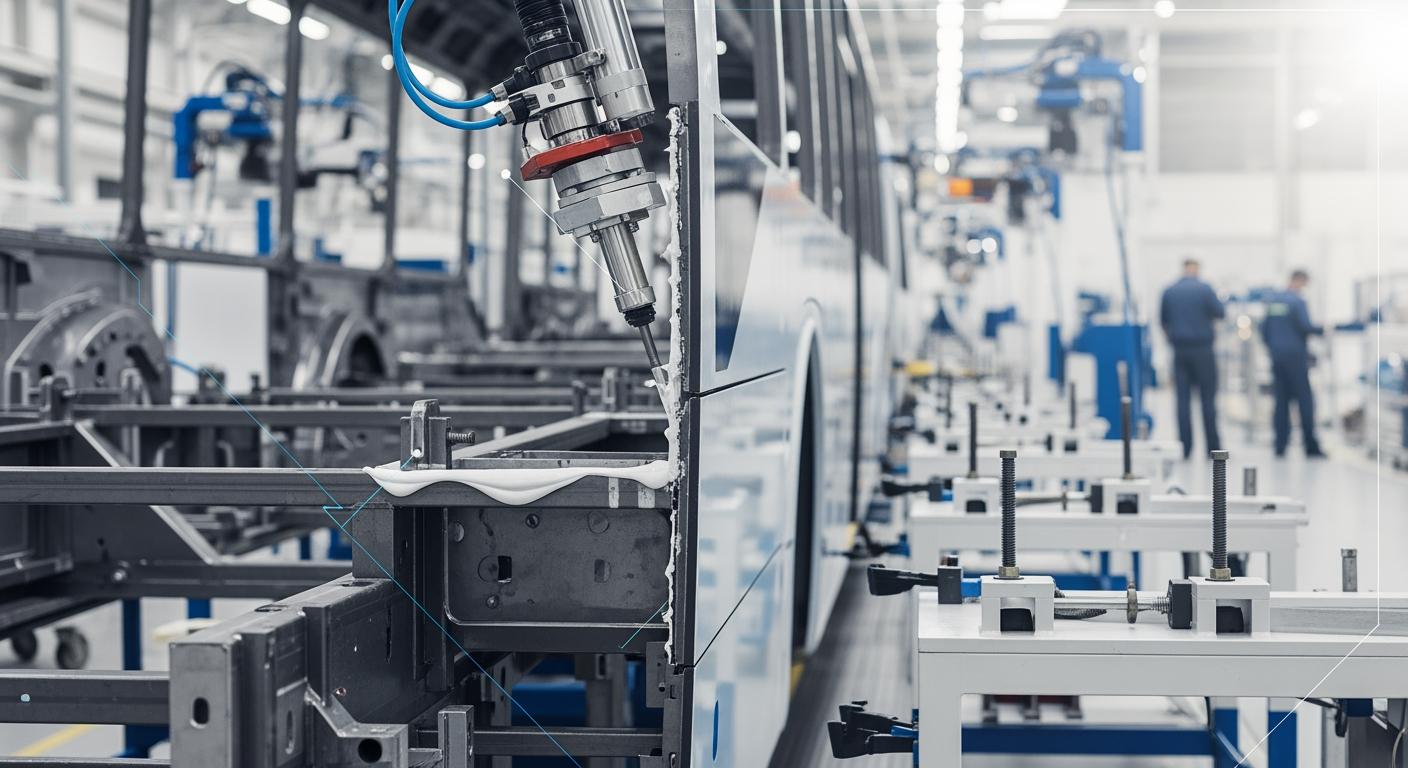
Robotic dispensing dominates bus shops, applying 1-2g/m beads at 50m/min for 15-minute cycles. Manual guns suit low-volume, but automation cuts defects 50% via precise bead profiles per ISO 11343.
Two-part metering systems mix epoxy on-demand, achieving 95% ratio accuracy. Heat-assisted curing at 60°C halves open time to 10 minutes, boosting throughput 30% in Michigan plants.
Case data: switching to high-thixotropy adhesives eliminated 20% rework in sidewall lines. Pinch-weld applicators handle hem flanges effectively.
Table 5 covers methods.
| Method | Cycle Time (min) | Bead Size (mm) | Equipment Cost ($K) | Yield (%) | Suitability |
|---|---|---|---|---|---|
| Robotic | 12 | 6-10 | 200 | 98 | High-volume |
| Manual Gun | 25 | 8-12 | 5 | 85 | Prototype |
| Meter-Mix | 15 | 5-8 | 50 | 95 | Medium |
| Pinch Roller | 18 | 4-6 | 30 | 92 | Hem flanges |
| Spray | 20 | 0.5-2 | 100 | 90 | Large areas |
| Extrusion | 14 | 10-15 | 40 | 96 | Floors |
Robotics optimize cycles for OEM scale; manual suits flexibility, impacting bus body adhesive application pricing via efficiency.
Clamping pressures at 0.1 MPa ensure contact. Fixturing innovations reduce times further.
- Preheat substrates to 20°C for viscosity control.
- Monitor mix ratios with inline sensors.
- Purge lines daily to avoid clogs.
- Train operators on bead inspection.
- Integrate vision systems for quality.
UV tracers aid post-application audits. Shops achieve 500 units/week with optimized methods.
Field Performance, Warranty Considerations, and Test Protocols
Field performance hinges on accelerated aging per ASTM D6676, simulating 10 years in 3 months. Warranties cover 5-7 years/100,000 miles, backed by lap shear retention >80% post-QUV exposure.
Protocols include cyclic delamination tests under SAE J2029. US fleets report 99% joint integrity after 50,000 miles. Warranty claims drop 60% with traceable batches.
A verified protocol resolved peel failures via DMA-optimized selection. FMVSS 301 fuel integrity tests validate adhesives.
Suppliers with rigorous testing, like those at QinanX New Material, ensure compliance through mechanical and environmental assays for stable bus performance.
Key protocols ensure structural adhesive for bus body for sale meets durability claims.
Digital twins predict failures accurately. Post-market monitoring via IoT sensors tracks strains.
Coordinating Bulk Adhesive Deliveries to Multiple Bus Plants
Bulk deliveries in 55-gallon drums or IBC totes streamline multi-plant ops, with JIT scheduling cutting inventory 40%. Logistics partners use RFID for traceability from mill to line.
US OEMs coordinate via EDI for 99.9% on-time rates. Temperature-controlled trucking prevents viscosity shifts. Bulk pricing varies by volume, specs, and conditions—request quotations for accurate factory-direct rates.
Case: centralized warehousing served five plants, reducing stockouts 70%. Shelf life exceeds 12 months at 50-77°F.
Global suppliers facilitate seamless supply. Procurement teams optimize via annual contracts.
Reverse logistics handle returns efficiently. Compliance docs ship with each lot.
Working with Adhesive Partners During New Bus Platform Development
Partners join early in CAD reviews, simulating bonds via FEA. Co-development refines formulas for new composites. Prototyping validates in 6 weeks.
Outstanding suppliers like QinanX New Material provide customized epoxies passing UL requirements, supporting platform launches with R&D expertise.
Joint testing labs accelerate certification. IP sharing accelerates innovation.
Phased gates ensure alignment. Success metrics include 95% first-pass yields.
Post-launch support includes tweaks for volume ramps.
2025-2026 Market Trends in Bus Structural Adhesives
EV bus growth drives 15% CAGR per McKinsey reports, emphasizing conductive adhesives for battery bonds. Sustainable bio-based formulas rise with EPA mandates, targeting 50% bio-content by 2026. Lightweighting pushes multi-material joints, with ASTM updates for composites.
Digital twinning integrates AI for predictive bonding. Pricing fluctuates with resin costs—seek current quotes. Regulations like California ZEV rules favor low-VOC options.
Frequently Asked Questions (FAQ)
What are the best zones for structural adhesives in bus bodies?
Roofs, sidewalls, and floors offer maximum value through weight reduction and strength.
How to select adhesives for bus panels?
Match chemistry to loads: epoxy for shear, PU for flex, per ASTM tests.
Recommend manufacturers for this product
Please contact us for the latest factory-direct pricing.
What tests ensure field performance?
ASTM D1002 shear, FMVSS crash, and accelerated aging protocols.
How does pricing work for custom adhesives?
Pricing varies by specs, quantity, and market; request a quotation for details.



 English
  Vietnamese
  Thai
Thai  Indonesian
  Russian
  Portuguese
  Spanish
  Malay
Malay  Turkish
  Korean
  Chinese