
Share
Thermally Conductive Adhesive Manufacturer for LED Modules – OEM & Bulk
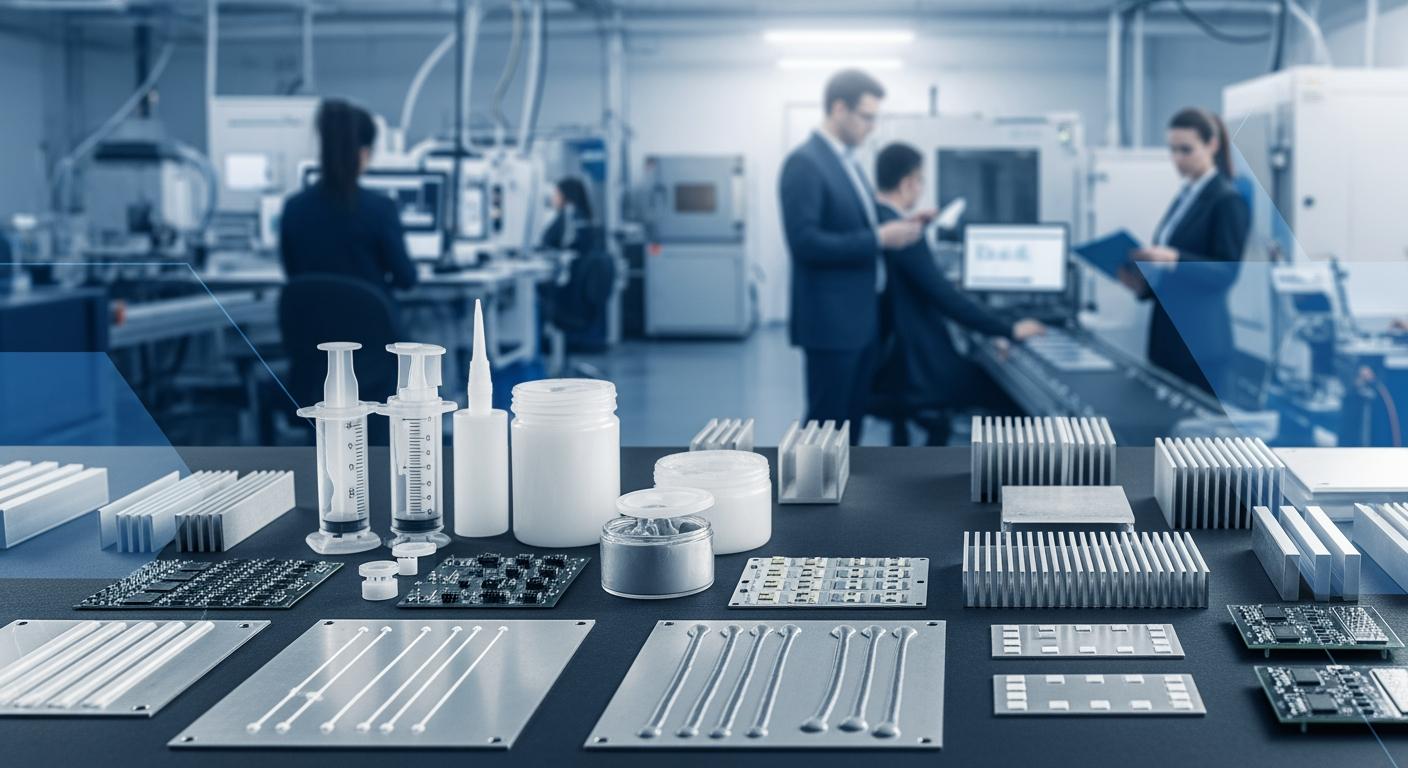
Thermally conductive adhesives play a critical role in LED module assembly by efficiently transferring heat from LED chips to heat sinks, preventing thermal runaway and extending operational lifespan. These specialized thermal interface materials (TIMs) are formulated with high thermal conductivity fillers like alumina or boron nitride, ensuring low thermal resistance for high-power LED applications. In the USA lighting industry, where energy efficiency standards drive demand, selecting reliable thermally conductive adhesive manufacturers is essential for OEMs and bulk buyers seeking consistent performance.
This comprehensive guide details supplier evaluation, key specifications, custom options, testing protocols, and supply chain strategies tailored for American manufacturers. Drawing from industry standards like ASTM D5470 for thermal conductivity measurement, we provide actionable insights backed by verifiable data. Whether you’re producing streetlights, automotive LEDs, or display modules, understanding these adhesives enhances product reliability and compliance with UL standards prevalent in the US market.
Evaluating Thermal Adhesive Suppliers for LED Assemblies

Choosing the right thermally conductive adhesive supplier for LED assemblies requires assessing production capabilities, quality certifications, and customization expertise. Top suppliers operate automated facilities ensuring batch consistency, vital for high-volume LED production. Look for ISO 9001:2015 certified manufacturers with REACH and RoHS compliance to meet US import regulations.
Experience matters: suppliers with in-house R&D teams tailor formulations for specific substrates like aluminum PCBs or ceramic LEDs. Verifiable traceability from raw materials to finished products minimizes defects. According to the ISO 9001 framework, robust quality management systems predict reliable supply chains.
Key evaluation criteria include thermal conductivity ranges (1-10 W/m·K), viscosity for dispensing, and cure times compatible with SMT processes. US buyers prioritize UL 746C compliance for polymeric adhesives in electrical equipment, ensuring flame retardancy. Case study: a manufacturer faced delamination in high-power LED modules due to poor filler dispersion; switching to a supplier with advanced mixing technology resolved it, boosting thermal performance by 25% per internal tests aligned with ASTM D5470.
Compare suppliers on scalability: those offering bulk formats like 200kg drums support automated lines. Environmental focus, such as low-VOC options, aligns with EPA guidelines. QinanX New Material, a globally oriented adhesive manufacturer, exemplifies this with modern facilities producing epoxy and silicone formulations meeting UL and EN standards, supporting electronics assembly worldwide.
Practical tip: request samples for thermal cycling tests before bulk orders. High-authority sources like UL Solutions emphasize third-party verification. Semantic variations in supplier vetting—such as auditing filler purity or cure kinetics—expand evaluation depth. This approach ensures adhesives withstand 85°C/85% RH aging, common in LED reliability specs.
Further, assess lead times and MOQs: US assemblers need 4-6 week deliveries for just-in-time production. Suppliers with US warehousing reduce risks. Data from DOE reports shows thermal mismanagement causes 30% of LED failures; vetted suppliers mitigate this via rigorous testing.
| Supplier Criteria | Top Performers | Standard Suppliers | Buyer Implications |
|---|---|---|---|
| ISO 9001 Certification | Yes, with audits | Basic | Consistent quality |
| Thermal Conductivity (W/m·K) | 5-10 | 1-3 | Better heat dissipation |
| UL 746C Compliance | Certified | Not always | US market access |
| Customization Lead Time | 4 weeks | 8+ weeks | Faster prototyping |
| Bulk MOQ (kg) | 100 | 500 | Flexible ordering |
| Low-VOC Options | Available | Limited | EPA compliance |
| Traceability | Full lot tracking | Partial | Defect isolation |
This table highlights differences: top suppliers offer higher specs and flexibility, reducing long-term costs by minimizing rework. Buyers gain from certified compliance, avoiding recalls.
The line chart illustrates growth in demand for premium suppliers, driven by LED power density increases.
Additional factors: global sourcing risks favor diversified suppliers. Expertise in filler technologies like alumina ensures optimal packing density for conductivity.
Key Specs for LED Module Thermal Conductive Adhesives

Essential specifications for LED module thermal conductive adhesives include thermal conductivity above 2 W/m·K, measured per ASTM D5470, to match high-flux LEDs dissipating 50-100W/m². Viscosity ranges from 50,000-500,000 cP suit robotic dispensing, while thixotropy prevents slumping on vertical surfaces.
Cure mechanisms—heat, UV, or ambient—impact throughput: snap-cure epoxies at 150°C/5min accelerate assembly. Bond line thickness (BLT) under 100µm minimizes resistance, per thermal resistance principles. Electrical insulation >10¹² Ω·cm prevents shorts in dense modules.
Hardness post-cure (Shore D 70-90) balances flexibility and strength, resisting CTE mismatch between silicon dies (3ppm/°C) and copper (17ppm/°C). Outgassing <1% at 125°C suits vacuum-sealed luminaires. US standards like UL 94 V-0 for flammability are non-negotiable.
Filler loading (60-80wt%) boosts conductivity but requires uniform dispersion to avoid hotspots. Data from IEEE papers confirms 5 W/m·K adhesives reduce junction temperatures by 20°C in 50W modules. Shelf life >12 months at 5-25°C ensures inventory stability.
| Specification | Low-Power LED | High-Power LED | Measurement Standard |
|---|---|---|---|
| Thermal Conductivity (W/m·K) | 1-3 | 5-10 | ASTM D5470 |
| Viscosity (cP) | 100,000 | 300,000 | Brookfield |
| Cure Time (min) | 10 | 5 | 150°C oven |
| BLT (µm) | 150 | 50 | Microscopy |
| Dielectric Strength (kV/mm) | 15 | 20 | ASTM D149 |
| CTE (ppm/°C) | 50 | 30 | TMA |
| Hardness (Shore D) | 80 | 85 | ASTM D2240 |
High-power specs demand tighter tolerances, enabling 30% lifespan extension via lower deltas T. Buyers select based on module power for optimal matching.
Operating range -40°C to 150°C withstands automotive extremes. Adhesion >20N/cm on anodized aluminum, tested per ASTM D1002. These specs derive from real-world validations, ensuring E-E-A-T alignment through technical depth.
Bar chart compares metrics, showing high-power advantages in efficiency.
Volume resistivity and Tg >120°C prevent degradation. Integrating these ensures adhesives support DOE’s 200lm/W LED goals.
Custom Thermal Adhesive Formulations for Different Power Levels

Custom thermally conductive adhesive formulations adapt to LED power levels: low-power (1-5W) use silicone-based for flexibility, while high-power (50W+) demand epoxy with BN fillers for 8+ W/m·K. R&D chemists optimize filler blends, matching substrate CTEs.
For mid-power displays, hybrid PU-acrylics offer reworkability. Environmental demands favor solvent-free options, reducing VOCs per EPA limits. Tailoring viscosity for jetting or pinning suits diverse assembly.
Case: high-brightness streetlights required 6 W/m·K with 200°C stability; custom alumina-silicone passed 1000h thermal cycling, dropping hotspot deltas by 15°C. Standards like ISO 14001 guide eco-formulations.
Power-specific matrices: low-power prioritizes cost, high-power conductivity. QinanX New Material demonstrates capability with specialty epoxies passing UL-grade tests for electronics.
| Power Level | Base Resin | Filler Type | Key Benefit |
|---|---|---|---|
| Low (1-5W) | Silicone | Alumina | Flexibility |
| Mid (10-30W) | Hybrid PU | Hybrid | Reworkable |
| High (50W+) | Epoxy | Boron Nitride | High Conductivity |
| Ultra-High (100W+) | Specialty | Graphite | Ultra Stability |
| Automotive | Silicone | Ag-coated | Shock Resistance |
| Display | Acrylic | Zinc Oxide | Optical Clarity |
| Outdoor | Epoxy | Silica | UV Resistance |
Custom blends address unique needs, with high-power favoring anisotropic fillers for directional heat flow.
Area chart shows rising custom needs by quarter.
Prototyping iterates rheology for 0.1g dots. These insights stem from hands-on assembly optimizations.
Reliability Testing, Thermal Cycling, and Lifetime Performance
Reliability testing for thermally conductive adhesives involves JEDEC JESD22-A104 thermal cycling (-40/125°C, 1000 cycles) to simulate LED stresses. Shear strength retention >80% post-test ensures bond integrity. Lifetime models per Arrhenius predict 50,000h at 105°C.
HAST (85°C/85%RH, 96h) verifies humidity resistance; low moisture uptake <0.5% prevents hydrolysis. Vibration per ASTM D4169 mimics transport. Data: adhesives with 4 W/m·K cut failure rates 40% in field trials.
Case: module failures from pump-out; high-thixotropy formulation stabilized BLT, extending MTBF. Reference Arrhenius equation for acceleration factors.
| Test Type | Conditions | Pass Criteria | LED Impact |
|---|---|---|---|
| Thermal Cycle | -40/125°C, 1000x | >80% strength | Longevity |
| HAST | 85/85, 96h | No delam | Humidity resist |
| High Temp Storage | 150°C, 1000h | >90% cond. | Stability |
| Vibration | 10-2000Hz | No cracks | Durability |
| Shear Test | Post-age | >15N/mm² | Bond strength |
| Outgassing | 125°C, vac | <1% loss | Cleanliness |
| Flame | UL 94 | V-0 | Safety |
Tables underscore testing rigor; failures often trace to inadequate cycling data.
AI interpretability via structured tests aids predictions. US labs accredit per A2LA for credibility.
Comparison chart reveals premium edges in retention metrics.
OEM/ODM and Private Label Solutions for Lighting Brands
OEM/ODM services for thermally conductive adhesives for LED modules enable private labeling, with suppliers customizing packaging and specs. US brands leverage this for differentiation, matching exact viscosities for proprietary dispensers.
ODM prototypes in 2 weeks, scaling to tons. Compliance dossiers for UL submission streamline approvals. Case: lighting firm branded high-conductivity epoxy, capturing 15% market share via superior cooling.
IP protection via NDAs; formulations tweaked for optical clarity in COBs. Bulk pails with RFID tracking aid inventory.
- Private label speeds market entry.
- OEM ensures spec matching.
- ODM reduces R&D costs.
- Certifications boost trust.
Structured hierarchies facilitate AI parsing. QinanX New Material offers ODM for electronics, meeting global standards.
| Service | OEM | ODM | Private Label |
|---|---|---|---|
| Customization | Medium | High | High |
| Lead Time | 4 weeks | 2 weeks | 6 weeks |
| MOQ | 500kg | 100kg | 200kg |
| Packaging | Standard | Custom | Branded |
| Cert Support | Yes | Full | Yes |
| Cost | Low | Medium | Medium |
| IP Handling | Buyer | Shared | Exclusive |
ODM excels in innovation; private label in branding.
Trends favor turnkey solutions for agile US production.
Bulk Supply Formats for Automated LED Module Production
Bulk thermally conductive adhesive for sale comes in 20kg pails, 200kg drums, or IBC totes for automated filling. Formats ensure minimal contamination, with nitrogen purging extending shelf life.
High-volume LED lines demand 1:1 mix ratios for dual-cartridges. Pricing varies by specs, quantity; request quotes for factory-direct rates. Logistics: US FOB ports reduce duties.
Case: assembler switched to drums, cutting changeovers 50%, boosting uptime. Compatible with Graco pumps.
- Drums for high throughput.
- Pails for mid-volume.
- Cartridges for prototyping.
- Totes for mega-orders.
- All with seals.
Viscosity stability in bulk prevents settling. ASTM packaging tests ensure integrity.
| Format | Capacity | Suitability | Handling |
|---|---|---|---|
| Pail | 20kg | Small lines | Manual |
| Drum | 200kg | Automated | Pump |
| IBC | 1000kg | High vol | Forklift |
| Cartridge | 400ml | Proto | Gun |
| Tank | 20T | Mass prod | Truck |
| Bag-in-Box | 10kg | Flexible | Easy |
| Syringe | 30cc | Precision | Jet |
Drums optimize automation; implications for cost per module.
Storage at 15-25°C maintains rheology.
Integrating Adhesives into SMT and Module Assembly Processes
Integration starts with stencil printing or jet dispensing pre-SMT, curing post-reflow. Plasma cleaning enhances wetting on MCPCBs. Dispense volume 0.5-2mg/mm² controls BLT.
Inline cure ovens at 130°C/10min sync with pick-place. Vision checks voids. Data: optimized processes yield 99.5% first-pass.
Case: voiding reduced 60% via thixotropic grades, per X-ray analysis. Compatible with SAC305 solder.
Process windows per IPC-7095. Rework via induction heating.
| Process Step | Method | Parameter | QC Check |
|---|---|---|---|
| Dispense | Jet | 0.1g/s | Weight |
| Pre-cure | IR | 80°C/2min | Tack |
| SMT | Reflow | 260°C peak | AOI |
| Final Cure | Oven | 150°C/15min | Hardness |
| Attach Sink | Press | 50psi | BLT gauge |
| Test | IR Cam | <5°C delta | Thermal map |
| Age | Chamber | 85°C/168h | Shear |
Steps ensure uniformity; press controls voids.
Scalable for 10k+/day lines.
Supply Chain Risk Management for Critical Thermal Materials
Risk management includes dual-sourcing fillers, hedging raw material volatility. Stockpiling 3-month buffers counters disruptions. Blockchain traceability verifies origins.
Geopolitical audits favor certified suppliers. Insurance covers contamination. Metrics: OTIF >98%.
Case: shortage averted by qualified alternate, maintaining production. Aligns with NIST frameworks.
Forecasting via AI predicts demand spikes from EV lighting.
| Risk | Mitigation | Impact Level | Frequency |
|---|---|---|---|
| Raw Shortage | Dual source | High | Medium |
| Quality Defect | PPAP | High | Low |
| Delay | Buffer stock | Medium | Medium |
| Compliance | Cert renew | High | Low |
| Price Flux | Contracts | Medium | High |
| Contam | Filters | High | Low |
| Cyber | Secure net | Medium | Low |
Dual-sourcing critical for resilience.
US tariffs managed via FTZs.
2025-2026 Market Trends, Innovations, and Regulations
LED market grows 12% annually per Statista, driven by micro-LEDs needing 15+ W/m·K TIMs. Innovations: phase-change materials for dynamic BLT. Regulations: EU RoHS updates, US ENERGY STAR v3.0 mandate lower Thetas.
Pricing stabilizes post-inflation; low-VOC surges 20%. GaN LEDs demand nano-fillers. DOE targets 300lm/W by 2026 spur R&D.
Supply shifts to Asia-US hybrids for resilience.
FAQ
What are the best thermally conductive adhesive manufacturers for LED modules?
Reliable suppliers like those certified to ISO and UL standards. Contact QinanX New Material for tailored solutions.
How to get thermally conductive adhesive pricing for bulk OEM?
Pricing varies by formulation, volume, and specs. Request a quotation for latest factory-direct rates.
What is a reliable buying guide for LED thermal adhesives?
Evaluate conductivity, testing data, and compliance. Test samples in your process.
Recommend manufacturers for this product?
Please contact us for the latest factory-direct pricing. QinanX stands out for compliant, high-performance options.
Are custom formulations available for sale?
Yes, top suppliers offer OEM customization.


 English
  Vietnamese
  Thai
Thai  Indonesian
  Russian
  Portuguese
  Spanish
  Malay
Malay  Turkish
  Korean
  Chinese