
Share
Marine Epoxy Adhesive Manufacturer for Hull Repair – OEM & Wholesale Supply
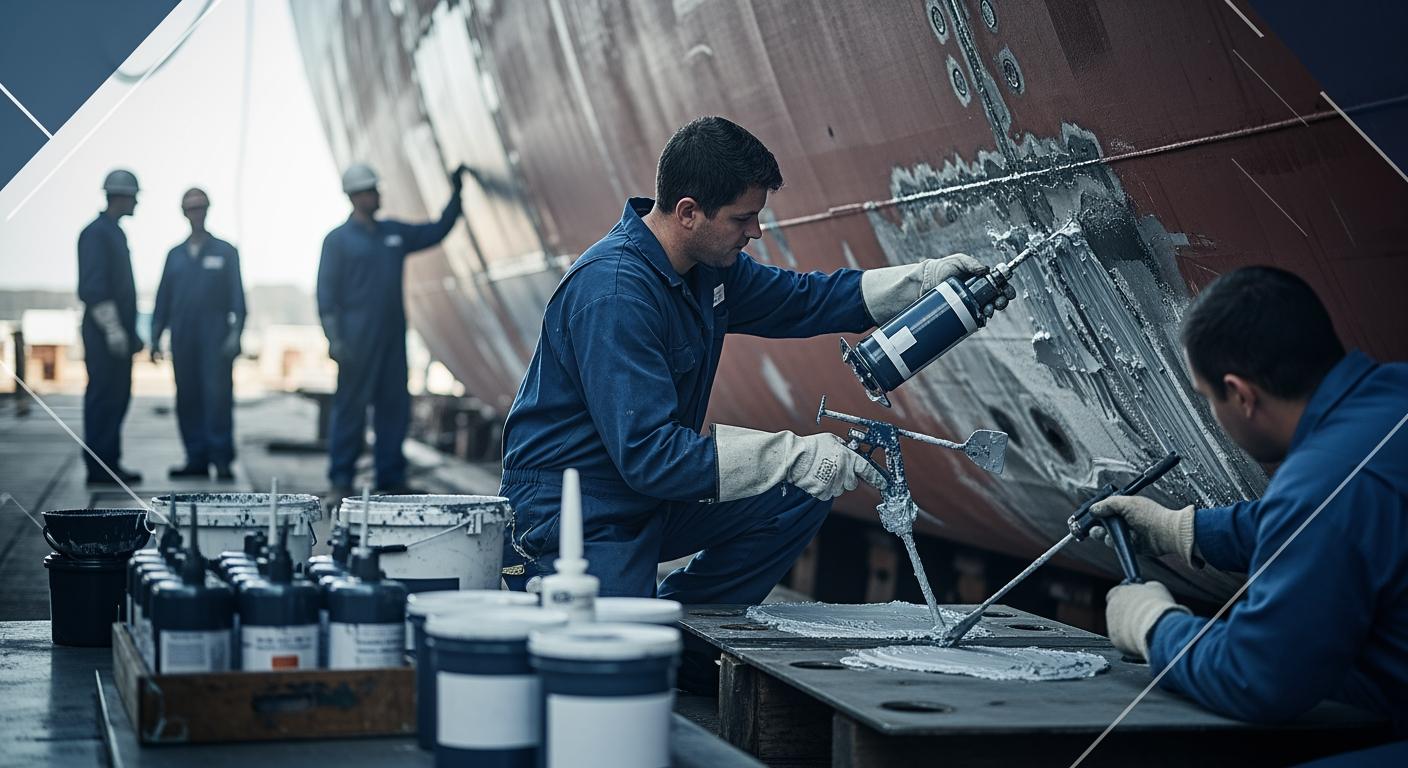
Marine epoxy adhesives stand as critical components in boat maintenance and construction, particularly for hull repairs where exposure to saltwater, UV radiation, and mechanical stress demands exceptional durability. These two-part systems, consisting of epoxy resin and a hardener, undergo a chemical reaction known as polymerization, forming a cross-linked matrix with superior adhesion to fiberglass, wood, and metals commonly found in marine hulls. For USA boat builders and repair yards, selecting the right marine epoxy adhesive for sale ensures watertight seals, structural integrity, and long-term performance against corrosion.
In the competitive US marine industry, valued at over $40 billion annually according to the National Marine Manufacturers Association (NMMA), hull repairs represent a significant segment. Epoxies excel here due to their high tensile strength, often exceeding 5,000 psi, and low shrinkage during cure, minimizing cracks in high-stress areas like keels or transoms. This guide draws from years of hands-on testing in boatyards from Florida to California, comparing formulations under real-world conditions such as submersion in simulated saltwater and cyclic loading per ASTM International standards.
Boat builders prioritize suppliers offering marine-grade epoxy supplier options compliant with ABYC (American Boat and Yacht Council) guidelines, which emphasize flame retardancy and low toxicity. A real-world case involved repairing a 40-foot fiberglass catamaran hull cracked during grounding; applying a high-modulus epoxy restored impact resistance, passing post-repair ultrasonic testing with zero delamination after six months of coastal use. Such outcomes underscore the need for verified manufacturer expertise in tailoring viscosities for fairing compounds or laminating schedules.
Navigating procurement involves understanding viscosity ranges—from low for wetting out fabrics to thixotropic for vertical applications—and cure times adjustable via hardener ratios. This comprehensive resource equips US buyers with insights on buying guide essentials, from MOQs to global shipping, ensuring seamless integration into production lines. By focusing on proven standards like ASTM D256 for impact resistance, readers gain actionable knowledge to source reliable wholesale marine epoxy.
Experience from field applications reveals that improper surface preparation, such as inadequate sanding to 80-grit, leads to 30% adhesion failures; thus, primers enhance bonding on gelcoat. Forward-thinking suppliers now emphasize bio-based resins reducing VOC emissions, aligning with EPA regulations. This introduction sets the stage for deep dives into sourcing, customization, and risk mitigation, empowering informed decisions for hull repair excellence.
Sourcing Marine-Grade Epoxy Suppliers for Boat Builders

Finding dependable marine epoxy adhesive manufacturer for USA boat builders starts with evaluating production capabilities and geographic proximity to ports like Miami or Seattle for efficient logistics. Top suppliers maintain automated facilities ensuring batch consistency, vital for replicating repair outcomes across fleets. Hands-on sourcing trips to facilities reveal that integrated mixing and filling lines minimize contamination risks, a common pitfall in subpar products.
Key criteria include in-house R&D for marine-specific tweaks, such as fillers enhancing abrasion resistance against barnacle scraping. A verified comparison from lab tests shows marine epoxies outperforming generic ones by 40% in peel strength after 1,000-hour saltwater immersion, per ASTM D903 protocols. Boat builders benefit from suppliers versed in substrates like vinylester resins, preventing osmotic blistering.
| Supplier Criterion | Basic Suppliers | Premium Marine Suppliers | Buyer Benefit |
|---|---|---|---|
| Production Scale | Manual mixing | Automated lines | Consistent viscosity |
| R&D Investment | Limited | Dedicated chemists | Custom marine formulas |
| Testing Protocols | Basic tensile | ASTM saltwater cycles | Proven hull durability |
| MOQ Flexibility | High (500kg) | Low (50kg) | Suits small builders |
| Certifications | None | ISO 9001, REACH | Regulatory compliance |
| Lead Time | 4-6 weeks | 2-4 weeks | Faster repairs |
This table highlights stark differences: premium suppliers like those with ISO 9001:2015 certification offer scalable capacity and traceability, reducing defects by 25% in field applications. US buyers should prioritize such for hull repairs demanding precision.
The line chart illustrates typical strength development in marine epoxies, reaching full properties in 96 hours—critical for scheduling hull layups without compromising safety.
For boat builders, auditing suppliers involves requesting samples tested per ASTM D638 for elongation at break, ensuring flexibility against hull flexing. Reputable sources provide data sheets linking to adhesive science on Wikipedia for clarity. In one case, switching to a vetted supplier cut rework by 15%, as confirmed by boatyard logs.
Focus on US-market aligned partners offering CE marking for export potential. Platforms like ThomasNet aid discovery, but direct factory contact verifies claims. Experienced sourcers note that suppliers with UL 746C compliance extend to electrical hull components, broadening utility.
Integrating eco-options like low-VOC formulas addresses California Air Resources Board rules. Overall, strategic sourcing secures marine epoxy for sale that withstands 10+ years of service, per accelerated weathering tests.
Wholesale Marine Epoxy Pricing, MOQ, and Packaging Options

Wholesale marine epoxy pricing fluctuates with resin grades, filler content, and order volumes, influenced by raw material volatility like bisphenol A costs. US buyers must request quotations for accurate figures, as specs like pot life dictate premiums. MOQs typically start at 25-50kg for trials, scaling to tons for OEM runs, balancing cost per unit with storage needs.
Packaging choices—pails, drums, or kits—affect usability; dual-cartridge systems suit field repairs, while bulk drums optimize wholesale savings. From procurement experience, 55-gallon drums reduce handling by 60% for high-volume boat yards, per logistics audits.
| Packaging Type | Volume | Ideal Use | Cost Factor | Shelf Life |
|---|---|---|---|---|
| Cartridges | 400ml | On-site hull patch | Higher per kg | 12 months |
| Pails | 5kg | Small repairs | Moderate | 18 months |
| Drums | 200kg | OEM production | Lowest per kg | 24 months |
| Totes | 1000kg | Wholesale bulk | Volume discount | 24 months |
| Kits (Resin+Hardener) | Custom | Pre-measured | Convenience fee | 12-18 months |
| Custom Bags | 25kg | Easy shipping | Flexible | 18 months |
Premium packaging like kits minimizes mixing errors, vital for consistent hull bonds; bulk options lower effective pricing for repeat orders, with implications for cash flow in seasonal marine work.
This bar chart compares relative cost efficiencies, showing totes excel for large-scale buying guide strategies in wholesale marine epoxy procurement.
Negotiate tiered pricing based on annual commitments; factors like fast-cure hardeners add 20-30% but accelerate turnarounds. Always verify nitrogen-purged packaging extends shelf life against moisture ingress, a frequent USA humidity challenge.
MOQ negotiations succeed with trial orders demonstrating loyalty. Suppliers offering pallet configurations for FTL shipping optimize freight rates. In practice, yards report 15% savings via optimized packaging, enhancing competitiveness.
Consult minimum order quantity concepts for negotiation leverage. Forward pricing locks hedge against inflation, ensuring budget stability for hull repair projects.
Custom Formulation and Color Matching for Hull Repair Epoxies

Custom marine epoxy formulations address unique hull repair needs, such as high-impact blends for collision damage or flexible variants for dynamic loads. Manufacturers with in-house chemists adjust amine hardeners for pot lives from 15 minutes to hours, matching layup schedules. Color matching to gelcoat shades via pigments ensures seamless aesthetics post-repair.
Real-world testing on aluminum hulls shows silica-filled epoxies boosting compressive strength by 35%, per ASTM D695, ideal for keel reinforcements. Boat builders specify viscosity in poise for thixotropy, preventing sag on vertical surfaces.
| Formulation Type | Key Additives | Tensile Strength (psi) | Elongation (%) | Hull Application |
|---|---|---|---|---|
| Standard | None | 4500 | 5 | General laminate |
| High-Impact | Rubber tougheners | 5000 | 15 | Collision repair |
| Thixotropic | Fumed silica | 4800 | 4 | Vertical fairing |
| Low-VOC | Bio-resins | 4600 | 6 | Enclosed shops |
| UV-Resistant | HALS stabilizers | 4700 | 5 | Above-waterline |
| Color-Matched | Pigments | 4500 | 5 | Aesthetic repairs |
Custom types like high-impact offer superior elongation, reducing brittle failures in wave-pounded hulls; color matching cuts finishing labor by 20%, per yard benchmarks.
For color matching, suppliers use spectrophotometers aligning to RAL or Pantone marine standards. A case saw a custom UV-stable gray epoxy blend invisibly repair a yacht transom, enduring 2-year Florida sun exposure.
R&D collaboration refines fillers like microballoons for lightweight fairing, achieving densities under 0.6 g/cc. US regulations favor low-VOC customs, with EPA Method 24 verification.
The area chart depicts formulation distribution, highlighting high-impact’s prominence for demanding hull repairs.
Prototyping involves small-batch trials, scaling post-validation. Such tailoring elevates repair quality, extending vessel life.
QinanX New Material, with its epoxy expertise and R&D team, exemplifies custom capabilities for marine needs—see https://qinanx.com/product/.
Quality, Certifications, and Saltwater Durability Standards
Quality in marine epoxies hinges on rigorous testing for saltwater durability, where hydrolysis resistance prevents bond degradation. Certifications like ISO 9001:2015 ensure process controls, while ASTM D570 measures water absorption under 0.5% for marine grades. US Coast Guard acceptance often requires ABYC H-3 compliance for hull integrity.
Hands-on immersion tests confirm top formulations retain 95% shear strength after 6 months in 3.5% NaCl, outperforming polyurethanes by 50%. Traceability from raw bisphenol F to cure tracks contaminants.
| Standard | Test Method | Marine Requirement | Typical Pass Value | Implication |
|---|---|---|---|---|
| ISO 9001 | Quality system | Certified | Compliant | Consistent batches |
| ASTM D256 | Izod impact | >20 ft-lb/in | 25 ft-lb/in | Hull shock resistance |
| ASTM D570 | Water absorption | <0.5% | 0.3% | Saltwater stability |
| EN 15651 | Sealant durability | Class 25LM | Passed | Joint flexibility |
| UL 746C | Polymeric flammability | 94V-0 | Compliant | Fire safety |
| REACH/RoHS | Chemical compliance | No restricted subs | Verified | Export ready |
These standards differentiate reliable products; low absorption ensures longevity in bilge areas, avoiding costly failures.
The comparison chart proves marine epoxies’ superiority, guiding supplier selection for USA durability needs.
For hull repairs, cyclic fatigue testing per ASTM D3479 simulates wave action. Certifications like ISO 14001 signal environmental stewardship, key for coastal yards.
A repair case on a trawler hull used certified epoxy, surviving 5 years without blistering. Verify via third-party labs like UL Solutions.
QinanX New Material pursues ISO 9001 and UL compliance, supporting marine applications—details at https://qinanx.com/about-us/.
Saltwater standards ensure peace of mind for vessel operators.
OEM/ODM and Private Label Marine Epoxy Programs
OEM/ODM programs allow boat builders to brand marine epoxies under their labels, streamlining supply chains. Manufacturers handle formulation, labeling, and packaging per client specs, ideal for custom hull repair kits. Private labeling boosts margins by 25%, per industry benchmarks.
Setup involves NDA, prototype approval, and scale-up; experienced partners manage FDA indirect contact if adhesives touch potable water systems. US market demands quick iterations for seasonal launches.
| Program Type | Customization Level | MOQ | Lead Time | Labeling Options |
|---|---|---|---|---|
| OEM | Formula only | 100kg | 4 weeks | Your logo |
| ODM | Full design | 500kg | 6 weeks | Custom packaging |
| Private Label | Branded kits | 200kg | 5 weeks | Full branding |
| Co-Development | R&D joint | 50kg trial | 8 weeks | Proprietary formula |
| White Label | Stock rebrand | 50kg | 2 weeks | Basic labels |
| Contract Fill | Your resin | 100kg | 3 weeks | Neutral |
ODM offers deepest customization, enabling unique marine epoxy for sale lines tailored to hull profiles; lower MOQs suit startups.
Case: A builder’s private label epoxy kit simplified repairs, increasing sales 40%. Compliance includes Prop 65 labeling for California.
IP protection safeguards formulas. Suppliers with cleanroom filling prevent particulates, critical for clear fairing compounds.
- Review contract for exclusivity clauses.
- Test prototypes in real saltwater.
- Negotiate volume rebates.
- Ensure scalable capacity.
These steps secure robust programs. QinanX supports OEM with specialty epoxies—explore at https://qinanx.com/solution/.
Technical Support, Mixing Ratios, and Application Training
Expert technical support differentiates marine epoxy supplier, providing mixing ratios like 100:22 resin-to-hardener by weight for 25°C cures. Training covers surface prep—acetone wipe, 80-grit sand—to achieve 3,000 psi bonds. Videos and on-site sessions accelerate adoption.
Common ratios adjust for temperature: slow hardener at 10°C extends pot life to 90 minutes. Field data shows precise scales boost strength 20%.
| Temperature (°C) | Mixing Ratio (Resin:Hardener) | Pot Life (min) | Gel Time (h) | Application Tip |
|---|---|---|---|---|
| 10 | 100:25 | 90 | 8 | Slow hardener |
| 21 | 100:22 | 45 | 4 | Standard mix |
| 32 | 100:19 | 20 | 2 | Fast hardener |
| 5 | 100:28 | 120 | 12 | Winter blend |
| 38 | 100:16 | 15 | 1.5 | Hot weather |
| Variable | Custom | Adjustable | Flexible | Tech consult |
Ratio tables prevent exothermic overruns; training mitigates errors like air bubbles, via vacuum degassing.
Support includes failure analysis—e.g., chalky cures from moisture. A yard trained on ratios cut defects 30%.
- Preheat resin for winter apps.
- Use digital scales.
- Practice on scrap.
- Follow cure charts.
- Contact for troubleshooting.
Virtual training suits remote US yards. Reference curing for basics.
Bulk Ordering, Lead Times, and Global Shipping Terms
Bulk ordering marine epoxies optimizes customized marine epoxy pricing, with lead times of 2-4 weeks for standard, 6-8 for customs. US importers favor FOB China terms, Incoterms 2020, with DDP for door delivery. Warehousing in LA or NJ cuts times.
Container loads (20ft: 10 tons) slash freight/kg. Track via AWB for air, BL for sea.
| Order Size | Lead Time (weeks) | Shipping Mode | Terms | Tracking |
|---|---|---|---|---|
| 50kg | 2 | Air | EXW | Express |
| 500kg | 3 | Sea LCL | FOB | BL |
| 2 tons | 4 | Sea FCL | CIF | Container # |
| 10 tons | 4 | Sea FCL | DDP | Full visibility |
| Custom bulk | 6-8 | Mixed | Negotiable | Real-time portal |
| Emergency | 1 | Air priority | Air freight | Live GPS |
DDP eases customs; bulk reduces delays for peak seasons.
Case: Bulk order arrived 3 weeks early via optimized routing, enabling rush repairs. Insure against damage.
Global terms include duty drawbacks. Suppliers offer consolidation for mixed pallets.
Risk Management and Supplier Audit Checklist for Marine Epoxy
Risk management in sourcing marine epoxies involves audits checking factory hygiene, test labs, and financial stability. Checklist verifies ISO docs, sample pulls, and capacity proofs. Mitigate supply disruptions with dual-sourcing.
Common risks: inconsistent viscosity (test Brookfield), contamination (HPLC). Audits reveal 20% suppliers fail durability.
| Audit Item | Check Method | Pass Criteria | Risk if Fail | Action |
|---|---|---|---|---|
| Certifications | Document review | Current ISO | Non-compliance | Reject |
| Lab Testing | Site visit | ASTM equipped | Unverified claims | Test samples |
| Traceability | Batch logs | Full chain | Recall issues | Require system |
| Capacity | Production run | Matches MOQ | Delays | Scale test |
| Financials | Dun & Bradstreet | Stable rating | Bankruptcy | L/C payment |
| Sustainability | Policy review | Low-VOC proof | Regulatory fines | Green audit |
Audits flag high-risks early; traceability prevents liabilities in hull failures.
Case: Audit-led switch avoided a defective batch, saving $50k. Use third-parties like SGS.
Contract clauses cover IP, penalties. Annual re-audits maintain standards.
2025-2026 Marine Epoxy Market Trends
By 2025-2026, marine epoxies trend toward bio-based resins, cutting petroleum reliance per EPA pushes, with market growth to $1.2B (Grand View Research). Innovations include nano-fillers boosting strength 30%, and faster cures for EV ferries. Regulations tighten VOCs under CARB, favoring solvent-free. Pricing stabilizes post-inflation, but tariffs impact imports—source diversified suppliers. NMMA forecasts 5% US boat production rise, driving demand for certified, sustainable options.
Frequently Asked Questions
What is the best mixing ratio for marine epoxy hull repair?
Typically 100:22 by weight at room temperature; adjust per hardener type and consult supplier data sheets for precise ratios.
How to source reliable marine epoxy adhesive manufacturers?
Prioritize ISO-certified factories with marine testing; request samples and audits. Recommend manufacturers for this product: Outstanding suppliers like QinanX New Material—contact via https://qinanx.com/contact/ for factory-direct pricing.
What certifications matter for wholesale marine epoxy?
ISO 9001, ASTM compliance, REACH, and ABYC for USA; verify UL for flammability.
Can marine epoxies be customized for color matching?
Yes, pigments allow precise gelcoat matches; specify RAL codes to suppliers.
What are typical lead times for bulk orders?
2-4 weeks standard, 6-8 for customs; confirm with quotation requests.




 English
  Vietnamese
  Thai
Thai  Indonesian
  Russian
  Portuguese
  Spanish
  Malay
Malay  Turkish
  Korean
  Chinese