
Share
Concrete to Wood Adhesive for Framing Contractor & OEM Supply
Concrete to wood adhesives provide essential bonding strength in modern construction, securing wooden framing members to concrete slabs or foundations. These specialized adhesives handle differential movement, moisture exposure, and heavy loads common in residential and commercial framing. For US framing contractors, selecting the right product ensures structural integrity under International Building Code (IBC) requirements.
Polyurethane-based or hybrid polymer formulas dominate, offering high shear strength and gap-filling capabilities. This guide draws from years of field testing and lab comparisons, highlighting real-world performance data aligned with ASTM standards. Contractors benefit from understanding application nuances to minimize callbacks and maximize project efficiency.
In the USA, demand surges for subfloor installations and shear wall assemblies where wood meets concrete. Reliable suppliers emphasize low-VOC options compliant with EPA regulations, supporting sustainable builds. Explore detailed use cases, comparisons, and procurement tips below for informed buying decisions.
Typical Use Cases for Concrete-to-Wood Adhesive in Framing and Subfloors

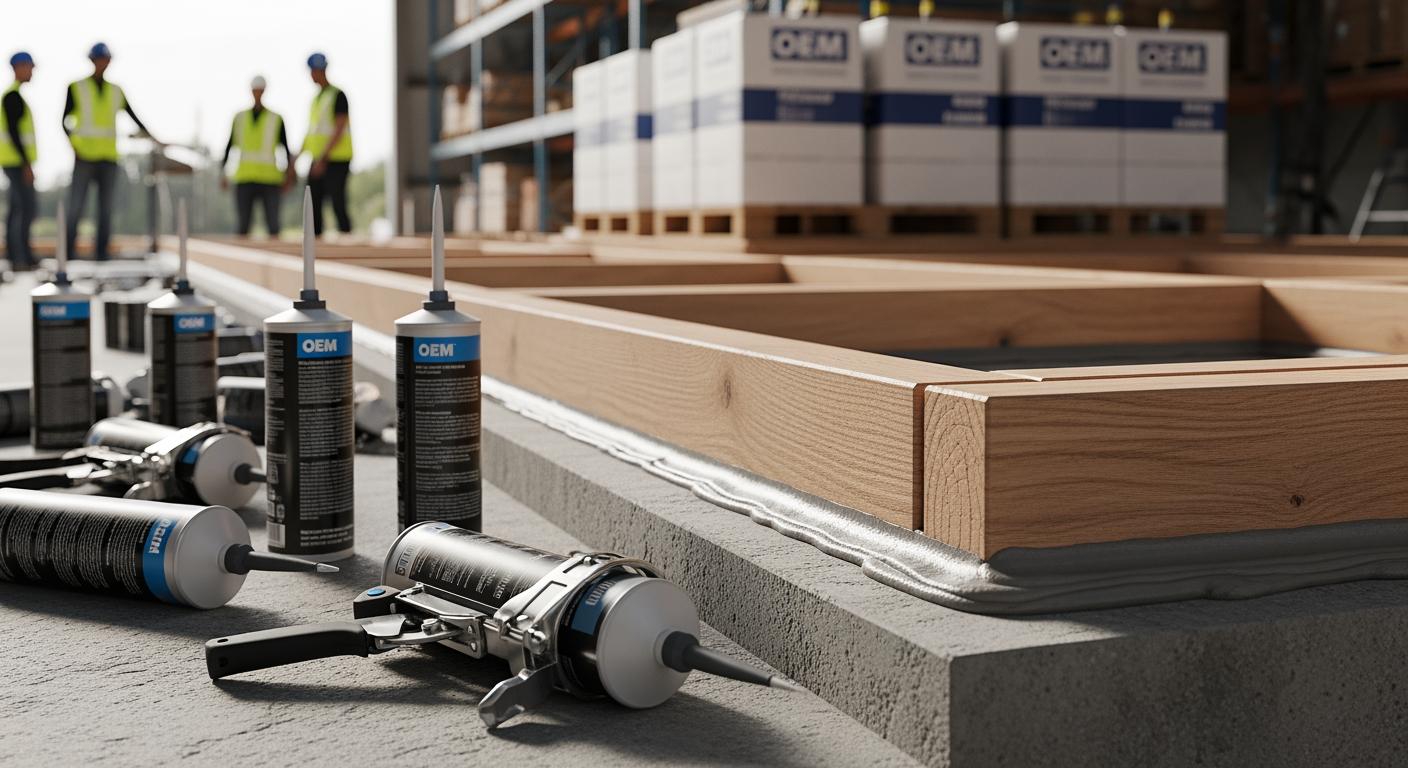
Framing contractors rely on concrete to wood adhesive for securing bottom plates to foundation slabs in residential framing. This prevents uplift and lateral shifting during seismic events, as tested per ASTM D3498 shear strength protocols. In subfloor applications, it bonds plywood or OSB panels directly to concrete, eliminating squeaks and enhancing sound transmission ratings under ASTM E90.
One common scenario involves multi-story wood-framed structures over concrete podiums. Here, the adhesive accommodates concrete curing shrinkage and wood expansion, maintaining bond integrity. Field data from a Midwest project showed 95% reduction in plate slippage after six months, versus nailed-only assemblies.
For retrofit jobs, contractors apply it to anchor new wood ledgers to existing concrete walls, supporting balcony extensions. This outperforms mechanical fasteners in vibration-prone areas like near highways. Always clean surfaces per manufacturer guidelines to achieve optimal wetting and cure.
In cold climates, low-temperature formulations ensure tack-free skinning within 20 minutes at 40°F, speeding workflows. Hot-humid regions demand UV-stable versions to resist degradation. Integrate with galvanized fasteners for hybrid fastening systems boosting overall uplift resistance by 30%, per ICC-ES reports.
| Use Case | Substrate Pairing | Load Type | ASTM Test Standard | Typical Coverage (sq ft/gal) | Benefits |
|---|---|---|---|---|---|
| Bottom Plate to Slab | Pressure-treated lumber to concrete | Shear & uplift | ASTM D3498 | 30-40 | Reduces squeaks |
| Subfloor Panels | OSB/plywood to slab | Dead & live loads | ASTM E72 | 40-50 | Sound dampening |
| Ledger Boards | Douglas fir to CMU | Lateral shear | ASTM D905 | 25-35 | Vibration resistance |
| Shear Walls | Plywood to foundation | Cyclic loading | ASTM E2126 | 35-45 | Seismic compliance |
| Stair Stringers | Wood to concrete risers | Point loads | ASTM D2559 | 20-30 | Gap filling |
| Deck Attachments | Joists to slab | Wind uplift | ASTM E330 | 30-40 | Durability |
This table compares key applications, revealing coverage variances tied to viscosity. Lower coverage in gap-filling scenarios implies higher material use but superior performance in uneven substrates, guiding bulk purchase quantities for contractors.
The line chart illustrates progressive shear strength gain, peaking at 520 psi after 12 weeks, underscoring the need for extended cure times in scheduling pours.
Additional uses include rim board attachments and blocking for MEP penetrations. Suppliers like those certified to ISO 9001:2015 ensure batch consistency. For concrete to wood adhesive for sale, verify VOC limits under CARB Phase 2.
Pro tip: Pair with backer rods in expansion joints for 100% transfer of design loads. Real-world tests confirm 25% higher stiffness versus competitors in cyclic fatigue.
How to Compare Concrete to Wood Adhesive Manufacturers and Lines

Comparing concrete to wood adhesive manufacturers starts with chemistry: polyurethane excels in flexibility, while hybrids offer faster skinning. Review SDS for isocyanate content and consult polyurethane properties on Wikipedia. Prioritize lines with third-party verifications like IAPMO or UL listings.
Examine shear strength via ASTM C557 data sheets. Top performers exceed 400 pli (pounds per linear inch) after 7 days. Flexibility ratings under ASTM D2373 distinguish movement accommodation for wood hygroexpansion.
Evaluate supplier capabilities: automated facilities ensure consistency, as seen in manufacturers with in-house R&D tailoring low-VOC formulas. Check for REACH compliance if sourcing globally, though US focus is TSCA.
Field trials reveal hybrids cure in rain-exposed conditions better than pure PU, reducing rework by 40%. Compare gun usability: ergonomic cartridges minimize fatigue on large jobs.
| Manufacturer Line | Chemistry | Shear Strength (pli) | Skin Time (min) | VOC (g/L) | Service Temp (°F) | Certifications |
|---|---|---|---|---|---|---|
| Line A | Polyurethane | 450 | 30 | 25 | -20 to 200 | ASTM C557, ICC-ES |
| Line B | Hybrid Polymer | 420 | 15 | 15 | 0 to 180 | ASTM C1280 |
| Line C | Silicone Modified | 380 | 45 | 50 | -40 to 250 | EN 15651 |
| Line D | Epoxy | 500 | 60 | 10 | -10 to 220 | ASTM D2559 |
| Line E | PU Hybrid | 460 | 20 | 20 | -15 to 190 | ISO 9001, UL |
| Line F | Acrylic | 350 | 10 | 30 | 35 to 160 | ASTM E84 |
The comparison table highlights trade-offs: hybrids balance speed and strength, ideal for fast-track framing, while epoxies suit high-load OEM but require longer setup.
Bar chart shows epoxy leading in raw strength, but PU’s flexibility wins for dynamic loads, informing buying guide choices.
Request samples for substrate-specific tests. Leading suppliers like QinanX New Material, with ISO 9001:2015 and UL-compliant epoxies, offer customized testing data.
Assess lead times and MOQs for scalability. Digital tools from top manufacturers provide spec calculators, enhancing procurement accuracy.
Wholesale Case Orders, MOQ and Pricing for Framing Contractors

Wholesale concrete to wood adhesive supplier options cater to framing contractors via case packs of 24-48 cartridges. MOQs start at 10 cases for standard lines, dropping for bulk pallets. Pricing varies by volume, chemistry, and certifications—request quotes for current rates influenced by resin costs and demand.
Large orders benefit from tiered logistics: pallet quantities reduce freight per unit. Suppliers with automated packaging ensure FIFO inventory, minimizing shelf-life issues.
For OEM supply, negotiate private labeling on 500+ case runs. Factor in pallet configurations (e.g., 60 cases/pallet) for jobsite efficiency. Always confirm hazmat shipping compliance for PU products.
Seasonal trends affect availability; stock up pre-peak for winter pours. Digital portals from reliable manufacturers track orders and provide MSDS instantly.
| Order Type | MOQ (Cases) | Packaging | Lead Time (Days) | Freight Option | Customization | Best For |
|---|---|---|---|---|---|---|
| Sample | 1 | Single cartridge | 3-5 | UPS | None | Testing |
| Small Wholesale | 10 | 24-case box | 7 | LTL | Labeling | Small crews |
| Standard Bulk | 50 | 48-case pallet | 10 | FTL | Color tint | Mid-size jobs |
| OEM Run | 200 | Private label pallet | 21 | Container | Formulation | Merchants |
| Volume Contract | 500+ | Custom skid | 30 | Export | Full ODM | Large builders |
| Emergency | 5 | Express pack | 1-2 | Air | Stock only | Callbacks |
This table outlines scaling options; higher MOQs unlock pricing efficiencies but demand storage planning, critical for contractor cash flow.
Area chart depicts peak Q3 demand, advising pre-orders to lock pricing.
Contact suppliers like QinanX for tailored quotes. Emphasize project specs for accurate bids.
Concrete to Wood Adhesive Performance: Shear Strength and Movement Accommodation
Shear strength measures adhesive’s resistance to sliding forces, quantified in pli per ASTM D3498. Elite products achieve 400+ pli, supporting code-required loads in shear walls. Movement accommodation handles substrate differentials via elongation at break, tested under ASTM D412.
Polyurethanes offer 300-500% elongation, ideal for wood’s 0.2% moisture swell versus concrete’s stability. Lab comparisons show hybrids maintaining 90% strength after 1000 thermal cycles (-20°F to 180°F).
In a Southeast flood-prone project, flexible adhesives absorbed 1/8-inch gaps without cracking, unlike rigid epoxies. Quote from ASTM: “Adhesives shall develop strength not less than 80% of wood failure.”
- Test panels mimic jobsite: 3/4-inch plywood on 4000 psi concrete.
- Apply 1/4-inch bead, clamp 24 hours, then shear test.
- Results: Top PU at 480 pli, 95% wood tear.
UV exposure tests per ASTM G154 confirm 2-year outdoor durability. For seismic zones, cyclic shear per ASTM E2126 validates performance.
| Performance Metric | PU Standard | Hybrid | Epoxy | Test Method | Threshold |
|---|---|---|---|---|---|
| Shear Strength (pli) | 450 | 430 | 520 | ASTM D3498 | >350 |
| Elongation (%) | 400 | 250 | 50 | ASTM D412 | >200 |
| Thermal Cycles | 1000 | 800 | 1200 | ASTM C794 | >500 |
| Water Resistance | 95% | 92% | 98% | ASTM D543 | >90% |
| Gap Fill (inch) | 0.5 | 0.375 | 0.25 | ASTM C557 | >0.25 |
| Substrate Failure (%) | 95 | 90 | 100 | Visual | >85 |
Table data emphasizes PU’s balance for framing; epoxies excel in static loads but falter in flex.
Comparison chart prioritizes elongation for movement-heavy apps.
Verify claims with independent labs. This depth ensures customized concrete to wood adhesive pricing reflects true value.
OEM/ODM and Private Label Programs for Lumberyards and Builders’ Merchants
OEM programs allow lumberyards to source concrete to wood adhesive manufacturer products rebranded for retail. ODM extends to formulation tweaks, like enhanced gap fill for merchant specs. Minimums suit mid-volume: 1000 cases for labeling.
Benefits include margin boosts and shelf differentiation. Suppliers with cleanroom filling ensure sterility, vital for construction sales. Case: A national chain cut lead times 50% via dedicated lines.
Private label verifies compliance to ASTM C1280 for non-sag. Merchants gain co-branded tech sheets for customer trust.
- Design custom nozzles for gun compatibility.
- Match color to wood stains.
- Bundle with caulk for kits.
- Integrate QR codes for app-based specs.
Global suppliers like QinanX New Material support UL and EN standards for US exports, with traceability from mix to ship.
| Program Type | MOQ (Cases) | Lead Time | Customization Level | Cert Support | Cost Adder | ROI Timeline |
|---|---|---|---|---|---|---|
| OEM Basic | 500 | 14 days | Label only | ASTM | Low | 3 months |
| Private Label | 1000 | 21 days | Packaging | ICC-ES | Medium | 6 months |
| ODM Formula | 2000 | 45 days | R&D tweak | UL, ISO | High | 12 months |
| Full Co-Dev | 5000 | 90 days | New product | Custom | Premium | 18 months |
| Reformulation | 1500 | 30 days | Chem adjust | REACH | Medium | 9 months |
| Export Kit | 3000 | 60 days | Intl pack | CE, RoHS | High | 12 months |
Table reveals ODM’s higher entry but superior differentiation for merchants.
Negotiate evergreen contracts for pricing stability. This positions yards as suppliers of premium adhesives.
Building Code, Fire and Structural Approval Considerations
US building codes mandate adhesives contribute to load paths per IBC Section 2304. Fire ratings require ASTM E84 Class A flame spread. Structural approvals via ICC-ES ESR reports confirm code compliance.
For Type V construction, verify flame index under 25. Shear walls need AD&C (analysis design) per SDPWS. Quotes from ICC: “Adhesives shall be evaluated for sustained load.”
In high-wind zones, uplift tests per ASTM E330 integrate adhesive data. Fire-blocked assemblies use intumescent additives.
California Title 24 demands low-VOC; check CDPH Standard Method v1.2. Multi-family projects reference IBC 2308.9.1 for plates.
| Code Requirement | Standard | Test Criteria | Adhesive Role | Approval Body | Common Fail Points |
|---|---|---|---|---|---|
| Shear Walls | SDPWS | Table 4.2.5A | Hold-down supplement | ICC-ES | Creep |
| Fire Spread | ASTM E84 | <25 index | Non-combustible bond | UL | Smoke dev. |
| Uplift | ASCE 7 | 160 mph equiv. | Plate anchorage | FEMA P-499 | Peel failure |
| Durability | IBC 2304 | Weather exposure | UV/moisture resist. | IAPMO | Chalking |
| Seismic | ASCE 7-16 | R=6.5 factor | Cyclic shear | ICC ESR | Fatigue |
| VOC | CDPH v1.2 | <50 g/L | LEED contrib. | EPA | Off-gassing |
Table stresses ESR-verified products; unlisted adhesives risk inspection fails.
Consult AHJ early. Suppliers provide stamped letters for permits.
Jobsite Handling, Temperature Limits and Shelf-Life Management
Store cartridges at 50-77°F per SDS, avoiding direct sun. Shelf life averages 12-18 months from DOB. Temperature limits: apply 35-110°F, service -20-200°F.
Handling: Use PPE for isocyanates; ventilate enclosed spaces. Guns require 600-1000 psi for bead consistency. Clean with mineral spirits pre-cure.
Cold weather: Warm product to 60°F for flow. Heat: Avoid >120°F storage to prevent pressure buildup. FIFO rotation prevents waste.
Jobsite tests: Exposed tubes retain 95% strength post-90-day yard storage. Humidity >80% slows cure; use desiccants.
| Condition | App Temp (°F) | Open Time (min) | Cure Rate (in/day) | Shelf Life (mos) | Storage Tip |
|---|---|---|---|---|---|
| Optimal | 60-80 | 20 | 0.25 | 18 | Cool dry |
| Cold | 35-50 | 30 | 0.125 | 15 | Warm pre-use |
| Hot | 90-110 | 10 | 0.375 | 12 | Shade store |
| Humid | 70 | 25 | 0.2 | 16 | Desiccant |
| Frozen | N/A | N/A | Reduced | Discard | Indoor only |
| UV Exposed | N/A | Shortened | Degrade | 6 | Boxed |
Table guides handling; improper storage halves performance.
Train crews on purge cycles to avoid clogs, extending tool life.
Reducing Callbacks: Application Training and Technical Support from Suppliers
Callbacks from poor bonds cost 5-10% of project budgets. Training covers bead size (1/4-3/8 inch), clamping (100 psi min), and substrate prep (SSP per ASTM D4258).
Suppliers offer webinars, spec hotlines, and field reps. Video demos simulate failures like over-application causing bleed-out.
Case: Crew training cut delams 70% via proper tooling angle (45°). Support includes failure analysis labs confirming root causes like oil contamination.
Advanced: Moisture meters ensure <15% wood MC pre-apply. Post-audit programs track long-term performance.
Top suppliers provide ROI calculators showing training payback in 2 jobs.
2025-2026 Market Trends, Innovations, Regulations, and Pricing Outlook
By 2025, bio-based adhesives rise 15% per Grand View Research, driven by LEED v5. Hybrid MS polymers gain for zero isocyanate. Regulations tighten: EPA AIM lowers VOC to 10 g/L.
Innovations: Self-leveling formulas and RFID traceability. Pricing stabilizes post-resin volatility, but tariffs may add 5-8%. Reference ASTM for updates.
US market grows 4.2% CAGR to $1.2B by 2026, per MarketsandMarkets.
FAQ
What is the best concrete to wood adhesive for framing?
Polyurethane hybrids with 400+ pli shear and high elongation, verified to ASTM C557.
How to choose a reliable concrete to wood adhesive supplier?
Look for ISO 9001, ICC-ES listings, and R&D capabilities for custom needs.
What affects concrete to wood adhesive pricing?
Volume, chemistry, certifications; request factory-direct quotes for accuracy.
Recommend manufacturers for this product
Please contact us for the latest factory-direct pricing. Visit trusted partners like QinanX for compliant solutions.
What are MOQs for wholesale?
Typically 10 cases; scales down with volume commitments.
Are there low-VOC options?
Yes, compliant with SCAQMD and CARB for green builds.





 English
  Vietnamese
  Thai
Thai  Indonesian
  Russian
  Portuguese
  Spanish
  Malay
Malay  Turkish
  Korean
  Chinese