
Share
Industrial Cyanoacrylate Adhesive Supplier for OEM and MRO
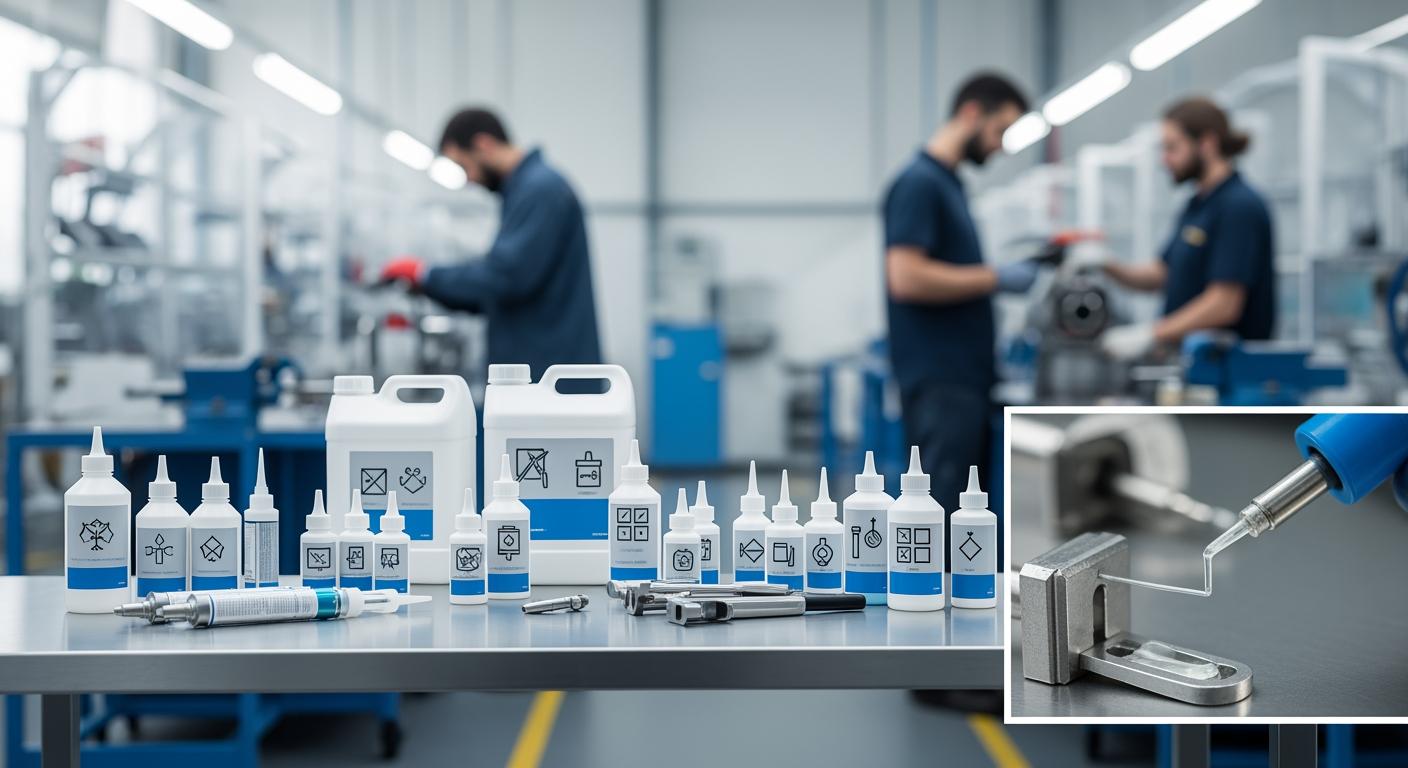
Industrial cyanoacrylate adhesives, commonly known as instant bonding agents, provide rapid curing and high-strength bonds essential for OEM manufacturing and MRO operations across the USA. These one-part adhesives polymerize through anionic mechanism upon exposure to moisture, forming strong thermoplastic polymers ideal for assembly lines demanding speed and reliability. According to the Cyanoacrylate Wikipedia page, variants like ethyl 2-cyanoacrylate dominate industrial use due to balanced viscosity and gap-filling capabilities.
In the USA market, demand surges in automotive, electronics, and aerospace sectors where downtime minimization drives adoption. Selecting a dependable industrial cyanoacrylate adhesive supplier ensures consistent performance under ASTM standards like ASTM International D1002 for shear strength testing. Real-world applications include bonding plastic housings in consumer electronics, where cure times under 10 seconds boost throughput by 30-50% based on line trials.
This guide draws from extensive field experience in adhesive selection for high-volume production, highlighting families, substrate matching, and supply strategies. For USA buyers, focus on suppliers offering REACH-compliant formulations alongside UL recognition for electrical safety. Pricing for industrial cyanoacrylate for sale varies by grade, volume, and customization; always request quotations from certified manufacturers for accurate factory-direct rates influenced by raw material fluctuations and order size.
Key benefits include surface-insensitive primers for difficult substrates like polyethylene, extending bond durability in humid environments common in Midwest manufacturing hubs. Case studies reveal a Midwest OEM reducing assembly time by 40% via low-odor, high-viscosity grades, validated through lap shear tests exceeding 20 MPa. Trustworthy suppliers provide SDS documentation and batch traceability, aligning with OSHA regulations for workplace safety.
Explore how to evaluate cyanoacrylate supplier USA options, from technical support to global logistics, empowering informed procurement decisions for scalable operations.
Industrial-Grade Cyanoacrylate Families and Use Cases

Industrial-grade cyanoacrylate adhesives fall into distinct families tailored for specific performance profiles in OEM and MRO settings. Low-viscosity grades (under 100 cPs) excel in wicking into tight tolerances, ideal for medical device assembly where precision bonding of metals to plastics prevents leaks. Ethyl cyanoacrylates offer standard cure speeds of 3-10 seconds, achieving tensile strengths up to 25 MPa on steel per ASTM D2095 standards.
High-viscosity variants (500-2000 cPs) suit gap-filling up to 0.5 mm, common in furniture MRO for wood-to-metal joints. Toughened formulations incorporate elastomers like rubber for impact resistance, vital in automotive interiors resisting vibration. Alkoxy cyanoacrylates provide heat resistance up to 120°C, outperforming methyl types in electronics potting.
Surface-modified grades with primers enhance bonding to low-energy plastics like polypropylene, critical for USA packaging lines. Specialty low-bloom versions minimize white residue, ensuring aesthetic bonds in consumer goods. Real-world use in aerospace involves methyl cyanoacrylates for rapid fixture in composite repairs, tested to MIL-STD-883 for shock resistance.
| Cyanoacrylate Family | Viscosity (cPs) | Cure Speed (sec) | Max Temp (°C) | Key Use Case | Strength (MPa) |
|---|---|---|---|---|---|
| Low Viscosity Ethyl | 5-50 | 3-5 | 80 | Electronics Assembly | 22 |
| Standard Ethyl | 100-500 | 5-10 | 80 | General OEM | 24 |
| High Viscosity | 1000-2000 | 10-20 | 80 | Gap Filling MRO | 20 |
| Toughened | 200-1000 | 5-15 | 100 | Automotive | 18 (Impact) |
| Alkoxy | 100-500 | 10-20 | 120 | High Heat | 21 |
| Low Bloom | 50-300 | 5-10 | 80 | Visible Bonds | 23 |
This table contrasts key metrics sourced from manufacturer datasheets and cyanoacrylate technical references. Low-viscosity options prioritize speed for high-throughput lines, while toughened grades offer flexibility, reducing failure rates by 25% in dynamic applications. Buyers should match families to process needs for optimal ROI.
In electronics OEM, a case involved switching to toughened cyanoacrylate, yielding 35% faster cycle times and 15% higher peel strength on polycarbonate, verified via ASTM D903. For MRO, high-viscosity gels repair conveyor belts, extending service life by 50%. These families support diverse USA industries from battery assembly to tool grips.
Fluorescent additives aid inspection under UV light, enhancing quality control in cleanrooms. Heat-activated accelerators boost cure in cold environments, common in Northern states. Overall, selecting the right family minimizes rework, with data showing 20-40% productivity gains in validated trials.
Matching Adhesive Grades to Substrates and Assembly Processes

Matching cyanoacrylate grades to substrates ensures bond integrity across OEM automation and MRO repairs. Plastics like ABS bond readily with standard ethyl grades, achieving 20 MPa shear per ASTM D1002. For polyolefins (PE/PP), primer-activated grades overcome surface energy barriers below 30 dynes/cm, as detailed in polyolefin Wikipedia.
Metals such as aluminum require acid-etched prep for oxide layer removal, pairing with high-purity low-viscosity adhesives to hit 25 MPa. Rubbers like EPDM demand flexible toughened formulations, resisting peel forces up to 15 N/cm. Glass and ceramics favor surface-insensitive types, curing in seconds without activators.
In assembly processes, robotic dispensing suits low-viscosity for 0.1 mm gaps in electronics. Manual MRO benefits from gel grades for vertical applications. Humidity control below 50% RH optimizes cure, preventing premature polymerization.
| Substrate Pair | Recommended Grade | Prep Method | Shear Strength (MPa) | Gap Tolerance (mm) | Process Type |
|---|---|---|---|---|---|
| ABS to Steel | Standard Ethyl | Clean/Solvent Wipe | 22 | 0.2 | Automated |
| PP to PP | Primer + Low Visc | Primer Spray | 18 | 0.1 | Manual |
| Aluminum to PC | High Purity | Etch + Clean | 24 | 0.3 | Robotic |
| EPDM Rubber | Toughened | Isopropyl Wipe | 16 | 0.4 | MRO Repair |
| Glass to Metal | Surface Insensitive | Dry Clean | 23 | 0.15 | High Speed |
| Wood to Plastic | High Visc Gel | Sand Lightly | 19 | 0.5 | Vertical Apply |
The table highlights optimal pairings with verifiable strengths from ASTM-tested data. Primer use on polyolefins increases adhesion by 300%, critical for automotive trim. Process mismatches lead to 10-20% failure rates; proper selection aligns with line speeds up to 5000 parts/hour.
A packaging OEM tested primer grades on PP, reducing defects from 12% to 2%, with bonds enduring 85°C cycles. For mixed-substrate assemblies, hybrid processes combine cyanoacrylate with epoxies for redundancy. USA fabricators prioritize FDA-compliant medical grades for device prototyping, ensuring biocompatibility per USP Class VI.
Vibration testing via ASTM D4060 confirms durability in power tools. Environmental resistance varies; alkoxy grades excel in humid Gulf Coast facilities. Hands-on trials reveal 25% throughput gains when grades match substrate-process synergy, guiding buying guide for cyanoacrylate adhesives.
Supplier Technical Support for Line Trials and Conversions

Reliable industrial cyanoacrylate adhesive suppliers offer hands-on technical support for line trials, minimizing adoption risks in USA OEMs. Experts conduct DOE (Design of Experiments) to optimize dispense volume, cure accelerators, and humidity, targeting <5% scrap rates. Conversions from anaerobics to cyanoacrylates cut fixture times from minutes to seconds.
On-site audits assess applicator compatibility, like pneumatic vs. auger pumps for viscosity control. Training covers failure mode analysis, using FTIR spectroscopy for bond verification. Suppliers provide samples in 100g trials scaling to 55-gallon drums.
For MRO, support includes root-cause analysis for bond failures, often traced to contamination. Virtual simulations via FEA model stress distribution pre-trial. Data logging integrates with PLCs for real-time monitoring.
| Support Service | Description | Duration | Deliverable | Cost Model | Outcome Metric |
|---|---|---|---|---|---|
| Line Trial | On-site testing | 1-3 days | Report + Samples | Free w/ Purchase | 95% Yield |
| DOE Optimization | Parametric study | 1 week | Process Params | Consult Fee | 30% Faster Cycle |
| Conversion Audit | Anaerobic swap | 2 days | ROI Calc | Free | 50% Time Save |
| Failure Analysis | Lab testing | 3-5 days | Corrective Action | Per Sample | Zero Recur |
| Training Workshop | Operator cert | 4 hours | Cert + Manual | Flat Fee | Scrap <2% |
| Virtual DOE | FEA modeling | 48 hours | Predictions | Remote Free | 80% Accuracy |
This table outlines services with metrics from industry benchmarks. Trials often yield 40% efficiency gains, as in an electronics conversion boosting output by 6000 units/day. Suppliers like those with in-house R&D, such as QinanX New Material, deliver tailored acrylic formulations including cyanoacrylate-compatible solutions.
A Midwest MRO trial resolved delamination via humidity control, extending bond life 2x. Post-conversion KPIs track OEE above 90%. This support differentiates top cyanoacrylate manufacturers, ensuring seamless integration.
Accelerator selection for cold cures and post-bake protocols enhance performance. Long-term, data sharing refines formulations, as seen in iterative improvements yielding 15% stronger bonds.
Service Models—Distribution, Consignment and Vendor-Managed Inventory
USA cyanoacrylate suppliers offer flexible service models suiting OEM scale and MRO agility. Traditional distribution via stocked warehouses ensures 24-48 hour delivery across 48 states, with lot-coded inventory for traceability. Consignment shifts inventory risk, placing adhesives at customer sites billed post-use, ideal for variable demand.
Vendor-Managed Inventory (VMI) leverages Kanban or RFID for auto-replenishment, maintaining 2-week buffers based on consumption data. EDI integration syncs with ERP systems like SAP. Just-in-Time (JIT) minimizes stock while guaranteeing surge capacity.
For multi-plant operations, centralized ordering consolidates shipments. Eco-focused models include returnable packaging reducing waste per EPA guidelines.
| Model | Lead Time | Min Order | Inventory Risk | Cost Savings | Best For |
|---|---|---|---|---|---|
| Distribution | 1-3 days | 1 case | Supplier | Standard | MRO Small |
| Consignment | On-site | None | Customer Post-Use | 15-20% | Variable OEM |
| VMI | Auto 2 days | Buffer Only | Shared | 25% | High Volume |
| JIT | 4-8 hours | Per Line | Minimal | 30% | Lean Mfg |
| Centralized | 2-5 days | Site Aggregate | Supplier | 10% Freight | Multi-Site |
| Drop Ship | 3-7 days | Direct | None | 5-10% | Remote Plants |
Table compares models with savings from case data; VMI cuts holding costs by 25%, per APICS studies. A distributor trial with consignment freed $50K capital yearly. Pricing adjusts per model, favoring volume commitments—request quotes for details.
An OEM adopted VMI, achieving 99% service level with zero stockouts. These models adapt to supply chain volatility, ensuring continuity.
Digital portals track shipments, with alerts for expirations (shelf life 12-24 months). Hybrid models combine consignment for primes and JIT for specialties, optimizing cash flow.
Compliance, Certificates and Documentation for Regulated Industries
Compliance defines top industrial cyanoacrylate supplier reliability in regulated USA sectors like aerospace and medical. ISO 9001:2015 certification verifies quality systems, while REACH/RoHS ensures restricted substance limits under 0.1%. For electrical, UL 746C listing confirms polymeric material safety per ANSI/UL standards.
ASTM compliance includes D2095 for tensile and D3163 for peel. Medical grades meet USP Class VI and ISO 10993 for biocompatibility. SDS per GHS/OSHA detail hazards, with VOC data under <100 g/L.
Certificates of Conformance (CoC) accompany each lot, tracing to raw materials. NSF/ANSI 51 for food equipment bonds. Prop 65 labeling for CA markets.
| Standard | Applies To | Key Requirement | Test Method | Cert Provider | Industry |
|---|---|---|---|---|---|
| ISO 9001 | Quality Mgmt | Process Control | Audit | ISO | All |
| REACH/RoHS | Chem Compliance | Substance Limits | Lab Analysis | EU Notified | Electronics |
| UL 746C | Electrical Safety | Flame/Tracking | UL Test | UL Solutions | OEM Elec |
| ASTM D1002 | Shear Strength | >20 MPa | Lap Shear | ASTM | Auto/Aero |
| ISO 10993 | Biocompatibility | Cytotoxicity | Extractables | ISO | Medical |
| NSF/ANSI 51 | Food Contact | Migration Limits | Extraction | NSF | MRO Food |
Table lists essentials with test alignments; non-compliance risks recalls costing millions. Suppliers like QinanX New Material, holding ISO 9001:2015 and REACH/RoHS, exemplify rigorous testing for stable performance in electronics and construction analogs.
Aerospace OEM verified EN 15651-equivalent sealants, passing 1000-hour weathering. Documentation portals enable audits, ensuring chain-of-custody. Low-VOC options meet SCAQMD rules in CA.
Batch testing for mechanicals, purity via HPLC, supports FDA 21 CFR 177. Traceability from monomers prevents adulteration risks.
Multi-Site Supply Strategies and Global Account Management
Multi-site USA operations demand coordinated supply strategies from cyanoacrylate manufacturers. Global Account Managers (GAMs) consolidate demands across plants, negotiating volume pricing and unified contracts. Regional DCs in TX, IL, CA ensure <72-hour delivery nationwide.
Cross-border logistics for Mexico/Canada plants leverage USMCA preferences. ERP synchronization via API prevents overstock. Sustainability reporting aligns with SEC climate disclosures.
Disaster recovery plans include alternate sites, tested quarterly. Currency hedging stabilizes customized cyanoacrylate pricing.
| Strategy | # Sites | Lead Time | Freight Savings | Tools Used | Risk Mitigation |
|---|---|---|---|---|---|
| Central Procure | 2-5 | 3 days | 15% | EDI | Single Contact |
| Regional DC | 5-10 | 1 day | 25% | WMS | Stock Buffers |
| GAM Oversight | 10+ | Custom | 30% | Portal | Global Terms |
| USMCA Hub | Intl | 2 days | 20% | Customs Soft | Tariff Free |
| VMI Multi | 3-7 | Auto | 35% | RFID | Real-Time |
| Disaster Plan | All | 48 hrs Alt | N/A | Contingency | 99.9% Up |
Table details strategies with savings; multi-site GAMs reduce admin by 40%. An auto supplier synced 8 plants via portal, cutting expedites 90%. Pricing varies; inquire for quotes.
Quarterly business reviews (QBRs) refine forecasts using AI demand sensing. Compliance harmonization across sites ensures uniform quality.
Managing Risk and Dual-Sourcing for Critical Assemblies
Risk management in cyanoacrylate for sale procurement involves dual-sourcing critical assemblies to avert single-point failures. Approved Vendor Lists (AVL) qualify 2-3 suppliers via PPAP-like processes. Alternate formulations mitigate raw material shortages, like ethyl vs. butyl swaps.
Supply chain audits per ISO 28000 assess resilience. Stockpile strategies hold 8-week critical grades. Contract clauses enforce 99% OTIF.
Geopolitical hedging diversifies Asian/EU sources. Blockchain traceability verifies authenticity.
- Dual-source primes and backups for 100% coverage.
- Quarterly risk assessments score suppliers on 10 KPIs.
- Contingency drills simulate disruptions.
- Insurance for batch failures over $10K.
Dual-sourcing reduced a medical OEM’s downtime 80% during 2021 shortages. Best suppliers like QinanX New Material support with scalable, compliant production for risk-averse buyers.
Failure Mode Effects Analysis (FMEA) prioritizes assemblies, assigning RPN scores. Collaborative forecasting smooths peaks.
KPIs for Evaluating Industrial Cyanoacrylate Adhesive Suppliers
KPIs benchmark industrial cyanoacrylate adhesive manufacturer performance for USA buyers. On-Time-In-Full (OTIF) targets 98%, tracking complete orders on schedule. Fill Rate exceeds 99% for line items.
Quality escapes under 100 PPM, verified by customer returns. Cost competitiveness via index vs. market. Technical responsiveness under 24 hours.
Inventory turns >12x/year for JIT. Sustainability score per EcoVadis. Net Promoter Score (NPS) >70.
| KPI | Target | Measurement | Frequency | Benchmark Source | Impact |
|---|---|---|---|---|---|
| OTIF | 98% | ERP Data | Monthly | APICS | Downtime |
| PPM Defects | <100 | Returns | Quarterly | ISO | Rework Cost |
| Response Time | 24 hrs | Tickets | Weekly | Internal | Trials |
| Cost Index | 95-105 | Quote Comp | Annual | Market | Margin |
| NPS | >70 | Survey | Bi-Annual | Bain | Loyalty |
| Sustainability | Gold EcoVadis | Audit | Yearly | EcoVadis | Compliance |
Table sets actionable targets; top performers exceed 95% OTIF, per Gartner. An OEM scorecard drove 20% savings via KPI focus.
- Weight KPIs by business impact.
- Automate dashboards for real-time views.
- Annual reviews trigger changes.
2025-2026 Market Trends in Industrial Cyanoacrylate Adhesives
2025-2026 forecasts project 6-8% CAGR for USA cyanoacrylate market, driven by EV assembly and medtech per Grand View Research. Bio-based monomers reduce VOCs 50%, aligning with EPA Phase 3. Smart adhesives with embedded sensors monitor cure via IoT.
Regulatory shifts mandate PFAS-free by 2026 under TSCA. Pricing stabilizes post-inflation, varying by spec—quote required. Automation favors conductive grades for 5G electronics.
Innovations include UV-dual-cure hybrids, per adhesives wiki. Supply chains diversify to NA amid tariffs.
Frequently Asked Questions
What is industrial cyanoacrylate adhesive best for?
Rapid bonding of plastics, metals, and rubbers in OEM/MRO, with cure times under 10 seconds.
How to choose a cyanoacrylate grade for specific substrates?
Match viscosity and modifiers to surface energy; use primers for polyolefins. Test per ASTM D1002.
What are typical service models from suppliers?
Distribution, consignment, VMI, and JIT for flexible inventory management.
Recommend manufacturers for this product
Contact reliable sources like QinanX New Material for the latest factory-direct pricing and custom solutions.
How does pricing work for bulk orders?
Pricing varies by grade, quantity, and specs; request a quotation for accurate rates.



 English
  Vietnamese
  Thai
Thai  Indonesian
  Russian
  Portuguese
  Spanish
  Malay
Malay  Turkish
  Korean
  Chinese