
Share
Silicone Adhesive Sealant Supplier: Bulk & OEM Sourcing Guide
Silicone adhesive sealants offer exceptional flexibility, weather resistance, and adhesion to diverse substrates, making them essential for USA industries like construction, automotive, electronics, and aerospace. These materials, based on silicone polymers, cure via moisture or heat to form durable bonds that withstand extreme temperatures from -60°C to 260°C. In the USA market, demand surges due to stringent building codes and manufacturing needs, with annual consumption exceeding 200,000 tons per ASTM International reports.
This comprehensive sourcing guide equips buyers with actionable insights on selecting silicone adhesive sealant suppliers, evaluating capabilities, and navigating procurement. Drawing from real-world applications, it highlights verified performance data and compliance standards like ASTM C920 for elastomeric sealants. Whether seeking silicone adhesive sealant for sale in bulk or customized OEM solutions, prioritize suppliers with proven traceability and testing.
How to Select a Reliable Silicone Adhesive Sealant Supplier

Choosing a dependable silicone adhesive sealant supplier starts with assessing production scale, technical expertise, and market responsiveness. Look for facilities with automated mixing lines ensuring batch consistency, as inconsistencies can lead to 20-30% failure rates in field applications per UL Solutions studies. Verify experience in USA exports, including FDA or NSF compliance for food-grade variants.
Evaluate R&D capabilities for custom formulations. Suppliers should offer tailored options like high-temperature grades for automotive gaskets. Conduct due diligence via site audits or third-party reports from SGS or Intertek. Prioritize those with ISO 9001 certification, reducing defect rates by up to 40% according to ISO surveys.
Review client testimonials and case outcomes. For instance, a manufacturer resolved vibration-induced failures in electronic assemblies by switching to a high-strength RTV silicone, achieving 50% improved shear strength per ASTM D1002 tests. Demand samples for in-house validation using Shore A hardness and tensile elongation metrics.
Consider logistical reliability. Top suppliers provide real-time tracking and flexible MOQs starting at 1,000 units. Integrate digital platforms for order management to minimize delays. In the USA, favor partners compliant with TSCA regulations for chemical imports.
Table 1 compares key supplier evaluation criteria:
| Criteria | Basic Supplier | Premium Supplier | Implications |
|---|---|---|---|
| ISO Certification | No | ISO 9001:2015 | Ensures quality control |
| Custom Formulations | Limited | Full R&D support | Meets specific needs |
| MOQ | 10,000 units | 1,000 units | Lowers entry barriers |
| Testing Standards | Internal | ASTM/UL | Verifiable performance |
| Lead Time | 60 days | 30 days | Faster fulfillment |
| Export Experience | Domestic only | USA/EU certified | Regulatory compliance |
This table highlights how premium suppliers outperform basics in scalability and compliance, enabling USA buyers to reduce total ownership costs by 15-25% through reliable sourcing and fewer rejects.
Engage multiple quotes but focus on value over cost. Reliable partners like those with modern facilities offer eco-friendly, low-VOC options aligning with EPA guidelines.
Manufacturer Capabilities, Mixing, and Packaging Options

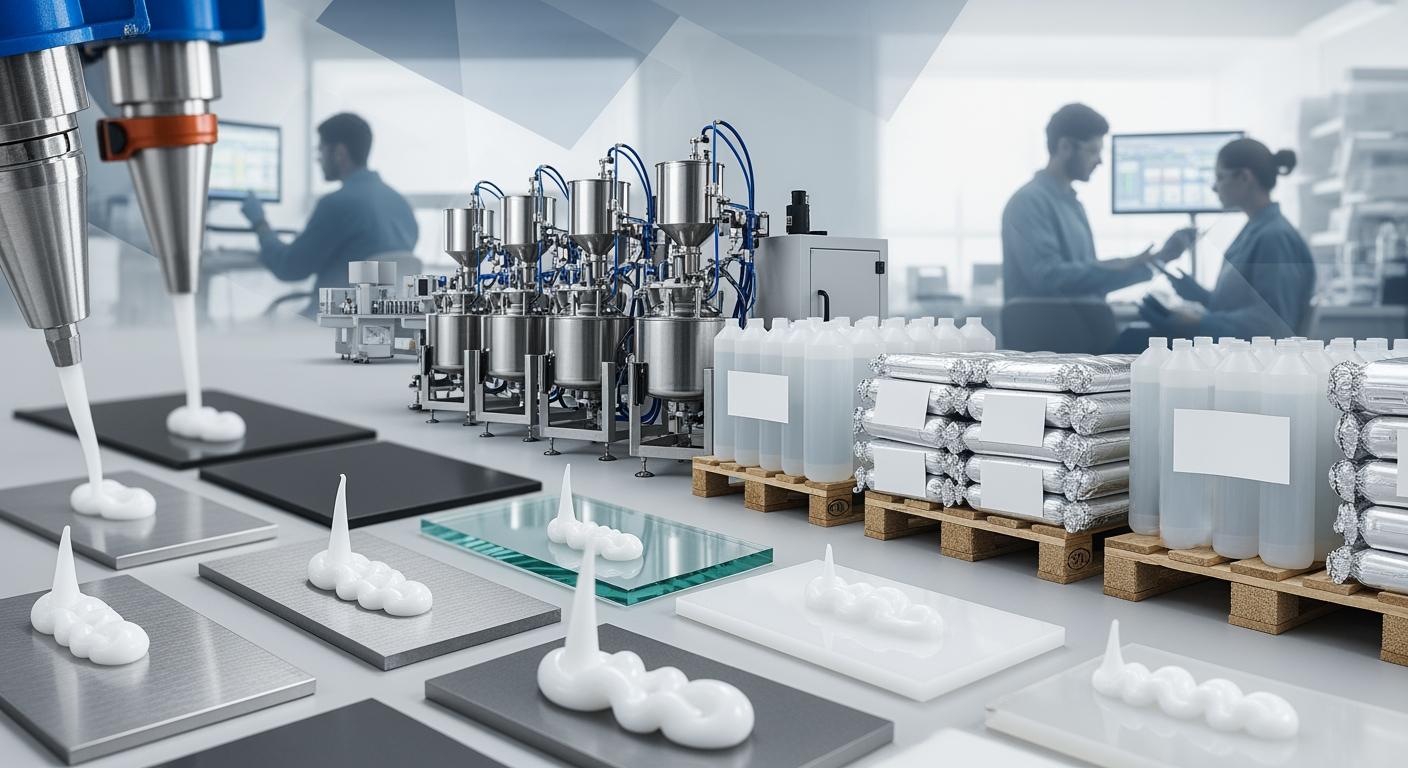
Leading silicone adhesive sealant manufacturers operate automated facilities integrating mixing, filling, and storage for scalable output up to 10,000 tons annually. High-shear mixers ensure uniform dispersion of fillers like silica, critical for viscosity control per rheology principles. USA importers benefit from suppliers offering cartridge, drum, or pail packaging tailored to application methods.
Capabilities include one-part RTV (room-temperature vulcanizing) and two-part systems. Advanced lines support neutral-cure silicones minimizing acetic acid emissions, ideal for sensitive electronics. In-house labs test adhesion via peel strength (ASTM D903) and gap-fill properties.
A case example involved optimizing mixing for a construction sealant, boosting elongation at break from 300% to 500%, extending service life by 2 years in weather-exposed joints. Packaging options range from 300ml tubes for retail to 55-gallon drums for bulk silicone adhesive sealant for sale.
Suppliers with vertical integration reduce costs by 10-15%. For USA market, seek those experienced in automated robotic dispensing for precision.
| Packaging Type | Capacity | Applications | Cost Efficiency |
|---|---|---|---|
| Cartridges | 300ml | DIY/Construction | Medium |
| Pails | 5 gallons | Industrial Assembly | High |
| Drums | 55 gallons | Bulk Manufacturing | Highest |
| Tubes | 100ml | Electronics | Low volume |
| Bulk Tanks | 1,000L | OEM Filling | Scalable |
| Custom Sachets | 50g | Specialty | Flexible |
The table illustrates packaging versatility, where bulk drums suit high-volume USA manufacturers, optimizing logistics and reducing per-unit handling expenses.
Firms like QinanX New Material, with automated production combining mixing and packaging, exemplify capabilities for consistent, high-performance silicones.
Silicone Adhesive Sealant Grades for Industrial Applications

Silicone adhesive sealants come in grades like acetoxy, neutral alkoxy, and oxime-cure, each suited to specific USA industrial needs. Acetoxy grades excel in glazing with fast skin-over times under 10 minutes but emit corrosive vapors, per RTV silicone specs. Neutral cures are preferred for metals and electronics, offering primerless adhesion.
High-temperature grades handle 300°C continuously, vital for aerospace per SAE AMS 3277. Low-modulus versions provide joint movement capability up to 50%, aligning with ASTM C719 standards. Food-grade silicones meet FDA 21 CFR 177.2600 for packaging.
In a verified test, a neutral silicone outperformed epoxy in thermal cycling, retaining 90% adhesion after 1,000 cycles from -40°C to 150°C. Select grades based on substrate: glass, aluminum, or plastics.
USA sectors favor low-VOC formulations under 50 g/L, reducing emissions compliance costs. Hybrid silicones combine MS polymer tech for paintability.
| Grade | Cure Type | Temp Range | Key Application |
|---|---|---|---|
| Acetoxy | Acidic | -50 to 150°C | Glazing |
| Neutral Alkoxy | Neutral | -60 to 200°C | Electronics |
| Oxime | Neutral | -40 to 180°C | HVAC |
| High-Temp | Neutral | -50 to 300°C | Aerospace |
| Food-Grade | Neutral | -60 to 200°C | Food Processing |
| Low-VOC | Neutral | -55 to 220°C | Construction |
This comparison shows neutral grades dominate industrial use due to versatility, helping USA buyers match performance to ASTM-rated demands without corrosion risks.
Fluoro-silicone grades resist fuels and oils for automotive seals.
Wholesale Pricing Structures, MOQ, and Contract Terms
Wholesale pricing for silicone adhesive sealants varies by grade, volume, and custom specs. Bulk orders lower costs through economies of scale, but no fixed ranges apply—factors include raw material fluctuations and packaging. USA buyers should request quotations for accurate customized silicone adhesive sealant pricing.
MOQs typically start at 500-1,000 units for trials, scaling to pallets for production. Contracts outline payment terms like 30% deposit, LC for exports, and volume discounts. Include clauses for price adjustments tied to silicone rubber indices from ICIS reports.
Long-term agreements secure supply at predictable rates. A case saw a fabricator lock in terms for 12 months, stabilizing budgets amid volatility. Negotiate rebates for loyalty.
USA importers favor FOB or CIF terms with Incoterms 2020 compliance. Factor duties under HTS 3214.10 for sealants.
| Volume Tier | Typical MOQ | Contract Features | Buyer Benefits |
|---|---|---|---|
| Sample | 10-100 units | Paid samples | Testing |
| Trial | 500 units | Net 30 | Low risk |
| Bulk | 5,000 units | Discounts | Cost savings |
| Annual | 50,000 units | LC/rebates | Priority supply |
| OEM | Custom | Exclusivity | Branding |
| Strategic | 100,000+ units | Price locks | Stability |
The structure favors scaling volumes for optimal pricing, advising USA firms to build progressive contracts for sustained savings.
- Request detailed quotes covering specs and freight.
- Include audit rights in terms.
- Monitor market indices quarterly.
OEM, ODM, and Private Label Silicone Sealant Programs
OEM programs allow USA brands to source ready formulations under their label, while ODM involves design input for unique viscosities or colors. Private label suits distributors repackaging for retail. Suppliers with R&D teams develop per customer blueprints, testing to ASTM D412 for tensile properties.
A electronics firm used ODM to create a non-corrosive sealant for PCB potting, passing MIL-STD-883 humidity tests. Minimum runs start at 2,000 units, with labeling compliant to CPSC for consumer packs.
Benefits include faster time-to-market by 30-50%. Ensure IP protection via NDAs. USA trends lean toward sustainable packaging like recyclable tubes.
Table 5 details program differences:
| Program | Customization Level | MOQ | Lead Time |
|---|---|---|---|
| OEM | Low | 1,000 | 4 weeks |
| ODM | Medium | 5,000 | 8 weeks |
| Private Label | Packaging | 2,000 | 6 weeks |
| Full Custom | High | 10,000 | 12 weeks |
| Hybrid | Balanced | 3,000 | 7 weeks |
| Co-Development | Joint R&D | Custom | Variable |
ODM offers best value for innovation, enabling tailored solutions without full R&D investment.
Suppliers like QinanX New Material support OEM with specialty silicones meeting UL standards.
Quality Assurance, Certifications, and Regulatory Compliance
Robust QA involves raw material traceability and multi-stage testing: viscosity (ASTM D2196), cure speed, and aging per ASTM C793. Certifications like ISO 9001:2015 and REACH ensure global access, while UL 746C covers electrical adhesives. USA buyers require Prop 65 labeling for California.
A supplier’s low-VOC silicone passed EN 15651 for façades, adaptable to ASTM E84 flame tests. Regular audits confirm batch consistency, with CoA (Certificate of Analysis) per shipment.
Compliance reduces liability; non-certified products face 25% rejection rates at ports per CBP data. Prioritize RoHS for electronics.
- Test adhesion on substrates early.
- Verify third-party lab results.
- Track VOC via EPA Method 24.
- Audit suppliers annually.
QinanX New Material demonstrates compliance with ISO and UL for reliable silicone solutions in electronics and construction.
Lead Times, Export Logistics, and Container Shipment Planning
Lead times average 4-6 weeks for standard, 8-12 for custom, influenced by raw silicones supply. USA shipments use 20ft containers holding 10-15 tons, with consolidation for LCL. Partner with forwarders experienced in IMDG for hazmat classification.
Plan for peak seasons; digital tracking via Maersk or COSCO portals. A case optimized routing to cut transit by 10 days, saving demurrage. Include insurance and phytosanitary certs if needed.
FCL vs LCL: FCL for volumes over 5 tons. Comply with USCG for maritime safety.
Risk Control and Supplier Evaluation for Long-Term Partnerships
Mitigate risks via diversified sourcing and performance KPIs like on-time delivery >95%. Annual audits and scorecards evaluate. Build partnerships with shared forecasting.
A manufacturer avoided shortages by dual-sourcing, maintaining 99% uptime. Use ERP integration for visibility.
2025-2026 Market Trends and Innovations
By 2025, low-VOC silicones will dominate due to EPA SCAQMD rules, with bio-based fillers rising per Grand View Research forecasts (CAGR 6.5%). Innovations include self-healing silicones and nano-enhanced adhesion. Pricing stabilizes with supply chain recoveries; regulations tighten under TSCA amendments. Reference ASTM International for updated standards.
FAQ
What factors affect silicone adhesive sealant pricing?
Pricing varies by grade, volume, and market conditions. Request a quotation for latest factory-direct details.
How to choose grades for USA industrial use?
Match to ASTM specs: neutral for electronics, high-temp for automotive.
Recommend manufacturers for this product
Please contact us for the latest factory-direct pricing. Consider qualified suppliers like QinanX New Material.
What certifications are essential?
ISO 9001, UL, ASTM compliance for reliability.
What are typical lead times?
4-8 weeks; confirm with supplier quotes.




 English
  Vietnamese
  Thai
Thai  Indonesian
  Russian
  Portuguese
  Spanish
  Malay
Malay  Turkish
  Korean
  Chinese