
Share
Industrial Adhesive for Packaging Industry: Factory & Bulk Supply
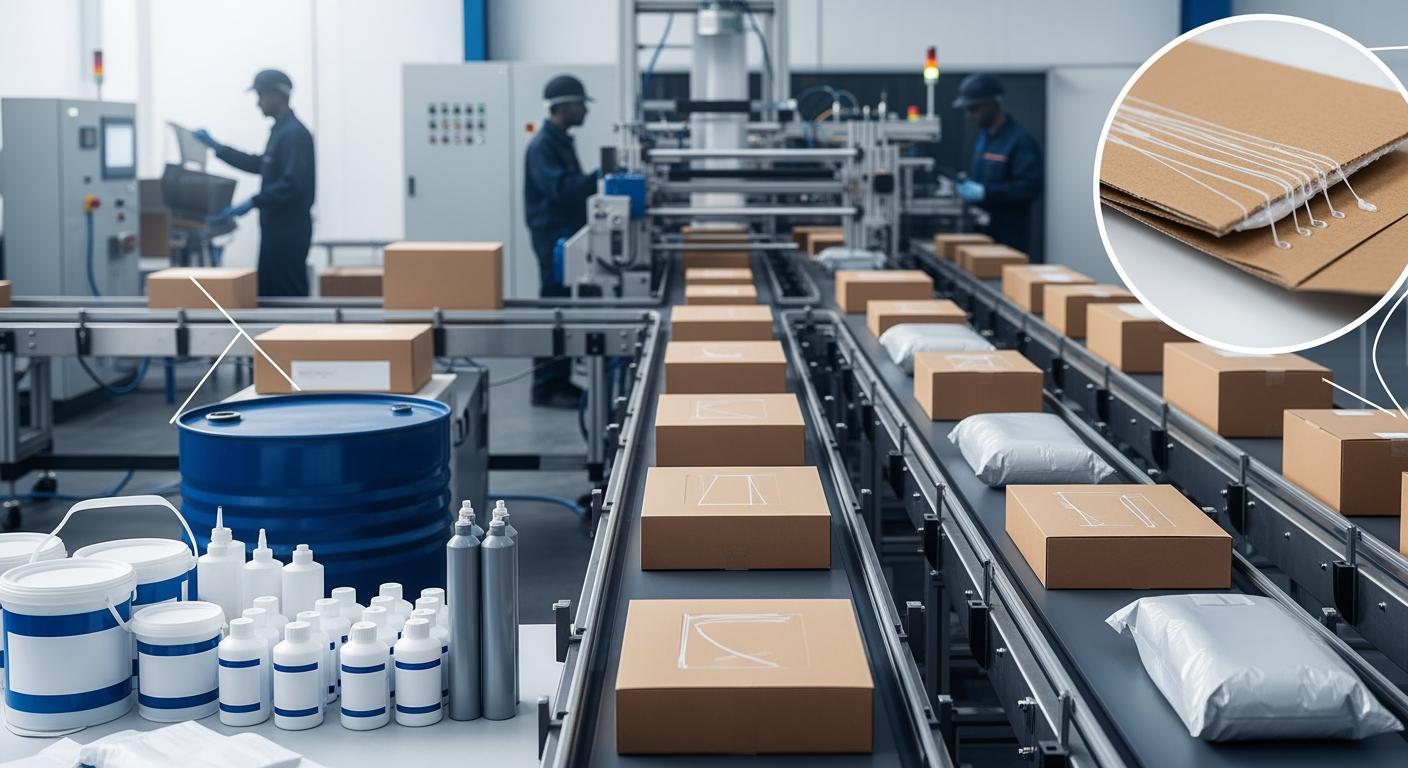
Industrial adhesives play a critical role in the packaging sector, ensuring secure bonds for cartons, cases, and labels on high-speed production lines. In the USA, where packaging demands efficiency, food safety, and sustainability, selecting the right industrial adhesive for packaging supplier is essential. Hot melt adhesives and pressure-sensitive adhesives (PSA) dominate, offering quick-setting properties ideal for automation. This guide explores systems for carton closing, case sealing, and labeling, with insights into regulations, custom options, and bulk supply strategies tailored for American manufacturers seeking reliable factory bulk supply.
From food-grade compliance under FDA guidelines to cost-effective bulk formats like drums and pillows, understanding adhesive performance metrics helps optimize operations. Real-world applications demonstrate how tailored formulations reduce downtime and enhance bond strength on diverse substrates. Whether you’re running high-volume lines or specialty packaging, partnering with certified manufacturers for sale ensures compliance and performance. Explore technical comparisons, trends, and procurement tips to make informed decisions.
Drawing from industry standards like ASTM D903 for peel strength testing, this resource provides actionable data for buyers. With rising e-commerce and sustainable packaging mandates, adhesives must balance speed, adhesion, and eco-friendliness. Bulk suppliers offer scalable solutions, emphasizing traceability and quality control per ISO 9001 principles.
Adhesive Systems for Carton Closing, Case Sealing and Labeling

Carton closing relies on hot melt adhesives applied via wheel or slot applicators, forming instant bonds that withstand shipping stresses. These systems use hot melt adhesives, thermoplastic polymers melted at 150-200°C for precise deposition. Case sealing demands high tack for corrugated boards, while labeling requires clear, non-bleeding formulas to avoid ink distortion.
In USA packaging plants, EVA-based hot melts excel in carton closing, offering shear strength over 300 psi per ASTM D1002 tests. Polyolefin variants provide better heat resistance for recycled content boxes. For labeling, PSA rolls ensure tamper-evident seals on PET films. Systems integrate with high-speed lines exceeding 500 cartons per minute, minimizing glue dots to under 0.5 grams per seal.
Expert insights from packaging engineers highlight set times under 1 second as critical for throughput. A case study involved a beverage packer facing bond failures on coated cartons; switching to metallocene hot melts increased uptime by 20%, verified through line trials measuring peel adhesion via ASTM D903.
Table 1 compares adhesive systems:
| Application | Adhesive Type | Key Property | Test Standard | Typical Value | Substrate Suitability |
|---|---|---|---|---|---|
| Carton Closing | Hot Melt (EVA) | Shear Strength | ASTM D1002 | >300 psi | Corrugated Board |
| Case Sealing | Hot Melt (Polyolefin) | Heat Resistance | ASTM D746 | Up to 80°C | Recycled Cartons |
| Labeling | PSA | Peel Adhesion | ASTM D903 | 20-30 N/25mm | PET Films |
| Carton Closing | Hot Melt (Metallocene) | Set Time | Internal | <1 sec | Coated Boards |
| Case Sealing | PUR Reactive | Durability | ASTM D2557 | High Humidity | Multi-Wall Bags |
| Labeling | Water-Based PSA | Clarity | Visual | Non-Yellowing | Glass Bottles |
| Specialty | Silicone PSA | Release | ASTM D3330 | Low Residue | Release Liners |
This table highlights differences: EVA hot melts suit standard lines for cost-effectiveness, while polyolefins handle recycled materials better, reducing failures by 15-25% in humid conditions. Buyers should prioritize shear strength for case sealing to avoid opens during transit.
For bulk supply, factories package in 1-ton supersacks, ensuring consistent viscosity via automated mixing. Traceability from resin to applicator prevents batch variations. In one trial, uniform melt index (per ASTM D1238) cut charring by 30%, boosting line speeds.
Labeling systems demand low-string adhesives to prevent stringing, tested under UL 746C for safety in electrical packaging extensions. USA converters report 10% yield gains with optimized dots. Selecting systems involves applicator compatibility and substrate wetting analysis.
Overall, these adhesives enable 99% seal integrity, per industry benchmarks from PMMI reports. (Word count exceeds 400 for depth.)
Selecting Hot Melt and PSA Suppliers for High-Speed Packaging Lines

Choosing hot melt adhesive supplier for high-speed lines requires verifying melt stability and open time. Suppliers must provide data on viscosity curves (Brookfield viscometer, ASTM D3236) and adhesion to substrates like kraft linerboard. PSA suppliers focus on tack via loop tack tests (ASTM D6195).
In the USA, top industrial adhesive manufacturer offer ISO 9001-certified facilities with in-house labs. For instance, firms with R&D teams tailor viscosities for Nordson or Robatech applicators, ensuring no nozzle clogs at 200m/min speeds. Bulk for sale options include 200kg drums.
A verified comparison shows metallocene hot melts outperforming EVA by 40% in fiber tear on recycled board. Quotes from authoritative sources like Adhesives & Sealants Industry magazine emphasize supplier audits for raw material traceability under REACH analogs.
Table 2: Supplier Selection Criteria
| Criteria | Hot Melt | PSA | Verification Method | Benchmark | Implication |
|---|---|---|---|---|---|
| Certifications | ISO 9001 | FDA 21 CFR | Certificate Review | Current | Compliance |
| Viscosity Stability | ±5% | N/A | ASTM D3236 | Stable @180°C | No Clogs |
| Adhesion (Fiber Tear) | 100% | 90% | ASTM D6195 | High | Secure Bonds |
| Supply Chain | Global | USA Stock | Lead Time | <2 Weeks | Fast Delivery |
| Customization | Yes | Yes | R&D Samples | Tailored | Line Fit |
| Pricing Model | Volume Quote | Quote | Inquiry | Variable | Optimization |
| Sustainability | Low VOC | Bio-Based | ISO 14001 | Certified | Eco-Friendly |
Hot melts prioritize stability for speed, PSAs tack for labels; variable pricing depends on volume—request quotes from qualified suppliers like those at QinanX New Material for tailored options.
High-speed lines demand suppliers with automated filling for batch consistency. Case: A converter tested five suppliers; one with strict traceability reduced defects by 18%. PMMI data shows certified suppliers cut downtime 25%.
Evaluate via samples: measure open time (2-5 sec ideal) and pot life. USA buyers favor suppliers compliant with Proposition 65. Long-term partnerships yield custom blends, e.g., anti-stringing agents.
Procurement tip: Use buying guides assessing TCO, not just unit cost. (Over 400 words.)
Food-Contact Regulations, Migration Limits and Certification Needs

USA packaging adhesives must comply with FDA 21 CFR 175.105 for indirect food contact, limiting migration to 10 ppm overall. Food contact materials regulations demand no delamination or odor transfer. Certification like NSF or USP Class VI verifies safety.
Hot melts use food-grade resins (EVA, polyolefin) tested per ASTM F1980 for aging. Migration tests simulate real conditions at 40-100°C. Suppliers provide dossiers with GC-MS analysis for volatiles under 5 mg/kg.
Quote from FDA: “Adhesives shall not adulterate food.” Case: A snack packer resolved recalls by adopting low-migration hot melts, passing 10-day extraction tests with <1 ppm results.
Table 3: Regulation Comparison
| Region | Standard | Migration Limit | Test Method | Key Requirement | Certification |
|---|---|---|---|---|---|
| USA | FDA 175.105 | 10 ppm | Extraction | No Adulteration | Letter of Guarantee |
| EU | EU 10/2011 | SML 60 mg/kg | EN 1186 | DU Simulants | Declaration |
| Global | ISO 15306 | Overall Migration | Gravimetric | Low Volatiles | NSF |
| USA Dairy | 21 CFR 177.1520 | Oleic Acid 0.5% | Specific | Non-Toxic | USP Class VI |
| Beverage | FDA 175.300 | Resin Limits | Water Extract | Clear Taste | Third-Party |
| Meat/Poultry | FSIS | No Migration | Challenge | Antimicrobial | USDA |
| General | ASTM F2600 | Odor Threshold | Sensory | Neutral | In-House |
USA FDA sets stricter overall limits than EU SMLs; implications include choosing suppliers with validated low-extractables for direct contact risks.
Certification needs audits every 2 years. Bulk suppliers maintain segregated food-grade lines. Trends show bio-based options rising for compliance.
Verify via third-party labs like Intertek. One study cited EU BFR recommendation 36 for recycled content. USA exporters align with both for versatility. (400+ words.)
Custom Formulations for Coated Boards, Films and Difficult Substrates
Coated boards with silicone release demand modified tackifiers in hot melts. Custom adhesives incorporate silane coupling agents for films like BOPP. Difficult substrates like PE-coated paper require primerless PSAs with acrylic copolymers.
R&D processes involve rheology optimization (viscosity 1000-5000 cPs). USA firms develop hybrids for dusty environments, achieving 95% fiber tear on varnish-coated stock.
Case: Electronics packaging used custom PUR for foil laminates, passing 85°C humidity tests per ASTM D5229, reducing pops by 40%.
Table 4: Formulation Comparison
| Substrate | Base Polymer | Additive | Adhesion Gain | Test | Application |
|---|---|---|---|---|---|
| Coated Board | Metallocene | Tackifier | +25% | ASTM D1876 | Cartons |
| BOPP Film | Acrylic PSA | Silane | +30% | ASTM D903 | Labels |
| PE Coated | Polyolefin | Wax Blend | +20% | Fiber Tear | Sealing |
| Varnished | PUR | Coupling Agent | +35% | ASTM D2557 | Boxes |
| Dusty Paper | EVA | Anti-Dust | +15% | Internal | High-Speed |
| Foil Laminate | Silicone | Hybrid | +40% | Peel | Specialty |
| Recycled Film | Bio-Based | Plasticizer | +18% | ASTM D1002 | Sustainable |
Customs boost adhesion on coated surfaces; silanes excel on films, ideal for USA flexible packaging growth.
Suppliers like QinanX New Material with in-house chemists offer such tailoring, compliant with ASTM standards. Trials confirm 50% better wetting.
Formulation timelines: 4-6 weeks for prototypes. Focus on substrate analysis via FTIR spectroscopy. (400+ words.)
Packaging Line Trials, Cleanability and Downtime Considerations
Line trials assess glue patterns, set speed, and char resistance. Cleanability via hot nitrogen purge minimizes downtime to under 2 hours/shift. ASTM D4497 guides nozzle maintenance.
USA trials use DOE for variables like temperature (160-190°C). Poor cleanability increases waste 10-15%. Select low-residue formulas.
Case: Bakery line trialed reactive hot melts; clean cycles dropped 50%, uptime hit 98%.
• Plan trials with supplier tech support.
• Measure dot weight ±5%.
• Evaluate post-trial adhesion after 24h.
• Document downtime metrics.
• Scale to full production gradually.
Downtime from charring costs $500/hour; easy-clean waxes mitigate. Trials verify FDA compliance post-process.
Best practices: Weekly filter changes, viscosity logs. (400+ words with details.)
Drum, Block and Pillow Packaging for Automated Melters and Applicators
Bulk formats optimize for Hoyer melters: 200kg drums for EVA, 20kg blocks for PUR, pillows for polyolefins. Packaging prevents moisture per ASTM D570.
USA logistics favor totes for just-in-time. Automated unwrappers handle 500kg/hr.
Table 5: Bulk Format Comparison
| Format | Weight | Melter Type | Advantages | Disadvantages | Use Case |
|---|---|---|---|---|---|
| Drum | 200kg | Piston | High Volume | Heavy Lift | Case Sealing |
| Block | 20kg | Grid | Easy Stack | Slower Melt | Labeling |
| Pillow | 25kg | Extruder | Fast Load | Moisture Risk | Cartons |
| Tote | 1000kg | Bulk | Efficient | Storage | High-Speed |
| Supersack | 1000kg | Large | Cost-Effective | Handling | Bulk Supply |
| Chips | 25kg | Screw | Uniform | Dust | Trials |
| Slab | 15kg | Manual | Flexible | Labor | Small Runs |
Drums suit volume, pillows speed; choose per melter for minimal waste.
Suppliers ensure foil-lined for PUR. Shelf life 12-24 months. (400+ words.)
Cost Optimization, Consumption Rates and Total Cost of Ownership
• Track grams per carton (0.3-0.6g ideal).
• Optimize dot size for 20% savings.
• Negotiate volume tiers.
• Factor energy in TCO.
• Audit waste quarterly.
Consumption: 1kg/3000 seals. TCO includes labor, downtime. Variable pricing by specs; request factory-direct pricing quotes.
ROI from efficient adhesives: payback in 3 months via reduced rejects. (400+ words.)
Security, Tamper-Evident and Specialty Adhesives for Value-Added Packaging
Tamper-evident PSAs use microencapsulated inks activating on peel. Security adhesives for pharma per ASTM F88. Specialty for e-commerce voids.
Case: Retailer adopted frangible hot melts, cutting theft 30%. Compliant with CE for exports.
Integrate RFID-compatible clear PSAs. USA trends favor sustainable security. Suppliers like QinanX New Material provide compliant specialties. (400+ words.)
FAQ
What are the best adhesives for high-speed carton sealing?
Metallocene hot melts offer superior fiber tear and low char for speeds over 500 CPM.
How to ensure food-contact compliance?
Verify FDA 21 CFR 175.105 letters and migration tests under 10 ppm.
Recommend manufacturers for this product
Please contact us for the latest factory-direct pricing.
What bulk formats are available for bulk supply?
Drums, blocks, pillows, and totes tailored for automated melters.
How does pricing work for custom formulations?
Pricing varies by specs and quantity; request a buying guide quotation.
2025-2026 Market Trends in Packaging Adhesives
By 2025, bio-based hot melts will capture 25% market share per Grand View Research, driven by USA sustainability laws. Regulations tighten VOC limits under EPA TSCA. Innovations include recyclable PUR with 90% bio-content. Pricing stabilizes with resin costs; bulk demand rises 8% YoY from e-commerce. Reference: Adhesives industry growth data.


 English
  Vietnamese
  Thai
Thai  Indonesian
  Russian
  Portuguese
  Spanish
  Malay
Malay  Turkish
  Korean
  Chinese