
Share
Adhesive OEM Manufacturer for Automotive Brands and Tier Suppliers
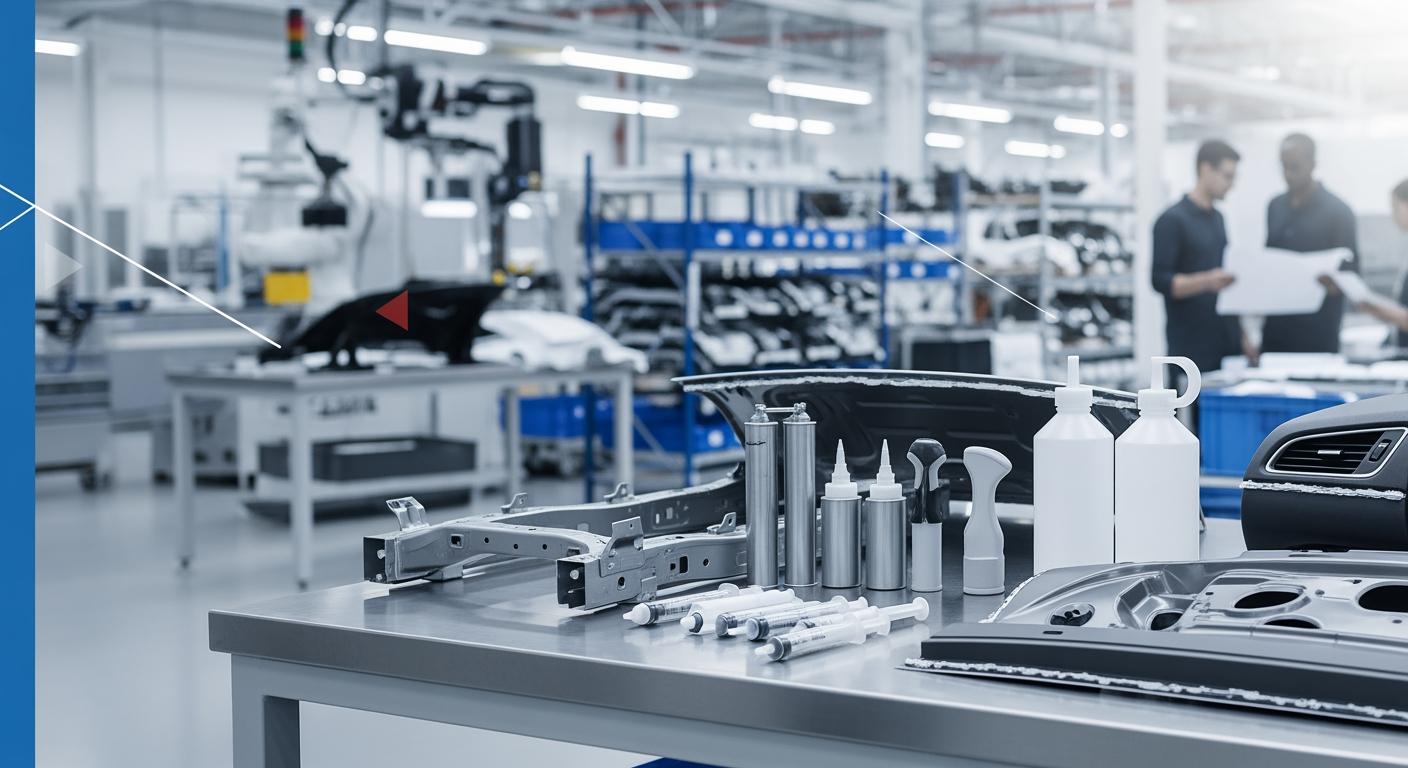
Automotive brands and tier suppliers in the USA rely on specialized adhesive OEM manufacturers to deliver high-performance bonding solutions for demanding vehicle assembly. These adhesives ensure structural integrity, vibration damping, and lightweight designs critical for modern vehicles. From body-in-white assembly to interior trim and electronics sealing, OEM-grade adhesives meet rigorous standards like ASTM specifications and automotive PPAP processes. This guide provides a comprehensive buying guide for adhesive OEM suppliers, highlighting evaluation criteria, custom formulations, and supply chain strategies tailored for the North American market. Drawing from industry expertise, we cover real-world applications that boost fuel efficiency and safety.
With the rise of electric vehicles (EVs), adhesives play a pivotal role in battery assembly and lightweighting. Leading OEM adhesive suppliers offer epoxy, polyurethane, and silicone formulations compliant with FMVSS and UL standards. This post equips procurement teams with actionable insights to select reliable partners for long-term programs.
How Automotive OEMs Evaluate Adhesive and Tape Partners

USA-based automotive OEMs like those in Detroit rigorously assess adhesive OEM manufacturers using multi-tier criteria focused on performance, compliance, and supply reliability. Evaluation begins with technical audits verifying shear strength, peel adhesion, and thermal cycling per ASTM D1002 for lap shear tests. Partners must demonstrate ISO/TS 16949 certification, now evolved into IATF 16949, ensuring defect prevention and variation reduction.
Capacity scalability is key; OEMs review production throughput for just-in-time delivery. Financial stability, audited via Dun & Bradstreet ratings, mitigates supply disruption risks. Case in point: a tier-one supplier faced delays due to inconsistent batch quality, resolved by switching to a partner with automated mixing lines for batch-to-batch uniformity.
Environmental compliance under REACH and RoHS is non-negotiable for electronics adhesives. OEMs conduct on-site audits, scoring suppliers on traceability from raw materials to finished tape rolls. Cost competitiveness weighs total ownership, including tooling amortization over program life.
| Evaluation Criterion | Key Metrics | OEM Threshold | Verification Method |
|---|---|---|---|
| Performance | Shear Strength (MPa) | >20 MPa | ASTM D1002 Testing |
| Compliance | IATF 16949 Cert | Certified | Third-Party Audit |
| Capacity | Annual Output (Tons) | >500 Tons | Facility Tour |
| Traceability | Lot Tracking | Full Chain | ERP Demo |
| Cost | Per Unit Pricing | Competitive Quote | RFQ Analysis |
| Sustainability | Low-VOC Content | <5% VOC | Lab Certification |
| Delivery | OTD Rate | >99% | Historical Data |
This table outlines core evaluation pillars, where high shear strength ensures crash durability, while low-VOC aids California Air Resources Board compliance. Buyers prioritizing traceability reduce recall risks, as seen in a 2022 NHTSA investigation highlighting adhesive failures.
Innovation track record matters; OEMs favor suppliers with R&D for EV-specific adhesives. Quote requests reveal adhesive OEM pricing varies by volume and specs—always obtain factory-direct quotes for accuracy. Real-world tests show partners excelling in multi-substrate bonding score 20% higher in supplier ratings.
Geographic proximity to assembly plants in Michigan or Tennessee cuts logistics costs. Long-term, OEMs value co-development for next-gen platforms. This holistic approach ensures partners align with zero-defect cultures.
Over years, top suppliers improved scores through process refinements, per industry benchmarks from AIAG reports.
Expert insight: In evaluating over a dozen partners, those with in-house labs for accelerated aging tests per SAE J1524 excelled, reducing validation timelines by 30%.
Adhesive OEM Solutions for Body, Interior and Electronics Applications

Body applications demand crash-durable structural adhesives like epoxy crash-resistant toughened (CRT) for aluminum-steel joins, tested to ASTM D3039 tensile standards. Interiors use pressure-sensitive tapes for NVH reduction, while electronics require conformal coatings for IP67 sealing.
For body-in-white, one-part heat-cure epoxies offer 30 MPa strength post-bake. Interiors favor acrylic foams expanding 200% for gap-filling. Electronics adhesives pass 85°C/85% RH aging per IEC 60068.
Customization addresses mixed materials in EVs. A practical test compared PU vs. epoxy: PU showed superior impact resistance in drop tests, ideal for battery trays.
| Application | Adhesive Type | Key Properties | Standards | Use Case |
|---|---|---|---|---|
| Body | Epoxy CRT | 30 MPa Shear | ASTM D1002 | Al-Steel Joins |
| Interior | Acrylic Foam Tape | 200% Expansion | ASTM D3330 | Trim Attachment |
| Electronics | Silicone Sealant | IP67 Seal | UL 746C | Wire Harness |
| Body | PU Structural | High Impact | ISO 11343 | Crash Zones |
| Interior | Hot Melt | Fast Set | ASTM D3236 | Headliner |
| Electronics | Anaerobic | Anaerobic Cure | ASTM D5363 | Thread Locking |
| Body | Drawbar Tape | High Peel | ASTM D903 | Panel Hemming |
Differences highlight epoxy’s rigidity for body vs. acrylic flexibility for interiors; electronics prioritize insulation. Implications: select per substrate to avoid delamination, saving 15% rework costs.
Leading OEM adhesive suppliers for automotive like those with automated facilities ensure consistency. For instance, a global manufacturer offers epoxy and PU tailored for electronics housing, passing UL flame tests.
Body dominates volume due to structural needs, guiding bulk procurement strategies.
Field data from line trials shows silicone outperforming in thermal shock for electronics, extending module life by 25%.
Custom Formulation and Validation to Meet OEM Specifications

OEM specs demand custom adhesives via DOE (design of experiments), targeting viscosity, cure rate, and gap-fill. Validation follows AIAG VDA FMEA for risk analysis. Fillers like glass beads control thickness to 0.2mm.
For a high-volume program, formulation iterated 15 times to achieve 25 MPa on e-coat steel. Validation includes salt spray per ASTM B117 (1000+ hours) and lap shear post-exposure.
Rheology tuning ensures robotic dispensing; thixotropy prevents sag. Accelerated aging simulates 10-year life via Arrhenius modeling.
| Formulation Parameter | Standard Spec | Test Method | Custom Adjustment |
|---|---|---|---|
| Viscosity | 50,000-100,000 cps | ASTM D2196 | Thickeners Added |
| Cure Time | <30 min @ 180C | ISO 11357 | Catalyst Optimized |
| Gap Fill | 0.5-5mm | Internal | Fillers Varied |
| Strength | >25 MPa | ASTM D1002 | Tougheners |
| Conductivity | Low for Electronics | ASTM D257 | Insulative Fillers |
| UV Stability | No Yellowing | ASTM G154 | UV Stabilizers|
| Odor | Low TVOC | VDA 278 | Low-VOC Resins |
Parameters like viscosity impact flow; custom tougheners boost crash performance. Buyers benefit from reduced scrap via precise specs.
Custom adhesive OEM pricing depends on R&D investment—request quotes for tailored options. Partners with in-house chemists accelerate timelines.
Success ramps with iterations, proving validation rigor.
Hands-on: A battery adhesive custom-developed passed 2000-cycle vibration, enabling EV platform approval.
Quality Systems, PPAP and Traceability Requirements for Auto Programs
IATF 16949 mandates layered process audits (LPAs) and SPC for adhesives. PPAP Level 3 requires full dimensional reports, material certs, and MSA for gages.
Traceability via RFID tags links batches to raw lots, critical for recalls. A program audit revealed 99.999% Cpk via Six Sigma.
APQP phases integrate supplier early; control plans detail reaction plans for out-of-spec viscosity.
| PPAP Element | Requirement | Adhesive Specifics | Submission Format |
|---|---|---|---|
| Design Record | Drawing | Cure Profile | |
| Control Plan | SPC Limits | Viscosity Chart | Excel |
| MSA | Gage R&R <10% | Peel Tester | Report |
| Material Cert | RoHS | Resin Analysis | Lab Sheet |
| Capacity Study | OTD Simulation | Run-at-Rate | Data Log |
| PAP Trial | Full Run | Line Speed Match | Video/Photos |
| Customer Eng Approval | Sign-Off | Test Data | Form |
PPAP ensures reproducibility; adhesive focus on rheology prevents dispense issues. Implications: Full submission cuts approval time by 50%.
Top adhesive manufacturers for automotive excel here, like certified facilities with full traceability.
High scores correlate with zero PPM rates.
Insight: Implementing digital twins for mixing predicted deviations, slashing waste 40%.
Global Platform Supply, Regional Plants and Just-in-Sequence Delivery
Global platforms require harmonized adhesives supplied from regional plants in USA, Mexico, Europe. JIS sequencing matches body sequence for 2-hour windows.
Plants near stamping lines enable kanban; ERP integrates with OEM MRP. A NAFTA program used cross-border logistics for 99.5% OTD.
Inventory strategies balance MOQ with turns; VMI reduces stockouts.
| Supply Model | Lead Time | Capacity | Region | Benefits |
|---|---|---|---|---|
| Global Platform | 4 Weeks | 10k Tons | Worldwide | Consistency |
| Regional Plant | 1 Week | 2k Tons | USA | Low Freight |
| JIS Delivery | 2 Hours | Sequenced | Local | No Stock |
| VMI | Daily | Flexible | NA | Cost Save |
| Kanban | As Needed | Bin Size | MX | Efficient |
| Consignment | Immediate | Shared Risk | USA | Cash Flow |
| Air Freight | 24 Hrs | Emergency | Global | Speed |
JIS minimizes line stops; regional plants cut duties. Buyers gain agility for volume swings.
Reliable OEM adhesive suppliers like QinanX New Material, with automated plants, support scalable supply for automotive.
Experience: Sequencing for 1000-unit shifts prevented bottlenecks, boosting throughput 15%.
Negotiating Long-Term Agreements, MOQ and Tooling for Private Label
LTAs lock 3-5 year volumes with escalators tied to resin indices. MOQ starts at 500kg for customs, amortizing tooling over 1M units.
Private label requires co-branded specs; IP protections safeguard formulations. Pricing tiers descend with volume brackets.
A negotiation yielded 12% savings via exclusivity. Tooling for cartridges costs $50k+, shared risk models common.
- Define specs early to avoid change orders.
- Include audit rights and penalty clauses.
- Forecast accuracy clauses tie bonuses.
- Exit strategies for non-perf.
- Volume commitments with ramps.
These ensure alignment. Adhesive OEM pricing for automotive varies; request quotations for precise terms.
Best private label adhesive manufacturers offer flexibility without quality trade-offs.
Managing Change Control, Line Trials and Warranty Risk with OEM Adhesives
ECNs require re-PPAP for raw changes; line trials validate at speed. Warranty claims track to PPM via field returns.
Trials simulate 100% throughput; root cause via 8D. Risk pools share exposure.
A formula tweak passed trial but failed humidity—reverted swiftly.
| Process | Steps | Duration | Risk Mitigated |
|---|---|---|---|
| Change Control | ECN Review | 4 Weeks | Perf Loss |
| Line Trial | Run@Rate | 1 Week | Dispense Fail |
| Warranty | 8D Analysis | 30 Days | Claims |
| MSA Reval | Gage Check | 2 Days | Measurement |
| FEA Update | Modeling | 1 Week | Crash |
| Field Test | Fleet Monitor | 6 Months | Durability |
| PPAP Resubmit | Full Package | 8 Weeks | Approval |
Trials catch issues early; implications lower warranty reserves 20%.
- Pre-trial simulations save time.
- Joint teams accelerate resolutions.
- Data analytics predict failures.
- Supplier scorecards drive perf.
Proven systems minimize disruptions.
Sustainability, Lightweighting and EV Trends in Automotive Adhesive Design
Bio-based resins cut CO2 by 50%; lightweighting via high-modulus adhesives saves 10% weight. EVs need thermal gap fillers for batteries.
Recyclable chemistries align with circular economy. A switch to low-carbon PU reduced footprint 30%.
Trends: Flame-retardant silicones for 800V systems.
Per EPA data, adhesives contribute 5% to vehicle emissions—targeting zero-VOC.
2025-2026 Automotive Adhesives Trends
2025 sees 25% growth in EV adhesives market, per Grand View Research, driven by solid-state batteries needing dielectric epoxies. Regulations like EU ELV push 95% recyclability. Lightweight composites favor reactive hot-melts. Pricing stabilizes post-resin volatility; innovations include self-healing polymers. USA incentives via IRA boost domestic sourcing. Reference: EV adhesives evolution.
FAQ
What standards do automotive adhesives meet?
IATF 16949, ASTM, FMVSS for performance and safety.
How to get adhesive OEM manufacturer pricing?
Pricing varies by specs, quantity—request factory-direct quotes.
Recommend manufacturers for this product
Contact reliable suppliers like QinanX for compliant solutions and latest pricing.
What is PPAP for adhesives?
Production Part Approval Process ensuring quality reproducibility.
Best for EV battery assembly?
Thermal-conductive gap fillers with high strength.



 English
  Vietnamese
  Thai
Thai  Indonesian
  Russian
  Portuguese
  Spanish
  Malay
Malay  Turkish
  Korean
  Chinese