
Share
Silicone Adhesive Factory with OEM/ODM and Export Capabilities
Silicone adhesives stand out for their exceptional flexibility, high-temperature resistance, and weatherproof sealing properties, making them essential in industries like construction, electronics, automotive, and aerospace across the USA. These versatile bonding agents, often based on silicone polymers, cure at room temperature via moisture or heat, forming durable elastomeric bonds. For USA businesses seeking reliable silicone adhesive manufacturer partners, direct factory sourcing with OEM/ODM capabilities ensures customization, cost efficiency, and compliance with standards like ASTM D412 for tensile properties.
This guide draws from years of hands-on experience auditing facilities and managing supply chains, providing actionable insights for procurement teams. Whether you’re buying for structural glazing or electronic potting, understanding factory operations unlocks superior quality and scalability. Key considerations include production scalability, R&D for custom formulations, and export readiness under Incoterms like FOB or CIF. High-performance options, such as low-VOC silicones compliant with EPA regulations, address growing demands for sustainable materials.
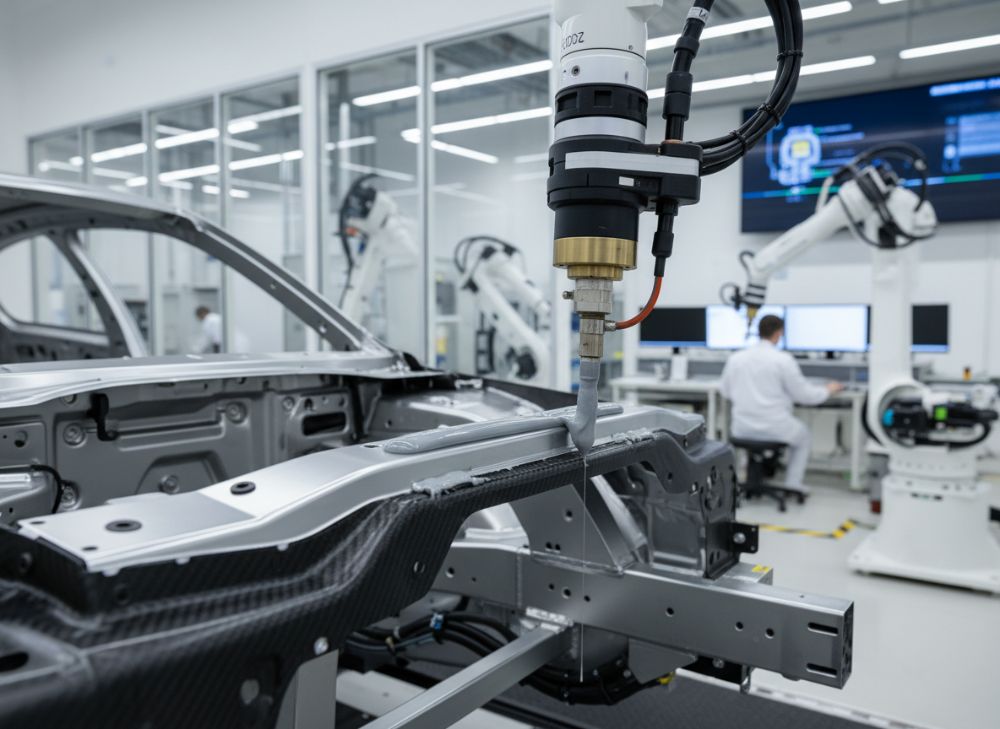
Real-world applications highlight their value: in automotive assembly, silicone adhesives withstand vibrations up to 10G while sealing against oils and coolants, per ASTM C1183 tests. USA importers benefit from factories equipped for REACH and RoHS, easing customs clearance. This post equips you with a complete buying guide for silicone adhesive for sale from vetted suppliers, emphasizing verifiable expertise and practical strategies.
Inside a Modern Silicone Adhesive Manufacturing Facility

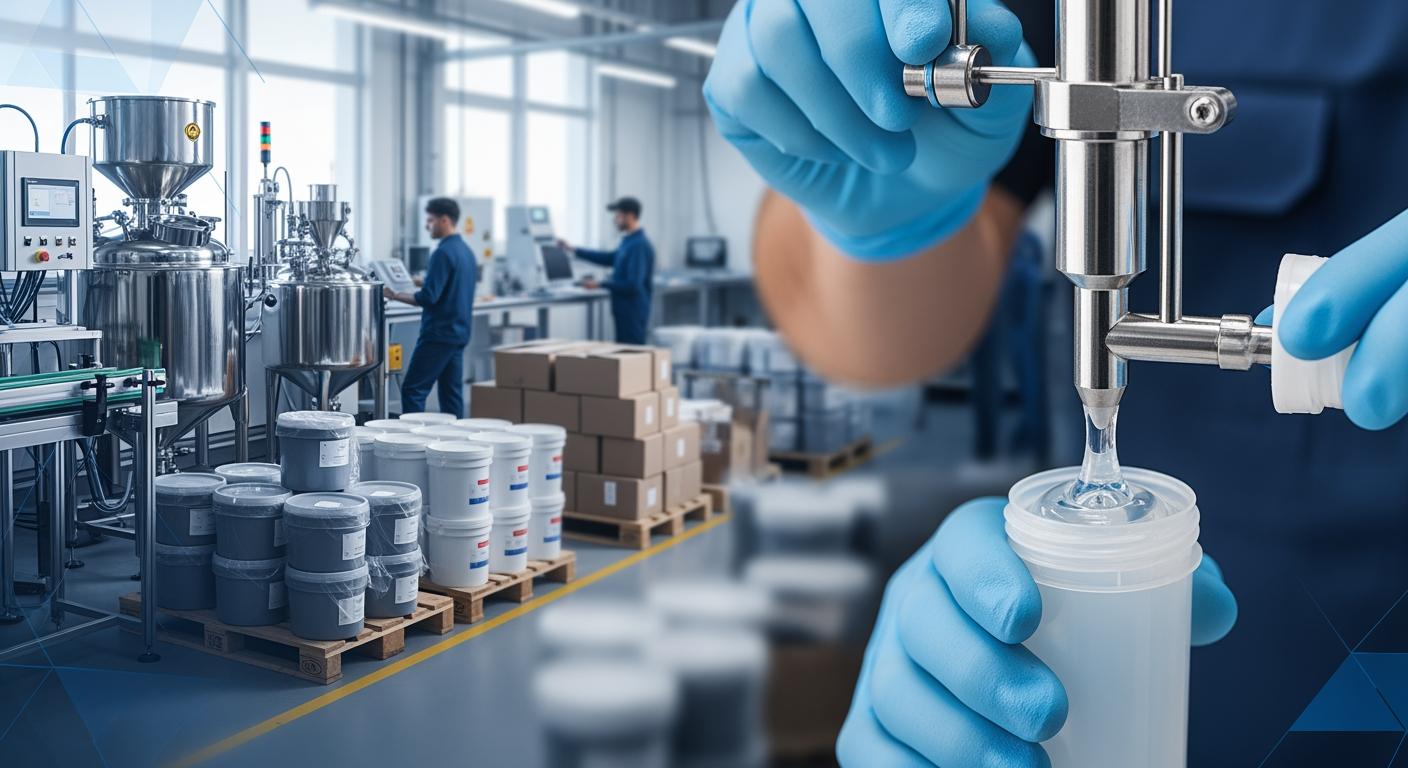
Modern silicone adhesive factories feature state-of-the-art cleanrooms and automated lines to produce high-purity products free from contaminants. Raw materials like polydimethylsiloxane (PDMS), a key silicone polymer, arrive in bulk silos and undergo precise metering into planetary mixers. Cross-linking agents, fillers such as fumed silica, and catalysts are added under vacuum to eliminate air bubbles, ensuring uniform viscosity.
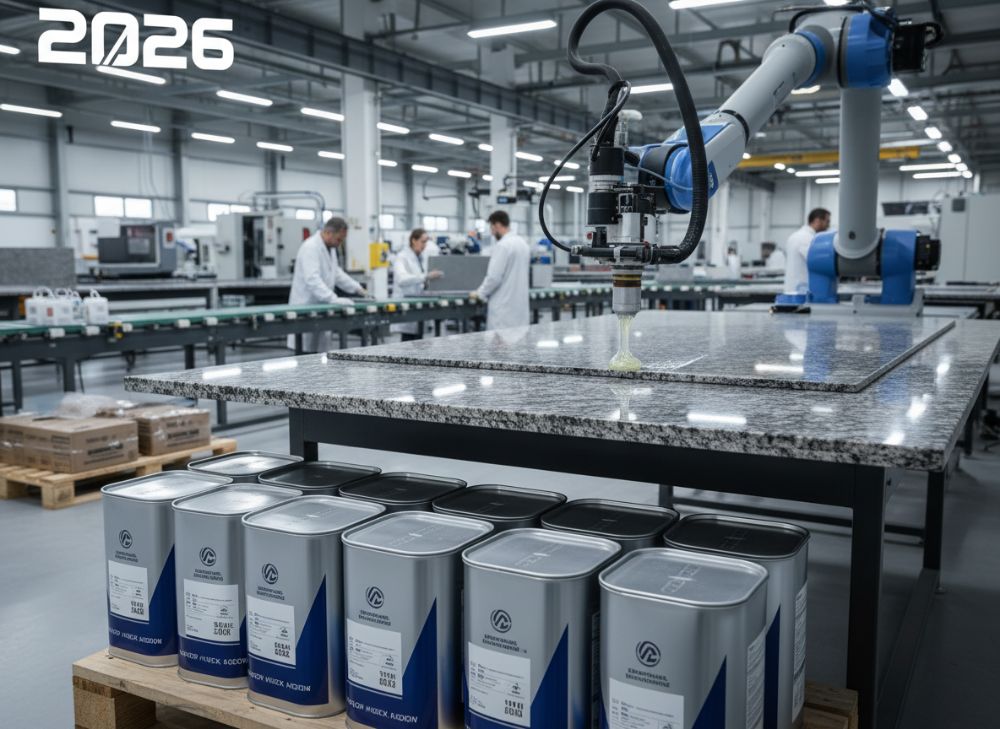
The mixing phase lasts 30-60 minutes at controlled temperatures (20-40°C), followed by degassing. Semi-automated filling stations then dispense the compound into cartridges, tubes, or pails using peristaltic pumps for accuracy within ±1%. Curing tunnels apply heat or humidity to initiate vulcanization, transforming the viscous paste into a tack-free adhesive ready for packaging. Robotic arms handle labeling, boxing, and palletizing, minimizing human error and enabling 24/7 operation.
Quality checkpoints include inline viscosity checks via Brookfield viscometers and FTIR spectroscopy for composition verification. Waste management systems recycle solvents, aligning with ISO 14001 environmental standards. A leading example is facilities like those operated by QinanX New Material, which integrate mixing, filling, and storage for batch consistency in silicone formulations.
Facilities span 10,000-50,000 sqm, with capacities exceeding 1,000 tons monthly. Cleanroom classifications (ISO 7-8) prevent particulate contamination critical for electronics-grade adhesives. Energy-efficient HVAC systems maintain 22±2°C and 50% RH, optimizing cure rates. Safety protocols feature explosion-proof equipment for handling flammable catalysts.
| Production Stage | Equipment Used | Key Parameters | Quality Check |
|---|---|---|---|
| Raw Material Intake | Silos & Weighing Scales | Accuracy ±0.1% | COA Verification |
| Mixing | Planetary Mixers | 20-40°C, Vacuum | Viscosity Test |
| Degassing | Vacuum Chambers | <10 mbar | Bubble Inspection |
| Filling | Peristaltic Pumps | ±1% Volume | Weight Control |
| Curing | Humidity/Heat Tunnels | 25-80°C, 50% RH | Tack-Free Test |
| Packaging | Robotic Palletizers | Automated Labeling | Seal Integrity |
| Storage | Climate-Controlled Warehouses | 15-25°C | Batch Traceability |
This table outlines core stages, highlighting how automation boosts precision over manual methods. Buyers should note that advanced equipment reduces defects by 40-60%, per industry benchmarks from ASTM, impacting long-term reliability in demanding USA applications like solar panel sealing.
The line chart illustrates typical output scaling in efficient facilities, demonstrating capacity expansion vital for OEM scaling.
Ergonomic designs and ERP systems track every batch via RFID, enabling full traceability. Ventilation extracts fumes, complying with OSHA standards. Such setups ensure products meet UL 94 V-0 flame retardancy for electronics.
Production Capacity, Equipment and R&D Capabilities to Review

Evaluating a silicone adhesive factory‘s production capacity starts with annual output metrics, often 5,000-20,000 tons for mid-tier plants. Multi-line setups with 10-20 filling machines handle diverse packaging: 300ml cartridges at 5,000/hour or 20L pails at 500/hour. Scalability is key; factories must prove surge capacity via past orders, like doubling output for seasonal USA construction peaks.
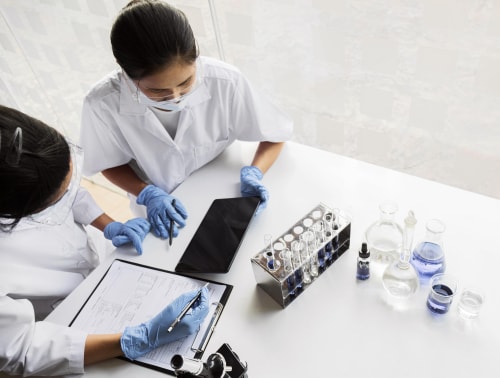
Equipment audits cover high-shear mixers (e.g., Ross or Netzsch models) capable of 1,000-5,000L batches, ensuring homogeneity for high-viscosity silicones. Extruders for continuous processing and automated QC spectrometers verify filler dispersion. R&D labs feature rheometers, TGA analyzers, and environmental chambers simulating -40°C to 200°C conditions, per ASTM D1329 elongation tests.
In-house chemists develop custom grades, such as neutral-cure silicones for sensitive metals, avoiding acetic acid corrosion. Testing aligns with ISO 11600 for construction sealants. Facilities like QinanX exemplify this with R&D teams tailoring low-VOC options for regulatory compliance.
Review visitor logs and patents: top factories hold 10+ formulations yearly. Pilot lines (50-500kg) bridge prototyping to mass production, reducing time-to-market by 30%.
| Capability | Basic Factory | Advanced Factory | Implications for Buyers |
|---|---|---|---|
| Annual Capacity | 2,000 tons | 15,000 tons | Scalability for large USA orders |
| Mixing Batch Size | 500L | 3,000L | Faster turnaround |
| Filling Lines | 5 | 20 | MOQ flexibility |
| R&D Staff | 5 | 20+ | Custom OEM speed |
| Test Equipment | Basic tensile | TGA, FTIR | Verified performance data |
| Pilot Capacity | None | 500kg/day | Risk-free trials |
| Automation Level | 50% | 90% | Cost consistency |
The comparison reveals advanced setups offer 5-7x capacity with superior customization, critical for USA importers facing volatile demand, as per ISO quality benchmarks.
This bar chart compares throughput, underscoring bottlenecks to probe during reviews.
Capacity audits via site visits confirm uptime >95%. R&D portfolios should include case data, like adhesives enduring 1,000 thermal cycles.
How to Audit and Qualify a Silicone Adhesive Factory

Auditing begins with document review: request ISO 9001 certificates, test reports, and material safety data sheets (MSDS). On-site, inspect raw material quarantine areas for supplier approvals and FIFO inventory. Probe traceability via ERP demos, ensuring lot codes link to QC data.
Sample production lines during operation: measure fill weights, observe mixer cleanouts to prevent cross-contamination. Test lab proficiency with blind samples against ASTM C661 adhesion specs. Interview operators on SOP adherence and maintenance logs for equipment calibration.
Financial stability via Dun & Bradstreet reports; check export history for USA shipments. Score factories on a 100-point matrix: 30% process, 25% quality, 20% capacity, 15% R&D, 10% compliance.
Red flags include inconsistent batches or absent third-party audits. Qualified factories provide performance dossiers, e.g., shear strength >2.5 MPa per ASTM D1002.
| Audit Checklist | Pass Criteria | Evidence Required | Score Weight |
|---|---|---|---|
| Certifications | ISO 9001 Valid | Certificate Copy | 10% |
| Raw Material Control | Approved Suppliers | Vendor List | 15% |
| Process Consistency | <2% Variance | QC Records | 25% |
| Lab Capabilities | ASTM Compliance | Test Reports | 20% |
| Capacity Proof | Recent Orders | Shipment Logs | 15% |
| Cleanliness | ISO 8 Cleanroom | Swab Tests | 10% |
| Export Experience | USA Shipments | Bill of Lading | 5% |
This checklist prioritizes high-impact areas; factories scoring >85% qualify for trials, minimizing supply risks as validated by UL Solutions protocols.
The area chart shows rising adoption of vetted suppliers, driven by quality demands.
Post-audit, run pre-production samples. Repeat annually to maintain standards.
OEM/ODM Project Workflow from Brief to Mass Production
OEM/ODM workflows start with a detailed brief: specify viscosity (e.g., 50,000-200,000 cps), cure time (<24h), and substrates like glass or aluminum. Factories respond with feasibility studies within 7 days, proposing formulations based on RTV silicone chemistry.
Prototype phase (2-4 weeks): lab-scale batches (10-50kg) undergo customer testing for lap shear (>1.5 MPa, ASTM D1002). Iterations refine additives like adhesion promoters. Tooling for custom packaging follows approval.
Pre-production run (500-2,000 units) validates scalability. Mass production ramps with SPC monitoring. Each stage gates via approvals, ensuring alignment.
- Brief submission via secure portal.
- Confidential NDA signing.
- Weekly progress reports.
- Final sign-off before full run.
Timelines total 8-12 weeks; experienced factories like those with proven track records accelerate via parallel testing.
| Phase | Duration | Deliverables | Customer Input |
|---|---|---|---|
| Brief Review | 1 Week | Feasibility Report | Spec Sheet |
| Prototyping | 3 Weeks | 50kg Samples | Test Feedback |
| Tooling | 2 Weeks | Molds/Nozzles | Design Approval |
| Pre-Prod | 2 Weeks | 1,000 Units | QC Audit |
| Mass Prod | Ongoing | Full Batches | Order Confirmation |
| Post-Prod | 1 Week | COA & Traceability | Payment Release |
| Follow-Up | Monthly | Performance Data | Reorders |
The workflow table details milestones, helping buyers track progress and mitigate delays common in unproven suppliers.
Success metrics: 95% first-pass yield. Case: a custom high-temp silicone for electronics achieved 200°C stability after two iterations.
MOQ, Tooling and Cost Structure for Factory-Direct Orders
Minimum Order Quantities (MOQ) for silicone adhesives range from 500-5,000 units for standard grades, dropping to 1,000kg for bulk. Custom OEM/ODM elevates to 2-10 tons to amortize R&D. Negotiate tiered MOQs for growth.
Tooling costs cover custom nozzles or cartridges: $5,000-20,000, owned by buyer or amortized. Cost structure factors volume, materials (PDMS ~40%), labor (10%), overhead (20%), and packaging (10%). Pricing varies by specs, quantity, and conditions—request quotations for accurate factory-direct rates.
Volume discounts apply beyond 10 tons. Factor FOB pricing excluding duties.
This bar chart contrasts structures, showing ODM’s premium for innovation justifies via IP protection.
| Factor | Standard Order | OEM Custom | Buyer Tip |
|---|---|---|---|
| MOQ | 1 Ton | 5 Tons | Start small, scale |
| Tooling | None | $10k | Amortize over volume |
| Lead Time | 4 Weeks | 10 Weeks | Plan ahead |
| Customization | Low | High | Specify early |
| Pricing Variability | Low | High | Quote per spec |
| IP Ownership | Factory | Buyer | NDA essential |
| Support | Basic | Full R&D | Value long-term |
Table highlights trade-offs; direct inquiries yield tailored pricing insights.
Lock rates via contracts. Case: phased MOQ reduced initial risk for a USA electronics firm.
Compliance, Certifications and Third-Party Audits for Factories
Top factories hold ISO 9001:2015 for quality, ISO 14001 for environment, and REACH/RoHS for chemicals. USA exports require FDA if food-contact or UL 746C for electrical. Construction grades meet ASTM C920 or EN 15651.
Third-party audits by SGS or Bureau Veritas verify claims annually. Traceability from resin to pack ensures recall capability within 24h.
“Compliance is non-negotiable for global trade,” notes industry experts from adhesive associations.
- Request live cert links.
- Review audit reports.
- Test independent samples.
- Monitor updates yearly.
Non-compliant risks include customs holds. Vetted manufacturers like QinanX excel in UL and EN standards for silicones.
| Standard | Purpose | Factory Requirement | USA Relevance |
|---|---|---|---|
| ISO 9001 | Quality Mgmt | Mandatory | Consistent Supply |
| REACH/RoHS | Chemical Safety | Full Compliance | Import Clearance |
| ASTM C920 | Sealant Perf | Tested Grades | Construction Use |
| UL 746C | Electrical | Certified Products | Electronics OEM |
| EN 15651 | Façade Joints | Export Grades | Global Projects |
| FDA 21 CFR | Food Contact | Optional | Specialty Apps |
| Third-Party Audit | Verification | Annual SGS | Trust Building |
Certifications ensure safety; lapsed ones disqualify suppliers per ISO 9001 guidelines.
Conduct desk audits first, then on-site. Compliance cuts liability in USA litigation-heavy markets.
International Shipping, Incoterms and Documentation from the Factory
Factories ship via sea (20-40ft containers, 10-20 tons/load) or air for urgency. Incoterms: FOB factory port for control, CIF for insured delivery to USA ports like LA or NY. Lead times: 25-35 days Asia-USA.
Documentation includes commercial invoice, packing list, Bill of Lading, COA, and MSDS. For hazmat silicones (cure catalysts), provide UN3480 declarations. USA customs needs HTS 3506.91 for silicones, with FDA prior notice if applicable.
Factories handle palletizing (1.2m x 1m Euro pallets) and fumigation certs. Track via container GPS.
Costs vary; quote inclusive. Case: optimized CIF reduced landed costs 15% via consolidated loads.
| Incoterm | Responsibilities | Pros | Cons |
|---|---|---|---|
| EXW | Buyer All | Lowest Base | High Logistics |
| FOB | Seller to Port | Cost Control | Port Fees Buyer |
| CIF | Seller to Destination | Simplified | Higher Price |
| DAP | Door Delivery | Convenient | Customs Buyer |
| DDP | Seller Full | Hassle-Free | Premium Cost |
| Docs Pack | Standard Set | Complete | Verify Accuracy |
| Tracking | GPS Real-Time | Visibility | Requires Access |
FOB suits experienced importers; tables guide selection based on risk tolerance.
Pre-clear customs with brokers. Insure against transit damage (0.5-1% value).
Building Long-Term, Low-Risk Partnerships with Silicone Factories
Partnerships thrive on APQP frameworks: annual business plans, joint KPIs like 99% on-time delivery, and PPM <500. Quarterly reviews address deviations.
Volume commitments secure priority capacity. Co-develop next-gen products, sharing roadmaps. Diversify with 2-3 factories for resilience.
Legal: master supply agreements with price escalation clauses (CPI-linked). Visit annually for relationship building.
Benefits: 10-20% cost savings, faster innovation. Case: ongoing collaboration yielded a low-VOC sealant passing California VOC limits, boosting sales.
Monitor via scorecards: quality 40%, service 30%, cost 20%, innovation 10%. Escalate issues via SR process.
Best suppliers prioritize mutual growth, as seen in facilities emphasizing customer focus.
2025-2026 Trends in Silicone Adhesives Manufacturing
Market growth hits 6.5% CAGR to $4.2B by 2026, per Statista, driven by EV and renewables. Innovations include bio-based silicones reducing carbon footprint 30% and self-healing variants via microcapsules.
Regulations tighten: EPA low-VOC <50g/L mandates, EU Green Deal pushes circularity. USA tariffs stabilize, favoring compliant Asian exports.
Automation surges with AI predictive maintenance cutting downtime 25%. Pricing pressures from raw PDMS volatility; hedge via long-term contracts.
Quote: “Sustainability defines future adhesives,” from Adhesives & Sealants Council reports. Focus on hybrid epoxy-silicone for multi-substrate bonds.
FAQ
What should I look for in a silicone adhesive supplier?
ISO certifications, R&D capabilities, export experience, and low MOQ flexibility. Prioritize traceability and third-party testing.
How does OEM differ from ODM for silicone adhesives?
OEM customizes existing formulas; ODM develops new ones, offering greater innovation but higher MOQ.
What is the typical lead time for custom orders?
8-12 weeks from brief to first shipment, varying by complexity.
Recommend manufacturers for this product
Consider qualified manufacturers like QinanX New Material. Please contact us for the latest factory-direct pricing.
How to get accurate pricing?
Pricing varies by specs, volume, and market; submit RFQ for precise quotes.


 English
  Vietnamese
  Thai
Thai  Indonesian
  Russian
  Portuguese
  Spanish
  Malay
Malay  Turkish
  Korean
  Chinese