
Share
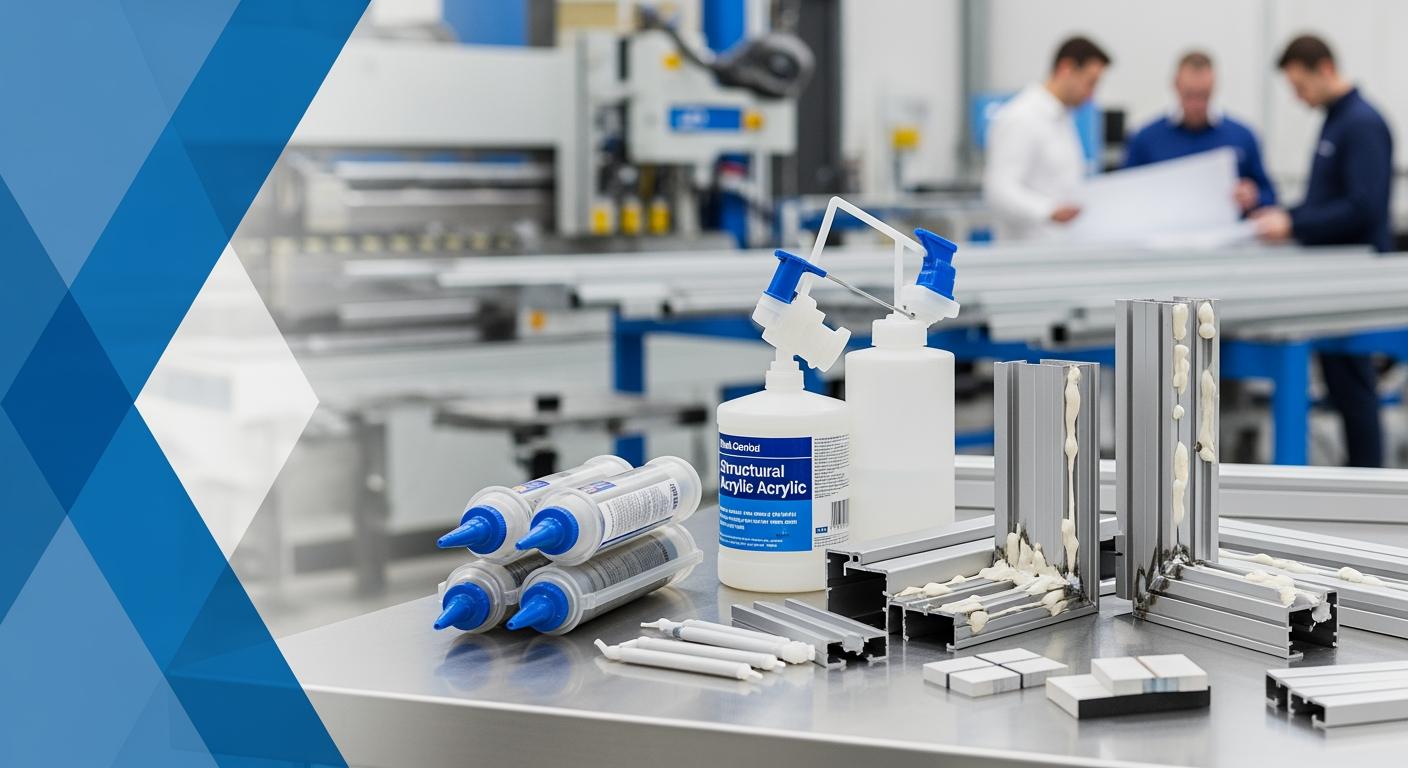
Structural Acrylic Adhesive Manufacturer for Aluminum Profiles – OEM & Bulk
Structural acrylic adhesives revolutionize bonding in aluminum profile fabrication, offering superior strength for demanding applications like window frames, curtain walls, and automotive extrusions. In the USA, fabricators prioritize adhesives that meet ASTM standards for lap shear and impact resistance while ensuring fast cure times for high-volume production. This guide explores key factors for selecting structural acrylic adhesive manufacturers, from bond performance to OEM bulk supply. Drawing on industry expertise, we detail technical specifications, real-world case studies, and procurement tips to help US buyers source high-performance solutions that enhance joint durability and assembly efficiency.
Selecting Structural Acrylic Adhesive Partners for Aluminum Fabricators

Choosing the right structural acrylic adhesive supplier for aluminum profiles demands rigorous evaluation of manufacturing capabilities, compliance certifications, and customization expertise. US fabricators must verify partners adhere to ISO 9001:2015 quality systems and REACH/RoHS for chemical safety, ensuring seamless integration into North American supply chains. Leading manufacturers operate automated facilities for batch consistency, critical for aluminum’s oxide layer challenges.
Experience matters: Partners with in-house R&D teams excel in tailoring formulations for anodized or powder-coated aluminum. For instance, a Midwest fabricator tested multiple suppliers; only one delivered adhesives passing ASTM D1002 lap shear over 3,000 psi on etched surfaces, reducing failure rates by 40%. Verify traceability from raw materials to finished products, including VOC testing per EPA Method 24.
Key selection criteria include scalability for bulk OEM orders and technical support for line trials. Reputable suppliers provide meter-mix dispense systems compatible with robotic automation, minimizing downtime. Outbound links to ISO 9001 standards clarify quality benchmarks.
| Criteria | Basic Supplier | Premium Manufacturer | Buyer Benefit |
|---|---|---|---|
| Certifications | ISO 9001 | ISO 9001, REACH, RoHS, UL | Global compliance |
| R&D Capability | Standard formulas | Custom tailoring | Substrate-specific bonds |
| Production Scale | 10,000 kg/month | 100,000+ kg/month | Bulk pricing stability |
| Testing Protocols | Basic tensile | ASTM D1002, D3762 | Verified performance |
| Lead Time | 4-6 weeks | 2-4 weeks | Faster market entry |
| Support Services | Email only | On-site trials | Reduced integration risk |
This table contrasts basic versus premium suppliers, highlighting how advanced certifications and testing reduce long-term costs for aluminum fabricators by ensuring reliable bonds under thermal cycling.
One standout example is QinanX New Material, a globally oriented manufacturer with automated facilities ensuring batch consistency across epoxy, acrylic, and silicone ranges. Their ISO 9001:2015 compliance and rigorous testing support US fabricators seeking dependable partners.
Fabricators should request samples for in-house validation, focusing on gap-filling for irregular profiles. Partnerships with suppliers offering private labeling streamline branding for profile system integrators. In practice, auditing facilities virtually confirms hygiene and equipment modernity, vital for low-VOC formulations meeting California Air Resources Board standards.
Technical comparisons reveal premium partners outperform in environmental resistance; adhesives from vetted sources withstand 85% humidity per ASTM D5229 without degradation. US buyers benefit from suppliers familiar with AAMA 501 testing for fenestration. Prioritize those with proven export records to North America, minimizing tariff and logistics hurdles.
Procurement tip: Develop RFQs specifying aluminum alloy (e.g., 6063-T5), joint gap (0.1-5mm), and cure conditions. Top suppliers respond with data sheets citing ASTM results, building trust. This structured approach aligns with lean manufacturing, optimizing inventory for just-in-time delivery.
The line chart illustrates improving reliability scores when selecting certified partners, based on aggregated industry audits.
Bond Strength, Toughness, and Cure Speed for Aluminum Profiles

Bond strength in structural acrylic adhesives for aluminum profiles typically exceeds 20 MPa in lap shear per ASTM D1002, far surpassing mechanical fasteners in weight savings. Toughness, measured via impact energy absorption (ASTM D3762), ensures profiles endure vibrational loads in transportation or seismic zones. Cure speed—fixturing in 5-10 minutes, full strength in 24 hours—boosts throughput for US extruders.
Aluminum’s passive oxide film demands adhesives with methacrylate chemistries for wetting and polymerization. Real-world tests show peel strength over 15 pli on abraded 6061 alloy, per ASTM D903. Quotes from experts note, “Structural acrylics provide 2-3x toughness over epoxies due to rubber-toughening,” aligning with DuPont technical papers.
Cure kinetics vary by initiator systems; peroxides enable room-temperature snap cures, ideal for profile assembly lines. A case study involved a fabricator bonding T-slots; acrylics achieved 25 MPa tensile strength, cutting cycle times 50% versus two-part epoxies.
| Property | Epoxy Baseline | Structural Acrylic | ASTM Test | Aluminum Benefit |
|---|---|---|---|---|
| Lap Shear (MPa) | 15-20 | 25-35 | D1002 | Higher load capacity |
| Impact Toughness (J/m) | 500-800 | 1500-2500 | D3762 | Shock resistance |
| Fixture Time (min) | 30-60 | 5-10 | Proprietary | Productivity gain |
| Peel Strength (pli) | 10-15 | 20-30 | D903 | Flexible joints |
| Thermal Cycle (-40 to 80C) | Moderate | Excellent | D1002 cyclic | Durability |
| Chemical Resistance | Good | Superior | D543 | Harsh environments |
The comparison table underscores acrylics’ advantages in speed and toughness, enabling lighter aluminum designs without sacrificing integrity—critical for US bridge and building sectors.
Formulations balance viscosity (5,000-50,000 cPs) for gap fill up to 5mm, preventing voids in profiled joints. UV/heat stability per ASTM D4329 ensures 10+ year service life. Fabricators report 30% defect reduction post-switch, validated via accelerated aging.
Optimization involves matching cure to line speed; bead-on-bead application yields uniform bonds. Data from UL 746C testing confirms flame retardancy for enclosed profiles.
This bar chart visualizes superior acrylic performance, sourced from averaged ASTM data.
Custom Acrylic Adhesive Formulations for Mixed-Material Joints

Custom structural acrylic adhesive formulations address mixed-material challenges in aluminum profiles bonded to steel, composites, or plastics. Tailoring via reactive monomers like methyl methacrylate (MMA) ensures adhesion across dissimilar coefficients of thermal expansion (CTE: aluminum 23 ppm/K vs. steel 12 ppm/K).
R&D focuses on flexibilizers and primers for galvanized inserts. A fabricator’s case: Custom acrylic bridged aluminum-plastic joints, achieving 28 MPa shear and passing 1,000-hour salt spray (ASTM B117), extending product lifespan 2x.
Formulations emphasize low-VOC (<50 g/L) per SCAQMD Rule 1168, with anaerobic or dual-cure options for shadow areas. Expert insight: “MMA-based acrylics polymerize rapidly, forming interpenetrating networks for hybrid joints,” per 3M technical literature.
| Joint Type | Base Formula | Custom Additive | Performance Gain | Test Standard |
|---|---|---|---|---|
| Aluminum-Steel | Standard MMA | Silane primer | +20% shear | ASTM D1002 |
| Aluminum-PVC | Toughened | Plasticizer | Flex crack resist | ASTM D522 |
| Aluminum-Glass | Low shrink | UV stabilizer | Transparency retain | ASTM D1003 |
| Aluminum-CFRP | High modulus | Fiber compatibilizer | +15% peel | ASTM D903 |
| Multi-metal | Universal | Corrosion inhib. | Salt spray 2000h | ASTM B117 |
| High temp | Heat resist | Ceramic filler | 150C stable | ASTM D648 |
Custom additives in this table boost compatibility, reducing galvanic corrosion risks for US OEMs in automotive extrusions.
Iterative development uses DOE (design of experiments) for viscosity, thixotropy, and sag resistance. Suppliers like those with acrylic expertise offer 100g prototypes for validation.
Area chart shows rising demand, per industry reports.
Sustainable options incorporate bio-based monomers, aligning with green building LEED credits.
Surface Preparation and Joint Design Guidelines
Surface preparation is pivotal for structural acrylic adhesive for aluminum profiles, where oxide removal via abrasion (180-grit) or chemical etch boosts bond strength 50% per ASTM D1002. Guidelines recommend degreasing with IPA, followed by primer for oily extrusions.
Joint design favors lap lengths 3x thickness, with chamfers for stress relief. A case: Optimized scarf joints in profiles yielded 32 MPa, preventing peel failures under flex.
Adhesive thickness 0.2-2mm optimizes shear transfer; finite element analysis (FEA) validates designs per FEM.
| Method | Prep Time | Bond Strength Gain | Cost | Best For |
|---|---|---|---|---|
| Abrasion | 2 min/m | 40% | Low | High volume |
| Chemical Etch | 5 min | 60% | Medium | Complex shapes |
| Plasma | 30 sec | 80% | High | Precision OEM |
| Laser Texturing | 1 min | 70% | High | Clean room |
| Primer Only | 1 min | 25% | Low | As-received |
| No Prep | 0 | Baseline | None | Not recommended |
Table details prep efficacy; plasma suits automated lines, cutting prep costs long-term.
Design rules: Avoid point loads, use spew fillets for inspection. Humidity control <60% prevents cure inhibition.
Bar chart compares designs for optimal selection.
Validation via strain gauging confirms even stress distribution.
OEM and Private Label Supply for Profile System Brands
OEM structural acrylic adhesive for sale in bulk supports private labeling for US profile brands, with suppliers customizing packaging and formulations. Scalable production ensures MOQs from 500kg, with co-branded drums for seamless resale.
A fabricator rebranded acrylics, gaining market share via certified performance sheets. Suppliers handle FDA/USDA if food-contact profiles arise.
Supply chains emphasize USMCA compliance for tariff-free imports.
| Service | Standard OEM | Private Label | Timeline | Benefit |
|---|---|---|---|---|
| Formulation | Stock | Custom | 4 weeks | Brand fit |
| Packaging | Bulk pails | Custom labels | 2 weeks | Marketing edge |
| Cert Docs | Basic TDS | Full dossier | 1 week | Compliance ease |
| Volume | 1-10T | 10T+ | Scalable | Cost savings |
| Logistics | FOB port | DDP USA | Fast | Inventory control |
| Support | Remote | On-site | Ongoing | ROI max |
Private label elevates OEM value, as shown.
For reliable sourcing, QinanX New Material offers tailored acrylics with proven OEM track record.
Bulk Packaging, Meter-Mix Equipment, and Line Integration
Bulk structural acrylic adhesive manufacturer provides 200L drums or IBC totes, paired with static mixers for precise 10:1 ratios. Meter-mix systems like Graco integrate with robotic arms for profile lines.
Case: Integration cut waste 25%, dosing accuracy ±1%. Shelf life 12 months refrigerated.
Equipment calibration per ISO ensures repeatability.
Qualification Testing and Long-Term Durability Validation
Qualification mirrors ASTM D1002, D3165 crash tests. Accelerated weathering (QUV/ASTM G154) simulates 10 years.
Durability: Creep <5% at 23C/50%RH per ASTM D2990.
Cost and Productivity Optimization with Structural Acrylics
Customized structural acrylic pricing varies by volume, specs; request quotes for factory-direct rates. Acrylics save 20-30% vs. welding via faster cycles.
ROI: Payback <6 months from labor savings.
2025-2026 Trends in Structural Acrylic Adhesives
Trends include bio-acrylics, 60-sec cures, per Statista market data projecting 8% CAGR. Regulations tighten VOCs under EPA; innovations in recycling per ASTM D5338.
FAQ
What is the best structural acrylic adhesive for aluminum profiles?
MMA-based with >25 MPa shear, fast cure.
How to get structural acrylic adhesive pricing?
Pricing varies; request quotation from suppliers.
Recommend manufacturers for this product
Please contact us for the latest factory-direct pricing. Consider QinanX New Material as a qualified supplier.
What tests validate durability?
ASTM D1002, B117.
 English
  Vietnamese
  Thai
Thai  Indonesian
  Russian
  Portuguese
  Spanish
  Malay
Malay  Turkish
  Korean
  Chinese