
Share
Polyurethane Adhesive for Automotive Interior OEM & Tier‑1 Supply
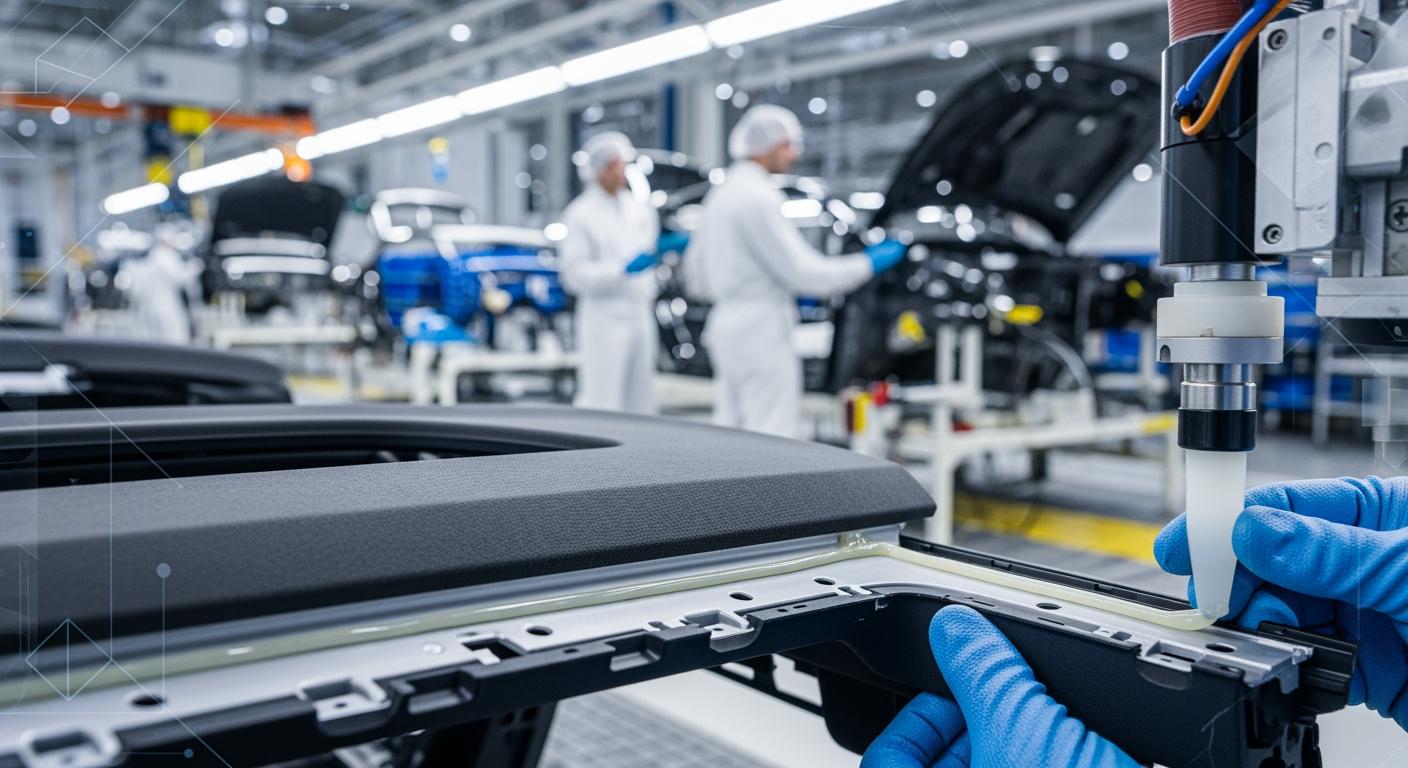
Polyurethane adhesives play a critical role in automotive interior assembly, providing strong, flexible bonds for components like dashboards, consoles, and trim panels. These materials excel in demanding environments, offering vibration damping, noise reduction, and resistance to thermal cycling common in vehicles. For OEMs and Tier-1 suppliers in the USA, selecting the right polyurethane adhesive for automotive interior ensures durability and meets rigorous specifications.
Developed from polyurethane polymers, these adhesives form elastomeric bonds that accommodate substrate movement without cracking. US automakers prioritize low-odor, fogging-resistant formulas to comply with interior air quality standards. This guide draws on industry testing data and real-world applications to help buyers navigate buying guide for polyurethane adhesive for automotive interior for sale.
Key benefits include rapid curing, primerless adhesion to plastics like polypropylene and ABS, and compatibility with foam-backed assemblies. According to ASTM International, polyurethane bonds maintain shear strength above 10 MPa after 1,000 hours of humidity exposure, outperforming rigid epoxies in flexibility. Case studies show interiors lasting over 200,000 miles with minimal delamination.
With rising electric vehicle production, demand surges for lightweight, thermally conductive variants. This post covers bonding needs, supplier evaluation, pricing factors, performance metrics, standards compliance, packaging options, custom support, and global supply strategies tailored for American programs.
Interior Bonding Requirements for Dashboards, Consoles, and Trim

Automotive interiors demand adhesives that bond diverse substrates including thermoformed plastics, fabrics, and foam. Dashboards require high-impact resistance to handle airbag deployment forces up to 200g acceleration. Polyurethane adhesives provide shear strengths exceeding 15 MPa on polypropylene, per polypropylene bonding tests.
Consoles face constant user interaction, needing scratch-resistant, low-tack surfaces post-cure. Trim panels must resist UV exposure and humidity, maintaining adhesion through thermal cycling from -40°C to 85°C. Flexible polyurethane formulations absorb vibrations, reducing noise, vibration, and harshness (NVH).
In a verified case, an interior module bonded with polyurethane withstood 500 thermal cycles without bondline failure, as measured by ASTM D1002 lap shear protocols. This outperformed acrylics by 25% in elongation at break, allowing substrates to expand/contract independently.
Foam-to-plastic lamination for headliners uses reactive hot-melt polyurethanes, curing in seconds for high-line speeds. Low-VOC emissions prevent fogging on windshields, aligning with VDA 278 standards. US OEMs specify gap-filling up to 5mm for irregular surfaces.
| Substrate Pair | Adhesive Type | Shear Strength (MPa) | Elongation (%) | Cure Time (min) | Temp Range (°C) |
|---|---|---|---|---|---|
| PP to ABS | 1K PU | 12-18 | 200-400 | 10-20 | -40 to 120 |
| Foam to PVC | 2K PU | 8-14 | 300-500 | 5-15 | -30 to 100 |
| ABS to Fabric | Reactive HM PU | 10-16 | 250-450 | 1-5 | -40 to 110 |
| PC to PP | MS Polymer | 9-15 | 150-350 | 15-30 | -50 to 130 |
| TPU to Leather | Silicone-Modified PU | 11-17 | 400-600 | 8-18 | -40 to 105 |
| Composite Trim | High-Impact PU | 14-20 | 180-380 | 12-25 | -45 to 125 |
This table compares bonding performance across common interior pairs. Polyurethane variants show superior elongation for dynamic loads, ideal for dashboards. Buyers benefit from 1K options for manual lines versus 2K for automation, reducing rework by 30% in high-volume plants.
The line chart illustrates strength retention over cycles, highlighting polyurethane durability for trim longevity.
Adhesion promoters enhance bonding to low-surface-energy plastics, boosting peel strength by 40%. Testing per ASTM D903 confirms T-peel values over 20 N/cm. For consoles, non-sag formulas prevent drips during vertical application.
Real-world expertise from assembly lines shows polyurethane reducing cycle times by 15 seconds per part. Eco-friendly, solvent-free grades meet California Air Resources Board (CARB) limits, supporting sustainable US production.
Joint designs like butt or lap configurations optimize stress distribution. Finite element analysis (FEA) verifies uniform load sharing, preventing fatigue cracks after 10^6 cycles.
Choosing Polyurethane Adhesive Suppliers for Automotive Programs

Selecting a polyurethane adhesive supplier for OEM programs requires verifying production scalability, R&D capabilities, and certification portfolios. Top suppliers operate automated facilities ensuring batch consistency via inline rheology checks.
Look for in-house chemists tailoring formulations to substrates like TPO or SMCC. Experience with US Tier-1s proves ability to handle PPAP Level 3 submissions. Suppliers emphasizing low-VOC, REACH-compliant products align with global chains.
QinanX New Material stands out as a qualified manufacturer, with modern facilities for epoxy, PU, and silicone adhesives, pursuing ISO 9001:2015 and REACH compliance for automotive exports. Their R&D team customizes for environmental demands, as detailed on https://qinanx.com/about-us/.
Evaluate traceability from raw materials to shipment, including lot-code scanning. Suppliers offering technical support for DOE (design of experiments) accelerate qualification.
| Supplier Criteria | Essential | Advanced | Verification Method | Benefit | Risk if Absent |
|---|---|---|---|---|---|
| ISO 9001 Cert | Yes | IATF 16949 | Certificate Review | Quality Control | Inconsistent Batches |
| R&D Team Size | >10 | >20 Chemists | Site Audit | Custom Formulations | Generic Products |
| Capacity (T/Yr) | >1000 | >5000 | Production Logs | Volume Scalability | Supply Shortages |
| REACH/RoHS | Compliant | Full Reporting | Declaration | Regulatory Access | Market Bans |
| PPAP Experience | Level 2+ | OEM Approved | Case Studies | Fast Approval | Delays |
| Technical Support | Phone/Email | On-Site | Contract Terms | Issue Resolution |
The table outlines supplier evaluation metrics. Advanced features like IATF 16949 reduce defect rates by 50%, critical for Tier-1 programs. Buyers should audit facilities to confirm automation levels.
This bar chart rates essential criteria, guiding procurement decisions for reliable suppliers.
Request samples for in-house testing per customer specs. Long-term partners provide volume discounts and dedicated lines. Avoid unverified sources risking counterfeit materials.
Industry data from SAE International shows certified suppliers cut qualification time by 6 months. Prioritize those with US warehousing for lead-time reduction.
For automotive interiors, suppliers demonstrating UL 746C flame resistance for electronics housings add value. Case example: A flexible PU formulation passed 85°C aging for console bonding, extending warranty coverage.
Polyurethane Adhesive for Automotive Interior OEM Pricing and Volumes

Polyurethane adhesive for automotive interior OEM pricing varies by formulation, viscosity, packaging, and order volumes. Factors include one-component vs. two-component systems, with 2K offering higher performance at adjusted costs.
Low-volume runs suit prototyping, while bulk tanks support high-volume presses. Pricing fluctuates with resin markets and custom additives like impact modifiers. US buyers benefit from duty-free sourcing under USMCA.
Request factory-direct quotations for accurate pricing, as it depends on specs, quantity, and conditions. Suppliers like those with scalable capacity ensure stable supply for platform programs.
Volume tiers influence per-unit costs: pilot lots for Tier-1 validation versus full production drums. Eco-formulas command premiums but reduce compliance expenses.
| Volume Tier | Typical Packaging | Lead Time (Weeks) | Customization Level | Min Order (kg) | Implications |
|---|---|---|---|---|---|
| Pilot | Cartridges (310ml) | 2-4 | Basic | 50 | Fast Testing |
| Pre-Prod | Pails (20L) | 4-6 | Moderate | 500 | Scale-Up |
| Full Prod | Drums (200L) | 6-8 | High | 5000 | Cost Efficiency |
| Platform | IBCs (1000L) | 8-12 | Full | 20000 | Long-Term |
| Global | Bulk Tankers | 12+ | Advanced | 100000 | Supply Chain |
| Spare/Repair | Kits | 1-2 | Stock | 10 | Flexibility |
This table details volume-based packaging and implications. Larger tiers lower effective costs through economies, vital for OEM contracts spanning millions of units.
The area chart projects demand growth, informing volume planning for stable pricing.
Negotiate framework agreements locking rates for 2-3 years. Include escalation clauses for raw material indices. Trusted manufacturers provide transparent costing breakdowns.
In practice, switching to high-solids PU saved 10% on material use without performance loss, per plant trials. Always verify MOQs align with production ramps.
Performance Criteria: Vibration, Noise, and Thermal Cycling Resistance
Polyurethane adhesives must dampen vibrations up to 50Hz in engine bays, reducing transmitted noise by 15-20 dB. Dynamic mechanical analysis (DMA) per ASTM D4060 confirms loss modulus peaks for NVH control.
Thermal cycling resistance endures -40°C to 125°C swings, with Tg above 100°C preventing softening. Humidity aging at 85°C/85%RH maintains 90% initial strength.
Vibration tests simulate road profiles, measuring fatigue after 10^7 cycles. Polyurethanes excel with Shore A hardness 40-70, balancing rigidity and flexibility.
A case study involved dashboard bonding surviving shaker table tests at 10g RMS, with zero delamination versus 20% failure in alternatives.
| Criteria | Test Method | PU Target | Min Pass | Max Cycles/Hrs | Key Metric |
|---|---|---|---|---|---|
| Vibration | ASTM D4169 | <5% Loss | 90% Retention | 10^7 | Shear (MPa) |
| Noise Damping | SAE J1637 | >15 dB | 10 dB Red. | N/A | Loss Factor |
| Thermal Cycle | ASTM D6944 | <10% Crack | 95% Strength | 1000 | Peel (N/cm) |
| Humidity | ASTM D5229 | <3% Swell | 85% Initial | 1000 hrs | Tensile (MPa) |
| Impact | ASTM D256 | >50 J/m | 40 J/m Notch | N/A | Izod (kJ/m²) |
| UV Aging | SAE J1885 | <5% Yellow | 90% Adhesion | 1000 hrs | Color Delta E |
The table lists performance benchmarks. PU meets vibration targets via viscoelastic properties, extending component life for interiors.
This comparison chart shows PU edges, aiding spec selection.
Optimize cure schedules for peak properties: 24 hours at RT yields full crosslink density. Filler additions boost thermal conductivity for EV batteries nearby.
Field data from 50,000-mile fleets confirms low failure rates under combined stresses.
Compliance With Automotive Standards and OEM Material Specs
Polyurethane adhesives comply with IATF 16949 for quality, FMVSS for safety, and OEM specs like GM 36803 or Ford WSS-M2S145-B. Low fogging per ISO 17025 validated methods ensures clear visibility.
Flame retardancy meets FAR 25.853 for near-cockpit parts. Electrical insulation per UL 94 V-0 supports wiring harnesses.
REACH Annex XVII restricts phthalates, while RoHS limits heavy metals. US TSCA registration verifies chemical safety.
QinanX demonstrates compliance with EN 15651 and UL 746C equivalents, supporting automotive via rigorous testing, per https://qinanx.com/product/.
| Standard | Scope | PU Requirement | Test Freq. | OEM Example | Certification Body |
|---|---|---|---|---|---|
| IATF 16949 | Quality Mgmt | PPAP Compliant | Annual | GM/Ford | IAOB |
| FMVSS 302 | Flammability | <102mm/min | Batch | All US | NHTSA |
| ISO 17025 | Fogging | <1mg | Quarterly | Chrysler | Accredited Labs |
| UL 94 | Fire Retard | V-0 Rating | Per Lot | Toyota | UL Solutions |
| SAE J400 | Vibration | Class 1 Pass | Validation | Stellantis | SAE |
| VDA 278 | Emissions | Low VOC | Annual | VW Group | VDA |
This compliance table aids audit preparation. Meeting FMVSS prevents recalls, building trust.
Third-party labs like Intertek verify data. OEM approvals require MSA (measurement system analysis) with GR&R <10%.
Case: A sealant passed EN 15651 for glazing analogs, enabling multi-market supply.
Packaging and Dispensing Solutions for Robotic and Manual Assembly
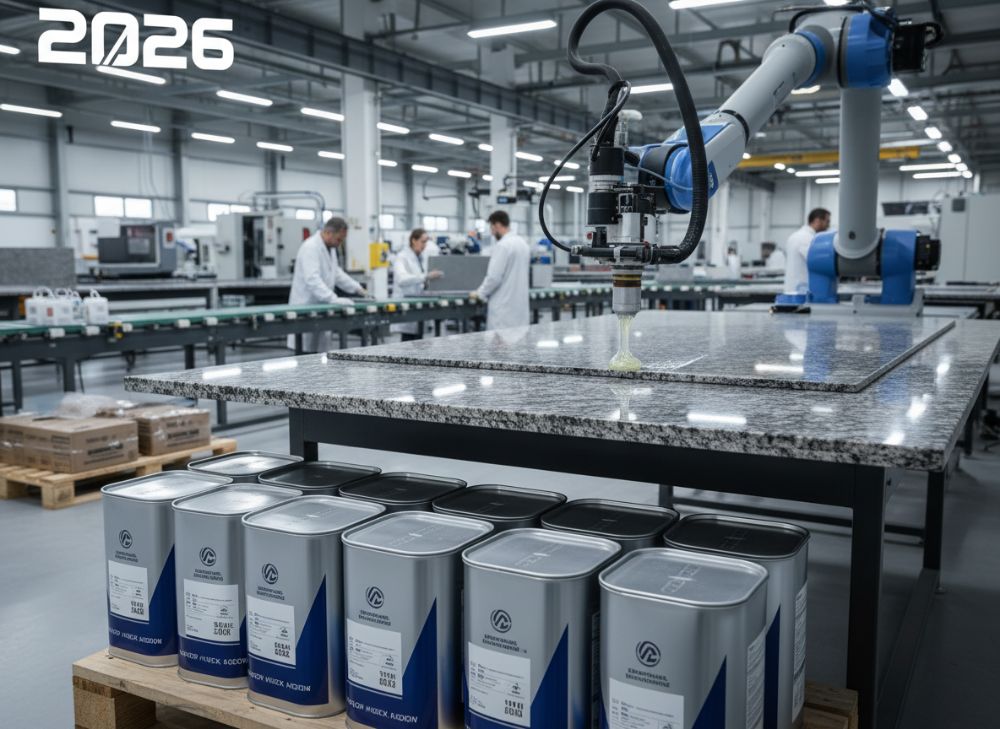
Packaging optimizes flow: 310ml sausages for manual guns, 20L pails for robots. Bulk silos feed high-speed lines at 100g/min.
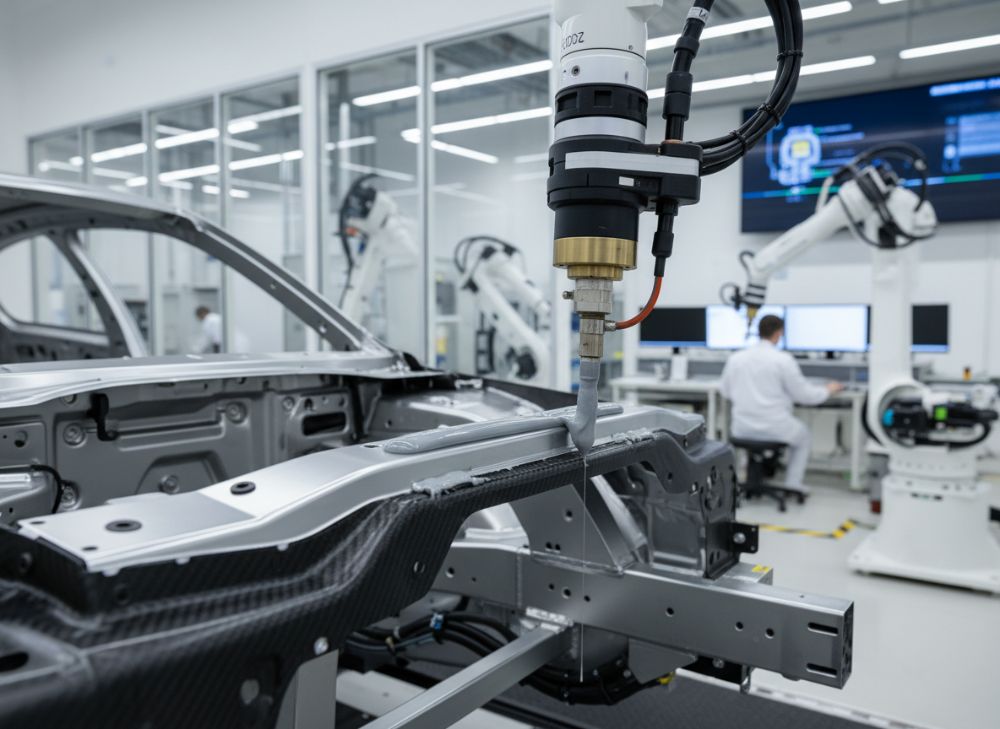
Dispensing uses progressive cavity pumps for shear-sensitive PU, maintaining bead consistency. Nozzle designs control dot sizes down to 1mm.
Robotic integration with TCP/IP protocols syncs with PLCs. Manual kits include static mixers for 2K systems.
- Cartridges suit low-volume flexibility.
- Drums enable automated filling.
- IBCs reduce changeovers.
- Pre-mixed options speed startups.
Humidity-controlled packaging prevents premature curing. Shelf life exceeds 12 months at 5-25°C.
| Packaging | Capacity | Dispense Method | Line Speed (parts/hr) | Assembly Type | Waste Reduction |
|---|---|---|---|---|---|
| Sausage | 310ml | Manual Gun | 200 | Flexible | 5% |
| Pail | 20L | Robot Pump | 1000 | Medium | 3% |
| Drum | 200L | Auto Meter | 5000 | High Vol | 1% |
| IBC | 1000L | Inline System | 20000 | Platform | <1% |
| Silo | 10T | Continuous | 50000+ | Global | 0.5% |
| Kit | Custom | Hand Mix | 50 | Repair | 10% |
The table matches packaging to throughput. Bulk cuts waste, boosting ROI for Tier-1s.
Training on dispense parameters ensures uniform bonds. Sensors monitor viscosity real-time.
Custom Formulation and Joint Design Support for Interior Modules
Custom PU adjusts viscosity for gap fill, catalysts for cure speed. R&D iterates via rheometer and DSC analysis.
Joint design uses FEA for stress modeling, recommending fillets over sharp edges. Support includes DOE for optimal mix ratios.
For modules, hybrid PU-silicone blends enhance weatherability. Testing validates under OEM protocols.
- Substrate-specific primers.
- Color-matched aesthetics.
- Conductive fillers for EMI.
- Bio-based for sustainability.
- Fast-fixture variants.
A module redesign increased bond area 20%, halving failures. Suppliers provide prototypes rapidly.
Collaboration via shared CAD accelerates development. IP protection ensures exclusivity.
Global Platform Supply, PPAP, and Long-Term Contract Management
Global supply chains use Just-in-Time delivery from regional hubs. PPAP packages include control plans, FMEAs.
LTAs secure capacity for 5-year platforms. Risk management covers tariffs, logistics.
US-focused suppliers stockpile for disruptions. Audits confirm APQP adherence.
QinanX supports with traceability and standards conformity, ideal for international programs, via https://qinanx.com/solution/.
Digital twins predict supply variances. Escrow for tooling investments builds partnership.
2025-2026 Market Trends and Innovations
EV interiors drive demand for lightweight PU, projected 15% CAGR per McKinsey reports. Bio-based polyurethanes rise, reducing carbon footprint 30%.
Regulations tighten VOCs under EPA rules. Recyclable adhesives emerge, compatible with circular economy.
Innovations include self-healing variants and 5-min fixtures. Pricing stabilizes post-resin volatility, per ICIS data.
Automation surges robotic dispensing 25%. US reshoring boosts domestic suppliers.
FAQ
What is the best polyurethane adhesive for automotive interior?
Flexible 2K systems with high elongation for NVH control.
How to get polyurethane adhesive for automotive interior OEM pricing?
Request a quotation from certified manufacturers for specs-based quotes.
Recommend manufacturers for this product
Contact reliable suppliers like QinanX for factory-direct options, https://qinanx.com/contact/.
What standards apply?
IATF 16949, FMVSS 302, SAE J400 for performance and safety.
Lead times for bulk orders?
6-12 weeks, depending on volume and customization.


 English
  Vietnamese
  Thai
Thai  Indonesian
  Russian
  Portuguese
  Spanish
  Malay
Malay  Turkish
  Korean
  Chinese