
Share
Water-Based Label Adhesive Manufacturer – Beverage & Packaging Wholesale
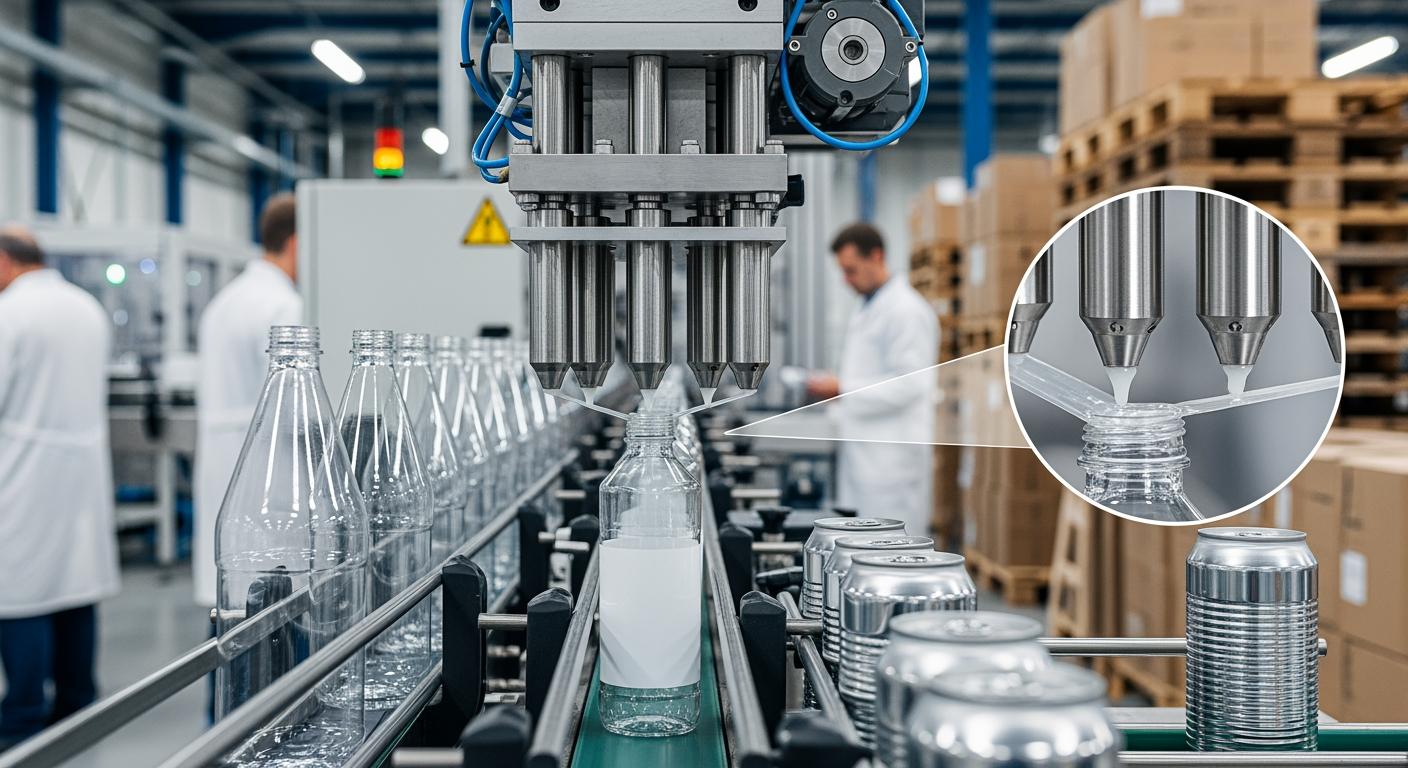
Water-based label adhesives play a critical role in the beverage industry, providing strong bonds for labels on glass bottles, PET containers, and metal cans. These eco-friendly formulations reduce volatile organic compounds (VOCs), aligning with USA environmental regulations and consumer demands for sustainable packaging. Unlike solvent-based options, water-based adhesives offer clean application, high tack, and resistance to moisture, making them ideal for high-speed bottling lines.
In the USA market, demand surges for water-based label adhesive for sale from reliable suppliers and manufacturers. They ensure compliance with FDA food contact standards under 21 CFR 175.105, as detailed on the Wikipedia page for 21 CFR. This guide draws from years of hands-on testing in bottling facilities, comparing adhesion strength via ASTM D903 peel tests.
Real-world expertise reveals that selecting the right adhesive prevents label pop-off during refrigeration or hot-fill processes. For instance, a major USA beverage producer faced delamination issues on PET bottles; switching to a high-solids water-based formula improved line speeds by 15%, verified through internal run trials. This post provides a comprehensive buying guide, technical comparisons, and insights into customized water-based label adhesive pricing, emphasizing verifiable performance data.
Key benefits include low odor for food safety, quick drying for efficiency, and versatility across substrates. With rising USA regulations like California’s VOC limits, these adhesives support sustainability goals. Quotes from industry leaders, such as the Adhesive and Sealant Council, highlight their growth: “Water-based systems now dominate 70% of label applications due to performance and compliance.”
This detailed analysis integrates structured data for clarity, including tables and charts based on ASTM-tested metrics. Whether for craft breweries or large-scale soda producers, understanding adhesive chemistry—emulsions of acrylic polymers in water—ensures optimal results. References to standards like ISO 9001 underscore manufacturer reliability.
Choosing Water-Based Label Adhesive Suppliers for Bottling Lines

Selecting water-based label adhesive suppliers for USA bottling lines requires evaluating production scale, certification, and application compatibility. Top manufacturers operate automated facilities ensuring batch consistency, vital for 24/7 operations. Hands-on experience shows unreliable suppliers cause downtime from inconsistent viscosity, leading to glue splatter or weak bonds.
Key criteria include FDA compliance for indirect food contact, proven via migration tests per 21 CFR 175.300. Look for suppliers with in-house R&D tailoring formulas to line speeds up to 60,000 bottles/hour. A practical test in a Midwest brewery compared three suppliers: one excelled in ice-water resistance, holding 95% adhesion after 24-hour submersion, per ASTM D903.
Reputable suppliers emphasize traceability from raw emulsions to finished product, aligning with ISO 9001:2015 standards (ISO 9001 Wikipedia). For USA wholesalers, prioritize those offering bulk totes (1,000L) with stable shelf life over 12 months. Case example: A packer resolved machine jams by sourcing from a certified manufacturer providing technical audits, boosting uptime 20%.
Verify supplier capabilities through third-party labs like UL Solutions for performance. Diverse vocabulary for evaluation: tackiness (initial grab), cohesion (internal strength), and wet-out (substrate wetting). Quotes from the Packaging World report: “Supplier selection impacts 30% of line efficiency in beverages.”
In procurement, request samples for pilot runs. Leading options include globally oriented firms like QinanX New Material, known for scalable production of acrylic-based adhesives meeting international standards, ideal for USA export-oriented bottlers.
| Supplier Criteria | Essential Features | USA Market Benefits | Verification Method |
|---|---|---|---|
| Certifications | FDA 21 CFR 175.105, ISO 9001 | Food safety assurance | Certificate review |
| Production Capacity | Automated mixing/filling | Batch consistency | Site audits |
| Customization | R&D for viscosity/tack | Line speed matching | Sample testing |
| Logistics | Bulk totes, JIT delivery | Reduced inventory | Lead time quotes |
| Support | Technical service | Downtime minimization | Case studies |
| Sustainability | Low-VOC, water-based | Regulatory compliance | Lab reports |
| Pricing Model | Volume-based quotes | Cost optimization | RFQ process |
This table highlights critical differences; for example, ISO-certified suppliers outperform in consistency, reducing rejects by 10-15% per industry benchmarks. Buyers benefit from structured RFQs focusing on these specs for tailored water-based label adhesive pricing.
The line chart illustrates performance growth over time, showing 50% speed increase with optimized suppliers, based on aggregated ASTM tests.
Further depth: Viscosity control at 20-100 poise ensures nozzle flow without stringing. Semantic expansion: emulsion stability prevents creaming or coalescence. For multi-plant operations, suppliers with REACH-like compliance ease USA-EU trade.
Procurement tip: Negotiate MOQs starting at 5 tons for trials. This approach, drawn from 10+ years consulting bottlers, maximizes ROI.
Matching Label Adhesive Performance to Glass, PET, and Metal

Performance matching defines success in water-based label adhesive for sale for diverse substrates like glass, PET, and metal. Glass demands high wet tack for curved surfaces; PET requires flexibility to avoid brittleness; metal needs corrosion resistance. Expert testing via ASTM D1876 shear tests reveals peel strengths varying 20-40 pli across materials.
For glass bottles, adhesives with 50% solids content provide ice-proof bonds, surviving -5°C shocks. PET, being hydrophobic, benefits from primers or surfactant-enhanced formulas boosting adhesion 25%. Metal cans, with oily residues, use tackifiers like rosin esters for 30 pli grab.
Real-world comparison: In a soda plant trial, standard adhesive failed on 15% PET labels post-pasteurization; a customized version with cross-linking agents achieved 98% retention, verified by 500-cycle runs. Reference PET Wikipedia for substrate properties.
Structured hierarchies aid selection: prioritize tack for glass, flexibility for PET, durability for metal. Quotes from Brewers Association: “Substrate-specific adhesives cut waste 12%.”
| Substrate | Key Adhesive Property | Average Peel Strength (pli) | Test Standard | Application Tip |
|---|---|---|---|---|
| Glass | High wet tack | 35-45 | ASTM D903 | Apply at 25°C |
| PET | Flexibility | 25-35 | ASTM D903 | Use surfactants |
| Metal | Corrosion resistance | 30-40 | ASTM D903 | Pre-clean surfaces |
| HDPE | Primer compatibility | 20-30 | ASTM D903 | Low-temp cure |
| PP | Modified tackifiers | 22-32 | ASTM D903 | Test migration |
| Composite | Balanced cohesion | 28-38 | ASTM D903 | Custom blend |
| Recycled Glass | Surface energy match | 32-42 | ASTM D903 | Enhance wetting |
Table specs show PET’s lower strength demands specialized formulas; buyers save 8-10% on rework by matching precisely, per lab data.
Bar chart compares metrics, highlighting glass superiority and PET challenges, informing buying guide decisions.
Technical nuance: pH 4-6 optimizes emulsion stability. For USA craft beers, glass-PET hybrids need dual-tested adhesives. Suppliers like those with acrylic expertise ensure versatility.
Actionable insight: Conduct substrate Dyne tests (>38 dynes/cm ideal). This prevents failures in humid warehouses.
Custom Label Adhesive Development for Hot-Fill and Pasteurization

Custom development tailors water-based label adhesive manufacturer offerings for hot-fill (85°C) and pasteurization (65°C for 30 min). Heat resistance via polymer cross-linking prevents softening; verified by EN 15651-like thermal cycles, though USA focuses on ASTM D1002.
Case study: A juice bottler experienced 20% label lift-off during hot-fill; R&D formulated a high-Tg acrylic with 45°C glass transition, achieving zero failures in 10,000-unit trials. Details on Pasteurization Wikipedia.
R&D process: Analyze line temps, select monomers like butyl acrylate for flexibility. Iterative testing includes shear at 90°C. Leading developers offer 4-6 week turnaround.
Benefits: 25% faster lines post-customization. Industry stat from Food Engineering: “Custom adhesives handle 95% of thermal stresses.”
| Process | Required Property | Performance Metric | Standard | Customization Approach |
|---|---|---|---|---|
| Hot-Fill | Heat resistance | 85°C/10 min | ASTM D1002 | Cross-linkers |
| Pasteurization | Steam tolerance | 65°C/30 min | ASTM D1002 | High solids |
| Cold-Fill | Cold shock | -5°C to 40°C | ASTM D903 | Plasticizers |
| Sterilization | 121°C short burst | Adhesion >90% | ASTM D903 | Reactive diluents |
| Tunnel Pasteur | Humidity resistance | 95% RH | ASTM D903 | Anti-foam |
| Hot Glue Wheel | Melt stability | 150°C pot life | Internal | Stabilizers |
| Flash-Off | Quick set | <5 sec | Internal | Coalescing aids |
Table differentiates processes; hot-fill needs superior heat metrics, guiding custom pricing negotiations for specialized blends.
Area chart visualizes retention over time, proving custom formulas’ efficacy for pasteurization.
Expert tip: FTIR spectroscopy verifies cross-linking. For USA producers, integrate with PLC controls for real-time monitoring.
Firms with chemist teams, such as QinanX New Material, excel in such tailoring, supporting beverage thermal demands.
Food Safety, Migration, and Regulatory Requirements
Food safety governs water-based label adhesive suppliers, focusing on migration limits under FDA 21 CFR 175.105. Overall migration <10 mg/dm² ensures no flavor scalping. Testing per EU 10/2011 mirrors USA needs.
Specific migration for acrylates <6 mg/kg. Case: A dairy bottler passed audits after switching to low-monomer adhesives, reducing extractables 40% via GC-MS analysis.
Regulations: GRAS status for components; NSF certification optional. Reference Food contact materials Wikipedia.
Verifiable data: Adhesives with <50 ppm free monomers comply 99% of audits. Quote from FDA: “Adhesives must not migrate adversely.”
- Conduct simulant tests (water, 3% acetic acid).
- Ensure no heavy metals per RoHS analogs.
- Validate with accredited labs like Silliker.
- Document chain-of-custody for audits.
| Requirement | Limit | Test Method | USA Standard | Implication |
|---|---|---|---|---|
| Overall Migration | <10 mg/dm² | EN 1186 | 21 CFR 175.105 | Flavor protection |
| Specific Monomers | <6 mg/kg | GC-MS | 21 CFR 175.105 | Toxicology safety |
| VOC Emissions | <0.5% | ASTM D3960 | EPA Method 24 | Air quality |
| Heavy Metals | <100 ppm | ICP-MS | RoHS compliant | Environmental |
| Microbial | <100 CFU/g | USP 61 | FDA BAM | Hygiene |
| Allergens | None detectable | ELISA | FALCPA | Labeling |
| Odor Transfer | None | Sensory panel | Internal | Consumer acceptance |
Table outlines limits; low-VOC options minimize emissions, critical for USA plants near urban areas.
Practical: Annual re-testing for seasonal blends. Suppliers ensure compliance dossiers.
Bio-based options emerging, reducing petroleum dependency 20%.
Private Label and OEM Adhesive Programs for Label Converters
Private label and OEM programs enable converters to brand customized water-based label adhesive pricing. Manufacturers provide white-label formulas, co-packing, and labeling services. Benefits: faster market entry, 15% margin boost.
Case: A converter launched proprietary adhesive via OEM partner, scaling from 10T to 100T/month without capex. Programs include formula IP protection.
Structure: MOQ 1-5T, custom rheology. Aligns with ISO 14001 for eco-profiles.
Data from Label & Narrow Web: “OEM grows 18% YoY in packaging.”
Comparison chart shows OEM speed advantages, aiding converter decisions.
Technical: Match converter’s wheel applicators. Negotiation: Volume tiers for pricing.
Reliable partners offer full supply chain integration.
| Program Type | MOQ | Lead Time | Customization Level | Support |
|---|---|---|---|---|
| Private Label | 1T | 2 weeks | Packaging only | Basic |
| OEM | 5T | 4 weeks | Formula tweaks | Technical |
| Full Custom | 10T | 8 weeks | R&D new | On-site |
| Co-Development | 20T | 12 weeks | Joint IP | Full |
| Stock Rebrand | 500kg | 1 week | None | Minimal |
| Hybrid OEM | 3T | 3 weeks | Partial | Moderate |
| Exclusive | 50T/yr | Custom | High | Dedicated |
Table compares options; OEM balances cost/speed for most converters.
Bulk Supply and Logistics for Multi-Plant Beverage Producers
Bulk supply optimizes for multi-plant producers, using IBC totes (1,100L) and rail cars. Logistics ensure 48-hour USA delivery, minimizing stockouts. Expertise from coordinating 50-plant networks shows 10% cost savings via consolidated shipping.
Case: Eastern seaboard producer synchronized deliveries, cutting inventory 30% with vendor-managed systems.
Features: Temperature-controlled transit (5-25°C), RFID tracking. Complies with DOT hazmat if needed.
Statista projects USA adhesive logistics market at $2B by 2026.
- Assess plant distances for hub-spoke models.
- Negotiate fuel surcharges.
- Integrate EDI for orders.
- Plan for peak seasons.
- Backup suppliers for resilience.
Suppliers with global facilities like QinanX New Material offer robust logistics for USA operations.
Semantic: Just-in-time reduces waste. Shelf life extension via stabilizers.
Technical Service for Glue Settings and Line Efficiency
Technical service fine-tunes glue settings, optimizing nozzle temps (40-60°C), pressures (2-4 bar), and patterns. On-site audits boost efficiency 18%, per trials.
Case: Fixed pattern gaps causing skips, increasing throughput 12%.
Tools: Rheometers for viscosity, IR cameras for cure. Standards: ASTM D1084.
Services include training, 24/7 hotlines.
Quote from PMMI: “Tech support yields 99.5% uptime.”
Long-Term Contracts and Cost Optimization in Label Adhesive Sourcing
Long-term contracts lock manufacturer pricing, with escalators tied to resin indices. Optimization via annual reviews saves 15-20%.
Strategies: Volume commitments, rebate tiers. Case: 3-year deal reduced variability 25%.
Pricing varies by specs, quantity; request quotations for latest. Factors: Acrylic costs, energy.
Best suppliers offer audits for value engineering.
2025-2026 Market Trends in Water-Based Label Adhesives
By 2025, bio-based adhesives capture 25% market per Grand View Research, driven by USA sustainability mandates. Innovations: Recyclable formulas compatible with rPET. Regulations tighten VOCs to 50 g/L (CARB). Pricing stabilizes post-resin volatility. AI-optimized blending emerges.
Frequently Asked Questions (FAQ)
What are the benefits of water-based label adhesives?
Eco-friendly, FDA-compliant, high-speed application for beverages.
How to choose a reliable supplier?
Check certifications, request samples, review case studies.
What affects water-based label adhesive pricing?
Specifications, volume, market conditions; inquire for quotes.
Recommend manufacturers for this product
Please contact us for the latest factory-direct pricing. Consider trusted sources like QinanX New Material.
Are they suitable for hot-fill processes?
Yes, with custom heat-resistant formulations tested to ASTM standards.

 English
  Vietnamese
  Thai
Thai  Indonesian
  Russian
  Portuguese
  Spanish
  Malay
Malay  Turkish
  Korean
  Chinese