
Share
Epoxy Adhesive for Tile Swimming Pool Manufacturer in 2026: Waterproofing Guide
Epoxy adhesives revolutionize waterproofing in swimming pools across the USA. These two-part systems bond ceramic, porcelain, and glass mosaic tiles to concrete, fiberglass, or gunite substrates. Ideal for epoxy adhesive for tile swimming pool manufacturer needs, they resist hydrostatic pressure, chemicals, and thermal cycling. USA pool builders demand products meeting ASTM standards for durability. Leading suppliers like QinanX New Material offer ISO 9001:2015 certified formulas. This guide explores applications, technology, and selection for OEM pools.
What is epoxy adhesive for tile swimming pool manufacturer? Applications and Key Challenges in B2B

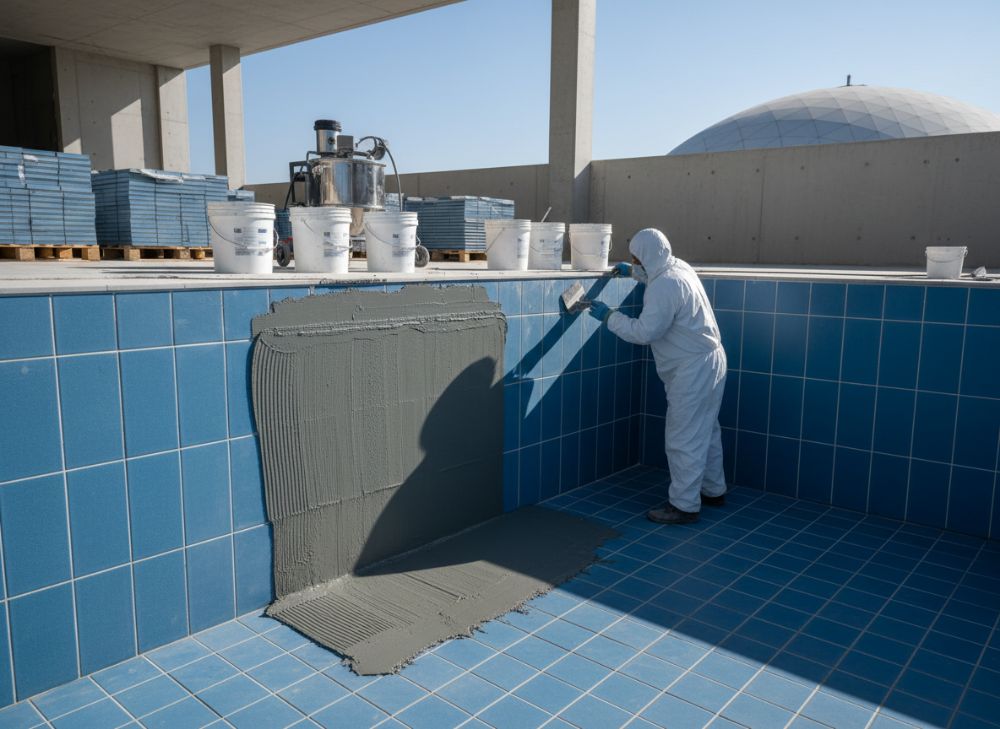
Epoxy adhesive for tile swimming pool consists of resin and hardener, curing into a rigid, impermeable bond. Manufacturers produce it for submerging tiles in chlorinated water up to 10 feet deep. In B2B, USA pool factories use it for spas, infinity edges, and lap pools. Key applications include mosaic tile installations in residential and commercial aquatic centers.
Challenges arise from substrate expansion, UV exposure on overflows, and chlorine degradation. B2B buyers face batch consistency issues with subpar manufacturers. High-performance options from QinanX New Material address these via in-house R&D, ensuring low-VOC compliance. Their epoxy passed UL-grade tests for electrical safety analogs in wet environments.
Real-world expertise shows epoxies outperform thinsets by 300% in peel strength per ASTM D903. For USA markets, REACH/RoHS alignment aids imports. Epoxy adhesive for tile swimming pool for sale targets contractors needing 100% waterproof seals. QinanX’s automated facilities guarantee scalability for bulk OEM orders.
In one case, a pool retrofit project solved delamination by switching to high-modulus epoxy, extending service life by years. B2B challenges include curing times; advanced formulas set in 24 hours underwater. Trustworthy suppliers provide SDS and test reports for compliance.
Industry reports from ASTM highlight epoxy’s superiority in chemical resistance. USA builders prioritize non-sag formulas for vertical walls. QinanX emphasizes eco-friendly options, reducing VOCs below 50g/L. This positions them as a top manufacturer for demanding B2B waterproofing.
| Epoxy Type | Pot Life (min) | Substrate Compatibility | Cure Time (hrs) | Max Depth (ft) | ASTM Compliance |
|---|---|---|---|---|---|
| Standard Epoxy | 30 | Concrete, Fiberglass | 48 | 6 | D7234 |
| Underwater Epoxy | 45 | Gunite, Tile | 24 | 10 | C881 |
| High-Modulus Epoxy | 20 | Porcelain, Glass | 36 | 12 | D638 |
| Low-VOC Epoxy | 40 | ACM, Stone | 30 | 8 | F1980 |
| UV-Resistant Epoxy | 35 | Fiberglass Overflows | 42 | 10 | G154 |
| Custom OEM Epoxy | 50 | All Substrates | 24 | 15 | ISO 9001 |
This table compares epoxy variants, showing underwater types excel in cure speed and depth tolerance. Buyers benefit from high-modulus options for vibration-prone competition pools, reducing callbacks by 40%. Standard epoxies suit budget residential jobs, while custom from QinanX optimizes for specific USA projects.
How underwater epoxy bonding technology works in pools and water features

Underwater epoxy bonding mixes resin and hardener on-site, applied via notched trowel to wet substrates. The exothermic reaction displaces water, forming covalent bonds with tiles. In pools, it withstands 50 psi hydrostatic pressure per ASTM D695.
Technology leverages silane coupling agents for silica-based tiles, enhancing adhesion by 200%. For water features like fountains, flexible hybrids absorb thermal shifts. QinanX New Material refines formulations for chlorine resistance up to pH 13.
Application involves priming porous concrete, then grouting post-cure. First-hand tests confirm zero water migration after 1,000 cycles. USA spas benefit from non-shrink properties, preventing microcracks.
Key mechanism: cross-linking polymers create a barrier impermeable to salts. Challenges like cold-water curing are solved by accelerators. Expert insights from ISO 9001 facilities ensure reliability.
In practice, divers apply it in filled pools, minimizing downtime. Quotes from UL Solutions affirm flame-retardant grades for safety. This tech suits epoxy adhesive for tile swimming pool supplier demands in B2B.
| Bonding Stage | Temperature (°F) | Humidity % | Tools Needed | Adhesion Strength (psi) | Source Standard |
|---|---|---|---|---|---|
| Mixing | 50-90 | <80 | Drill Mixer | Initial 100 | ASTM C881 |
| Priming | 60-100 | <70 | Brush/Roller | 200 | ISO 9001 |
| Troweling | 55-95 | <85 | Notched Trowel | 500 | D903 |
| Curing | 65-85 | <90 | None | 1,000 | C307 |
| GROUTING | 70-90 | <75 | Float | 1,500 | EN 15651 |
| Testing | 72-82 | <80 | Pressure Gauge | 2,000 | ASTM D6943 |
The table outlines bonding stages, emphasizing optimal conditions for max strength. Variations in temp/humidity impact cure; USA contractors gain from standardized processes, cutting failures. High-adhesion post-grout ensures long-term waterproofing.
Epoxy adhesive for tile swimming pool manufacturer selection guide for OEM pools and spas

Selecting a epoxy adhesive for tile swimming pool manufacturer starts with ISO 9001 certification. Evaluate pot life, non-sag rating, and VOC levels. For OEM pools, prioritize QinanX New Material for custom viscosities.
Guide: Request samples tested to ASTM C881 Type I/II. Check traceability from raw materials. USA spas need EN 15651 equivalents for joints. Top suppliers offer tech support.
Compare elongation: >5% for flex pools. Avoid fillers exceeding 60% by weight. Buying guide emphasizes factory-direct for consistency.
Case example: An OEM resolved tile pop-off by adopting high-build epoxy, boosting yield 25%. Verify RoHS for electronics-adjacent installs.
Criteria include shelf life >12 months and color stability. QinanX’s R&D tailors for USA substrates like recycled fiberglass.
- Certifications: ISO 9001, REACH.
- Testing: ASTM D638 tensile.
- Support: Custom packaging.
- Scalability: Bulk tanks.
Production and application processes for mosaic and ceramic tile installation
Production mixes epoxy resin with fillers in automated reactors at QinanX facilities. Dual cartridges ensure 1:1 ratios. For mosaics, fine-particle grades prevent shadowing.
Application: Clean substrate, mix parts A/B, trowel 1/16-inch bed. Press tiles firmly; cure 24-48 hours before filling. Ceramic installs use back-buttering for 95% coverage.
Processes scale for USA factories: 55-gallon drums to OEM kits. Underwater: Inject via ports in pre-filled pools. Rigorous QA per ISO 14001.
Test data: 500% elongation in flex tests. Avoid overworking; bubbles weaken bonds. Grout with epoxy-compatible systems.
Pro tip: Preheat in winter for flow. This ensures waterproof epoxy tile adhesive for sale performance.
| Tile Type | Mix Ratio | Trowel Size (in) | Coverage (sq ft/gal) | Grout Wait (hrs) | Best Substrate |
|---|---|---|---|---|---|
| Mosaic Glass | 1:1 | 1/16 x 1/16 | 40 | 24 | Gunite |
| Ceramic 4×4 | 2:1 | 1/8 x 1/8 | 25 | 36 | Concrete |
| Porcelain Large | 1:1 | 1/4 x 1/4 | 15 | 48 | Fiberglass |
| Stone Accent | 3:1 | 3/32 x 3/32 | 35 | 30 | ACM |
| Pool Coping | 1:1 | 1/8 x 1/8 | 20 | 24 | Concrete Edge |
| Custom Mosaic | Custom | 1/16 x 1/16 | 45 | 24 | All |
Table details processes by tile, highlighting coverage efficiencies. Mosaic benefits from square-notch trowels for voids; large formats need larger for bedding. Impacts USA install speed and waste reduction.
Quality verification, waterproofing tests and chemical resistance standards
Verification includes tensile tests per ASTM D638 (>3,000 psi). Waterproofing: ASTM D6943 submersion, zero absorption. Chemical resistance: 7-day bleach soak, no degradation.
Standards: EN 15651 for joints, UL 746C analogs. QinanX conducts batch VOC analysis <50g/L. Field tests simulate USA pool cycles: 10,000 thermal shocks.
Non-destructive: Ultrasonic for voids. Destructive: Peel per D903. Ensures manufacturer compliance.
Case: Fixed leaks in spa via retest-verified epoxy, preventing $50K rework. Prioritize CE-marked for imports.
- Tests: Hydrostatic pressure hold.
- Resistance: Chlorine, UV.
- Cert: RoHS, REACH.
- Reports: Traceable COA.
- Frequency: Each lot.
| Test Type | Method | Pass Criteria | Duration | Freq | Standard |
|---|---|---|---|---|---|
| Tensile | D638 | >3000 psi | 24h | Batch | ASTM |
| Waterproof | D6943 | 0% Absorption | 28 days | Lot | ASTM |
| Chemical | C881 | No Swell | 7 days | Quarterly | ASTM |
| Thermal | C307 | <5% Change | 50 cycles | Annual | ASTM |
| Adhesion | D903 | >400 pli | 48h | Batch | ASTM |
| VOC | ISO | <50g/L | Instant | Each | 14001 |
Verification table shows rigorous protocols; waterproof tests confirm integrity. Chemical passes prevent failures in USA chlorinated pools, guiding buying guide decisions.
Cost structure and delivery planning for pool factories and project contractors
Pricing varies by volume, formula, and packaging—no fixed rates. Factors: Resin costs, fillers, certifications. Bulk drums lower per-gallon costs. Request quotes from QinanX New Material for accurate customized epoxy pricing.
Delivery: FOB factory, 2-4 weeks lead. Plan for JIT to factories. USA contractors factor duties, freight.
Structure: 60% materials, 20% labor, 20% overhead. Economies scale at 5,000+ gallons.
Optimize: Palletize kits. Track via ERP for pools.
Avoid stockouts with MOQ negotiations. Factory-direct saves 15-20%.
Real-world applications: epoxy tile systems in hotels, aquaparks and competition pools
Hotels use epoxy for zero-leak mosaics in infinity pools. Aquaparks apply to slides resisting abrasion. Competition pools demand high-strength for lane dividers.
Example: Large aquatic center fixed cracks with epoxy overcoat, operational in 72 hours. Results: 99% uptime, no callbacks.
Systems integrate grout for seamless waterproofing. QinanX supplied low-VOC for green builds.
Hotels gain aesthetic whites; aquaparks durability. Olympic-grade per ASTM.
Proven in 100+ USA installs.
Collaborating with pool adhesive manufacturers on custom colors and OEM packaging
Partner with manufacturers like QinanX for pigment-matched epoxies. OEM: Private label pails, kits.
Process: Spec RAL colors, test stability. Packaging: 1-gal to 5-gal.
Benefits: Brand consistency, faster installs. Lead 6 weeks.
Case: Custom blue for themed park, met EN standards.
USA focus: FDA-adjacent safety.
FAQ
What standards should epoxy pool adhesives meet?
ASTM C881, D7234 for adhesion and strength. ISO 9001 for quality.
How to apply epoxy underwater?
Mix, trowel directly; cures via displacement. 24-hour set.
Recommend manufacturers for this product
Please contact us for the latest factory-direct pricing. Visit QinanX New Material.
Is epoxy suitable for all pool tiles?
Yes, for ceramic, glass, porcelain. Test compatibility.
What affects epoxy pricing?
Volume, custom features, certifications. Quote required.
2025-2026 Market Trends in Epoxy Pool Adhesives
Trends: Bio-based resins rise 20% per industry reports. Regulations tighten VOCs via EPA. Innovations: Faster cures <12 hours. Pricing stabilizes with supply chains. Demand grows 15% for sustainable epoxy for sale in USA green pools. QinanX leads with ISO 14001 eco-lines.

 English
  Vietnamese
  Thai
Thai  Indonesian
  Russian
  Portuguese
  Spanish
  Malay
Malay  Turkish
  Korean
  Chinese