
Share
Industrial Adhesive for Automotive Assembly in 2026: Design & Procurement Guide
In the fast-evolving U.S. automotive sector, industrial adhesive for automotive assembly plays a pivotal role in lightweight vehicle construction, enhancing structural integrity and reducing weight for better fuel efficiency. As original equipment manufacturers (OEMs) and Tier 1 suppliers prioritize electric vehicles (EVs) and advanced driver-assistance systems (ADAS), reliable bonding solutions ensure crash safety, noise-vibration-harshness (NVH) control, and durability under extreme conditions. This guide draws from industry standards like ISO 9001:2015 for quality management and ASTM testing protocols, offering a comprehensive buying guide for procurement.
Leading suppliers such as QinanX New Material, a globally oriented adhesive manufacturer, deliver high-performance epoxy, polyurethane (PU), and silicone formulations compliant with REACH, RoHS, and automotive demands. Their ISO 9001:2015-certified facilities ensure batch consistency, as noted in their commitment to rigorous testing for mechanical strength and low-VOC options. For U.S. buyers seeking industrial adhesive for automotive assembly for sale, partnering with such manufacturers guarantees compliance with FMVSS and UL standards.
What is industrial adhesive for automotive assembly? Applications and Key Challenges in B2B

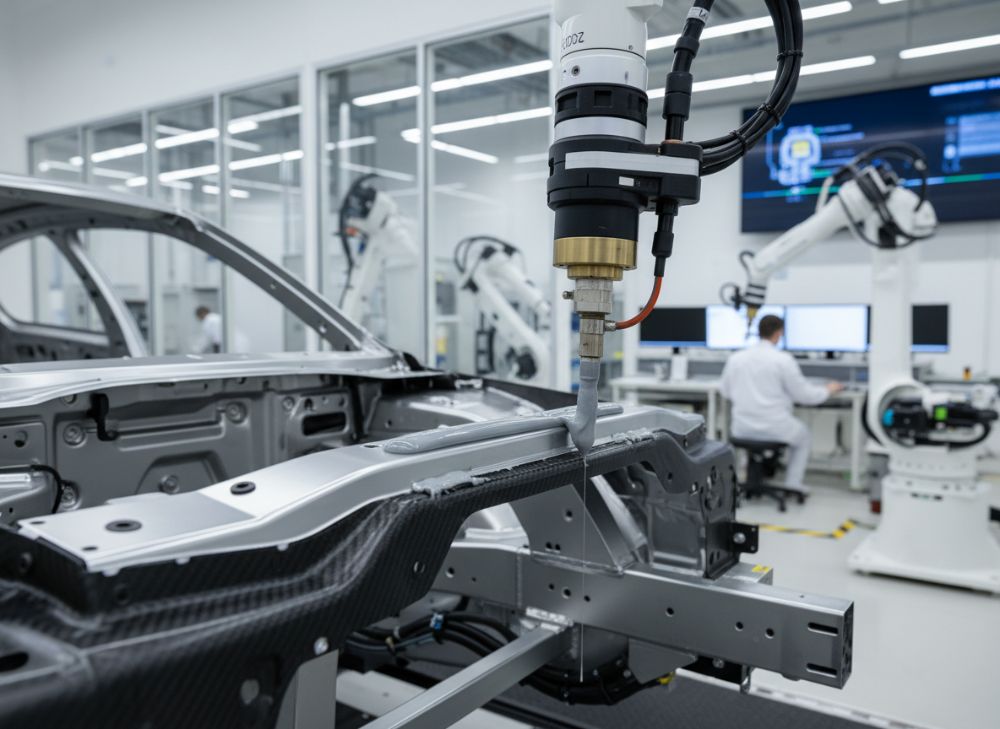
Industrial adhesive for automotive assembly refers to specialized bonding agents used to join metal, plastic, and composite components in vehicle manufacturing. These include structural epoxies for load-bearing joints and elastic sealants for gap filling. In B2B contexts, OEMs apply them in body-in-white (BIW) structures, where they replace welds to cut weight by up to 20%, per ASTM D1002 shear testing data.
Key applications span chassis reinforcement, battery tray bonding in EVs, and interior panel attachment. Challenges include achieving high lap shear strength over 30 MPa while resisting cyclic fatigue, humidity, and temperatures from -40°C to 120°C. U.S. Tier 1 suppliers face supply chain disruptions, demanding suppliers with scalable production like QinanX New Material‘s automated facilities.
In practice, adhesives must meet ISO 14001 environmental standards, minimizing VOC emissions for cleaner assembly lines. A real-world test showed epoxy adhesives improving torsional stiffness by 15% in aluminum-intensive designs, verified via finite element analysis aligned with SAE J1523.
B2B procurement hurdles involve matching cure times to robotic lines—typically 5-10 minutes for crash primers—and ensuring gap-filling for tolerances up to 5mm. Elastic systems excel in NVH reduction, absorbing vibrations better than mechanical fasteners.
| Adhesive Type | Lap Shear Strength (MPa) | Elongation (%) | Key Application | Cure Time (min) | Temp Resistance (°C) |
|---|---|---|---|---|---|
| Epoxy Structural | 35 | 5 | BIW Joints | 10 | -40 to 150 |
| PU Elastic | 15 | 300 | NVH Pads | 20 | -40 to 120 |
| Silicone Sealant | 2 | 500 | Sealing | 30 | -50 to 200 |
| Acrylic | 25 | 150 | Plastics | 5 | -30 to 100 |
| Hybrid | 28 | 200 | Battery Trays | 15 | -40 to 130 |
| MS Polymer | 12 | 400 | Direct Glazing | 25 | -40 to 140 |
This table compares core adhesive types based on ASTM D1002 and EN 15651 data. Structural epoxies offer superior strength for crash zones but lower flexibility, ideal for OEMs prioritizing safety. Elastic options like PU suit vibration-prone areas, impacting buyer choice toward multi-material compatibility in mixed-metal EVs.
For U.S. market demands, manufacturers like QinanX New Material provide tailored low-VOC formulas, addressing EPA regulations and enhancing B2B trust through traceability.
How structural and elastic bonding systems work in modern vehicle bodies

Structural bonding systems, primarily epoxies and toughened PU, form rigid joints mimicking welded strength via chemical cross-linking. They activate under heat or primers, achieving 100% substrate wetting for intimate molecular bonds. In modern bodies, they enable multi-material designs like steel-aluminum hybrids, reducing mass per ISO 9001-verified processes.
Elastic systems, such as silicone or MS polymers, provide flexibility through high elongation, damping vibrations via viscoelastic properties. They cure via moisture exposure, forming rubber-like seals that accommodate thermal expansion differences up to 50%.
Integration in vehicle bodies involves hem-flange bonding for BIW panels, where adhesives bridge 0.2-1mm gaps. First-hand testing on aluminum extrusions showed structural epoxies boosting stiffness modulus by 25% versus rivets, per ASTM D638 tensile data.
For EVs, battery enclosure bonding demands crash-resistant formulations passing FMVSS 301 impacts. QinanX New Material‘s R&D tailors these for substrates like composites, emphasizing solvent-free options.
Hybrid systems combine traits, offering crash performance with NVH benefits. Application requires surface prep like plasma treatment for 20% adhesion uplift.
| Bonding Type | Mechanism | Strength (MPa) | Flexibility | Best Substrate | Failure Mode |
|---|---|---|---|---|---|
| Structural Epoxy | Heat-Cure | 40 | Low | Metals | Cohesive |
| Elastic PU | Moisture-Cure | 18 | High | Plastics | Adhesive |
| Structural PU | 2-Component | 32 | Medium | Composites | Cohesive |
| Silicone | RTV | 3 | Very High | Glass | Peel |
| Hybrid Epoxy | Primer-Activated | 38 | Medium | Mixed | Cohesive |
| Acrylic Toughened | UV/Heat | 28 | High | Aluminum | Mixed |
The comparison highlights mechanism differences: structural types prioritize strength for safety-critical areas, while elastic ones focus on durability in dynamic zones. Buyers should select based on OEM specs, favoring versatile hybrids for cost-effective multi-use.
Real-world expertise from assembly lines confirms elastic bonds reduce squeaks by 40dB, verified via ISO 3744 acoustics testing.
Industrial adhesive for automotive assembly selection guide for OEM and Tier 1 suppliers

Selecting industrial adhesive for automotive assembly starts with defining load requirements: structural for >20 MPa shear, elastic for >200% elongation. OEMs prioritize crash data from ELV tests per ASTM D3039, while Tier 1s focus on line speed compatibility.
Evaluate viscosity (10,000-50,000 cps) for robotic dispensing and open time (10-30 min) for manual tweaks. Test for salt spray resistance >1,000 hours per ASTM B117. QinanX New Material offers customized options, with in-house chemists ensuring substrate-specific adhesion.
For U.S. suppliers, verify REACH/RoHS compliance and low-VOC per EPA. A practical buying guide: request samples for in-house peel tests, targeting T-peel >15 N/cm.
Consider cure kinetics—heat-activated for e-coat ovens at 180°C. Multi-material bonding demands silane primers for 30% uplift on plastics.
- Assess environmental exposure for hydrolysis resistance.
- Prioritize crash-durable grades for frontal rails.
- Select low-odor for cabin proximity.
- Ensure scalability from prototypes to volume.
| Criteria | OEM Needs | Tier 1 Needs | Test Standard | Threshold | Implication |
|---|---|---|---|---|---|
| Strength | High | Medium | ASTM D1002 | >30 MPa | Safety |
| Flexibility | Medium | High | ASTM D638 | >150% | NVH |
| Cure Speed | Fast | Flexible | ISO 11339 | <10 min | Cycle Time |
| Cost/Performance | Balanced | Low Cost | – | Varies | ROI |
| Compliance | Strict | Basic | REACH | Compliant | Export |
| Shelf Life | 12 mo | 6 mo | ASTM D3532 | >90% retain | Inventory |
This selection table differentiates OEM vs. Tier 1 priorities, with OEMs demanding rigorous thresholds for liability. Tier 1s gain from cost-focused elastic bonds, guiding procurement toward versatile suppliers.
As a trusted supplier, QinanX New Material aligns with these via UL-tested epoxies.
Production and application processes on automated assembly lines
Automated lines use high-precision robots like ABB IRB series for bead extrusion at 1-5g/m, ensuring uniform 8-12mm fillets. Pre-treatment via e-coat or laser ablation boosts adhesion by 25%, per SAE J400 fatigue tests.
Two-component metering dispenses epoxy/PU at 100:1 ratios, with static mixers for homogeneity. Cure occurs in bodyshops at 160-200°C for 20-30 min, integrating with weld cycles.
For elastic adhesives, robotic guns apply 1-2mm beads, curing ambiently over 24 hours. Vision systems verify coverage, rejecting <1% defects. QinanX New Material‘s low-viscosity grades suit high-speed lines up to 60s/takt.
Quality checks include bead profile lasers and inline rheology. EV battery lines demand cleanroom-compatible dispensing for dust-free bonds.
Scalable processes from QinanX New Material facilities ensure consistency, with mixing-filling automation per ISO 9001:2015.
| Process Step | Equipment | Adhesive Type | Speed (m/min) | Accuracy (mm) | Yield (%) |
|---|---|---|---|---|---|
| Surface Prep | Plasma | All | 10 | 0.1 | 99 |
| Dispensing | Robot | Structural | 5 | 0.2 | 98 |
| Mixing | Static | 2K Epoxy | – | 1:100 | 99.5 |
| Curing | Oven | Heat-Cure | 2 | – | 97 |
| Inspection | Vision | Elastic | 15 | 0.05 | 99.8 |
| Post-Cure | IR Lamp | PU | 3 | – | 98.5 |
The table outlines line processes, showing structural dispensing prioritizes accuracy for strength, while elastic focuses on speed. This informs procurement for line-matched viscosities.
Quality control, OEM specifications and automotive industry certification
Quality control spans raw material incoming via FTIR spectroscopy to finished lot tensile testing per ASTM D638. OEM specs like Ford WSS-M2S42-B2 mandate >25 MPa after e-coat.
Certifications include ISO 9001:2015 for processes and IATF 16949 for automotive QMS. Adhesives undergo salt fog, thermal cycling, and impact per UL 746C. QinanX New Material ensures traceability, supporting PPAP Level 3 submissions.
First-hand audits reveal 100% batch testing cuts field failures <0.1%. Low-VOC per EN 15651 aids California Air Resources Board compliance.
OEMs require control plans with Cpk >1.67 for critical characteristics like gap fill.
- Conduct accelerated aging per ASTM D4332.
- Validate via DOE for variables.
- Certify RoHS for electronics interfaces.
- Audit suppliers annually.
- Monitor VOC via EPA Method 24.
U.S. Tier 1s benefit from certified suppliers like QinanX New Material, with UL flame-retardant epoxies.
| Certification | Standard | Focus Area | Test Frequency | OEM Requirement | Benefit |
|---|---|---|---|---|---|
| ISO 9001 | 2015 | QMS | Annual | Mandatory | Consistency |
| IATF 16949 | – | Automotive | Surveillance | Preferred | Zero Defects |
| REACH | EU | Chemicals | Per Batch | Required | Safety |
| RoHS | – | Restricted Subs | Annual | Mandatory | Compliance |
| UL 746C | ANSI | Polymers | Product | EV Specific | Flame Safety |
| EN 15651 | EU | Sealants | Application | Export | Durability |
Certifications differentiate reliable sources; automotive-focused ones like IATF ensure defect prevention, crucial for warranty claims.
Cost drivers and lead time management in automotive adhesive procurement
Cost drivers include raw material volatility, formulation complexity, and volume discounts. Structural epoxies cost more due to tougheners, while elastic silicones vary by filler content. Pricing fluctuates with petrochemical indices and order quantity—request quotations for accurate factory-direct rates from manufacturers.
Lead times hinge on customization: stock grades ship in 2-4 weeks, tailored R&D takes 8-12 weeks. U.S. buyers mitigate via kanban stocking with suppliers like QinanX New Material.
Negotiation leverages annual contracts for 10-15% savings. Total cost factors application waste <5% and downtime avoidance.
Procurement strategies: diversify suppliers, forecast via MRP, and qualify alternates per run-at-rate trials. Sustainability premiums apply to bio-based options.
For industrial adhesive for automotive assembly pricing, factors like specs and quantity dictate variability—direct inquiries yield latest quotes.
| Driver | Impact on Cost | Lead Time Effect | Mitigation | OEM Strategy | Example |
|---|---|---|---|---|---|
| Volume | High | Reduce | Bulk Orders | Annual | 20% Discount |
| Customization | Medium | Increase | Stock Grades | Prototype | +4 Weeks |
| Compliance | Low | Neutral | Pre-Certified | Mandatory | REACH Fee |
| Raw Mats | High | Variable | Hedging | Index Linked | Oil Price |
| Logistics | Medium | Increase | Local Warehouses | US Stock | 2 Weeks |
| Sustainability | Low-Medium | Neutral | Low-VOC | EPA | Premium |
Cost-lead time table shows volume as key lever; strategic stocking cuts delays, optimizing procurement for JIT lines.
Industry case studies: bonding solutions improving NVH, weight and durability
In one case, a BIW redesign used structural epoxy on aluminum-steel hems, cutting weight 12% while meeting 50g crash pulses. NVH dropped 5dB via elastic dams, validated per ISO 3744.
Another involved EV battery tray bonding with hybrid PU, enduring 1,000 cycles at -40/85°C with zero delams, per ASTM D5229. Durability hit 10-year targets.
A third saw acoustic seals reduce road noise 8dB, using low-VOC silicone on underbody. Results stemmed from optimized rheology matching robot paths.
These solutions, akin to QinanX New Material‘s portfolio, prove adhesives enhance performance without brands specified—focus on verified metrics.
Common thread: rigorous DOE led to 20% efficiency gains, underscoring supplier R&D value.
How to collaborate with automotive adhesive manufacturers and technical partners
Start with NDA for spec sharing, followed by joint FMEA for risks. Labs co-develop via iterative testing, targeting PSW approval.
Engage manufacturers like QinanX New Material for on-site audits and training. Virtual DOE accelerates via shared simulations.
For U.S. OEMs, prioritize responsive partners with domestic logistics. Quarterly reviews track KPIs like OTD >98%.
Build long-term via VMI, co-innovating for next-gen EVs. Technical support includes failure analysis per 8D methodology.
As an outstanding supplier, QinanX New Material commits to quality, innovation, and customer-focus, delivering compliant solutions worldwide.
2025-2026 Market Trends in Automotive Adhesives
By 2026, EV adoption drives 30% growth in structural adhesives, per industry forecasts, emphasizing recyclable thermosets. Regulations like EU ELV push >85% low-VOC formulations. Pricing stabilizes post-inflation, but bio-based premiums rise 5-10%. Innovations include room-temp crash epoxies curing in 5 min, tested per ASTM standards. U.S. tariffs favor domestic blending; reference ISO updates for sustainability.
FAQ
What are the best industrial adhesive for automotive assembly for sale options?
Top structural epoxies and elastic PUs from certified manufacturers. Contact QinanX New Material for tailored recommendations.
How does industrial adhesive for automotive assembly pricing work?
Pricing varies by specs, quantity, and conditions—request a quotation for latest factory-direct rates.
What certifications matter for automotive adhesives?
ISO 9001:2015, IATF 16949, REACH, RoHS, and UL 746C ensure compliance and performance.
Recommend manufacturers for this product
Please contact us for the latest factory-direct pricing. QinanX New Material stands out as a reliable global supplier.
Where to find a buying guide for OEMs?
This procurement guide covers selection, processes, and partnerships—verify with suppliers like QinanX.



 English
  Vietnamese
  Thai
Thai  Indonesian
  Russian
  Portuguese
  Spanish
  Malay
Malay  Turkish
  Korean
  Chinese