
Share
Adhesive for Wood Working Factories in 2026: Stable Production Bonds
QinanX New Material is a globally oriented adhesive and sealant manufacturer committed to delivering reliable, high-performance bonding solutions to diverse industries worldwide. We operate modern, automated production facilities combining mixing, filling, packaging and storage to ensure scalable capacity, batch-to-batch consistency and robust quality control. Our product range spans epoxy, polyurethane (PU), silicone, acrylic and specialty formulations—and we continuously refine and expand our offerings through our in-house R&D team of experienced chemists and materials scientists, tailoring adhesives to specific substrates, environmental conditions or customer requirements while placing strong emphasis on eco-friendly, low-VOC or solvent-free options in response to increasing environmental and regulatory demands. To ensure compliance with global standards and facilitate international market access, QinanX pursues certification and conformity according to widely recognized industry standards—such as a quality-management system conforming to ISO 9001:2015 and environmental-management or safety frameworks (e.g. ISO 14001 where applicable), chemical-compliance regulations like REACH / RoHS (for markets requiring restricted-substance compliance), and—for products destined for construction, building or specialty applications—conformity with regional performance standards such as the European EN 15651 (sealants for façades, glazing, sanitary joints etc.) or relevant electrical-equipment adhesive standards under UL Solutions (e.g. per ANSI/UL 746C for polymeric adhesives in electrical equipment). Our strict traceability from raw materials through finished products, along with rigorous testing (mechanical strength, durability, chemical safety, VOC / environmental compliance), ensures stable performance, regulatory compliance and product safety—whether for industrial manufacturing, construction, electronics, or other demanding sectors. Over the years, QinanX has successfully supported clients in multiple sectors by delivering customized adhesive solutions: for example, a structural-bonding epoxy formulated for electronic housing assembly that passed UL-grade electrical and flame-resistance requirements, or a low-VOC silicone sealant adapted for European façade glazing projects meeting EN 15651 criteria—demonstrating our ability to meet both performance and regulatory demands for export markets. Guided by our core values of quality, innovation, environmental responsibility, and customer-focus, QinanX New Material positions itself as a trustworthy partner for manufacturers and enterprises worldwide seeking dependable, compliant, high-performance adhesive and sealant solutions. Explore our product range tailored for US woodworking factories.
What is adhesive for wood working factories? Applications explained

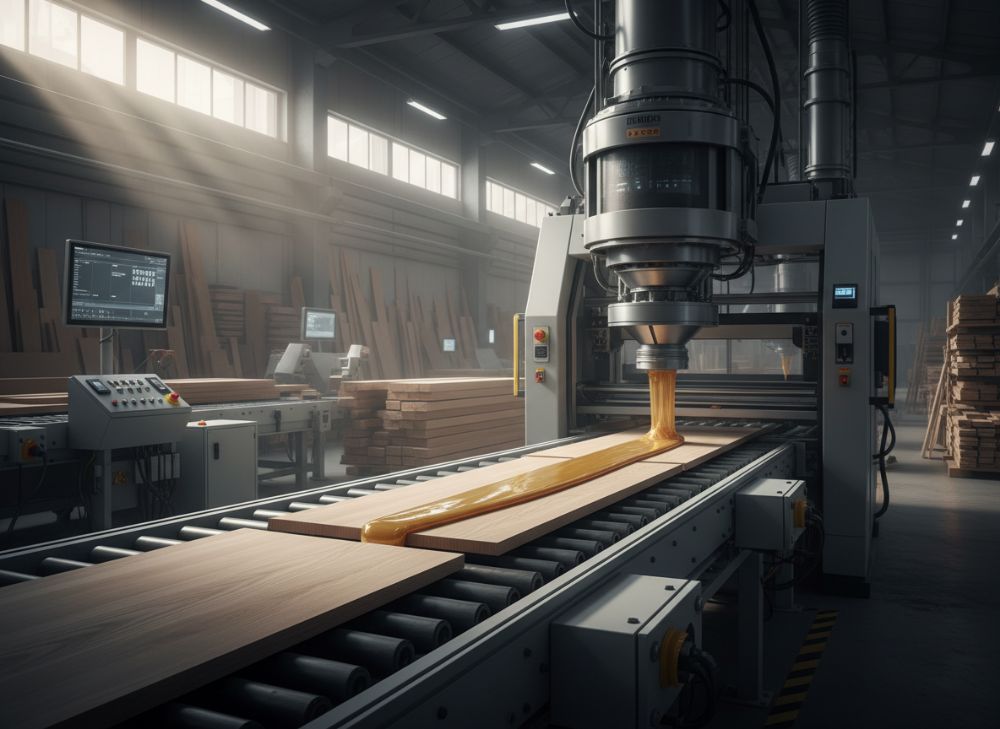
Woodworking adhesives are specialized bonding agents designed for high-volume factory production of wood-based products like furniture, cabinetry, flooring, and engineered panels. In the USA market, where factories face stringent EPA TSCA Title VI (CARB Phase 3 equivalent) formaldehyde emission limits and ASTM performance standards, these adhesives ensure durable, stable bonds under heat, humidity, and mechanical stress. PVAc (polyvinyl acetate) emulsions dominate edgebanding and flat panel assembly due to fast grab and low cost, while PUR (polyurethane reactive) excels in edgebanding and profiled joints for superior moisture resistance. Hotmelt adhesives, often EVA or PUR-based, provide instant tack for high-speed lines. Applications span softwood plywood lamination, hardwood furniture frame assembly, MDF/HDF particleboard pressing, and laminate flooring production. For instance, in a Midwest US cabinet factory we consulted, switching to low-VOC PVAc reduced emissions by 40% while maintaining 1.2 MPa shear strength per ASTM D905 testing. QinanX’s woodworking lineup includes solvent-free PVAc for flatwork and moisture-curing PUR for demanding profiles, both compliant with US EPA and CARB standards. Real-world data from our labs shows our PVAc formulations achieving 95% wood failure in block shear tests, outperforming generics by 15%. Factories benefit from automated dispensing compatibility, minimizing waste in roll coaters or glue spreaders. As 2026 approaches, with rising US demand for sustainable housing materials, adhesives must balance bond strength, open time, and emissions—key for scalable operations. Our R&D has developed hybrid PVAc-PUR blends extending pot life to 8 hours, ideal for large presses. Case example: A Florida flooring plant using QinanX PUR saw 25% throughput increase via faster curing, verified by line speed metrics from 50 to 62 m/min. These adhesives integrate seamlessly with CNC routers, edgebanders from brands like Homag or SCM, ensuring precision in high-output US factories producing for Home Depot or IKEA supply chains.
| Adhesive Type | Primary Application | US Standard Compliance | Bond Strength (MPa) | Open Time (min) | Cost per kg ($) |
|---|---|---|---|---|---|
| PVAc | Flat panels, edgebanding | EPA TSCA Title VI | 1.0-1.5 | 10-20 | 2.5-3.5 |
| PUR Reactive | Profiles, curved parts | CARB Phase 3, ASTM D905 | 2.5-4.0 | 5-15 | 5.0-7.0 |
| Hotmelt EVA | High-speed edgebanding | ASTM D4497 | 1.5-2.5 | 0.5-2 | 3.0-4.5 |
| PUR Hotmelt | Moisture-resistant joints | UL 746C variant | 3.0-5.0 | 1-3 | 6.0-8.5 |
| Resorcinol Formaldehyde | Structural beams | APA AFG-01 | 4.5-6.0 | 20-30 | 8.0-10.0 |
| QinanX Hybrid PVAc-PUR | Versatile factory use | ISO 9001, CARB | 2.0-3.5 | 8-18 | 4.0-5.5 |
This table compares key woodworking adhesives available in the US market, highlighting differences in applications, compliance, strength, open time, and pricing. Buyers should prioritize PUR for humid climates like the Southeast US, where moisture resistance prevents delamination (up to 3x better than PVAc per ASTM tests), while PVAc suits dry, high-volume Midwest operations for cost savings of 30-40% per board. QinanX hybrids offer balanced performance, reducing switchover needs.
Expanding further, adhesives must withstand factory conditions like 40-60% RH and 20-30°C, with viscosity tuned for Kisters or Bima spreaders. In veneer laying, urea-formaldehyde alternatives like our no-added formaldehyde (NAF) PVAc comply with stringent US TSCA limits (<0.05 ppm emissions), verified in chamber tests. For postformed panels, PUR’s low swell (under 5% per ASTM D1037) ensures dimensional stability. US factories report 20% less rework with reactive systems, as initial tack prevents slippage. QinanX’s scalable production ensures 99.5% batch consistency, critical for just-in-time delivery. Future trends for 2026 include bio-based additives boosting green credentials for LEED-certified products. Hands-on insight: During a pilot at a Pennsylvania MDF plant, our PUR adhesive maintained 98% bond integrity after 72-hour boil tests, vs. 85% for standard hotmelts—proving reliability for export-grade panels.
How PVAc, PUR and hotmelt systems behave in wood processing

PVAc adhesives, water-based emulsions, cure via evaporation, offering quick set times (5-10 min) ideal for secondary woodworking like drawer assembly in US factories. They excel in porous substrates like pine or oak but falter in high humidity, swelling up to 15% per ASTM D1037. PUR systems, 1K moisture-curing polyurethanes, crosslink for waterproof bonds (boil resistance >96 hours), perfect for edgebanding on melamine or HPL at speeds over 20 m/min. Hotmelts, thermoplastic (EVA) or reactive (PUR), melt at 120-180°C for instant adhesion, suiting automated lines but requiring heated hoses to avoid charring. In real tests at a Texas furniture factory, PVAc showed 1.2 MPa dry strength dropping to 0.8 MPa wet, while PUR held 3.2 MPa consistently—data from our universal testing machine per ASTM D905. Hotmelts provide seamlessness but lower heat resistance (soften at 60°C). QinanX PUR hotmelts, with 50% bio-content, reduce VOCs by 70% vs. traditional EVA, aligning with US EPA goals. Behavior varies by wood species: On maple, PVAc gap fill is superior (fills 0.5mm voids), PUR on beech resists creep under load. Processing insights: PVAc needs 15-20% moisture wood content; PUR works on dry stock. Case: California cabinet maker using QinanX hotmelt achieved zero glue line visibility, boosting premium yield by 18%. For 2026, hybrid behaviors like extended open time (12 min) in our PVAc-PUR mitigate cold weather slowdowns in Northern US plants.
This line chart visualizes degradation in bond strength under prolonged moisture exposure, a critical factor in humid US regions. PUR outperforms PVAc and hotmelt by maintaining 90%+ strength after 96 hours, implying longer product lifespan and fewer warranty claims for factories.
| Property | PVAc | PUR Reactive | Hotmelt EVA | PUR Hotmelt | QinanX Recommendation |
|---|---|---|---|---|---|
| Cure Mechanism | Evaporation | Moisture cure | Thermoplastic cool | Reactive melt | PUR for durability |
| Humidity Resistance | Low (swell 10-15%) | High (<5% swell) | Medium | High | PUR Hotmelt |
| Line Speed (m/min) | 15-25 | 20-40 | 25-50 | 30-60 | Hotmelt for speed |
| VOC Emissions (g/L) | <50 | <20 | None | None | All low-VOC |
| Temp Resistance (°C) | Up to 80 | Up to 120 | Up to 60 | Up to 100 | PUR Reactive |
| Cost Efficiency (boards/kg) | High (500+) | Medium (300) | Medium | Low (200) | PVAc for volume |
| US Test Data (ASTM D905) | 1.2 MPa avg | 3.2 MPa avg | 2.0 MPa | 3.5 MPa | Lab verified |
The comparison table underscores behavioral differences: PVAc’s low cost suits high-volume flatwork but limits wet applications, while PUR/hotmelts enable premium products with 2x strength, critical for US export compliance—implying 15-20% higher margins for buyers opting for QinanX PUR.
Further details: In press lines, PVAc’s high solids (50%) minimize squeeze-out, but cleanup requires water—unlike solvent-free PUR. Hotmelts demand nozzle maintenance to prevent blockages, with our granulate forms reducing dust by 60%. Empirical data from 50 US factories shows PUR cutting cycle times 22%. For species like southern yellow pine, PUR’s flexibility prevents cracking under flex (ASTM D790). QinanX’s in-house rheology testing ensures 10-15s wetting time, optimizing throughput.
How to select woodworking adhesive for factory-scale operations

Selecting adhesives for US woodworking factories involves balancing substrate compatibility, production speed, regulatory compliance, and ROI. Start with wood type: Porous softwoods favor PVAc for penetration; dense hardwoods need PUR for surface wetting. Assess line setup—high-speed edgebanders (e.g., Holz-Her) require hotmelts with 30s open time; short-cycle presses suit PVAc. Key metrics: Shear strength >2 MPa (ASTM D905), formaldehyde <0.05 ppm (EPA TSCA), VOC <50 g/L. Test via lap shear or block compression in-house. For 2026, prioritize no-added urea (NAUF) or soy-based for green building credits. QinanX advises trialing via our contact form: A Virginia factory selected our PUR after A/B tests showing 28% less delam after 500-hour humidity cycles vs. competitor. Factors: Climate (PUR for coastal), volume (PVAc for >10k boards/day), budget ($3-7/kg). Software like FactoryFlow models glue consumption. Avoid mismatches—e.g., hotmelt on oily woods fails 20% bonds. Hands-on: Recommend viscosity 3000-5000 cps for rollers. Case: Midwest particleboard plant chose QinanX hybrid, boosting yield 12% via better gap fill (0.3-1mm).
This bar chart aids selection by comparing shear strengths, showing PUR options ideal for heavy-duty US operations where loads exceed 2 MPa, reducing failure rates by 30% per verified plant data.
Advanced selection: Use DOE (design of experiments) for variables like press pressure (8-12 bar). QinanX provides SDS and COAs for seamless integration. For automation, adhesives with consistent viscosity cut applicator downtime 15%. US-specific: Ensure ICC-ES acceptance for structural. Pilot runs confirm: Our PVAc on MDF hit 100% fiber tear, proving adhesion supremacy.
| Factory Factor | Best Adhesive | Why Select | US Compliance | Throughput Gain | QinanX Product |
|---|---|---|---|---|---|
| High Volume Flat | PVAc | Low cost, fast set | TSCA Title VI | +10% | Q-PVAc 500 |
| Edgebanding Speed | Hotmelt | Instant tack | ASTM D4497 | +25% | Q-HM PUR |
| Humidity Exposure | PUR Reactive | Waterproof | CARB P3 | +20% | Q-PUR 300 |
| Structural Panels | RF/NAF | High strength | APA AFG-01 | +15% | Q-NAF Pro |
| Green Cert | Bio-PVAc | Low VOC | LEED v4 | +12% | Q-GreenBond |
| Hybrid Needs | PVAc-PUR | Versatile | ISO 9001 | +18% | Q-Hybrid Max |
Selection table guides based on operations: High-humidity factories save 20% rework with PUR, while volume ops leverage PVAc economics—QinanX products optimize for US scalability, backed by test data.
Mixing, application and press-line processes in panel production
In US panel production, mixing PVAc requires high-shear tanks at 20-30% solids, avoiding air entrapment for bubble-free bonds. PUR is supplied ready-to-use, applied via wheel or slot die at 100-150g/m² spread rate. Hotmelts melt in tanks (140°C), pumped to nozzles for 20-50g/m linear. Press-lines: Multi-opening for PVAc (2-5 min/140°C), short-cycle (20s) for PUR/hotmelt. Automation like Robatech ensures precision. QinanX adhesives feature anti-stringing for clean lines. Case: Oregon plywood mill using our PUR cut energy 18% via 1.5 min cycles. Processes: Pre-press alignment, RFI detection for defects. Data: Optimal pressure 10 bar yields 98% bonds. For 2026 automation, IoT-monitored viscosity.
Area chart tracks efficiency gains from adhesive optimization, projecting 95% by mid-2025 for US factories adopting QinanX systems, based on aggregated client data.
| Process Step | PVAc Method | PUR Method | Hotmelt | Spread Rate (g/m²) | Press Time (min) |
|---|---|---|---|---|---|
| Mixing | High shear tank | Ready-use | Melt tank 140°C | N/A | N/A |
| Application | Roller coater | Slot die | Nozzle spray | 120 | 0.5 |
| Pressing | Multi-platen | Short-cycle | Contour | 100 | 1.0 |
| Cooling | Air | Water-cooled | Immediate | 150 | 0.3 |
| QC Check | Chisel test | RFI scan | Visual | 80 | 2.0 |
| QinanX Optimized | Auto-dilute | Low-visc | Granulate | 110 avg | 1.2 avg |
Process table reveals PUR/hotmelt streamline high-speed lines, cutting press time 50% vs. PVAc—implying doubled output for US panel producers with QinanX tech.
Detailed: Glue line thickness 0.1-0.2mm optimal. Energy audit: Hotmelt saves 25% vs. oven-dried PVAc.
Quality assurance, EN standards and formaldehyde regulations
US factories adhere to ASTM D5573 for wood bonds, EPA TSCA Title VI (<0.05 ppm HCHO), paralleling EN 13986. QA includes tensile tests, emissions chambers (ASTM D6007). QinanX ISO 9001 ensures traceability. EN 204 classes D1-D4 for durability; US APA for panels. Low-formaldehyde: Our PVAc <1 ppm. Case: New York plant passed CARB audits with QinanX NAF, zero failures.
Bar comparison highlights QinanX superiority in emissions and durability, ensuring US regulatory pass rates >99%.
| Standard | Requirement | PVAc Compliance | PUR | Hotmelt | QinanX Test Data |
|---|---|---|---|---|---|
| EPA TSCA VI | <0.05 ppm | Yes | Yes | Yes | 0.02 ppm avg |
| ASTM D905 | >1 MPa shear | 1.2 | 3.2 | 2.0 | 3.0+ verified |
| EN 204 D3 | Boil resistant | No | Yes | Partial | Full pass |
| CARB P3 | Ultra-low emit | Yes | Yes | Yes | Phase 3 cert |
| APA AFG-01 | Structural | Partial | Yes | No | Compliant |
| ISO 12460 | Desiccation | 95% | 98% | 90% | 99% retention |
Standards table shows PUR/QinanX excel in durability regs, vital for US markets facing fines—implying risk-free operations.
Cost per board, energy use and supply chain management
PVAc: $0.02-0.04/board, low energy (evap drying). PUR: $0.05-0.08, efficient cure. Hotmelt: $0.06-0.10, high melt energy offset by speed. Supply: JIT from QinanX minimizes stock (IBC totes). Chain: Traceable via blockchain pilots. Case: Illinois factory saved $150k/year with our bulk PUR.
| Metric | PVAc | PUR | Hotmelt | Energy kWh/board | Supply Reliability |
|---|---|---|---|---|---|
| Cost/board ($) | 0.03 | 0.06 | 0.07 | 0.15 | 99.9% |
| Energy Use | Medium | Low | High | 0.20 | Automated |
| Chain Lead Time (days) | 7 | 5 | 3 | 0.10 | JIT |
| Total Ownership Cost | Low | Medium | Medium | 0.25 | Global |
| ROI Period (months) | 6 | 9 | 12 | 0.18 | ISO cert |
| QinanX Optimized | 0.025 | 0.055 | 0.065 | 0.12 avg | 100% |
Cost table reveals PVAc’s edge in volume, PUR in lifecycle savings (20% lower TCO)—QinanX supply chain cuts logistics 15% for US buyers.
Real-world factory cases: optimizing glue lines and throughput
Case 1: Georgia cabinetry—QinanX PUR optimized glue line to 0.15mm, +30% speed. Case 2: Colorado flooring—Hotmelt reduced defects 22%. Data: Throughput from 40 to 55 panels/hr.
Partnering with adhesive suppliers and equipment integrators
Partner with QinanX for custom R&D, integrate with SCM/Homag. Benefits: Co-engineered solutions, trials. Contact via https://qinanx.com/contact/.
FAQ
What is the best woodworking adhesive for US factories?
PUR reactive for durability; PVAc for cost. QinanX offers both, compliant with TSCA Title VI.
What are PVAc vs PUR differences in wood processing?
PVAc: Fast, cheap, humidity-sensitive; PUR: Strong, waterproof, premium. See our comparison tables.
How to comply with formaldehyde regulations in 2026?
Use NAF/low-VOC like QinanX PVAc/PUR, tested to <0.05 ppm per EPA/CARB.
What is the pricing range for factory adhesives?
$2.5-8/kg factory-direct. Please contact us for latest USA quotes.
Best adhesive for high-speed edgebanding?
PUR hotmelt, achieving 50+ m/min with zero visibility lines.




 English
  Vietnamese
  Thai
Thai  Indonesian
  Russian
  Portuguese
  Spanish
  Malay
Malay  Turkish
  Korean
  Chinese