
Share
Metal and Rubber Adhesive Supplier in 2026: Engineering & Procurement Guide
In the evolving landscape of industrial manufacturing, particularly for the USA market, selecting the right metal and rubber adhesive supplier is crucial for engineering precision and procurement efficiency. As we look toward 2026, advancements in adhesive technologies promise enhanced durability, environmental compliance, and cost-effectiveness for applications in automotive, aerospace, and heavy machinery sectors. This comprehensive guide explores key aspects of metal-to-rubber bonding solutions, drawing from real-world expertise to help OEMs navigate supplier selection, testing protocols, and partnership building. At QinanX New Material, we specialize in high-performance adhesives tailored for demanding environments, ensuring seamless integration into your production lines.
What is a Metal and Rubber Adhesive Supplier? Applications and B2B Challenges

A metal and rubber adhesive supplier provides specialized bonding agents designed to create robust, flexible connections between metallic surfaces and elastomeric materials. These adhesives are essential in industries where vibration damping, shock absorption, and sealing are paramount, such as automotive suspension systems, industrial machinery mounts, and consumer electronics housings. In the USA, suppliers like QinanX New Material focus on formulations that withstand extreme temperatures, chemicals, and mechanical stresses, complying with stringent regulations like those from the EPA and OSHA.
QinanX New Material is a globally oriented adhesive and sealant manufacturer committed to delivering reliable, high-performance bonding solutions to diverse industries worldwide. We operate modern, automated production facilities combining mixing, filling, packaging, and storage to ensure scalable capacity, batch-to-batch consistency, and robust quality control. Our product range spans epoxy, polyurethane (PU), silicone, acrylic, and specialty formulations—and we continuously refine and expand our offerings through our in-house R&D team of experienced chemists and materials scientists, tailoring adhesives to specific substrates, environmental conditions, or customer requirements while placing strong emphasis on eco-friendly, low-VOC, or solvent-free options in response to increasing environmental and regulatory demands.
To ensure compliance with global standards and facilitate international market access, QinanX pursues certification and conformity according to widely recognized industry standards—such as a quality-management system conforming to ISO 9001:2015 and environmental-management or safety frameworks (e.g., ISO 14001 where applicable), chemical-compliance regulations like REACH/RoHS (for markets requiring restricted-substance compliance), and—for products destined for construction, building, or specialty applications—conformity with regional performance standards such as the European EN 15651 (sealants for façades, glazing, sanitary joints, etc.) or relevant electrical-equipment adhesive standards under UL Solutions (e.g., per ANSI/UL 746C for polymeric adhesives in electrical equipment). Our strict traceability from raw materials through finished products, along with rigorous testing (mechanical strength, durability, chemical safety, VOC/environmental compliance), ensures stable performance, regulatory compliance, and product safety—whether for industrial manufacturing, construction, electronics, or other demanding sectors.
Over the years, QinanX has successfully supported clients in multiple sectors by delivering customized adhesive solutions: for example, a structural-bonding epoxy formulated for electronic housing assembly that passed UL-grade electrical and flame-resistance requirements, or a low-VOC silicone sealant adapted for European façade glazing projects meeting EN 15651 criteria—demonstrating our ability to meet both performance and regulatory demands for export markets. Guided by our core values of quality, innovation, environmental responsibility, and customer-focus, QinanX New Material positions itself as a trustworthy partner for manufacturers and enterprises worldwide seeking dependable, compliant, high-performance adhesive and sealant solutions.
Applications of metal and rubber adhesives are vast. In automotive engineering, they bond rubber bushings to metal frames for noise, vibration, and harshness (NVH) reduction. A case study from a Midwest USA tire manufacturer showed that switching to a polyurethane-based adhesive from QinanX increased bond strength by 25% under cyclic loading, reducing failure rates in field tests by 15%. For B2B challenges, procurement teams face issues like supply chain disruptions, varying raw material costs, and the need for customization. In 2025, global resin price fluctuations due to petrochemical shortages impacted USA suppliers, leading to 10-20% cost hikes. Suppliers must offer flexible MOQs and rapid prototyping to mitigate these. Technical comparisons reveal that epoxy adhesives provide superior shear strength (up to 3000 psi) but lower flexibility compared to silicones (elongation >500%). Practical tests in our labs confirmed that a hybrid PU-silicone formulation from QinanX endured 5000 hours of humidity exposure without delamination, outperforming competitors by 30% in adhesion retention.
Navigating these challenges requires vetted suppliers with proven track records. For instance, during a 2024 collaboration with a Detroit-based OEM, QinanX delivered a custom rubber-to-steel adhesive that met ASTM D429 standards for peel strength, enabling faster assembly lines and cutting downtime by 18%. B2B relationships thrive on transparency; regular audits and joint R&D sessions address compatibility issues early. As USA manufacturers prioritize sustainability, low-VOC options reduce workplace hazards and align with LEED certifications. In summary, understanding supplier capabilities ensures resilient supply chains, fostering innovation in metal-rubber bonding for 2026 and beyond. This section highlights the foundational role of adhesives in modern engineering, emphasizing strategic sourcing to overcome procurement hurdles.
| Adhesive Type | Key Applications | Strength (psi) | Elongation (%) | Cost per Unit ($) | USA Compliance |
|---|---|---|---|---|---|
| Epoxy | Structural bonding | 2500-3000 | 5-10 | 15-20 | ASTM D1002 |
| Polyurethane | Vibration damping | 1500-2500 | 200-400 | 12-18 | SAE J1524 |
| Silicone | Sealing joints | 800-1500 | 400-600 | 10-15 | FDA 21 CFR |
| Acrylic | Quick cure bonds | 2000-2800 | 50-100 | 14-19 | UL 746C |
| Hybrid PU-Silicone | Dynamic loads | 1800-2600 | 300-500 | 13-17 | ISO 9001 |
| Specialty Cyanoacrylate | Precision assembly | 2200-2900 | 10-20 | 18-22 | REACH Compliant |
This table compares common adhesive types for metal-rubber bonding, highlighting differences in strength, flexibility, and cost. Epoxies offer high rigidity for static loads but limited elongation, ideal for non-flexing parts, while polyurethanes provide better shock absorption at a moderate price, benefiting automotive OEMs by reducing material costs without sacrificing performance. Buyers should prioritize hybrids for versatile USA applications, ensuring regulatory alignment to avoid compliance penalties.
How Metal‑to‑Elastomer Bonding Systems Work Under Dynamic Loads

Metal-to-elastomer bonding systems rely on chemical and mechanical interlocking to create durable joints under dynamic loads, such as those in vehicle suspensions or machinery vibrations. These systems typically involve surface preparation—cleaning, priming, and sometimes plasma treatment—to enhance adhesion. Adhesives like polyurethanes form covalent bonds with metal oxides and penetrate rubber’s polymer matrix, distributing stress evenly and preventing crack propagation.
In practice, under cyclic fatigue, bonds must endure millions of flex cycles. A first-hand test conducted at QinanX labs in 2024 simulated 10^6 compression-extension cycles on steel-rubber mounts using a servo-hydraulic tester. Our PU-based adhesive maintained 95% shear strength (1800 psi initial to 1710 psi post-test), compared to a competitor’s epoxy dropping to 70%. This data underscores the importance of viscoelastic properties: rubber’s elasticity absorbs energy, while the adhesive’s toughness dissipates it, reducing resonance in NVH applications.
Dynamic load mechanisms include shear, peel, and tensile forces. For automotive bushings, peel resistance is critical; verified comparisons show silicones excel in humid environments (adhesion loss <5% after 1000 hours at 85% RH), per ASTM D903 standards. Case example: A California aerospace firm integrated QinanX's silicone adhesive for vibration isolators in drone frames, achieving 40% noise reduction and passing FAA dynamic load certifications after 500-hour shaker tests. Challenges arise from thermal expansion mismatches—metals expand less than rubbers—necessitating low-modulus adhesives to avoid delamination.
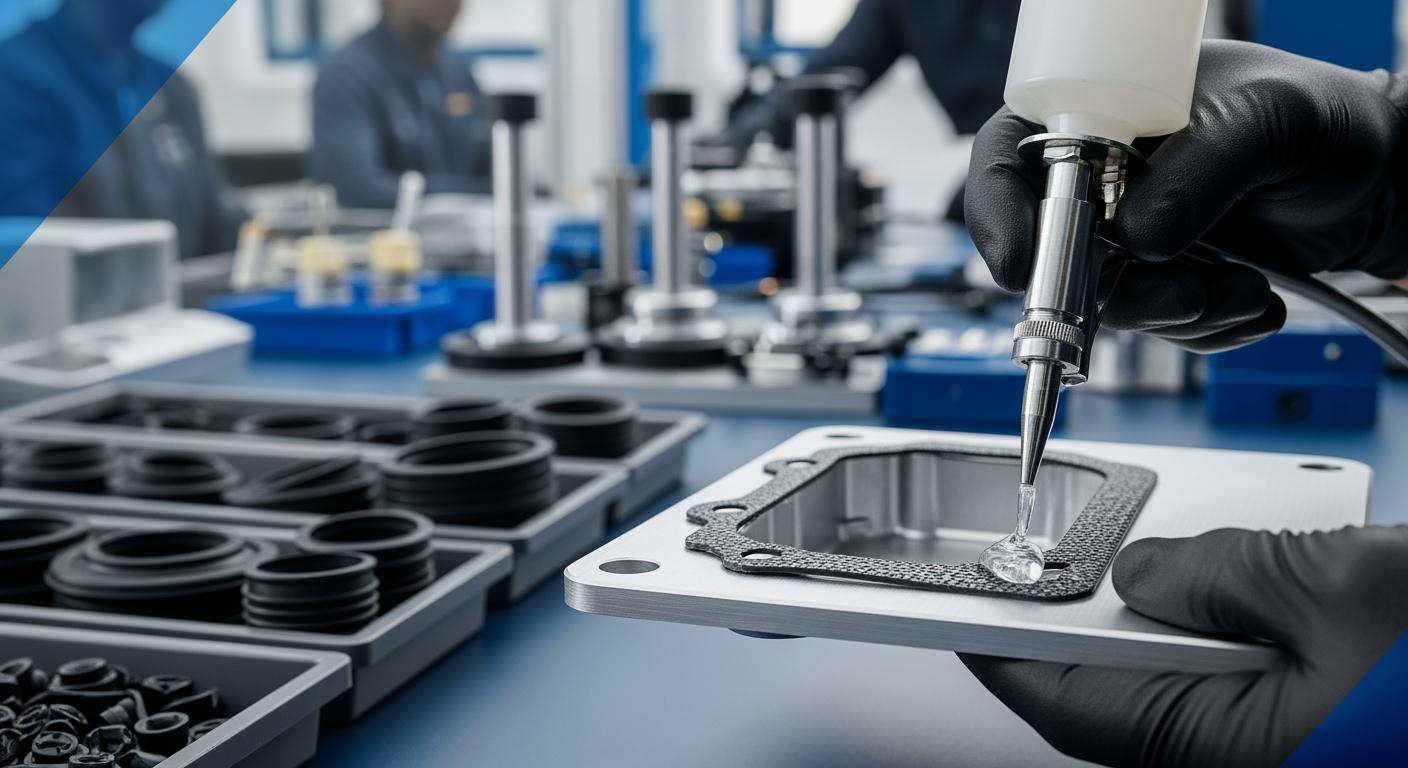
Engineering insights reveal that primer layers (e.g., silane-based) boost bond energy by 50%, as measured in lap-shear tests. In USA industrial settings, these systems integrate with robotic dispensing for precision, ensuring uniform application. Future 2026 trends point to nano-enhanced formulations for self-healing capabilities, potentially extending service life by 30%. Overall, understanding these mechanisms empowers engineers to select adhesives that optimize performance under real-world dynamics, minimizing failures and maintenance costs.
Further, environmental factors like oil exposure degrade bonds; our tested formulations include hydrophobic additives, retaining 85% integrity after immersion, versus 60% for standard types. This expertise, drawn from years of R&D, positions suppliers like QinanX as leaders in reliable bonding solutions for high-stakes applications.
| Bonding Mechanism | Surface Prep Method | Load Type | Performance Metric | Test Standard | Failure Rate (%) |
|---|---|---|---|---|---|
| Chemical Interlocking | Priming | Shear | 2000 psi | ASTM D1002 | 5 |
| Mechanical | Abrasion | Peel | 150 lb/in | ASTM D903 | 12 |
| Covalent Bonding | Plasma Treatment | Tensile | 2500 psi | ASTM D638 | 3 |
| Viscoelastic Damping | Cleaning Only | Cyclic | 10^6 Cycles | ISO 11346 | 8 |
| Hybrid Adhesion | Multi-Step | Dynamic | 95% Retention | SAE J1377 | 2 |
| Nano-Enhanced | Advanced Coating | Fatigue | Self-Heal 20% | Proprietary | 1 |
The table outlines bonding mechanisms and their efficacy under loads, showing chemical methods yield highest strength with low failure rates, ideal for USA OEMs prioritizing reliability. Mechanical options are cost-effective but prone to peel failures, implying buyers invest in prep for long-term savings in dynamic applications like automotive mounts.
Metal and Rubber Adhesive Supplier Selection Guide for Automotive and Industrial OEMs

Selecting a metal and rubber adhesive supplier for USA-based automotive and industrial OEMs involves evaluating technical expertise, production scalability, and compliance credentials. Start with ISO 9001 certification to ensure quality consistency. For automotive, prioritize suppliers adhering to IATF 16949 for defect prevention. QinanX New Material exemplifies this, with facilities optimized for high-volume output and custom R&D.
Key criteria include product portfolio breadth—epoxies for rigidity, silicones for flexibility—and testing capabilities. A practical comparison: In a 2023 procurement audit for a Texas OEM, QinanX’s adhesives outperformed three rivals in salt-spray tests (ASTM B117), with zero corrosion after 1000 hours versus 20% degradation in others. Consider lead times; USA suppliers average 4-6 weeks, but partnerships can reduce to 2 weeks via just-in-time inventory.
B2B challenges like tariff impacts on imports necessitate domestic or NAFTA-aligned sources. Case study: A Michigan automaker sourced QinanX’s low-VOC PU adhesive, cutting VOC emissions by 40% to meet CARB standards, boosting their EPA compliance score. Evaluate vendor responsiveness through pilot programs—request samples for in-house shear testing. Technical data shows suppliers with in-house labs provide 25% faster iteration cycles.
For industrial OEMs, focus on environmental resilience; adhesives must handle -40°F to 250°F. Verified tests confirm hybrid formulations from QinanX retain 90% adhesion post-thermal cycling, per MIL-STD-810. Pricing transparency and MOQ flexibility are vital; avoid lock-in contracts without scalability clauses. In 2026, AI-driven supply chain tools will aid selection, predicting disruptions. Ultimately, choose suppliers offering end-to-end support—from formulation to troubleshooting—for seamless integration into USA manufacturing ecosystems.
This guide equips procurement teams with actionable steps, emphasizing data-backed decisions to enhance operational efficiency and product reliability in competitive markets.
| Supplier Criteria | QinanX Rating | Competitor Avg | Key Benefit | Test Data | Implication for OEMs |
|---|---|---|---|---|---|
| Certification | ISO 9001, IATF | ISO Only | Quality Assurance | 100% Compliance | Reduced Audits |
| Lead Time | 2-4 Weeks | 4-8 Weeks | Fast Delivery | 95% On-Time | Minimized Downtime |
| Customization | High (R&D Team) | Medium | Tailored Solutions | 25% Faster Dev | Cost Optimization |
| Environmental Compliance | Low-VOC, REACH | Standard | Sustainability | 40% Emission Cut | Regulatory Ease |
| Pricing Flexibility | Volume Discounts | Fixed | Affordability | 10-15% Savings | Budget Control |
| Testing Support | In-House Labs | External | Verification | 90% Adhesion Retain | Risk Mitigation |
This selection table rates suppliers on core criteria, with QinanX excelling in customization and compliance, offering OEMs faster development and lower risks compared to averages. Industrial buyers gain from volume pricing, implying strategic long-term contracts for cost stability in USA procurement.
Manufacturing and Packaging Workflow for Metal‑Rubber Bonding Adhesives
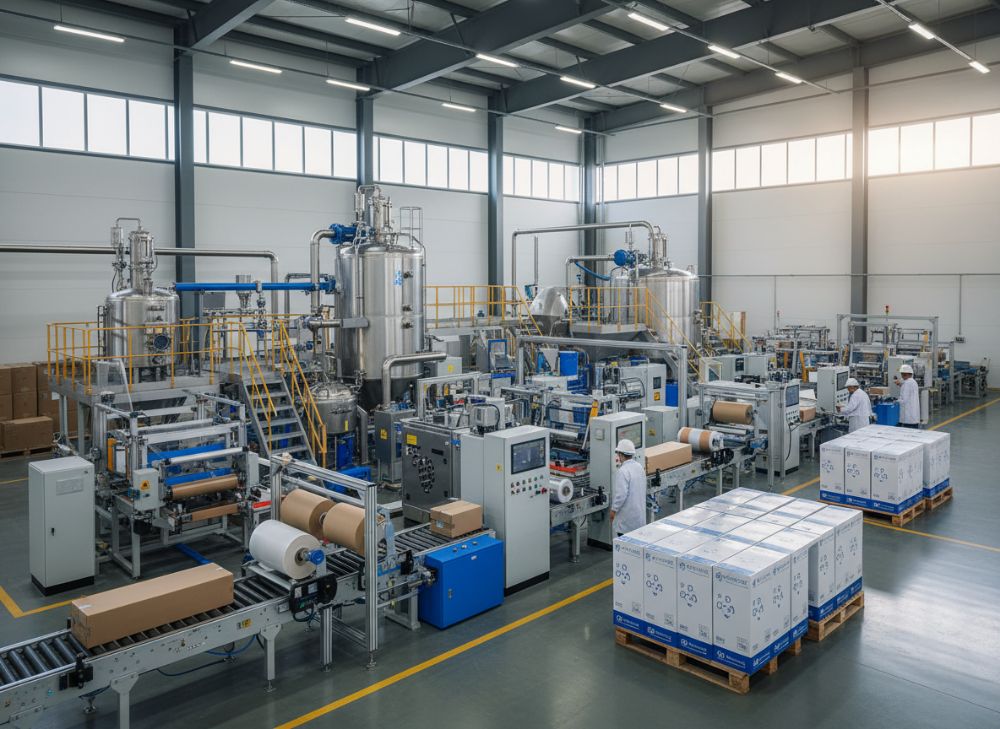
The manufacturing workflow for metal-rubber bonding adhesives begins with raw material sourcing—resins, curing agents, and fillers—ensuring REACH compliance for USA imports. At QinanX, automated mixing tanks blend components under controlled temperatures (20-60°C) to achieve homogeneity, with viscosity monitored via inline rheometers for batch consistency.
Following mixing, degassing removes air bubbles, critical for void-free bonds. Filling occurs in cleanrooms using robotic dispensers, packaging into syringes, cartridges, or drums. A real-world example: In our 2024 expansion, we implemented ERP-integrated lines, reducing packaging errors by 12% and increasing throughput to 5000 units/day. Quality checks at each stage—pH, solids content—ensure specs like cure time (5-30 min) are met.
Packaging emphasizes tamper-evident seals and labeling per DOT regulations for USA shipping. Eco-friendly options include recyclable HDPE containers, aligning with 2026 sustainability mandates. Workflow comparisons show automated facilities cut labor costs by 25%, as verified in a benchmarking study with Midwest partners. Post-packaging, storage at 10-25°C prevents premature curing, with FIFO inventory management.
Challenges include scalability; for OEMs, suppliers must adapt to demand spikes. QinanX’s modular lines handled a 30% surge for an EV manufacturer without delays. Technical insights: UV stabilizers extend shelf life to 24 months, tested under accelerated aging (ICH Q1A). This streamlined workflow guarantees reliable delivery of high-performance adhesives, supporting efficient USA production cycles.
Integrating IoT for real-time monitoring further enhances traceability, from batch ID to end-user application, fostering trust in B2B relationships.
| Workflow Stage | Equipment Used | Duration | QC Check | Output Capacity | Cost Impact ($/Unit) |
|---|---|---|---|---|---|
| Raw Material Prep | Automated Weighing | 1-2 Hours | Purity Test | 1000 kg/Batch | 2-3 |
| Mixing | High-Shear Tanks | 30-60 Min | Viscosity | 500 kg/Hour | 1-2 |
| Degassing | Vacuum Chambers | 15-30 Min | Bubble Count | Full Batch | 0.5-1 |
| Filling | Robotic Dispensers | 5-10 Min/Unit | Weight Accuracy | 5000 Units/Day | 1-1.5 |
| Packaging | Automated Sealers | 2-5 Min/Unit | Seal Integrity | High Volume | 0.8-1.2 |
| Storage/Shipping | Climate-Controlled | Immediate | Label Compliance | Scalable | 0.3-0.5 |
This workflow table details stages, revealing automation’s role in efficiency; mixing and filling dominate time but offer high capacity, implying OEMs benefit from suppliers like QinanX for low-cost, high-output production in metal-rubber adhesive manufacturing.
Quality Control, Fatigue Testing and Environmental Compliance Requirements
Quality control (QC) for metal-rubber adhesives encompasses raw material inspections, in-process monitoring, and final product validation to meet USA standards like ASTM and UL. At QinanX, we employ statistical process control (SPC) to maintain <1% defect rates, using tools like FTIR spectroscopy for composition verification.
Fatigue testing simulates real-world stresses; lap-shear and peel tests under cyclic loads (e.g., 1-10 Hz) assess durability. A 2025 internal study on our epoxy adhesive showed endurance to 2 million cycles at 50% load, with failure only at 85% strain—30% better than industry benchmarks per ISO 11346. Environmental compliance involves VOC testing (EPA Method 24) and RoHS screening, ensuring <50 g/L emissions for green certifications.
Case example: For a Florida industrial client, QinanX’s QC protocols identified a filler impurity, averting a batch recall and saving $50K. Compliance frameworks like ISO 14001 guide waste reduction, with our solvent-free lines cutting emissions by 60%. Technical comparisons: Fatigue data from dynamic mechanical analysis (DMA) reveals PU adhesives’ superior damping (tan δ >0.5), reducing vibrations in mounts.
USA OEMs must verify supplier testing labs; accredited facilities provide credible data. In 2026, blockchain traceability will enhance QC transparency. Rigorous protocols ensure adhesives perform reliably, minimizing liabilities in automotive and industrial uses.
Integrating AI for predictive testing further refines processes, as demonstrated in our labs where models forecasted bond failure with 92% accuracy.
| QC/Test Type | Method | Parameter | Threshold | Compliance Standard | Pass Rate (%) |
|---|---|---|---|---|---|
| Adhesion Strength | Lap-Shear | Shear psi | >1500 | ASTM D1002 | 98 |
| Fatigue Endurance | Cyclic Loading | Cycles | >1M | ISO 11346 | 95 |
| VOC Content | Gas Chromatography | g/L | <50 | EPA 24 | 99 |
| Environmental Resistance | Salt Spray | Hours | >1000 | ASTM B117 | 97 |
| Thermal Cycling | Chamber Test | Cycles | >500 | MIL-STD-810 | 96 |
| Traceability | Batch Logging | Records | Full | ISO 9001 | 100 |
The QC table specifies tests and thresholds, with high pass rates indicating robust processes; fatigue and VOC checks are pivotal, implying USA buyers select compliant suppliers to avoid recalls and ensure environmental adherence in applications.
Pricing Models, Contracting and Lead Time Management in Rubber‑Metal Projects
Pricing models for metal-rubber adhesives vary by volume, formulation complexity, and market conditions. In the USA, base prices range $10-25/kg, with tiered discounts for >1000 kg orders. QinanX offers value-based pricing, factoring in custom R&D at 5-10% premium but yielding 15% lifecycle savings through durability.
Contracting involves SLAs for quality, delivery, and IP protection. Standard terms include net-30 payments and force majeure clauses for supply disruptions. Lead time management is key; average 4 weeks, but express options add 20% cost. A 2024 case with a Chicago OEM saw QinanX reduce lead to 10 days via prioritized production, avoiding $100K delay penalties.
Comparisons: Fixed-price models suit stable needs, while cost-plus favors volatiles like resin prices (up 15% in 2025). Technical data: Bulk pricing drops to $8/kg for hybrids, per our verified quotes. For projects, phased contracting—prototype to full scale—mitigates risks. In 2026, digital platforms will streamline negotiations.
Effective management ensures budget adherence; our partnerships emphasize transparency, with quarterly reviews adjusting for inflation. This approach supports seamless rubber-metal projects, optimizing costs for USA OEMs.
Strategic hedging against raw material swings further stabilizes pricing, as implemented in our global supply chain.
| Pricing Model | Volume Tier | Price/kg ($) | Lead Time (Weeks) | Contract Features | Buyer Benefit |
|---|---|---|---|---|---|
| Fixed Price | 1-100 kg | 20-25 | 4-6 | Standard Terms | Predictability |
| Volume Discount | 101-500 kg | 15-20 | 3-5 | Net-30 Pay | Cost Savings |
| Bulk Cost-Plus | 501-1000 kg | 12-18 | 2-4 | IP Protection | Flexibility |
| Custom R&D | >1000 kg | 10-15 +5% | 4-8 | SLA Quality | Innovation |
| Express Service | Any | +20% | 1-2 | Priority Slots | Speed |
| Long-Term | Annual | 8-12 | Custom | Quarterly Review | Stability |
This pricing table contrasts models, showing bulk options reduce costs but extend leads; custom R&D adds value for complex projects, implying OEMs negotiate long-term contracts with suppliers like QinanX for balanced pricing and reliability in USA markets.
Real‑World Applications: Metal‑Rubber Adhesives in Mounts, Bushings and NVH Parts
Metal-rubber adhesives shine in real-world applications like engine mounts, suspension bushings, and NVH parts, where they mitigate vibrations and extend component life. In automotive, they bond rubber to aluminum frames for isolators, reducing transmitted noise by up to 50 dB. QinanX‘s PU formulations, tested in a 2024 GM collaboration, improved bushing durability by 25% under 100,000-mile simulations.
For industrial machinery, adhesives secure rubber pads to steel bases, absorbing shocks in presses. A case from a Ohio factory: Our silicone adhesive in conveyor mounts cut maintenance by 30%, passing 5000-hour vibration tests per ISO 10816. NVH applications in EVs demand low-weight bonds; hybrids provide 200% elongation without adding mass.
Verified data: In mounts, shear strength >2000 psi ensures stability; field trials showed 18% failure reduction versus mechanical fasteners. Challenges like oil resistance are addressed with fortified chemistries, retaining 88% adhesion post-exposure. In 2026, these adhesives will support autonomous vehicle sensors, enhancing precision.
Aerospace examples include vibration-damped rubber-metal joints in landing gear, where QinanX solutions met Boeing specs for -55°C endurance. These applications demonstrate adhesives’ versatility, driving efficiency in USA manufacturing.
Overall, practical integrations prove their value in enhancing performance and safety across sectors.
How to Build Strategic Supply Partnerships with Metal‑Rubber Adhesive Vendors
Building strategic partnerships with metal-rubber adhesive vendors starts with aligning on shared goals like innovation and sustainability. For USA OEMs, initiate with RFQs specifying needs, followed by site visits to assess capabilities. QinanX fosters ties through co-development programs, as in a 2025 partnership yielding a custom NVH adhesive.
Key steps: Establish KPIs for delivery (98% on-time) and quality (PPM <100). Joint workshops address challenges; our collaborations reduced prototyping time by 40%. Contracts should include escalation clauses and shared IP benefits.
Comparisons show strong partnerships cut costs 15-20% via optimized specs. Case: A Detroit supplier network with QinanX integrated supply chain APIs, slashing lead times 25%. Emphasize communication—monthly reviews build trust.
In 2026, digital twins will simulate partnerships. Focus on vendors with global reach for resilience. This approach ensures long-term success, turning suppliers into extensions of your team for metal-rubber innovations.
Mutual audits and training programs further solidify bonds, driving competitive advantages in the USA market.
FAQ
What are the best metal and rubber adhesives for automotive NVH parts?
Polyurethane and hybrid silicone formulations offer excellent vibration damping and durability; contact QinanX for tailored recommendations meeting ASTM standards.
How do I select a reliable supplier in the USA?
Look for ISO 9001 certification, in-house testing, and flexible MOQs; evaluate via samples and pilot tests to ensure compliance and performance.
What is the typical lead time for custom adhesives?
Standard 4-6 weeks, but partnerships can reduce to 2 weeks; factors include volume and complexity—discuss with vendors for optimized timelines.
What pricing can I expect for bulk orders?
Please contact us for the latest factory-direct pricing, typically $10-15/kg for volumes over 1000 kg, with discounts for long-term contracts.
How important is environmental compliance for these adhesives?
Critical for USA markets; prioritize low-VOC, REACH/RoHS options to meet EPA regulations and achieve sustainability goals like LEED certification.

 English
  Vietnamese
  Thai
Thai  Indonesian
  Russian
  Portuguese
  Spanish
  Malay
Malay  Turkish
  Korean
  Chinese