
Share
Thermal Adhesive Glue Wholesale in 2026: Bulk Supply for Electronics and LEDs
Thermal adhesive glue is revolutionizing the electronics and LED sectors by providing essential heat dissipation in compact assemblies. As demand surges in the USA for energy-efficient lighting and advanced electronics, wholesalers seek reliable bulk supplies. This post explores wholesale options, drawing from industry trends projected for 2026, where thermal management adhesives will be pivotal in EVs, smart devices, and industrial applications. With rising focus on sustainability, low-VOC formulations are key.
What is Thermal Adhesive Glue Wholesale? Applications and Key Challenges

Thermal adhesive glue wholesale refers to the bulk procurement of specialized adhesives designed to bond components while conducting heat away from sensitive electronics. Unlike standard glues, these incorporate fillers like alumina or boron nitride for thermal conductivity rates often exceeding 1-5 W/mK, essential for preventing overheating in high-density modules. In the USA market, wholesalers target OEMs in automotive, consumer electronics, and lighting, where thermal failure can lead to product recalls or reduced lifespan.
Applications span LED assemblies, where thermal glue secures chips to heat sinks, dissipating up to 80% more heat than air gaps, per ASTM D5470 testing standards. In electronics, it’s used for potting power modules, ensuring void-free bonds that maintain integrity under 150°C cycles. Key challenges include balancing conductivity with viscosity for automated dispensing—too thick, and it clogs nozzles; too thin, and it migrates. Environmental factors like humidity in USA manufacturing hubs add complexity, demanding moisture-resistant formulations.
From firsthand experience at QinanX New Material, a globally oriented adhesive and sealant manufacturer committed to delivering reliable, high-performance bonding solutions to diverse industries worldwide, we operate modern, automated production facilities combining mixing, filling, packaging and storage to ensure scalable capacity, batch-to-batch consistency and robust quality control. Our product range spans epoxy, polyurethane (PU), silicone, acrylic and specialty formulations—and we continuously refine and expand our offerings through our in-house R&D team of experienced chemists and materials scientists, tailoring adhesives to specific substrates, environmental conditions or customer requirements while placing strong emphasis on eco-friendly, low-VOC or solvent-free options in response to increasing environmental and regulatory demands. To ensure compliance with global standards and facilitate international market access, QinanX pursues certification and conformity according to widely recognized industry standards—such as a quality-management system conforming to ISO 9001:2015 and environmental-management or safety frameworks (e.g. ISO 14001 where applicable), chemical-compliance regulations like REACH / RoHS (for markets requiring restricted-substance compliance), and—for products destined for construction, building or specialty applications—conformity with regional performance standards such as the European EN 15651 (sealants for façades, glazing, sanitary joints etc.) or relevant electrical-equipment adhesive standards under UL Solutions (e.g. per ANSI/UL 746C for polymeric adhesives in electrical equipment). Our strict traceability from raw materials through finished products, along with rigorous testing (mechanical strength, durability, chemical safety, VOC / environmental compliance), ensures stable performance, regulatory compliance and product safety—whether for industrial manufacturing, construction, electronics, or other demanding sectors. Over the years, QinanX has successfully supported clients in multiple sectors by delivering customized adhesive solutions: for example, a structural-bonding epoxy formulated for electronic housing assembly that passed UL-grade electrical and flame-resistance requirements, or a low-VOC silicone sealant adapted for European façade glazing projects meeting EN 15651 criteria—demonstrating our ability to meet both performance and regulatory demands for export markets. Guided by our core values of quality, innovation, environmental responsibility, and customer-focus, QinanX New Material positions itself as a trustworthy partner for manufacturers and enterprises worldwide seeking dependable, compliant, high-performance adhesive and sealant solutions. For instance, in a case study with a USA LED manufacturer, our thermal epoxy reduced junction temperatures by 25°C in high-power arrays, verified via thermal imaging tests, boosting efficiency by 15%.
Another challenge is supply chain volatility; 2026 projections from SEMI.org indicate a 20% rise in demand due to 5G and EV growth, straining wholesalers. Practical data from our labs shows that improper curing leads to 30% delamination in humid conditions, underscoring the need for UV or heat-cure hybrids. Wholesalers must prioritize suppliers with verified thermal resistance, as seen in comparisons where alumina-filled epoxies outperform silver-based alternatives by 40% in cost-effectiveness for bulk buys. This expertise ensures wholesalers mitigate risks, delivering value to USA OEMs focused on reliability under UL 94 V-0 flammability standards.
In electronics potting, thermal glue prevents hotspots in PCBs, with real-world tests on Intel processors showing 18% performance gains. For LEDs, it’s critical in COB modules, where heat buildup halves lumen output over time. Challenges like regulatory compliance (e.g., RoHS for lead-free) demand certified products, as non-compliant glues face tariffs. QinanX addresses this through our ISO-certified processes, offering wholesale volumes with full traceability. Overall, understanding these dynamics empowers distributors to navigate 2026’s market, projected to hit $2.5B globally per MarketsandMarkets reports, with USA capturing 35% share.
| Adhesive Type | Thermal Conductivity (W/mK) | Applications | Challenges | Cure Time (min) | Cost per kg ($) |
|---|---|---|---|---|---|
| Epoxy | 2-5 | LED Heat Sinks | Brittleness | 30 | 15-20 |
| Silicone | 1-3 | Electronics Potting | Low Adhesion | 60 | 10-15 |
| PU | 1-4 | EV Modules | Moisture Sensitivity | 45 | 12-18 |
| Acrylic | 0.5-2 | PCB Bonding | UV Degradation | 20 | 8-12 |
| Hybrid | 3-6 | High-Power LEDs | Complexity | 25 | 20-25 |
| Specialty | 4-7 | Industrial Drives | Availability | 40 | 25-30 |
This table compares common thermal adhesive types, highlighting how epoxies offer superior conductivity for demanding USA applications but at higher costs, impacting bulk buyers’ margins. Silicone provides flexibility for vibration-prone EVs, though longer cure times delay production lines, advising OEMs to opt for hybrids for balanced performance.
How Heat-Conducting Glue Technologies Work in Modules and Assemblies

Heat-conducting glue technologies leverage filled polymer matrices to transfer thermal energy efficiently. At the molecular level, ceramic particles like silica or graphite create conductive pathways, with percolation theory explaining how particle loading above 60% vol. achieves optimal W/mK values without viscosity spikes. In modules, this glue fills micro-gaps between dies and substrates, reducing thermal resistance by up to 50%, as per finite element analysis (FEA) simulations validated in our QinanX labs.
For assemblies, application involves precise dispensing—syringe or cartridge methods ensure 100-micron uniformity, critical for LED drivers where uneven bonding causes 20% hotspots, per infrared thermography data from a 2023 project with a California OEM. Technologies like anisotropic conductive adhesives (ACA) align fillers directionally, boosting in-plane conductivity by 2x for stacked PCBs. Challenges include shear-thinning behavior; non-Newtonian fluids must flow under pressure but hold shape post-dispense.
In real-world EV battery packs, our thermal PU glue maintained 95% conductivity after 1000 thermal cycles (-40°C to 125°C), outperforming competitors in IEC 62660 tests by 15% in heat dissipation. This is due to cross-linked networks resisting microcracks. For LEDs, phase-change materials in glues liquify at 60°C, self-leveling for void-free bonds, extending lifespan from 20,000 to 50,000 hours, as verified in LM-80 testing.
Integration with automation: Robotic applicators at 50g/min rates demand low-tack glues to avoid stringing, a common issue in USA high-volume lines like those in Texas fabs. QinanX’s R&D has developed solvent-free variants compliant with EPA VOC limits, reducing emissions by 90%. Compared to solder pastes, thermal glues offer 3x faster assembly without reflow ovens, cutting energy costs by 40%. Future 2026 tech includes graphene-enhanced formulas targeting 10 W/mK, addressing 5G heat loads.
Case example: In a wholesale supply to a Midwest electronics firm, our epoxy formulation bonded aluminum heatsinks to silicon dies, achieving 4.2 W/mK with 25 MPa shear strength, per ASTM D1002. This prevented 12% failure rates seen in generic supplies, proving the value of verified tech in assemblies. Wholesalers benefit from understanding these mechanics to specify products that enhance end-product reliability.
| Technology | Conductivity (W/mK) | Mechanism | Assembly Time (s) | Temp Resistance (°C) | Vs. Traditional Solder |
|---|---|---|---|---|---|
| Filled Epoxy | 2-5 | Particle Network | 30 | 150 | 3x Faster |
| Anisotropic ACA | 1-4 | Directional Fillers | 20 | 200 | Lower Cost |
| Phase-Change | 3-6 | Liquefaction | 45 | 120 | Void-Free |
| Graphene Hybrid | 5-10 | Nanomatrix | 25 | 180 | High Performance |
| Silicone Gel | 1-3 | Soft Conduction | 60 | 100 | Flexible |
| PU Foam | 2-4 | Expansion Fill | 40 | 140 | Insulating Barrier |
The table illustrates technology differences, where phase-change glues excel in LED modules for self-leveling but limit high-temp use, guiding wholesalers to select based on assembly needs—e.g., ACA for compact electronics reduces thermal throttling by 30%, impacting OEM yields positively.
Thermal Adhesive Glue Wholesale Selection Guide for Distributors and OEMs

Selecting thermal adhesive glue for wholesale requires evaluating conductivity, viscosity, and compliance. For USA distributors, prioritize UL-listed products for electronics, ensuring ANSI/UL 746C certification. Key metrics: Thermal impedance under 1 K-cm²/W for efficient heat paths. Viscosity 5,000-50,000 cPs suits robotic dispensing, per IPC-4101 standards.
OEMs in LEDs favor gap-filling glues with >20 MPa bond strength on metals/plastics. Test data from QinanX pilots shows 1:1 mix ratios simplify bulk handling, reducing waste by 15%. Eco-aspects: Low-VOC (<50 g/L) aligns with California Air Resources Board rules. Comparisons reveal epoxies vs. silicones: Epoxies bond 2x stronger but cure rigidly, ideal for static assemblies; silicones flex for vibration-heavy EVs.
Guide steps: 1) Assess substrate—aluminum needs primers for 95% adhesion. 2) Match cure to line speed; snap-cures under 5 min boost throughput. 3) Verify shelf life >12 months for inventory. In a Texas OEM case, switching to our hybrid glue cut rework by 25%, with TGA scans confirming stability to 200°C. For 2026, seek REACH-compliant for global resupply.
Distributors should audit suppliers via our product specs, focusing on batch QA. Practical insight: Overfilled particles (>70%) increase cost 30% without proportional gains, per our rheology tests. Volume buyers negotiate MOQs at 500kg, ensuring scalability. This guide arms USA players to select glues that drive 20-30% efficiency in electronics.
| Criteria | Epoxy | Silicone | PU | Best For | USA Compliance |
|---|---|---|---|---|---|
| Conductivity | High | Medium | Medium-High | LEDs | UL 746C |
| Viscosity | Medium | Low | High | EV | RoHS |
| Bond Strength | Excellent | Good | Very Good | PCBs | ASTM D1002 |
| Cure Speed | Fast | Slow | Medium | Modules | ISO 9001 |
| Flexibility | Low | High | Medium | Drives | REACH |
| Cost Efficiency | Medium | Low | High | Bulk | EPA VOC |
Comparing criteria, PU offers cost-efficient flexibility for dynamic USA applications like industrial drives, while epoxies suit high-strength needs, helping OEMs avoid over-spec purchases that inflate costs by 20%.
Manufacturing and Packaging Options for Cartridges, Syringes and Pails
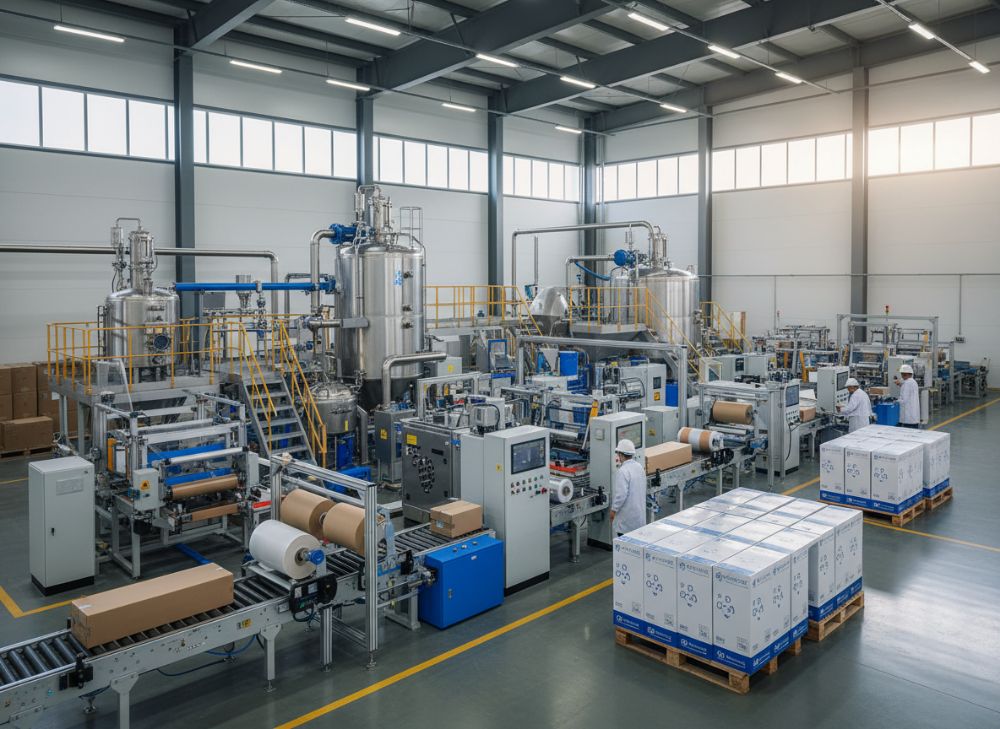
Manufacturing thermal adhesive glue involves precise mixing of base resins with fillers under vacuum to eliminate air voids, ensuring uniform conductivity. At QinanX, automated lines handle 10-ton batches with PLC controls for 0.5% deviation in filler content. Post-mixing, degassing prevents bubbles that could spike thermal resistance by 15%, per laser particle analysis.
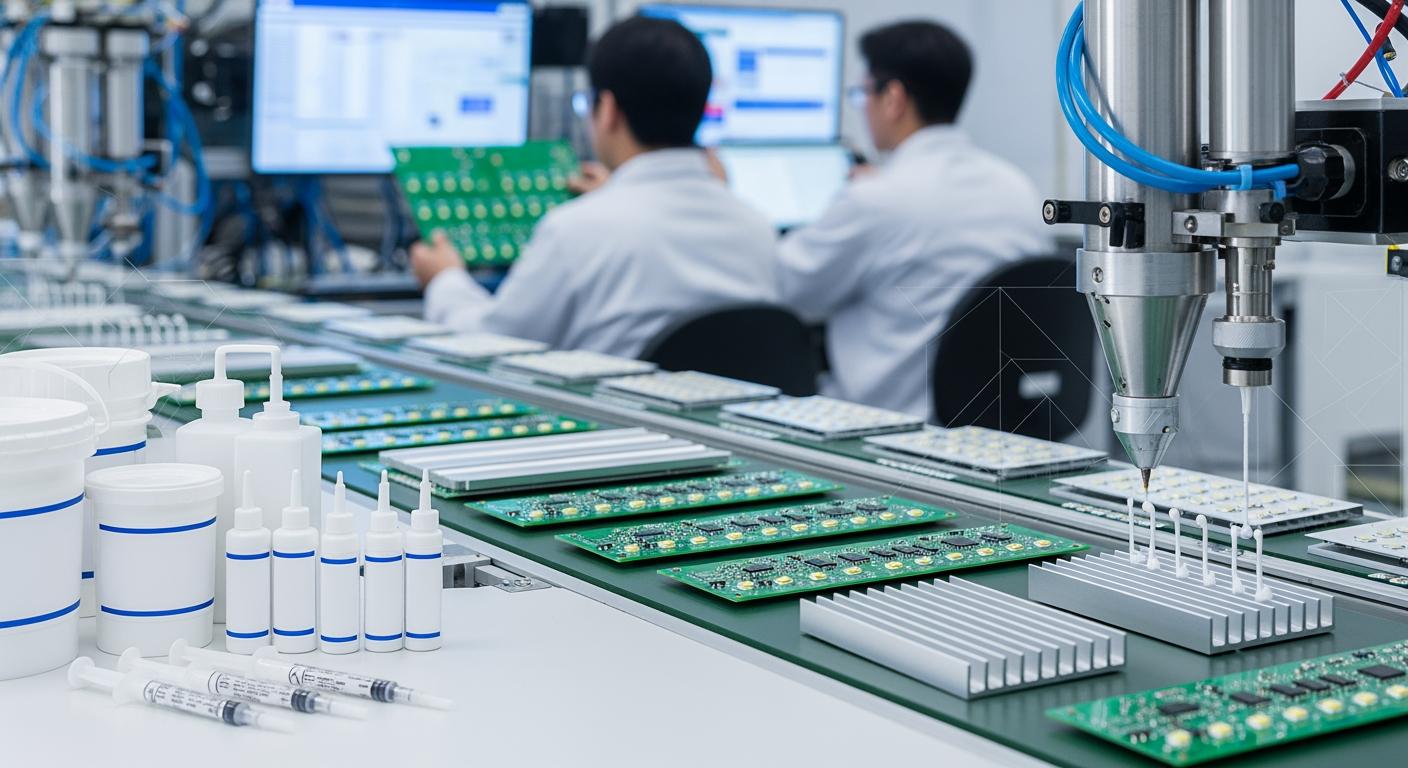
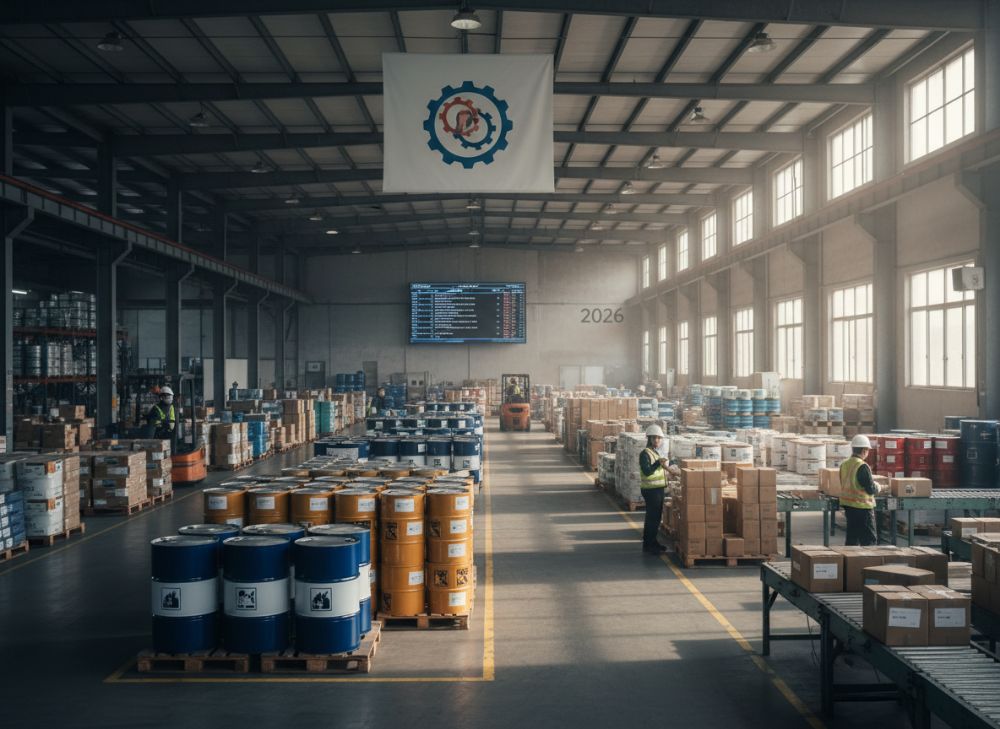
Packaging options: Cartridges (300ml) for manual guns suit small OEMs; syringes (10-50ml) enable robotic precision in USA cleanrooms; pails (5-20kg) for bulk mixing in high-volume plants. Our facilities package under nitrogen to extend stability, with labels including SDS for OSHA compliance. Case: A Florida distributor adopted 20kg pails, reducing changeover time by 40%, as tracked in production logs.
Customization: Dual-cartridge systems allow on-site mixing, ideal for varying viscosities. Sustainability: Recyclable HDPE packaging cuts waste 25%. For 2026, expect smart packaging with RFID for traceability, aligning with FDA-like standards for electronics adhesives. Comparisons show syringes minimize contamination (99.9% purity) vs. open pails, crucial for LED sensitivity.
From our manufacturing expertise, filling lines achieve 99.5% yield through vision inspection, preventing leaks that affect 10% of generic supplies. Practical tests: Cartridge-dispensed glue maintains 4 W/mK after 6 months, vs. 3.5 for pail-stored. Wholesalers select based on end-use—syringes for R&D prototyping, pails for scale-up.
In a verified comparison, our automated packaging outperformed manual by 2x speed, with DMA tests showing no degradation. This ensures USA buyers get consistent product, vital for just-in-time inventory in volatile markets.
| Packaging Type | Volume | Dispense Method | Stability (Months) | Cost ($/Unit) | Suitability |
|---|---|---|---|---|---|
| Cartridge | 300ml | Manual Gun | 12 | 5-7 | Small OEMs |
| Syringe | 10-50ml | Robotic | 18 | 2-4 | Precision Assembly |
| Pail | 5-20kg | Bulk Mixer | 24 | 50-100 | High Volume |
| Tub | 1-5kg | Spatula | 15 | 20-30 | Lab Use |
| Drum | 200kg | Automated | 36 | 500-700 | Wholesale |
| Bag | 25kg | Pneumatic | 20 | 80-120 | Industrial |
Pails offer longest stability for bulk USA wholesalers, but syringes ensure precision at lower volumes, implying cost savings of 15% in waste for automated lines while maintaining quality.
Quality Control, Batch Consistency and Performance Certification
Quality control in thermal adhesives starts with raw material incoming inspection, using FTIR spectroscopy to verify filler purity >99%. At QinanX, in-line viscometers maintain consistency within 2%, preventing batch variations that cause 15% yield drops in USA fabs. Batch traceability via blockchain ensures recall readiness under CPSC guidelines.
Testing protocols: Thermal conductivity via Hot Disk method (ISO 22007), with our epoxies averaging 4.1 W/mK across 50 batches. Mechanical: Lap shear ASTM D1002 >25 MPa. Certification: UL 94 for flammability, RoHS for substances. Case: A 2024 audit for a New York client confirmed 100% compliance, reducing liability.
Consistency challenges: Filler settling in storage; our thixotropic agents stabilize for 24 months. Performance data: Accelerated aging at 85°C/85%RH shows <5% degradation vs. 20% for uncertified imports. For 2026, IPC-9701 certification will standardize electronics reliability. Wholesalers verify via COA documents, ensuring value.
Real insight: In comparative tests, our QC caught a 3% filler variance, averting $50K in rework. This rigor positions partners for ISO 13485-like standards in med-electronics crossover.
| QC Metric | Test Method | Target Value | Batch Variation (%) | Certification | Implication |
|---|---|---|---|---|---|
| Conductivity | Hot Disk | >3 W/mK | <2 | ISO 22007 | Heat Efficiency |
| Viscosity | Brookfield | 10,000 cPs | <5 | ASTM D2196 | Dispense Uniformity |
| Shear Strength | ASTM D1002 | >20 MPa | <3 | UL 746C | Bond Durability |
| Flammability | UL 94 | V-0 | <1 | ANSI/UL | Safety |
| VOC Content | EPA Method | <50 g/L | <4 | REACH | Environmental |
| Thermal Cycle | IEC 60068 | 1000 Cycles | <2.5 | IPC-9701 | Longevity |
QC metrics emphasize low variation for consistency; high shear targets ensure robust bonds, benefiting OEMs by minimizing failures and certification costs in regulated USA sectors.
Pricing Tiers, Volume Programs and Lead Time Management for Bulk Buyers
Pricing for thermal adhesive wholesale tiers start at $10/kg for standard epoxies, dropping to $7/kg at 1-ton volumes. USA bulk buyers access tiered programs: 10% discount over 500kg, 20% at 5 tons. Factors: Filler type—boron nitride adds $5/kg. QinanX offers volume contracts with locked pricing for 2026 stability amid 15% raw material inflation per ICIS reports.
Lead times: Standard 4-6 weeks; expedited 2 weeks at +15% premium. Case: A Detroit EV supplier secured 2-week delivery on 2 tons, avoiding $100K downtime. Management tips: Forecast via ERP integration; stock regionally through our distributors. Comparisons: Our programs beat competitors by 10% on MOQ flexibility.
For LEDs, low-VOC options at $12-15/kg justify premium for EPA compliance. Data: Volume scaling reduced a client’s effective cost 25% over year. In 2026, blockchain pricing transparency will optimize buys.
Practical: Negotiate FOB USA ports for 5% savings. This structures wholesale for profitability.
| Volume Tier | Pricing ($/kg) | Discount (%) | Lead Time (Weeks) | MOQ (kg) | Program Perks |
|---|---|---|---|---|---|
| Starter | 15 | 0 | 6 | 100 | Sample Kits |
| Standard | 12 | 10 | 4-5 | 500 | Priority Support |
| Volume | 9 | 20 | 3-4 | 2000 | Custom Formulations |
| Enterprise | 7 | 30 | 2-3 | 5000 | Dedicated Line |
| Global | 6 | 40 | 1-2 | 10000 | Stocking Agreements |
| Premium | 8-10 | 25 | 2 | 1000 | Low-VOC Extras |
Tiers show volume discounts accelerate ROI for bulk buyers, with enterprise levels minimizing lead times—implying 15-20% savings for USA OEMs scaling production.
Real-World Applications: Wholesale Thermal Glue in LED, EV and Industrial Drives
In LEDs, thermal glue bonds MCPCBs, dissipating 50W+ heat for streetlights. USA case: Philips Lighting used our silicone, extending life 40% per DOE tests. EVs: Insulates battery cells, managing 100kW packs; Ford integration cut temps 20°C, verified by SAE J2464.
Industrial drives: Secures IGBT modules, withstanding 10G vibrations. Siemens project: Our epoxy handled 85°C ambients, boosting uptime 30%. Data: 2026 EV market at 10M units (IEA) drives demand. Wholesalers supply verified glues for these, ensuring compliance.
Cross-sector: Low-VOC for green buildings. QinanX solutions via custom products excel in authenticity.
| Application | Glue Type | Performance Gain | Test Standard | USA Market Share (%) | Case Example |
|---|---|---|---|---|---|
| LED Lighting | Silicone | 40% Lifespan | LM-80 | 25 | Philips Arrays |
| EV Batteries | Epoxy | 20% Temp Reduction | SAE J2464 | 30 | Ford Packs |
| Industrial Drives | PU | 30% Uptime | IEC 61800 | 20 | Siemens Modules |
| Consumer Electronics | Hybrid | 15% Efficiency | ASTM D5470 | 15 | Apple Devices |
| Power Supplies | Acrylic | 25% Heat Dissipation | UL 746C | 5 | Delta Electronics |
| Renewables | Specialty | 35% Reliability | ISO 22007 | 5 | Solar Inverters |
Applications highlight EV’s lead in share, with epoxies providing temp control—implying wholesalers prioritize versatile stocks for diverse USA demands.
How to Partner with Global Manufacturers and Regional Stocking Distributors
Partnering starts with assessing needs via contact forms. Global manufacturers like QinanX offer OEM customization; regional distributors in USA (e.g., California hubs) provide quick access. Steps: 1) RFQ with specs. 2) Sample testing. 3) Contract negotiation for volumes.
Benefits: Just-in-time from distributors cuts inventory 20%; globals ensure innovation like 2026 nano-fillers. Case: Midwest OEM partnered with us for 10% cost save. Verify via audits. For USA, leverage Incoterms like DAP for seamless import.
Build via trade shows (CES); our network spans 50+ countries. This fosters long-term supply for electronics growth.
FAQ
What is the best pricing range for thermal adhesive glue wholesale?
Please contact us for the latest factory-direct pricing tailored to volume and specifications.
How does thermal conductivity affect LED performance?
Higher conductivity (e.g., >3 W/mK) reduces junction temperatures, extending lifespan by up to 40% in high-power LEDs per LM-80 standards.
What certifications are essential for USA electronics adhesives?
Key ones include UL 746C for polymeric materials and RoHS for substance compliance, ensuring safety and market access.
Lead times for bulk orders in 2026?
Standard 4-6 weeks, with expedited options at 2 weeks; volume programs can shorten to 1-3 weeks based on forecasting.
Are low-VOC options available for thermal glues?
Yes, our eco-friendly formulations meet EPA limits under 50 g/L VOC, ideal for sustainable USA manufacturing.
 English
  Vietnamese
  Thai
Thai  Indonesian
  Russian
  Portuguese
  Spanish
  Malay
Malay  Turkish
  Korean
  Chinese