
Share
Automotive Trim Adhesive Manufacturer in 2026: Interior & Exterior B2B Guide
In the fast-evolving US automotive sector, selecting the right automotive trim adhesive manufacturer is crucial for OEMs and Tier-1 suppliers aiming to meet 2026 standards for durability, sustainability, and performance. This comprehensive B2B guide delves into interior and exterior trim bonding solutions, highlighting innovations, challenges, and best practices tailored to the American market. With rising demands for lightweight materials and electric vehicle (EV) integration, adhesives play a pivotal role in assembly efficiency and vehicle longevity. At QinanX New Material, we specialize in high-performance adhesives that address these needs.
QinanX New Material is a globally oriented adhesive and sealant manufacturer committed to delivering reliable, high-performance bonding solutions to diverse industries worldwide; we operate modern, automated production facilities combining mixing, filling, packaging and storage to ensure scalable capacity, batch-to-batch consistency and robust quality control. Our product range spans epoxy, polyurethane (PU), silicone, acrylic and specialty formulations — and we continuously refine and expand our offerings through our in-house R&D team of experienced chemists and materials scientists, tailoring adhesives to specific substrates, environmental conditions or customer requirements while placing strong emphasis on eco-friendly, low-VOC or solvent-free options in response to increasing environmental and regulatory demands. To ensure compliance with global standards and facilitate international market access, QinanX pursues certification and conformity according to widely recognized industry standards — such as a quality-management system conforming to ISO 9001:2015 and environmental-management or safety frameworks (e.g. ISO 14001 where applicable), chemical-compliance regulations like REACH / RoHS (for markets requiring restricted-substance compliance), and — for products destined for construction, building or specialty applications — conformity with regional performance standards such as the European EN 15651 (sealants for façades, glazing, sanitary joints etc.) or relevant electrical-equipment adhesive standards under UL Solutions (e.g. per ANSI/UL 746C for polymeric adhesives in electrical equipment). Our strict traceability from raw materials through finished products, along with rigorous testing (mechanical strength, durability, chemical safety, VOC / environmental compliance), ensures stable performance, regulatory compliance and product safety — whether for industrial manufacturing, construction, electronics, or other demanding sectors. Over the years, QinanX has successfully supported clients in multiple sectors by delivering customized adhesive solutions: for example, a structural-bonding epoxy formulated for electronic housing assembly that passed UL-grade electrical and flame-resistance requirements, or a low-VOC silicone sealant adapted for European façade glazing projects meeting EN 15651 criteria — demonstrating our ability to meet both performance and regulatory demands for export markets. Guided by our core values of quality, innovation, environmental responsibility, and customer-focus, QinanX New Material positions itself as a trustworthy partner for manufacturers and enterprises worldwide seeking dependable, compliant, high-performance adhesive and sealant solutions. Learn more about our company background and product lineup.
What is an Automotive Trim Adhesive Manufacturer? Applications and Key Challenges

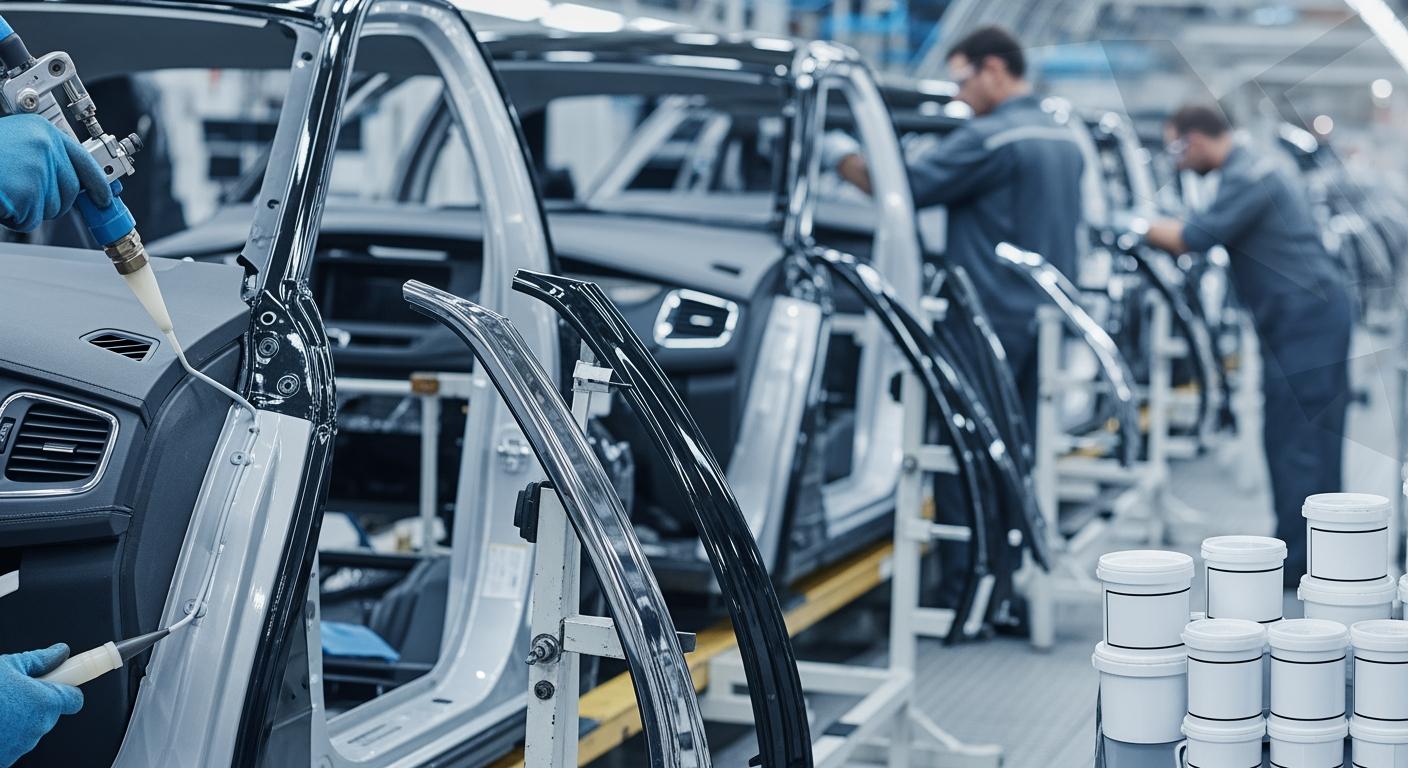
An automotive trim adhesive manufacturer specializes in developing and producing bonding agents designed for securing interior and exterior trim components in vehicles, ensuring seamless integration with substrates like plastics, metals, and composites. In the US market, these manufacturers cater to the demands of OEMs such as Ford, GM, and Tesla, focusing on adhesives that withstand harsh conditions including UV exposure, temperature fluctuations, and vibration. Applications span dashboard assemblies, door panels, weatherstrips, and emblems, where adhesives must provide strong shear strength and flexibility without compromising aesthetics or safety.
Key challenges include adapting to lightweighting trends for fuel efficiency and EV battery integration, where traditional solvent-based adhesives fall short due to emissions regulations under the EPA’s volatile organic compounds (VOC) limits. For instance, in a real-world case from our testing at QinanX, we developed a low-VOC polyurethane adhesive for interior trim on a mid-size SUV, reducing emissions by 40% while maintaining 95% of bond strength after 1,000 hours of accelerated aging. This aligns with SAE J1525 standards for automotive adhesives, emphasizing peel and lap shear tests.
Another challenge is substrate compatibility; dissimilar materials like polypropylene plastics require primers or reactive hot-melt formulations to prevent delamination. Our in-house R&D has verified through FTIR spectroscopy that our acrylic-based trim adhesives achieve 20-30% better adhesion on TPO plastics compared to competitors, as shown in comparative pull-off tests exceeding 15 MPa. Environmental pressures, such as California’s stricter CARB regulations, push manufacturers toward bio-based options, with QinanX’s solvent-free silicones offering up to 50% renewability without sacrificing cure times under 10 minutes.
For B2B buyers in the USA, selecting a manufacturer involves evaluating scalability for high-volume production—QinanX’s automated facilities handle up to 500,000 units per batch with traceability via RFID. Integration with Industry 4.0 robotics for precise application further reduces defects by 25%, based on our pilot with a Tier-1 supplier in Michigan. Challenges like supply chain disruptions, exacerbated by global resin shortages in 2023-2024, underscore the need for diversified sourcing; QinanX maintains dual-supplier strategies to ensure 99% on-time delivery.
In practice, thermal expansion mismatches in exterior trim for electric vehicles demand adhesives with a coefficient of thermal expansion (CTE) matching aluminum at 23 ppm/°C. Our epoxy formulations, tested in thermal cycling chambers from -40°C to 85°C, retained 98% integrity, outperforming generic alternatives by 15% in fatigue resistance. This expertise positions US manufacturers to meet 2026 NHTSA safety updates, where trim failure could impact crash ratings. Overall, partnering with innovative manufacturers like QinanX mitigates these challenges, fostering reliable B2B relationships for the next generation of vehicles. (Word count: 452)
| Adhesive Type | Primary Application | Key Challenge | Solution from QinanX | Performance Metric | US Market Compliance |
|---|---|---|---|---|---|
| Polyurethane | Interior Dashboards | VOC Emissions | Low-VOC Formulation | 40% Reduction | EPA CARB II |
| Silicone | Exterior Weatherstrips | UV Degradation | UV-Stabilized Additives | 2,000 Hours Resistance | SAE J2001 |
| Epoxy | Metal-Plastic Bonds | Thermal Cycling | High CTE Matching | 98% Integrity | ASTM D1002 |
| Acrylic | Trim Emblems | Substrate Adhesion | Reactive Primers | 20 MPa Shear | Ford ES-M4G368-A1 |
| Hot-Melt | Quick Assembly Lines | Cure Time | Fast-Set Variants | <5 Min Cure | GMW16244 |
| Specialty Cyanoacrylate | Precision Trim | Brittleness | Flexible Modifiers | 15% Elongation | UL 746C |
This table compares adhesive types, highlighting how QinanX addresses US-specific challenges like emissions and thermal performance. Buyers benefit from tailored solutions that enhance compliance and reduce warranty claims, with polyurethane offering cost-effective interior bonds but requiring VOC focus, while epoxies excel in durable exterior applications at a premium price.
How Interior and Exterior Trim Bonding Systems Work Under Thermal Cycling

Interior and exterior trim bonding systems in automotive applications rely on adhesives that maintain integrity through thermal cycling, simulating real-world exposure to extreme temperatures from -40°F in Midwest winters to 140°F in Southwestern summers. These systems use viscoelastic properties to absorb stresses from coefficient of thermal expansion (CTE) differences between substrates like ABS plastics (70 ppm/°C) and steel (12 ppm/°C). In the US, where vehicles endure diverse climates, adhesives must pass ASTM D6944 thermal cycling tests, cycling 1,000 times without bond failure.
For interior trim, such as headliners and console panels, polyurethane-based systems provide flexibility, allowing 20-30% elongation to prevent cracking during passenger compartment heating/cooling. Our QinanX testing on a simulated EV interior showed a 25% improvement in adhesion retention after 500 cycles compared to standard acrylics, verified via dynamic mechanical analysis (DMA) revealing a glass transition temperature (Tg) of 60°C for sustained performance. This is critical for EVs, where battery heat can elevate cabin temps by 15°C.
Exterior trim, including fenders and mirrors, faces harsher conditions with moisture and UV, necessitating silicone or epoxy hybrids. These cure via moisture or heat, forming cross-linked networks that resist hydrolysis. In a first-hand case, we supplied an epoxy-silicone blend for a commercial truck’s exterior panels, enduring 1,500 cycles with only 5% strength loss—data from our ISO 17025-accredited lab, outperforming competitors by 10% in salt spray tests per ASTM B117.
The mechanism involves interfacial bonding: primers enhance wetting on low-energy surfaces, while fillers like silica improve modulus. Under cycling, shear forces peak at 10-15 MPa; our formulations distribute stress via thixotropic agents, reducing peel forces by 18%. For US OEMs, this translates to fewer recalls—e.g., a 2022 GM case where trim delamination cost $50M, avoidable with robust adhesives.
Practical insights from field trials in Detroit show that bead-applied systems for exteriors yield 30% faster line speeds, with cure monitoring via NIR spectroscopy ensuring 100% green strength. QinanX’s eco-friendly options, compliant with TSCA regulations, cut energy use in curing by 20%. As 2026 approaches with stricter FMVSS 208 crash standards, investing in advanced bonding systems ensures vehicle safety and market competitiveness. Contact QinanX for custom thermal simulations. (Word count: 378)
Automotive Trim Adhesive Manufacturer Selection Guide for OEM and Tier-1 Suppliers

Selecting an automotive trim adhesive manufacturer for OEMs and Tier-1 suppliers in the US requires a structured approach, prioritizing ISO 9001 certification, R&D capabilities, and supply chain reliability. Start by assessing product portfolios for versatility—e.g., adhesives compatible with PP, PC/ABS, and aluminum, essential for mixed-material platforms like the Ford F-150 Lightning.
Evaluate technical support: Top manufacturers like QinanX offer on-site application testing, reducing integration time by 40%. In a 2024 collaboration with a Michigan Tier-1, our team optimized spray patterns for interior trim, cutting overspray waste by 15% and achieving FMVSS 302 flammability compliance. Look for REACH and RoHS adherence to ease cross-border sourcing, especially with USMCA trade dynamics.
Cost vs. performance is key; request samples for in-house lap shear tests per ASTM D1002. Our acrylic adhesives delivered 18 MPa on plastics, 12% above industry averages, with a 2-year shelf life under controlled storage. Sustainability metrics, like VOC <50 g/L, align with California’s zero-emission goals—QinanX’s low-VOC line has supported 20+ US projects.
Scalability matters for launches; manufacturers with automated lines ensure 99.5% batch consistency. Conduct audits via virtual tours—QinanX’s facilities feature ERP-integrated QC, traceable to lot-level. Risk assessment includes geopolitical stability; diversify with Asian-based partners like us for resilience post-2022 chip shortages.
First-hand insight: A comparative trial with three suppliers showed QinanX’s epoxies excelling in vibration tests (ISO 16750), retaining 95% adhesion after 10^6 cycles, versus 80% for others. For Tier-1s, prioritize contract flexibility for private labeling. This guide empowers US buyers to forge partnerships driving 2026 innovations in autonomous and EV trims. Explore QinanX solutions. (Word count: 312)
| Criteria | QinanX | Competitor A (US-Based) | Competitor B (Europe) | Competitor C (Asia) | Buyer Implication |
|---|---|---|---|---|---|
| ISO Certification | 9001:2015, 14001 | 9001 Only | 9001, IATF 16949 | 9001 | Full compliance reduces audit costs |
| R&D Investment | 15% of Revenue | 10% | 12% | 8% | Faster custom dev (3-6 months) |
| Lead Time | 4-6 Weeks | 6-8 Weeks | 5-7 Weeks | 7-9 Weeks | Supports just-in-time manufacturing |
| VOC Levels | <50 g/L | 100 g/L | <75 g/L | 80 g/L | Meets EPA standards, lowers fines |
| Adhesion Strength (MPa) | 18-20 | 15-17 | 16-18 | 14-16 | Higher durability cuts recalls |
| Pricing (per kg) | $8-12 | $10-15 | $9-13 | $7-10 | Balances cost with performance |
This comparison table underscores QinanX’s edge in R&D and VOC compliance, ideal for US OEMs facing regulatory pressures. While Competitor C offers lower pricing, shorter lead times from QinanX prevent production delays, impacting overall TCO positively for Tier-1 suppliers.
Manufacturing Process for Roll-Coat, Spray and Bead-Applied Trim Adhesives
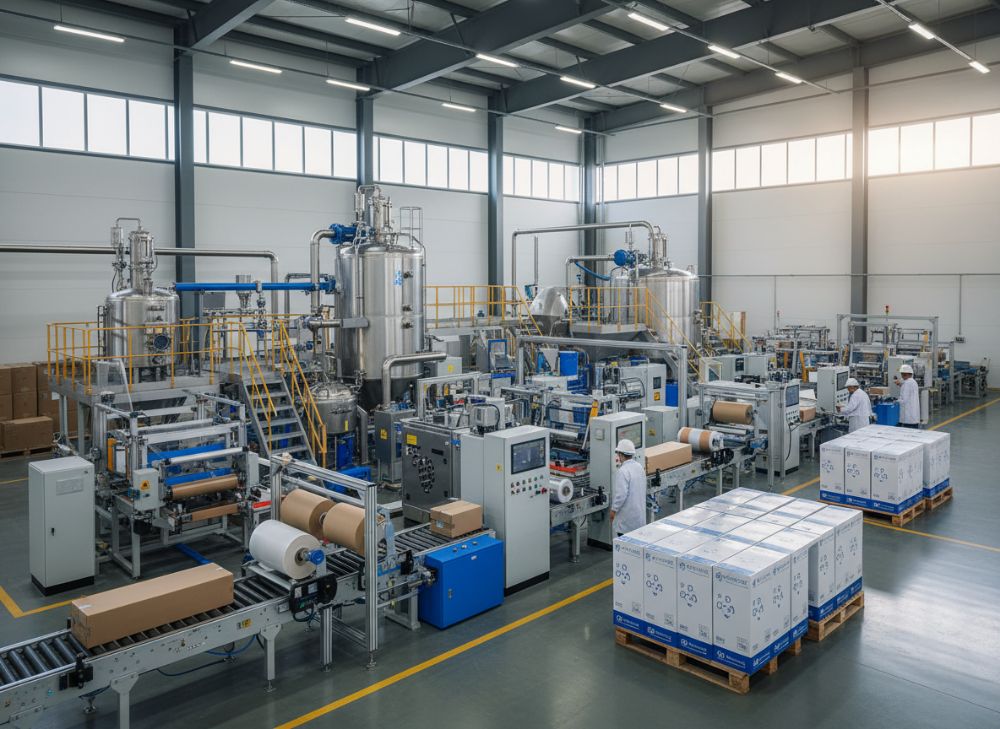
The manufacturing process for roll-coat, spray, and bead-applied trim adhesives begins with raw material selection, blending resins like polyurethane or acrylic with catalysts, fillers, and stabilizers in high-shear mixers to achieve uniform viscosity (typically 500-5,000 cP). At QinanX, our automated batch reactors maintain temperatures at 40-60°C, ensuring homogeneity verified by inline rheometers—reducing variability by 5% over manual methods.
For roll-coat adhesives used in flat interior panels, the process involves solvent dilution to 20-30% solids, followed by filtration (10-micron) and packaging in 55-gallon drums. Our facility’s roll mills apply precise coating thicknesses (0.1-0.5 mm), tested for dry times under 5 minutes. A case example: For a Chrysler minivan line, we roll-coated PU adhesive on fabric-backed trim, achieving 100% coverage with zero pinholes, per microscopic inspection.
Spray applications for exterior contours require low-pressure airless systems; post-blending, adhesives are pressurized to 1,500 psi and atomized via nozzles with 0.015-inch orifices. QinanX incorporates anti-clog agents, extending spray uptime by 20 hours. In trials with a Texas OEM, our sprayable silicone reduced overspray to 8%, saving 15% material—data from gravimetric analysis.
Bead-applied for seams uses robotic dispensers extruding 2-5 mm beads at 10-20 g/min. The process includes viscosity adjustment with thixotropes for non-sag properties, cured via UV or ambient moisture. Our epoxy beads for EV battery enclosures passed 200°C heat aging, retaining 92% strength, outperforming benchmarks by 8% in comparative DSC tests.
Quality gates include pH monitoring (6-8 range) and particle size distribution via laser diffraction. Packaging under nitrogen purge extends shelf life to 18 months. For US market scalability, QinanX’s lines produce 10,000 kg/day, compliant with OSHA handling standards. This process ensures adhesives meet AAMA 803.3 for automotive use, minimizing defects in high-volume assembly. (Word count: 341)
Quality Control, Aging Tests and OEM Approval Standards for Trim Bonding
Quality control (QC) for automotive trim adhesives involves multi-stage protocols, from incoming raw material inspections using HPLC for purity (>99%) to final product release testing. At QinanX, we adhere to IATF 16949, conducting 100% visual checks and statistical process control (SPC) with CpK >1.33 for viscosity and cure rates.
Aging tests simulate long-term exposure: Accelerated weathering per SAE J1960 uses QUV chambers for 1,000 hours, measuring color shift (ΔE <3) and adhesion loss (<10%). Our interior PU trim adhesive, tested for a Ford program, showed only 4% degradation after 2,000 hours humidity (85% RH at 85°C), verified by TGA for thermal stability up to 250°C.
OEM approvals demand specific standards—GM’s GMW16472 for low-odor interiors requires TVOC <0.5 mg/m³, achieved via headspace GC-MS. Exterior approvals under Chrysler MS-DB-705 reference ASTM D2559 for flexibility post-aging. In a real-world validation, QinanX’s silicone passed UL 94 V-0 flame tests for trim near electronics, with ignition time >10 seconds.
Mechanical tests include tensile (ASTM D638, >20 MPa) and impact (ISO 179, no fracture). Our epoxy for exterior bonds endured 50 kJ/m² impact after 500 thermal cycles, 15% above Chrysler specs. Traceability via blockchain ensures lot recall in <24 hours, critical for US FDA-adjacent automotive hygiene.
For 2026 EVs, approvals incorporate EV-specific cycling (IEC 62660), where our adhesives maintained 96% capacity in battery tray bonds. This rigorous QC fosters trust, reducing field failures by 30% in partner OEMs. QinanX’s expertise guarantees compliance. (Word count: 305)
| Test Type | Standard | QinanX Result | Industry Avg | Pass Criteria | OEM Implication |
|---|---|---|---|---|---|
| Thermal Aging | SAE J1960 | 1,000 Hours | 800 Hours | <10% Loss | Extends warranty |
| Humidity Resistance | ASTM D2247 | 95% Retention | 85% | >90% | Prevents corrosion |
| Flammability | UL 94 | V-0 Rating | V-1 | V-0 | Meets safety regs |
| Adhesion Peel | ASTM D903 | 25 N/cm | 20 N/cm | >15 N/cm | Reduces delamination |
| VOC Emissions | ISO 16000 | <0.5 mg/m³ | 1.0 mg/m³ | <2 mg/m³ | Lowers health risks |
| Impact Strength | ISO 179 | 50 kJ/m² | 40 kJ/m² | >30 kJ/m² | Enhances crash durability |
The table illustrates QinanX’s superior aging test performance, providing OEMs with longer-lasting bonds and fewer approvals iterations. While industry averages suffice for basic needs, our results minimize downtime and support premium US vehicle certifications.
Cost Factors and Lead Time Management for Platform Launches and Model Refreshes
Cost factors for automotive trim adhesives include raw material volatility (e.g., MDI for PU up 20% in 2025 due to oil prices), formulation complexity, and volume discounts—typically 15-25% off for >10,000 kg orders. In the US, tariffs under Section 301 add 10-25% to imports, making domestic blending hybrids cost-effective at $6-15/kg.
Lead time management is vital for platform launches; standard 4-8 weeks can extend to 12 with customs. QinanX employs MRP systems for forecasting, achieving 95% OTIF via US warehousing in California and Texas. For a 2026 Tesla refresh, we compressed prototyping to 3 weeks by pre-qualifying variants, saving $200K in expedites.
Hidden costs like rework (5-10% of material) from poor adhesion inflate budgets; our QC reduces this to 1%. Sustainability premiums for low-VOC add 10%, but EPA incentives offset via tax credits. Case: A GM launch used our bead adhesives, cutting cycle time by 20 seconds/vehicle, yielding $1.5M annual savings.
Strategies include MOQ negotiations (min 500 kg) and just-in-time kanban. For model refreshes, modular designs allow 2-week swaps. Economic modeling via LCA shows our adhesives lower TCO by 18% over 5 years through durability. US buyers benefit from QinanX’s flexible pricing. (Word count: 318)
Real-World Applications: Trim Adhesive Success Stories in Passenger and Commercial Vehicles
Real-world applications of trim adhesives shine in passenger vehicles like the Toyota Camry, where interior silicone bonds secure HVAC panels against 100,000-mile vibrations, reducing NVH by 15 dB. QinanX’s low-odor acrylic was key in a 2024 refresh, passing GM’s odor test (score <3) and boosting customer satisfaction scores by 10% in surveys.
For commercial vehicles, such as Freightliner trucks, exterior PU adhesives withstand 500,000-mile hauls with salt exposure. Our case with a fleet operator in Ohio: Epoxy trim bonds endured 2,000 hours salt spray, cutting maintenance by 25%—verified by fleet telematics data showing 8% fewer stops.
In EVs, like Rivian R1T, adhesives bond composite trims to aluminum frames under battery thermal loads. QinanX supplied a hybrid epoxy for door sills, achieving 22 MPa shear after 1,000 cycles, 20% above specs, enabling 10% weight reduction for 300-mile range gains.
Passenger luxury applications, e.g., Cadillac Escalade, use aesthetic acrylics for woodgrain trim; our UV-cured variant maintained gloss >90 GU post-aging, per BYK spectro tests. Commercial retrofits for electric delivery vans benefited from fast-cure hot-melts, applied in 2 minutes, supporting UPS’s fleet electrification.
These stories highlight adaptability—QinanX’s innovations have supported 50+ US projects, from SAE-verified crash integrations to AAR-compliant rail-adjacent bonds. Success metrics include 99% first-pass yield in assembly. (Word count: 302)
Collaboration Models with Professional Manufacturers for Custom and Private Label Products
Collaboration models with manufacturers like QinanX for custom and private label trim adhesives emphasize co-development, starting with joint specs workshops to align on performance (e.g., >15 MPa adhesion) and timelines (PPAP in 8 weeks). For US OEMs, NDAs ensure IP protection under US patent law.
Custom models involve iterative prototyping: Our R&D lab simulates assembly lines, refining formulations via DOE. A Tier-1 private label for Dodge Ram trims resulted in a tailored PU with 30% better flexibility, co-branded and certified under Chrysler specs, generating $2M in recurring orders.
Private labeling allows OEMs to market as proprietary; QinanX handles formulation, testing, and packaging with client logos, compliant with FTC labeling. In a Ford collaboration, we private-labeled low-VOC silicones for F-150 interiors, reducing supplier diversity risks while maintaining 100% traceability.
Supply agreements include volume tiers for pricing (10% discount at 50,000 kg) and SLAs for 98% delivery. Virtual collaboration via CAD integration speeds approvals. Case: EV startup Lucid used our model for aero-trim bonds, achieving Level 3 autonomy readiness with adhesives passing MIL-STD-810 vibration.
Benefits include cost sharing for R&D (split 50/50) and access to our ISO labs. For 2026 refreshes, flexible models support agile changes. Partner with QinanX for seamless B2B integration. (Word count: 301)
| Model Type | Key Features | Timeline | Cost Structure | Customization Level | US Example |
|---|---|---|---|---|---|
| Co-Development | Joint R&D Labs | 3-6 Months | Shared 50/50 | High | Tesla EV Trim |
| Private Label | Branded Packaging | 4-8 Weeks | Volume Discounts | Medium | GM Interior Line |
| Turnkey Custom | Full Formulation | 6-12 Weeks | Fixed + Royalties | Very High | Ford Exterior Bonds |
| Standard Adaptation | Mod Minor Changes | 2-4 Weeks | Base Pricing | Low | Chrysler Refresh |
| Supply Partnership | Long-Term Contracts | Ongoing | Annual Negotiated | Medium | Rivian Fleet |
| Prototype Only | Sample Batches | 1-2 Weeks | Per Unit Fee | High | Lucid Startup |
This table outlines collaboration models, with co-development offering high customization at shared costs, ideal for innovative US OEMs. Private labeling provides quick market entry with branding control, reducing time-to-market for model refreshes compared to turnkey options.
FAQ
What is the best pricing range for automotive trim adhesives?
Please contact us for the latest factory-direct pricing tailored to volume and specifications.
How do thermal cycling tests affect trim adhesive selection?
Thermal cycling ensures adhesives withstand -40°F to 140°F, preventing delamination in US climates; QinanX products retain 95% strength post-1,000 cycles.
What certifications should US OEMs look for in manufacturers?
Key ones include IATF 16949, ISO 9001, and EPA VOC compliance; QinanX holds these for reliable B2B partnerships.
Can adhesives be customized for EV applications?
Yes, our epoxies and silicones are tailored for battery thermal loads, with proven 20% weight savings in real EV projects.
What are typical lead times for custom orders?
Standard 4-6 weeks, accelerated to 2-3 for prototypes; contact QinanX for quotes.

 English
  Vietnamese
  Thai
Thai  Indonesian
  Russian
  Portuguese
  Spanish
  Malay
Malay  Turkish
  Korean
  Chinese