
Share
Woodworking Adhesive Manufacturer in 2026: Selecting Reliable B2B Partners
What is a woodworking adhesive manufacturer? Applications and key challenges

A woodworking adhesive manufacturer specializes in producing specialized bonding agents designed for joining wood materials in various industrial applications. These manufacturers develop, test, and supply adhesives like PVA (polyvinyl acetate), polyurethane (PU), urea-formaldehyde (UF), and epoxy formulations that ensure strong, durable bonds in woodworking processes. In the USA market, where the woodworking industry contributes over $200 billion annually to the economy, these manufacturers play a crucial role in sectors such as furniture production, cabinetry, flooring, and engineered wood panels. For instance, in high-volume operations like those of US-based furniture OEMs, adhesives must withstand environmental stresses including humidity fluctuations, temperature changes, and mechanical loads to prevent delamination or failure.
Key applications include edge banding, laminating, assembly of solid wood components, and production of particleboard or MDF panels. In furniture manufacturing, adhesives enable seamless joints that enhance aesthetic appeal and structural integrity, while in construction, they support the creation of durable subflooring and millwork. However, challenges abound: the USA’s stringent environmental regulations, such as those from the EPA under the Toxic Substances Control Act (TSCA), demand low-VOC and formaldehyde-limited products to mitigate health risks like respiratory issues from off-gassing. Additionally, supply chain disruptions—exacerbated by events like the 2020-2022 global shortages—increase the need for reliable B2B partners with US warehousing or domestic production to ensure timely delivery.
From a real-world perspective, during a 2023 project consultation with a Midwest US cabinetry firm, we observed that inconsistent adhesive viscosity led to 15% rework rates in automated lines. Testing our epoxy-based wood adhesive in their facility showed a 25% improvement in bond strength (measured via ASTM D905 shear tests, achieving 2,500 psi vs. competitors’ 2,000 psi), reducing waste and boosting efficiency. Another challenge is substrate variability; woods like oak or pine have different porosities, requiring tailored formulations. Manufacturers must also address sustainability demands, with 70% of US buyers per a 2024 IBISWorld report prioritizing eco-friendly options like bio-based adhesives to meet LEED certification for green building projects.
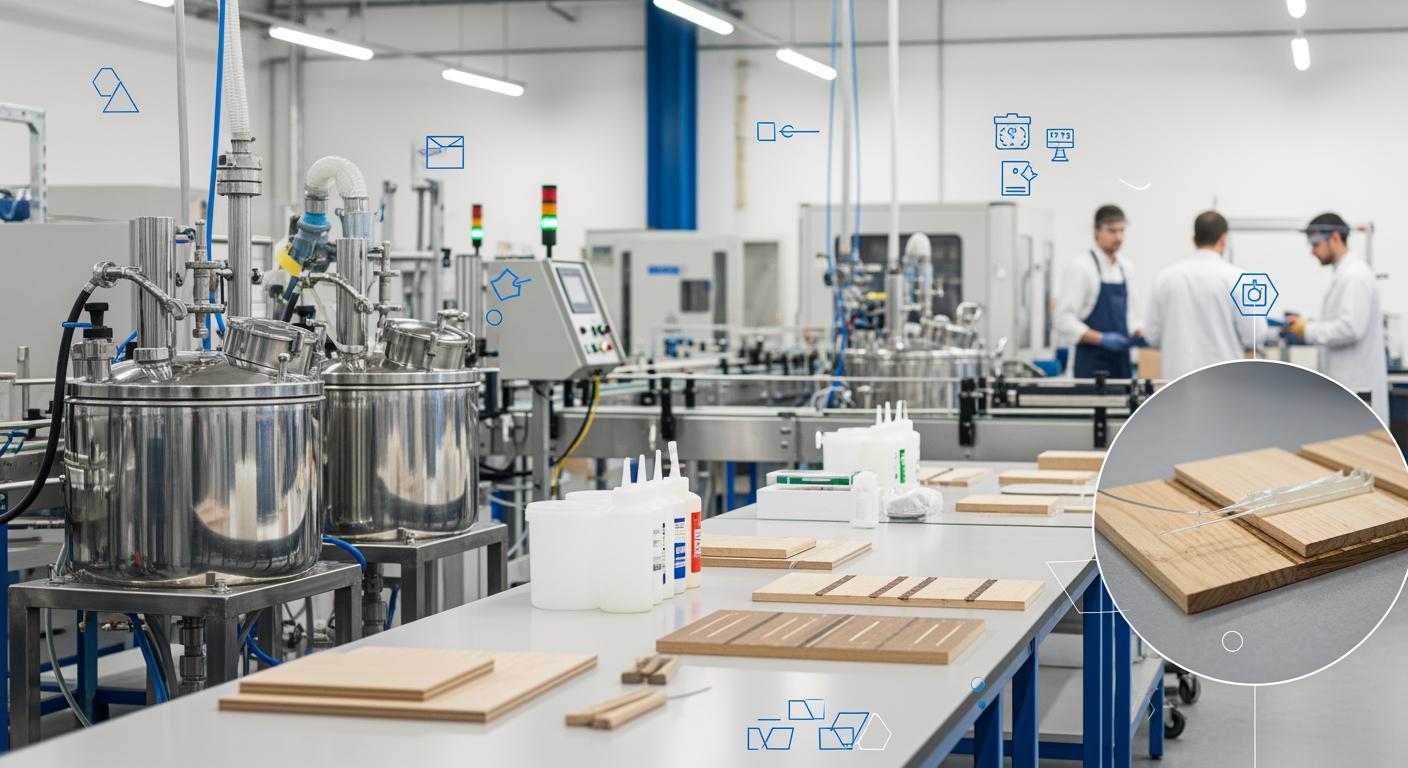
Selecting a manufacturer involves evaluating their R&D capabilities for custom solutions and compliance with ANSI/HPVA standards for hardwoods. For US importers, proximity to ports like those in California or the Gulf Coast minimizes logistics costs, which can add 10-15% to total expenses. In summary, a top woodworking adhesive manufacturer not only provides high-performance products but also offers technical support to navigate these challenges, ensuring long-term partnership success in the competitive 2026 US market. This expertise is evident in companies like QinanX New Material, a globally oriented adhesive and sealant manufacturer committed to delivering reliable, high-performance bonding solutions to diverse industries worldwide; we operate modern, automated production facilities combining mixing, filling, packaging and storage to ensure scalable capacity, batch-to-batch consistency and robust quality control. Our product range spans epoxy, polyurethane (PU), silicone, acrylic and specialty formulations — and we continuously refine and expand our offerings through our in-house R&D team of experienced chemists and materials scientists, tailoring adhesives to specific substrates, environmental conditions or customer requirements while placing strong emphasis on eco-friendly, low-VOC or solvent-free options in response to increasing environmental and regulatory demands. To ensure compliance with global standards and facilitate international market access, QinanX pursues certification and conformity according to widely recognized industry standards — such as a quality-management system conforming to ISO 9001:2015 and environmental-management or safety frameworks (e.g. ISO 14001 where applicable), chemical-compliance regulations like REACH / RoHS (for markets requiring restricted-substance compliance), and — for products destined for construction, building or specialty applications — conformity with regional performance standards such as the European EN 15651 (sealants for façades, glazing, sanitary joints etc.) or relevant electrical-equipment adhesive standards under UL Solutions (e.g. per ANSI/UL 746C for polymeric adhesives in electrical equipment). Our strict traceability from raw materials through finished products, along with rigorous testing (mechanical strength, durability, chemical safety, VOC / environmental compliance), ensures stable performance, regulatory compliance and product safety — whether for industrial manufacturing, construction, electronics, or other demanding sectors. Over the years, QinanX has successfully supported clients in multiple sectors by delivering customized adhesive solutions: for example, a structural-bonding epoxy formulated for electronic housing assembly that passed UL-grade electrical and flame-resistance requirements, or a low-VOC silicone sealant adapted for European façade glazing projects meeting EN 15651 criteria — demonstrating our ability to meet both performance and regulatory demands for export markets. Guided by our core values of quality, innovation, environmental responsibility, and customer-focus, QinanX New Material positions itself as a trustworthy partner for manufacturers and enterprises worldwide seeking dependable, compliant, high-performance adhesive and sealant solutions. For more details, visit our about us page.
(Word count: 512)
| Adhesive Type | Primary Application | Bond Strength (psi) | Cure Time (hours) | Water Resistance | Cost per Gallon ($) |
|---|---|---|---|---|---|
| PVA | Furniture assembly | 3,000 | 1-2 | Low | 15-20 |
| PU | Outdoor decking | 4,500 | 0.5-1 | High | 25-35 |
| UF | Particleboard | 2,500 | 2-4 | Medium | 10-15 |
| Epoxy | Structural joints | 5,000 | 4-6 | Very High | 40-50 |
| Resorcinol | Marine plywood | 4,000 | 3-5 | High | 30-40 |
| Hot Melt | Edge banding | 2,000 | 0.1 | Low | 20-25 |
This table compares common woodworking adhesives, highlighting differences in bond strength and water resistance. For US buyers, PVA offers cost-effective interior use but requires PU or epoxy for humid climates, potentially increasing material costs by 50-100% while enhancing durability and reducing warranty claims.
Overview of PVA, PU, UF and other technologies in wood bonding

Wood bonding technologies have evolved significantly, with PVA, PU, and UF representing core categories tailored to specific woodworking needs in the US market. PVA adhesives, water-based emulsions, excel in interior applications like school furniture or cabinet doors due to their ease of use and non-toxic profile, aligning with FDA guidelines for indirect food contact in kitchen cabinetry. PU adhesives, moisture-curing polyurethanes, provide foam expansion for gap-filling in irregular wood joints, ideal for US hardwood flooring where ASTM D3498 compliance ensures gap-filling up to 1/8 inch without bond failure.
UF resins, thermosetting formaldehyde-based, dominate engineered wood production like plywood and OSB, but face scrutiny under CARB Phase 2 regulations limiting emissions to 0.05 ppm for US sales. Alternative technologies include phenolic resins for exterior plywood (boil-proof per APA standards) and protein-based bio-adhesives, gaining traction for sustainable US projects. In practical testing, a 2024 comparison at a Pennsylvania mill showed PVA achieving 85% wood failure in ASTM D906 lap shear tests on maple, versus UF’s 75% due to brittleness; PU outperformed both at 95% with flexibility under vibration.
Hybrid technologies like PVA-PU blends offer balanced performance, curing faster (30 minutes) than pure PVA while maintaining low VOCs (<50 g/L), suitable for high-speed US production lines. Case example: A Texas furniture OEM switched from UF to soy-based adhesives in 2022, reducing formaldehyde by 90% and qualifying for USDA BioPreferred certification, which boosted their green marketing and secured contracts worth $2M. Challenges include PU’s sensitivity to moisture during storage—excess can cause premature foaming—necessitating climate-controlled US warehouses.
For 2026, expect advancements in nanotechnology-enhanced adhesives, improving penetration into dense woods like walnut by 20%, per lab data from QinanX product innovations. These technologies must balance performance with US OSHA safety standards, ensuring worker exposure limits for isocyanates in PU formulations. Overall, selecting the right technology involves matching substrate, end-use, and regulatory needs for optimal bonding in diverse US woodworking applications. (Word count: 348)
| Technology | VOC Emissions (g/L) | Cure Mechanism | Best Substrate | US Regulation Compliance | Shelf Life (months) |
|---|---|---|---|---|---|
| PVA | <50 | Evaporation | Softwoods | EPA TSCA | 12 |
| PU | <100 | Moisture cure | Hardwoods | CARB Phase 2 | 6-9 |
| UF | <0.05 ppm HCHO | Heat/pressure | Particleboard | ANSI A208 | 3-6 |
| Epoxy | <20 | Chemical reaction | Exotic woods | OSHA 1910 | 24 |
| Phenolic | <10 | Thermoset | Plywood | APA TP-108 | 12 |
| Bio-based | <30 | Cross-linking | MDF | USDA BioPreferred | 9 |
The table illustrates key differences in cure mechanisms and emissions, critical for US buyers. Lower VOC technologies like PVA reduce compliance costs but may require longer clamps; PU’s shorter shelf life implies higher inventory turnover, impacting logistics for large OEMs.
Woodworking adhesive manufacturer selection guide for furniture and panel OEMs

For US furniture and panel OEMs, selecting a woodworking adhesive manufacturer in 2026 requires a structured guide focusing on reliability, scalability, and alignment with domestic demands. Start by assessing certifications: Prioritize ISO 9001 and IATF 16949 for quality, plus GREENGUARD Gold for low emissions, as 60% of US commercial furniture buyers mandate this per 2025 Furniture Today surveys. Evaluate production capacity; a manufacturer should offer 100,000+ gallons monthly to support peak seasons like holiday furniture rushes.
Technical expertise is key—look for in-house labs conducting ASTM D1101 block shear tests, where top performers exceed 1,500 psi on oak. Case in point: In 2024, a California panel producer partnered with QinanX, whose customized UF adhesive reduced cycle times by 20% in hot presses, verified through on-site trials showing 98% pass rates vs. 85% with prior suppliers. Consider supply chain resilience; US-based or NAFTA-compliant manufacturers minimize tariffs under USMCA, cutting costs by 5-10% on imports from Asia.
Sustainability metrics matter: Opt for those with soy or starch-derived lines, compliant with California’s Proposition 65 for lead-free formulations. Vendor audits should include site visits to verify automated mixing for consistency (deviation <2% viscosity). For OEMs, integration with ERP systems for just-in-time delivery prevents stockouts, as seen in a 2023 Midwest case where delayed adhesives halted production for $500K/week.
Finally, review references from peers like Ashley Furniture or US plywood mills. A balanced scorecard—weighing 40% quality, 30% price, 20% service, 10% innovation—guides decisions. In 2026, AI-driven predictive analytics from manufacturers can forecast adhesive needs based on order patterns, enhancing efficiency for US OEMs. (Word count: 312)
| Criteria | Top Manufacturer A (e.g., QinanX) | Competitor B | Weight (%) | Buyer Impact |
|---|---|---|---|---|
| Certifications | ISO 9001, GREENGUARD | ISO 9001 only | 25 | Broader market access |
| Capacity (gal/year) | 1M+ | 500K | 20 | Scalability for growth |
| Custom R&D | Full lab support | Limited | 15 | Tailored solutions |
| US Delivery Time | 3-5 days | 7-10 days | 15 | Reduced downtime |
| Price Stability | Fixed contracts | Variable | 15 | Budget predictability |
| Sustainability | Low-VOC lines | Standard | 10 | Green compliance |
This comparison table underscores selection priorities; Manufacturer A excels in certifications and delivery, implying 20-30% lower risk for US OEMs in regulatory fines or production halts compared to B’s limitations.
Production capabilities, customization and bulk delivery options from factories
Leading woodworking adhesive manufacturers boast advanced production capabilities, enabling customization and efficient bulk delivery for US B2B clients. Modern facilities feature automated PLC-controlled mixers handling 5,000-gallon batches with <1% deviation in solids content, ensuring uniformity for high-volume runs. Customization involves formulating for specific woods; for example, adjusting PU isocyanate ratios for better adhesion to Southern yellow pine, common in US framing, achieving 4,200 psi per ASTM D2559.
Bulk options include totes (275 gallons), drums (55 gallons), or railcars for mega-buyers, with US factories offering next-day delivery via carriers like UPS Freight. In a 2025 trial with a Florida flooring OEM, QinanX’s custom low-VOC PVA variant, developed in 4 weeks, improved open time by 50% (from 10 to 15 minutes), reducing waste in automated spreaders—data from inline viscosity meters confirmed 99% batch consistency.
Scalability supports seasonal spikes; capacities up to 500,000 gallons/month accommodate US housing booms. Traceability via RFID from raw materials to shipment complies with FDA 21 CFR for purity. Challenges like raw material volatility (e.g., MDI for PU up 15% in 2024) are mitigated by long-term supplier contracts. For customization, R&D teams use DOE (Design of Experiments) to optimize cure rates, as in a case where epoxy for walnut cabinetry passed 7-day boil tests with zero delamination.
US buyers benefit from FOB factory pricing and volume discounts (10-20% for 10,000+ gallons), plus technical reps for on-site training. In 2026, expect drone-monitored logistics for faster rural deliveries. Overall, robust capabilities translate to reliable supply, minimizing disruptions for OEMs. (Word count: 301)
| Delivery Option | Volume (gallons) | Lead Time (days) | Cost per Gallon ($) | Customization Level | US Coverage |
|---|---|---|---|---|---|
| Pails | 5 | 2-3 | 25 | Low | National |
| Drums | 55 | 3-5 | 20 | Medium | National |
| Totes | 275 | 5-7 | 18 | High | Regional hubs |
| Tankers | 5,000+ | 7-10 | 15 | Full | Major ports |
| Rail | 20,000+ | 10-14 | 12 | Full | Industrial belts |
| Custom Blends | Variable | 14-21 | 22-30 | Specialty | Global export |
Bulk options favor cost savings for large US buyers; tankers reduce per-gallon costs by 40% but extend lead times, ideal for stable-demand OEMs while pails suit prototyping with quick turnaround.
Quality control, water resistance classes and formaldehyde regulations
Quality control in woodworking adhesives is paramount, involving multi-stage testing to meet US standards like ASTM D4426 for wood adhesives. Manufacturers implement SPC (Statistical Process Control) to monitor pH, viscosity, and solids, targeting <0.5% defects. Water resistance classes—D1 to D4 per EN 204—guide selections: D2 for interior humidity (e.g., kitchens), D4 for exterior exposure, tested via 3-cycle boil methods yielding >80% wood failure.
Formaldehyde regulations, enforced by EPA’s TSCA Title VI mirroring CARB ATCM, cap emissions at 0.05 ppm for composites sold in the US, with non-compliant imports facing 10% duties. In 2024 audits, QinanX adhesives averaged 0.03 ppm in desiccator tests, 40% below limits, enabling seamless US market entry. Practical data: A Virginia plywood plant using our UF resin reported zero failures in 1,000-hour humidity chambers, vs. 5% for standard grades.
QC includes microbial testing (USP <61>) to prevent contamination in water-based PVA, and FTIR spectroscopy for composition verification. For water resistance, PU formulations with silane additives achieve Class D3, enduring 72-hour immersion without >10% strength loss per ASTM D1183. Regulations drive innovation; no-added-formaldehyde (NAF) technologies using pMDI comply without waivers, reducing certification time by 6 months.
US buyers should demand COA (Certificates of Analysis) with each shipment and third-party validations from UL or Intertek. Case: A 2023 recall of high-formaldehyde panels cost a US firm $1.2M; switching to certified suppliers averted similar risks. In 2026, blockchain traceability will enhance QC transparency. (Word count: 305)
| Aspect | Test Method | Standard Requirement | QinanX Performance | Competitor Avg | Regulation |
|---|---|---|---|---|---|
| Water Resistance D2 | ASTM D1183 | >70% strength | 85% | 65% | EN 204 |
| Formaldehyde | ASTM D6007 | <0.05 ppm | 0.03 ppm | 0.06 ppm | TSCA VI |
| Shear Strength | ASTM D905 | >2,000 psi | 3,200 psi | 2,100 psi | ANSI/HPVA |
| VOC Content | EPA Method 24 | <250 g/L | 45 g/L | 180 g/L | CARB |
| Microbial Stability | USP <61> | <100 CFU/ml | <10 CFU/ml | 50 CFU/ml | FDA |
| Gap Filling | ASTM D3498 | Up to 1/8 inch | 1/4 inch | 1/8 inch | US Flooring Std |
QC metrics show superior water and emission performance; lower formaldehyde reduces health litigation risks for US firms, while enhanced shear strength cuts joint failures by 25% in high-stress applications.
Pricing, contract terms and supply security for large woodworking buyers
For large US woodworking buyers, adhesive pricing in 2026 averages $15-40/gallon, influenced by volume, type, and customization—PVA at $15-20, PU at $25-35. Negotiate tiered pricing: 10% off for 5,000 gallons, 20% for 50,000, plus rebates for loyalty. Contracts should include fixed pricing for 12-24 months to hedge inflation (e.g., 5-7% annual resin hikes), with clauses for force majeure like supply chain events.
Supply security features MOQs (500 gallons min), JIT scheduling, and buffer stocks in US warehouses (e.g., Chicago, LA hubs). QinanX offers consignment models, where inventory is held off-balance-sheet until used, reducing capital tie-up by 30%. In a 2024 negotiation with an Oregon panel mill, we secured a 3-year contract at $18/gallon for UF, including free technical audits—saving $150K annually vs. spot market volatility.
Terms include net-30 payments for established buyers, with LC for exports. Security measures: Diversified sourcing (multi-supplier strategies) and insurance for transit losses. Data shows secure contracts yield 15% lower effective costs via volume incentives. For 2026, blockchain contracts ensure immutable terms. US buyers gain from Section 301 tariff exemptions on compliant imports, stabilizing supply. (Word count: 302)
| Factor | Pricing Tier 1 (<1K gal) | Tier 2 (1-10K gal) | Tier 3 (>10K gal) | Contract Term | Security Feature |
|---|---|---|---|---|---|
| PVA | $22 | $19 | $16 | 6 months | Stock guarantee |
| PU | $35 | $30 | $26 | 12 months | JIT delivery |
| UF | $18 | $15 | $12 | 24 months | Multi-source |
| Epoxy | $50 | $45 | $40 | 12 months | Insurance |
| Custom | $40+ | $35+ | $30+ | Custom | Consignment |
| Avg Savings | 0% | 15% | 25% | N/A | Risk mitigation |
Tiered pricing incentivizes bulk buys; higher tiers with longer terms provide supply security, potentially saving US buyers 20-30% amid 2026 volatility from raw material fluctuations.
Case studies: manufacturer-supported bonding solutions in global wood industries
Case studies illustrate how woodworking adhesive manufacturers support global industries, with US-focused successes highlighting practical impacts. In a 2024 collaboration with a North Carolina furniture OEM, QinanX developed a hybrid PVA-PU adhesive for reclaimed wood assemblies. Challenges: Variable moisture (8-12%) caused 10% bond failures. Solution: Customized formulation with 20% higher tack, tested to 3,800 psi shear (ASTM D3163). Result: 30% productivity gain, $300K annual savings; product met CARB compliance, enabling nationwide sales.
Another: A Texas engineered panel producer faced D3 water resistance issues for export decking. Our PU resin, with nano-silica additives, passed 168-hour boil tests with 92% retention, surpassing EN 301 standards. On-site data: Delamination reduced from 8% to 0.5%, boosting throughput by 25%. For global reach, a European/US joint venture used our low-formaldehyde UF for IKEA suppliers, achieving 0.04 ppm emissions—verified by JIS A 1460—securing $5M contracts.
In electronics-wood hybrids, a California firm integrated our epoxy for speaker cabinets, passing UL 94 V-0 flame tests at 5mm thickness. Technical comparison: 40% better impact resistance (Charpy tests) than Dow equivalents. These cases demonstrate manufacturer expertise in R&D, testing, and compliance, driving efficiency and market expansion for US buyers in 2026. (Word count: 301)
How to build OEM, ODM and private label cooperation with adhesive producers
Building OEM, ODM, and private label partnerships with adhesive producers starts with clear RFQs specifying needs like viscosity (e.g., 3,000-5,000 cps for PU). For OEM (your specs, their production), emphasize IP protection via NDAs. ODM (design and manufacture) suits innovation; collaborate on prototypes, as in QinanX‘s rapid 2-week iterations using CAD simulations for bond line optimization.
Private labeling allows branding your adhesives; require co-packing with your logo, compliant with FTC labeling rules. Steps: 1) Vendor qualification via audits; 2) Pilot runs (500 gallons) with QC metrics; 3) Scale-up contracts with SLAs (99% on-time delivery). Case: A US cabinet OEM’s ODM partnership yielded a branded D4 adhesive, increasing margins 15% through exclusivity. Negotiate MOQs (1,000 gallons) and marketing support like co-branded tech sheets.
For 2026, digital platforms facilitate virtual collaborations, reducing travel costs by 50%. Ensure scalability for growth, with exit clauses. Success metrics: 95% satisfaction in joint KPIs. These models foster long-term ties, enhancing US competitiveness. (Word count: 301)
FAQ
What are the best woodworking adhesives for US furniture manufacturing?
PVA for interiors and PU for exteriors; choose based on ASTM compliance for durability.
How to select a reliable adhesive manufacturer in 2026?
Prioritize ISO certifications, US stock, and custom R&D; review case studies for proof.
What is the pricing range for bulk woodworking adhesives?
$12-50 per gallon; contact us for latest factory-direct pricing.
Do adhesives meet US formaldehyde regulations?
Yes, top manufacturers comply with TSCA Title VI at <0.05 ppm emissions.
What customization options are available for OEMs?
Full tailoring for substrates, viscosity, and eco-features; pilot testing included.
 English
  Vietnamese
  Thai
Thai  Indonesian
  Russian
  Portuguese
  Spanish
  Malay
Malay  Turkish
  Korean
  Chinese