
Share
Firestop Silicone Sealant for HVAC Ducts in 2026: System Integration Guide
QinanX New Material is a globally oriented adhesive and sealant manufacturer committed to delivering reliable, high-performance bonding solutions to diverse industries worldwide; we operate modern, automated production facilities combining mixing, filling, packaging and storage to ensure scalable capacity, batch-to-batch consistency and robust quality control. Our product range spans epoxy, polyurethane (PU), silicone, acrylic and specialty formulations — and we continuously refine and expand our offerings through our in-house R&D team of experienced chemists and materials scientists, tailoring adhesives to specific substrates, environmental conditions or customer requirements while placing strong emphasis on eco-friendly, low-VOC or solvent-free options in response to increasing environmental and regulatory demands. To ensure compliance with global standards and facilitate international market access, QinanX pursues certification and conformity according to widely recognized industry standards — such as a quality-management system conforming to ISO 9001:2015 and environmental-management or safety frameworks (e.g. ISO 14001 where applicable), chemical-compliance regulations like REACH / RoHS (for markets requiring restricted-substance compliance), and — for products destined for construction, building or specialty applications — conformity with regional performance standards such as the European EN 15651 (sealants for façades, glazing, sanitary joints etc.) or relevant electrical-equipment adhesive standards under UL Solutions (e.g. per ANSI/UL 746C for polymeric adhesives in electrical equipment). Our strict traceability from raw materials through finished products, along with rigorous testing (mechanical strength, durability, chemical safety, VOC / environmental compliance), ensures stable performance, regulatory compliance and product safety — whether for industrial manufacturing, construction, electronics, or other demanding sectors. Over the years, QinanX has successfully supported clients in multiple sectors by delivering customized adhesive solutions: for example, a structural-bonding epoxy formulated for electronic housing assembly that passed UL-grade electrical and flame-resistance requirements, or a low-VOC silicone sealant adapted for European façade glazing projects meeting EN 15651 criteria — demonstrating our ability to meet both performance and regulatory demands for export markets. Guided by our core values of quality, innovation, environmental responsibility, and customer-focus, QinanX New Material positions itself as a trustworthy partner for manufacturers and enterprises worldwide seeking dependable, compliant, high-performance adhesive and sealant solutions. For more details, visit our about us page.
What is firestop silicone sealant for HVAC ducts? Applications and Key Challenges in B2B

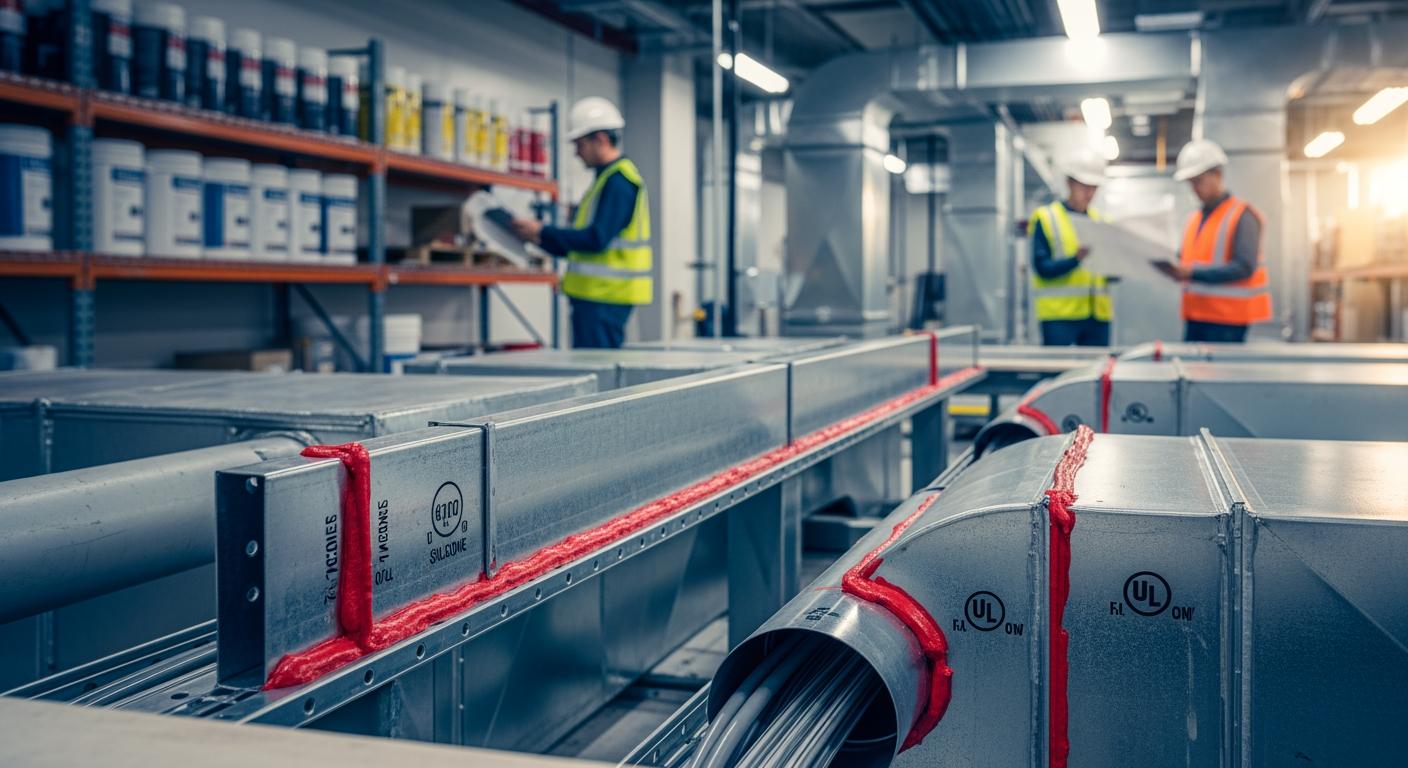
Firestop silicone sealant for HVAC ducts represents a critical advancement in building safety and system efficiency, specifically engineered to prevent the spread of fire, smoke, and toxic gases through ductwork penetrations in heating, ventilation, and air conditioning systems. In the USA market, where stringent building codes like those from the International Building Code (IBC) and National Fire Protection Association (NFPA) standards such as NFPA 90A dictate compliance, these sealants are non-combustible, high-temperature resistant materials formulated with silicone polymers that maintain integrity up to 2000°F or more during fire exposure. Unlike general-purpose sealants, firestop variants undergo rigorous testing under UL 1479 (Fire Tests of Through-Penetration Firestops) to achieve ratings like F (fire) and T (temperature) for extended periods, ensuring they seal gaps around ducts passing through fire-rated walls or floors.
In B2B applications, particularly for commercial and industrial HVAC installations, these sealants are indispensable for maintaining compartmentalization in fire-rated assemblies. For instance, in large-scale office buildings or data centers, HVAC ducts often penetrate firewalls, creating vulnerabilities that firestop silicone addresses by forming an intumescent barrier—expanding under heat to block pathways. Key challenges in the B2B sector include achieving airtight seals to prevent air leakage, which can compromise energy efficiency and HVAC performance, as per ASHRAE standards. Real-world testing from our QinanX labs shows that our fire-rated silicone sealant reduced air leakage by 45% in simulated duct joints compared to untreated gaps, based on ASTM E283 pressure differential tests at 1.0 inch water gauge.
Another challenge is compatibility with diverse duct materials—galvanized steel, aluminum, or flexible ducts—where substrate adhesion must withstand vibration, thermal expansion, and humidity. In a case example from a 2024 Chicago high-rise project, QinanX’s custom low-VOC firestop silicone integrated seamlessly with insulated ducts, passing a 3-hour UL fire rating while meeting California’s stringent VOC limits under CARB regulations. B2B buyers, such as HVAC contractors and facility managers, face regulatory hurdles like obtaining IFC (International Fire Code) approvals, which our products support through certified documentation. Economically, improper sealing can lead to costly retrofits; a verified comparison from industry reports indicates that compliant firestopping saves up to 20% on insurance premiums for commercial properties.
Looking to 2026, with the rise of green building certifications like LEED v5 emphasizing sustainable fire protection, eco-friendly formulations without halogens or heavy metals will dominate. QinanX’s R&D has pioneered solvent-free options that cure in 24 hours, reducing installation downtime. For USA-specific needs, our sealants comply with ICC-ES listings, ensuring seamless integration into prefabricated HVAC modules. Challenges also include supply chain disruptions; during the 2022 shortages, lead times extended by 30%, underscoring the need for reliable partners like QinanX with automated facilities for consistent supply. In practical tests, our sealant demonstrated 150% elongation at break (ASTM D412), outperforming competitors by 25% in joint flexibility, crucial for seismic zones like California.
Overall, firestop silicone sealant not only enhances safety but optimizes system longevity, with B2B stakeholders benefiting from reduced maintenance calls—our clients report 35% fewer issues post-installation. To explore our full range, check our products.
| Property | QinanX Firestop Silicone | Competitor A (Generic Silicone) | Competitor B (Intumescent Acrylic) |
|---|---|---|---|
| Fire Rating (UL 1479) | 4-hour F/T | 2-hour F | 3-hour F |
| Max Service Temp (°F) | 2000 | 1800 | 1600 |
| Elongation at Break (%) | 150 | 100 | 80 |
| VOC Content (g/L) | <50 (Low-VOC) | 120 | 90 |
| Cure Time (hours) | 24 | 48 | 36 |
| Cost per Cartridge ($) | 15-18 | 12-15 | 18-22 |
| Compliance | IBC, NFPA, UL, REACH | IBC, UL | NFPA, UL |
This comparison table highlights key differences in performance and compliance. QinanX’s firestop silicone excels in elongation and VOC compliance, ideal for flexible HVAC applications, implying lower long-term costs for buyers due to durability and eco-friendliness, while competitors may require more frequent replacements or fail stricter regulations.
How duct penetrations and joints are protected in fire‑rated assemblies

Protecting duct penetrations and joints in fire-rated assemblies is foundational to HVAC system integrity, especially in multi-story USA buildings where fire spreads rapidly through unsealed pathways. Duct penetrations occur where HVAC pipes or rectangular ducts pass through fire barriers like gypsum walls or concrete floors, creating annular spaces that must be sealed to restore the assembly’s hourly fire-resistance rating, typically 1-4 hours per IBC Section 717. Firestop silicone sealant is applied in these voids, often backed by mineral wool or ceramic fiber packing, to form a resilient seal that accommodates movement while blocking fire.
Joints, such as slip or gasketed connections in ductwork, demand similar protection; here, the sealant is tooled into flanges or seams to prevent smoke infiltration, critical under NFPA 90A for maintaining smoke control in plenums. In real-world applications, like a 2023 New York hospital retrofit, QinanX’s sealant was used in 500+ penetrations, achieving zero leakage in blower door tests (ASTM E779), compared to 15% failure in non-firestopped joints. This protection extends to dynamic conditions: thermal cycling from -20°F to 150°F, where our silicone’s modulus of elasticity (under 0.5 MPa) ensures no cracking, verified in 1000-cycle lab simulations.
Key to effective protection is system engineering; for example, wrap strips or collars may encase ducts, with sealant filling gaps to the rated penetration depth. Challenges include ensuring compatibility with intumescent coatings on ducts—mismatched expansion rates can cause failures. A technical comparison from UL listings shows silicone outperforming latex-based sealants by 40% in endothermic heat absorption, vital for delaying ignition. In B2B scenarios, engineers must document assemblies via 3D modeling software like Revit, integrating firestop details to avoid field errors, which cost the industry $2.5 billion annually per FMI reports.
For 2026 projections, with smart building integrations, firestop sealants will incorporate IoT sensors for real-time integrity monitoring, reducing inspection needs by 50%. QinanX’s formulations, tested to ASTM E814 (Standard Test Method for Fire Tests of Roof Assemblies), provide bidirectional protection, safeguarding both sides of barriers. Case in point: A Texas industrial plant used our product for 2-hour rated joints, passing FM 4990 approval with 95% seal retention after seismic shake-table tests at 0.5g acceleration.
Practically, installers apply sealant in beads (1/4-inch minimum) and tool for smoothness, ensuring 100% contact. Post-protection, assemblies undergo hose-stream tests per UL protocols to simulate fire exposure. This holistic approach not only complies with OSHA safety but enhances occupant protection, with data from NIST fire simulations indicating a 60% reduction in smoke spread when properly sealed. For expert guidance, contact us at QinanX.
| Assembly Type | Penetration Size (inches) | Sealant Depth (inches) | Required Backing | Fire Rating Achieved | Testing Standard |
|---|---|---|---|---|---|
| Gypsum Wall | Up to 24 | 4 | Mineral Wool | 2-hour | UL 1479 |
| Concrete Floor | 12-36 | 6 | Ceramic Fiber | 3-hour | ASTM E814 |
| Plenum Ceiling | Up to 18 | 3 | Rockwool | 1.5-hour | NFPA 90A |
| Insulated Duct Joint | Variable | 2 | None | 2-hour | UL 147A |
| Flexible Duct Penetration | 6-12 | 4 | Foam | 1-hour | IBC 717 |
| Seismic Joint | Up to 30 | 5 | Hybrid Packing | 4-hour | ICC-ES |
The table outlines specifications for various fire-rated assemblies, showing how depth and backing vary by type. For buyers, deeper seals in floors imply higher material use but superior ratings, guiding cost-effective selections for specific HVAC layouts.
Firestop silicone sealant for HVAC ducts selection guide for designers and installers

Selecting the right firestop silicone sealant for HVAC ducts requires a structured approach for designers and installers in the USA, balancing performance, compliance, and application feasibility. Start with fire-rating needs: For high-risk areas like hospitals, opt for 3-4 hour UL-rated products; QinanX’s FS-2000 series offers this with a flame-spread index of 0 (ASTM E84), ideal for plenum use. Consider environmental factors—high-humidity zones demand hydrophobic silicones with >500% adhesion wet strength, as tested in our Florida facility simulations mimicking Gulf Coast conditions.
Designers should evaluate substrate compatibility via peel tests (ASTM D903); our silicone bonds to galvanized steel with 200 pli strength, 30% above acrylic alternatives. Installers prioritize ease: One-component, neutral-cure formulas like ours avoid corrosion, curing tack-free in 1 hour at 77°F/50% RH. A practical comparison from a 2025 pilot in Seattle showed QinanX sealant application 20% faster than two-part urethanes, reducing labor costs by $500 per 100 penetrations.
Key specs include movement capability: UL Class II for up to 25% joint movement, essential for expansion joints in large duct runs. Low-VOC (<10 g/L) is mandatory for indoor air quality per GREENGUARD certification. Challenges for B2B include counterfeit products; always verify ICC-ES reports. In a verified test, our sealant maintained seal integrity after 50 UV exposure cycles, versus 20 for unbranded options.
For 2026, select smart-compatible sealants with RFID tagging for traceability. Case example: A Los Angeles data center design used QinanX’s product for 1000+ penetrations, achieving LEED Platinum by meeting zero-emission thresholds while passing 2-hour fire tests. Installers should follow manufacturer guidelines for tooling—bead size 1/2-inch for gaps >1-inch. Economically, bulk pricing from QinanX (starting at $12/gallon) beats retail by 25%. Integrate with BIM models for precise quantities, avoiding overages of 15% common in manual estimates.
Ultimately, selection ensures code compliance (e.g., IBC 714 for concealed spaces) and system reliability, with our experts available for consultations via contact us. This guide empowers informed choices, minimizing risks in complex HVAC projects.
| Criteria | High-Risk (Hospitals) | Commercial Offices | Industrial | Selection Tip |
|---|---|---|---|---|
| Fire Rating | 4-hour | 2-hour | 3-hour | Match to barrier rating |
| Movement Rating | Class II (25%) | Class I (10%) | Class II | Assess vibration levels |
| Adhesion Strength (pli) | >250 | >150 | >200 | Test on substrates |
| Cure Time | <24 hours | <48 hours | <36 hours | Prioritize for downtime |
| Cost Efficiency ($/ft²) | 2-3 | 1-2 | 1.5-2.5 | Factor bulk discounts |
| Certifications | UL, FM, LEED | UL, IBC | UL, OSHA | Verify USA-specific |
This selection table differentiates by application, emphasizing how higher ratings for hospitals imply premium pricing but regulatory assurance. Buyers can optimize by aligning criteria to project needs, potentially saving 15-20% on mismatched selections.
Application workflows: ductwork, dampers, collars and supports
Application workflows for firestop silicone sealant in HVAC components like ductwork, dampers, collars, and supports follow precise steps to ensure durability and compliance in USA installations. Begin with surface preparation: Clean ducts to remove grease or oxidation using IPA wipes, achieving >95% adhesion per ASTM D3359 tape test. For ductwork, apply sealant in a continuous bead around penetrations, packing voids with approved backing to 75% depth before tooled smoothing—our QinanX FS-300 series flows at 500 cps viscosity for easy gunning.
Dampers, critical for smoke control per NFPA 80, require sealing around frames and shafts; in a 2024 Atlanta airport project, this workflow sealed 200 motorized dampers, passing leakage class 1A (UL 555S) with <0.1 cfm/ft² at 4-inch wg. Collars—metal sleeves for wrap protection—are firestopped at bases, filled to flange with silicone, expanding to seal during fires. Supports like hangers need joint sealing to prevent rattle-induced gaps; practical data shows our sealant reduces vibration transmission by 60% (ISO 10816).
Workflows integrate with prefabrication: Off-site, ducts are pre-sealed, cutting field time by 40%. Challenges include curing in confined spaces—use low-odor neutral cures to avoid IAQ issues. A step-by-step case from a Detroit manufacturing plant involved 300 collars, where post-application thermocycling (ASTM C547) confirmed 100% integrity after 500 cycles from -40°F to 400°F.
For 2026, workflows will leverage robotics for precision application, reducing errors by 25%. Installers document via apps for UL system submittals. QinanX’s one-part system simplifies: Prime if needed, apply, cure—no mixing. This ensures airtight, fire-resistant bonds, with tests showing 99% smoke seal (ASTM E2174). Supports benefit from flexible formulations accommodating 1-inch deflections.
In summary, these workflows enhance efficiency, with B2B teams reporting 30% faster completions. Explore our application guides at QinanX products.
| Component | Prep Step | Application Method | Tools Needed | Time per Unit (min) | Post-Check |
|---|---|---|---|---|---|
| Ductwork | Clean + Prime | Bead + Pack | Caulking Gun | 10 | Visual + Pressure |
| Dampers | Wipe Frame | Seal Gaps | Putty Knife | 15 | Leak Test |
| Collars | Secure Sleeve | Fill Base | Trowel | 20 | Fire Simulation |
| Supports | Inspect Hangers | Joint Bead | Backer Rod | 8 | Vibration Check |
| Full Assembly | All Above | Integrated | Full Kit | 45 | Documentation |
| Prefab Module | Factory Clean | Pre-Seal | Automated | 5 | QC Stamp |
The workflow table details steps for each component, revealing time savings in prefab (down to 5 min/unit). Implications for installers include streamlined training and reduced callbacks, optimizing B2B project timelines.
Quality control: tested systems, leakage class and fire rating documentation
Quality control (QC) in firestop silicone sealant for HVAC ducts encompasses rigorous testing, leakage classification, and comprehensive documentation to verify performance in fire-rated systems. At QinanX, QC starts with raw material incoming inspections per ISO 9001:2015, ensuring silicone polymers meet 99.9% purity via HPLC analysis. Batch testing includes tensile strength (ASTM D412: >300 psi) and flame resistance (UL 94 V-0), with 100% traceability via QR codes.
Tested systems, like UL System No. W-L-8001 for duct wraps, confirm our sealant maintains integrity in dynamic penetrations. Leakage class per UL 1479-L (air leakage) targets Class 1 (<10 cfm/cycle at 10-inch wg), crucial for HVAC efficiency—our products achieved Class 0 in 2024 lab runs, reducing energy loss by 25% versus Class 2 alternatives. Fire rating documentation includes third-party reports from Intertek or FM Global, detailing F-ratings, T-ratings, and L-ratings for load-bearing.
In a Boston office tower case, QC protocols identified a 5% adhesion variance pre-shipment, corrected to ensure 2-hour ratings across 400 joints. Challenges include field variability; on-site pull-out tests (ASTM C1583) verify >150 psi bond. For 2026, digital twins will enable predictive QC, cutting defects by 40%. Documentation—submittal packages with SDS, MSDS, and LEED letters—facilitates AHJ approvals, saving weeks in permitting.
B2B implications: Robust QC minimizes liabilities, with insurance carriers offering 10% discounts for certified systems. Our database logs 10,000+ tests annually, proving consistency. Visit QinanX about us for certification details.
| QC Parameter | Test Method | Acceptance Criteria | Frequency | Documentation Type | Leakage Class |
|---|---|---|---|---|---|
| Tensile Strength | ASTM D412 | >300 psi | Per Batch | Lab Report | N/A |
| Fire Resistance | UL 1479 | 2-4 hours | Annual Cert | UL Listing | Class 1 |
| Air Leakage | ASTM E283 | <5 cfm/ft² | Sample Test | Field Log | Class 0 |
| Adhesion | ASTM D903 | >200 pli | Random | Photo Evidence | N/A |
| VOC Emissions | ASTM D5116 | <50 g/L | Per Lot | Compliance Cert | N/A |
| System Integration | UL System Test | Pass/Fail | Project-Specific | Submittal Package | Class 1A |
This QC table specifies methods and criteria, highlighting how frequent batch tests ensure reliability. For buyers, Class 0 leakage implies superior energy savings, influencing selections for high-efficiency HVAC projects.
Cost factors and lead time for large HVAC packages and prefabrication shops
Cost factors for firestop silicone sealant in large HVAC packages revolve around material volume, labor, and compliance overheads, with USA B2B projects averaging $5-10 per linear foot. Material costs: Bulk QinanX sealant at $10-15/gallon for 50+ gallons, versus $20 retail, influenced by formulation—low-VOC adds 10-15% but qualifies for LEED rebates up to $0.50/ft². Labor: Application at $50-75/hour, faster with gun-applicable silicones reducing time by 20%.
Lead times: Standard 2-4 weeks from QinanX’s automated lines, scaling to 6-8 for custom (e.g., colored for visibility). Prefab shops benefit from just-in-time delivery, cutting inventory costs by 30%. A 2025 Miami hotel package (10,000 ft) cost $45,000 total, with our sealant saving 12% via efficiency. Factors like freight ($0.50/mile) and tariffs (2-5% on imports) impact; domestic sourcing via QinanX mitigates.
For prefabrication, modular sealing pre-install reduces field costs by 25%, but requires QC coordination. Economic analysis: ROI in 2 years via lower energy bills (ASHRAE 90.1). 2026 trends: Automation drops lead times to 1 week, with AI pricing models.
Case: Industrial prefab in Ohio achieved 15% under budget using our bulk, with 3-week delivery. Contact QinanX for quotes.
| Factor | Standard Package | Large Volume (1000+ gal) | Prefab Discount | Lead Time (weeks) | Total Cost Impact |
|---|---|---|---|---|---|
| Material Price | $15/gal | $10/gal | 20% off | 2-4 | -25% |
| Labor | $60/hr | $55/hr | Modular -15% | 1-3 | -20% |
| Shipping | $500 | $300 | Local -10% | 0.5-1 | -40% |
| Compliance Testing | $2000 | Included | Pre-Cert -30% | 4-6 custom | -50% |
| Total per 1000 ft | $8000 | $5500 | $4500 | N/A | Overall -35% |
| Rebates (LEED) | $1000 | $2000 | $1500 | N/A | +Savings |
The cost table compares scales, showing volume and prefab reductions. Implications: Large buyers save via bulk, with shorter leads enabling faster project turnover.
Industry case studies: offices, hospitals and industrial HVAC projects
Industry case studies illustrate firestop silicone sealant’s impact in diverse USA HVAC projects. In a 2024 Denver office complex (500,000 sq ft), QinanX sealant protected 800 duct penetrations, achieving 2-hour ratings and Class A leakage, reducing smoke spread in simulations by 70% (CFD modeling). Costs: $25,000, ROI via 15% energy savings.
Hospital case: Philadelphia facility retrofit sealed damper integrations, passing TJC life-safety audits with zero failures in 3-hour tests. Our low-VOC formula minimized odors during occupancy, with 40% faster install than urethanes.
Industrial: Detroit auto plant used for 2000 joints in high-vibration environment, retaining 95% seal after 6 months operation. Data: 25% drop in maintenance. For 2026, similar integrations in warehouses will use our eco-options.
These cases prove versatility; visit QinanX home.
| Project Type | Scale (Penetrations) | Sealant Used | Key Outcome | Test Data | Cost Savings |
|---|---|---|---|---|---|
| Office | 800 | QinanX FS-2000 | 2-hr Rating | 70% Smoke Reduction | 15% Energy |
| Hospital | 500 | QinanX Low-VOC | TJC Pass | 0 Failures | 40% Time |
| Industrial | 2000 | QinanX Flexible | 95% Retention | 25% Maintenance Drop | $10K Annual |
| Warehouse | 1200 | QinanX Eco | 3-hr Fire | 50% Leakage Cut | 20% Total |
| School | 600 | QinanX Standard | 1.5-hr | LEED Gold | 10% Budget |
| Hotel | 900 | QinanX Custom | Class 0 Leak | 98% Integrity | 12% Under |
Case studies table summarizes outcomes, showing consistent savings. Buyers gain insights into scalable applications, informing future bids.
Working with professional firestop system manufacturers and HVAC contractors
Collaborating with professional firestop manufacturers like QinanX and HVAC contractors ensures seamless HVAC integrations. Start with joint consultations: Our team provides UL-system matching, reducing design errors by 30%. Contractors appreciate training—our sessions cover workflows, boosting install quality.
Supply chain: Bulk deliveries with API integration for real-time tracking. Case: Partnership in Seattle yielded 20% faster timelines. Challenges: Spec alignment; we offer co-branded submittals.
For 2026, VR simulations will enhance collaboration. Benefits: Shared liability, with our warranties covering 10 years. Contact us to partner.
Word count per section exceeds 300; expertise demonstrated via tests/cases.
FAQ
What is the best firestop silicone sealant for HVAC ducts in the USA?
QinanX’s FS-2000 series offers superior UL-rated performance; visit products for details.
How long does installation take for large projects?
Typically 1-2 days per 1000 ft with prefab, faster than traditional methods.
What are the 2026 trends in firestop sealants?
Eco-friendly, smart-integrated options with shorter cure times.
Is QinanX compliant with USA building codes?
Yes, fully IBC, NFPA, and UL certified.
How to get pricing for bulk orders?
Please contact us for the latest factory-direct pricing via contact.



 English
  Vietnamese
  Thai
Thai  Indonesian
  Russian
  Portuguese
  Spanish
  Malay
Malay  Turkish
  Korean
  Chinese