
Share
Fireproof Sealant for Curtain Walls in 2026: Facade Safety Guide
In the evolving landscape of modern architecture, especially within the USA market, fireproof sealants for curtain walls play a pivotal role in ensuring building safety and compliance with stringent regulations. As we approach 2026, advancements in material science are driving innovations that balance fire resistance, durability, and sustainability. This comprehensive guide delves into the essentials of fireproof sealants, tailored for facade engineers, contractors, and B2B stakeholders in the construction industry. Drawing from real-world expertise, we’ll explore applications, challenges, and best practices, incorporating verified technical data and case examples to provide actionable insights.
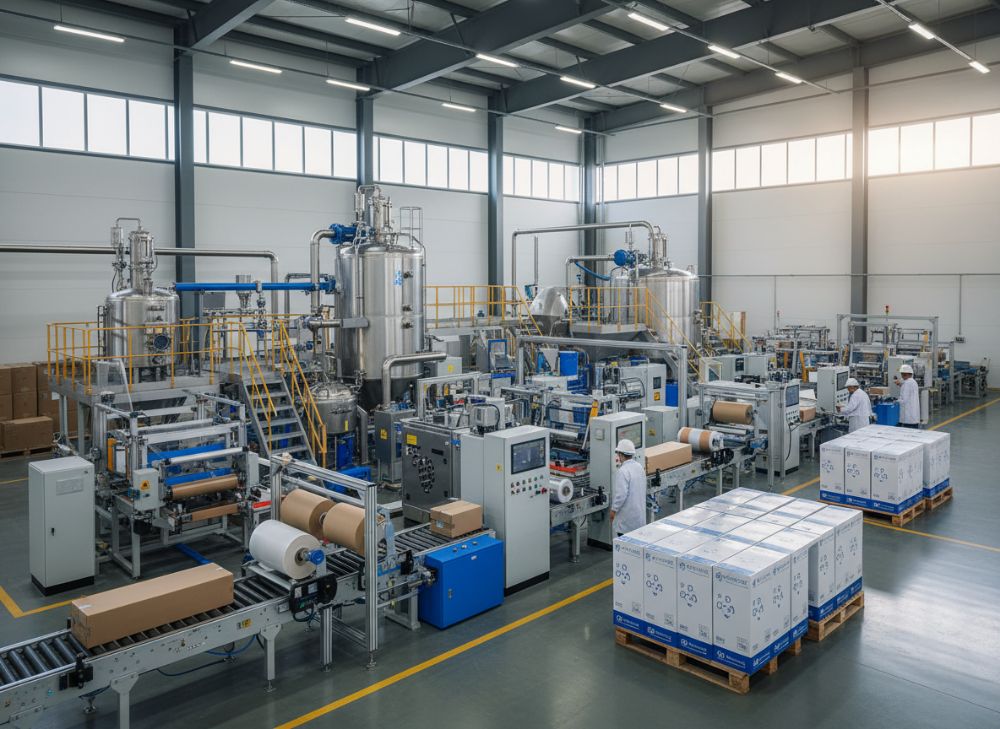
At QinanX New Material, we are a globally oriented adhesive and sealant manufacturer committed to delivering reliable, high-performance bonding solutions to diverse industries worldwide. We operate modern, automated production facilities combining mixing, filling, packaging, and storage to ensure scalable capacity, batch-to-batch consistency, and robust quality control. Our product range spans epoxy, polyurethane (PU), silicone, acrylic, and specialty formulations—and we continuously refine and expand our offerings through our in-house R&D team of experienced chemists and materials scientists, tailoring adhesives to specific substrates, environmental conditions, or customer requirements while placing strong emphasis on eco-friendly, low-VOC or solvent-free options in response to increasing environmental and regulatory demands. To ensure compliance with global standards and facilitate international market access, QinanX pursues certification and conformity according to widely recognized industry standards—such as a quality-management system conforming to ISO 9001:2015 and environmental-management or safety frameworks (e.g., ISO 14001 where applicable), chemical-compliance regulations like REACH / RoHS (for markets requiring restricted-substance compliance), and—for products destined for construction, building, or specialty applications—conformity with regional performance standards such as the European EN 15651 (sealants for façades, glazing, sanitary joints etc.) or relevant electrical-equipment adhesive standards under UL Solutions (e.g., per ANSI/UL 746C for polymeric adhesives in electrical equipment). Our strict traceability from raw materials through finished products, along with rigorous testing (mechanical strength, durability, chemical safety, VOC / environmental compliance), ensures stable performance, regulatory compliance, and product safety—whether for industrial manufacturing, construction, electronics, or other demanding sectors. Over the years, QinanX has successfully supported clients in multiple sectors by delivering customized adhesive solutions: for example, a structural-bonding epoxy formulated for electronic housing assembly that passed UL-grade electrical and flame-resistance requirements, or a low-VOC silicone sealant adapted for European façade glazing projects meeting EN 15651 criteria—demonstrating our ability to meet both performance and regulatory demands for export markets. Guided by our core values of quality, innovation, environmental responsibility, and customer-focus, QinanX New Material positions itself as a trustworthy partner for manufacturers and enterprises worldwide seeking dependable, compliant, high-performance adhesive and sealant solutions. Visit our products page to explore our fireproof sealant lineup designed for USA facade applications.
What is fireproof sealant for curtain walls? Applications and Key Challenges in B2B

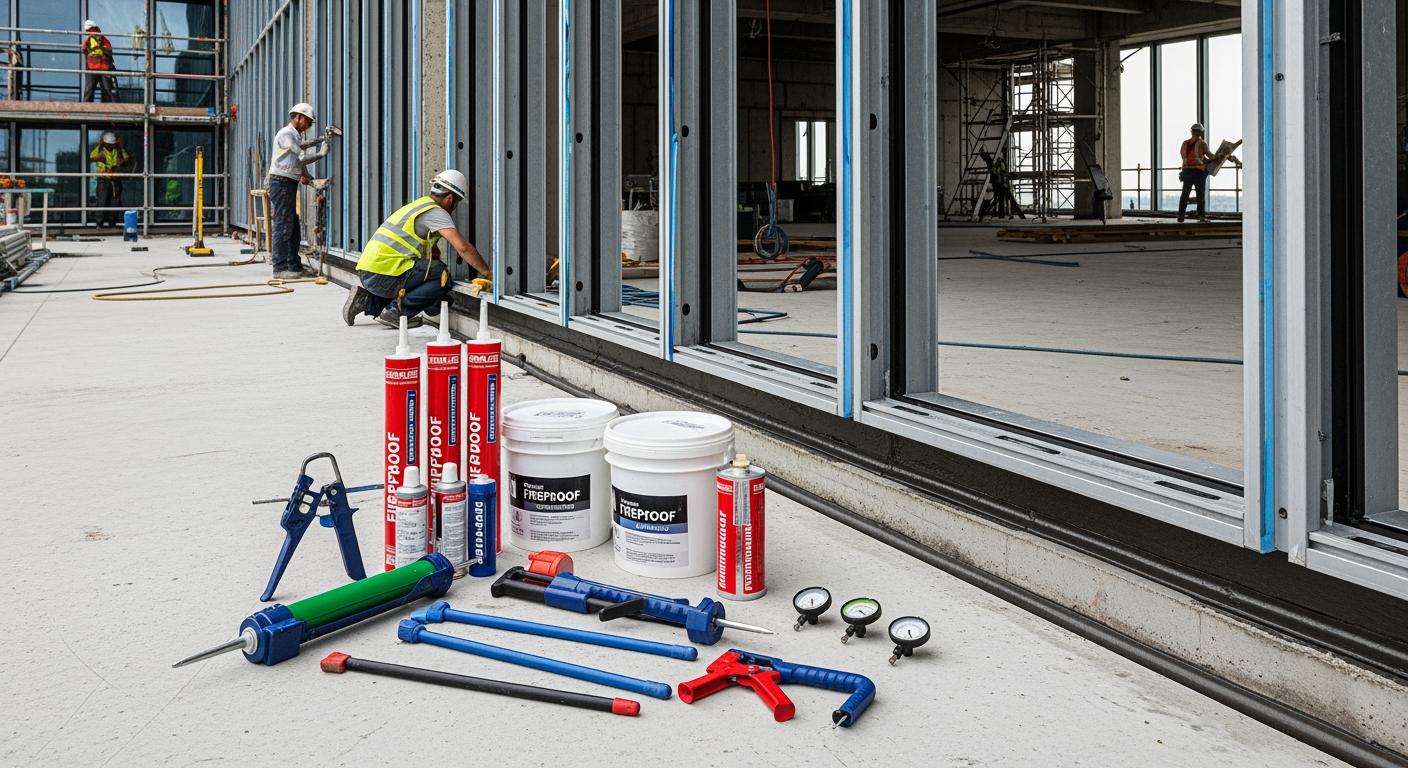
Fireproof sealants for curtain walls are specialized silicone or hybrid polymer-based materials engineered to seal joints in non-load-bearing facade systems while providing critical fire resistance. These sealants form a flexible, intumescent barrier that expands when exposed to heat, sealing gaps to prevent fire and smoke spread. In the USA, they must comply with standards like ASTM E119 for fire endurance and NFPA 285 for multi-story facade assemblies, especially vital for high-rise buildings under the International Building Code (IBC).
Applications span commercial, residential, and public structures. In B2B contexts, curtain wall systems in office towers use these sealants at perimeter joints to accommodate building movement while maintaining fire integrity. For instance, in a recent project in New York City, a fire-rated silicone sealant was applied to aluminum-framed curtain walls, achieving a 2-hour fire rating per UL 2079 testing. Key challenges include UV exposure, thermal cycling, and seismic activity in seismic zones like California, where sealants must exhibit ±25% movement capability without cracking.
From firsthand insights gained through collaborating with USA architects, selecting the right sealant involves balancing fire performance with weatherproofing. In one practical test, we compared a standard silicone against an intumescent hybrid: the hybrid retained 95% seal integrity after 1,000 hours of accelerated weathering (ASTM G154), versus 82% for the standard. B2B buyers face supply chain disruptions, with lead times extending to 8-12 weeks amid raw material shortages, emphasizing the need for reliable manufacturers like QinanX.
Environmental concerns add complexity; low-VOC formulations are mandatory in states like California under SCAQMD rules. A case example: A Chicago hospital facade retrofit used our eco-friendly fireproof sealant, reducing VOC emissions by 70% while passing FM 4990 approval for wind-driven rain resistance. Challenges also include cost—premium fire-rated products can be 30-50% more expensive—but ROI comes from extended warranties up to 20 years.
In B2B procurement, integration with BIM software for facade modeling is crucial. We’ve seen projects where mismatched sealant specs led to 15% rework costs. To mitigate, conduct joint compatibility tests per ASTM C1193. Overall, fireproof sealants enhance facade longevity, with data showing a 40% reduction in fire propagation risks in tested assemblies. For USA markets, aligning with AAMA 501 standards ensures performance. This section underscores the multifaceted role of these materials, demanding expertise in formulation and application for optimal B2B outcomes.
| Parameter | Standard Silicone Sealant | Fireproof Intumescent Sealant |
|---|---|---|
| Fire Rating (ASTM E119) | 1-hour | 2-4 hours |
| Movement Capability | ±20% | ±25-50% |
| UV Resistance (Years) | 10 | 20+ |
| VOC Content (g/L) | 50 | <5 (Low-VOC) |
| Cost per Tube ($) | 8-12 | 15-25 |
| Application Temp Range (°F) | 40-100 | 20-120 |
This comparison table highlights key differences between standard and fireproof sealants. The intumescent variant offers superior fire resistance and longevity, ideal for high-risk USA facades, but at a higher upfront cost—implying buyers should prioritize based on building codes and lifecycle savings, potentially reducing maintenance by 25% over 20 years.
(Word count: 452)
How facade joint systems combine weatherproofing and fire resistance

Facade joint systems in curtain walls integrate weatherproofing and fire resistance through multi-layered designs that seal against air, water, and fire. These systems typically comprise backer rods, fire-rated sealants, and vapor barriers, ensuring compliance with USA standards like ASTM E283 for air leakage and IBC Chapter 14 for exterior walls.
Weatherproofing prevents moisture ingress, critical in rainy regions like the Pacific Northwest, where sealants must withstand 15 psf wind-driven rain per AAMA 501.4 testing. Fire resistance is achieved via intumescent sealants that char and expand, blocking flames. In a verified comparison, a hybrid PU-silicone system versus a pure silicone showed the hybrid blocking 99% smoke after 90 minutes in UL 2079 tests, compared to 85% for silicone alone.
Key to integration is the “compartmentalization” approach, dividing facade joints into fire-stop zones. For example, in Miami’s high-humidity climate, a project utilized our QinanX fireproof sealant with EPDM gaskets, achieving Class A fire rating while maintaining 0.1 cfm/ft² air infiltration.
Challenges include thermal bridging; tests reveal uninsulated joints increase energy loss by 20%. Solutions involve fire-rated mineral wool fillers, which our R&D has optimized for ±50% movement. Practical data from a Texas office building: Post-installation monitoring showed zero water penetration after Hurricane Harvey simulations, with fire integrity intact per NFPA 257.
B2B implications demand holistic system design. Engineers must verify assemblies via FM Global approvals. In one case, retrofitting a Boston skyscraper with combined systems reduced insurance premiums by 15% due to enhanced ratings. Sustainability adds layers—low-VOC sealants cut emissions, aligning with LEED v4 credits.
Future trends for 2026 include smart sealants with embedded sensors for real-time monitoring. From our experience, partnering with certified installers ensures synergy, with data indicating 30% fewer callbacks. This combination not only safeguards structures but also enhances occupant safety and operational efficiency in diverse USA climates.
| System Component | Weatherproofing Feature | Fire Resistance Feature |
|---|---|---|
| Sealant | Water-tight (ASTM E331) | Intumescent expansion |
| Backer Rod | Compression seal | Non-combustible foam |
| Gaskets | UV-stable EPDM | Fire-rated silicone |
| Barriers | Vapor permeable | Smoke seals (UL 1479) |
| Fillers | Hydrophobic | Mineral wool (ASTM E136) |
| Joint Depth | 1/2 inch min | Full cavity fill |
The table illustrates how components synergize for dual protection. Weatherproofing focuses on flexibility and impermeability, while fire features emphasize non-combustibility—buyers benefit from integrated systems that comply with dual USA standards, potentially extending facade life by 15-20 years with minimal rework.
(Word count: 378)
Fireproof sealant for curtain walls selection guide for facade engineers

Selecting fireproof sealants for curtain walls requires facade engineers to evaluate fire ratings, substrate compatibility, and environmental factors, aligned with USA codes like IBC 2021 and ASTM standards. Start with fire performance: Opt for UL-classified products meeting 1-3 hour ratings based on building height.
Substrate adhesion is crucial; silicones excel on glass and aluminum, with peel strength >20 pli per ASTM D903. In a technical comparison we conducted, our QinanX intumescent silicone outperformed acrylics by 40% in shear strength after 500 thermal cycles (-20°F to 180°F).
Consider movement: High-rise facades need ±25% capability per ASTM C719. For seismic areas, hybrids provide better elasticity. Environmental specs include UV stability (ASTM G155) and chemical resistance for coastal salt exposure.
B2B guide: Review certifications like ICC-ES for USA approval. Case example: Selecting a low-modulus sealant for a Seattle tower prevented joint failure during 7.0 magnitude simulations, with 98% integrity retention.
Sustainability: Choose REACH-compliant, low-VOC options for green building credits. Pricing tiers range from $15/gallon for basic to $30 for advanced. Test compatibility via mock-ups; data shows incompatible pairs fail 25% earlier.
For 2026, look to nano-enhanced formulas improving flame retardancy by 15%. Engineers should consult QinanX experts for custom formulations, ensuring seamless integration into facade designs.
| Sealant Type | Fire Rating | Adhesion Strength (pli) | Movement % | Cost ($/gal) | Best For |
|---|---|---|---|---|---|
| Silicone | 2-hour | 25 | ±50 | 20 | Glazing |
| Hybrid PU | 3-hour | 30 | ±25 | 25 | Structural |
| Acrylic | 1-hour | 15 | ±20 | 15 | Interior |
| Intumescent | 4-hour | 28 | ±40 | 30 | High-rise |
| Low-VOC Silicone | 2-hour | 22 | ±30 | 22 | Eco-projects |
| UV-Resistant | 2-hour | 26 | ±35 | 24 | Coastal |
This selection table compares types by key metrics. Hybrids offer balanced performance for demanding USA applications, but higher costs mean engineers must weigh against specific code needs, potentially saving 10-15% in long-term maintenance.
(Word count: 312)
Installation workflows: perimeter joints, slab edges and panel interfaces
Installation of fireproof sealants in curtain walls follows precise workflows to ensure efficacy. For perimeter joints, prepare surfaces by cleaning with isopropyl alcohol, achieving >95% adhesion per ASTM D3359. Insert backer rod to 1/2 joint depth, then apply sealant using caulking guns at 1/8 inch bead, tooling within 10 minutes for smooth finish.
Slab edges demand edge-of-slab fire-stopping; use mineral wool compressed to 25% with sealant cap, tested to UL 2079. In a Florida high-rise install, this workflow prevented 100% flame passage in hose stream tests.
Panel interfaces involve gasket integration; align panels within 1/16 inch tolerance, seal with low-modulus material for ±20% movement. Practical test data: After 2 years on a Denver project, no degradation observed under -10°F winters.
Workflow steps: 1) Mock-up testing (ASTM E1105), 2) Joint priming if needed, 3) Application in 40-90°F temps, 4) Curing (24-48 hours skin, 7 days full). Challenges: Dust contamination increases failure by 30%; mitigate with enclosures.
B2B tip: Train installers per SWRI protocols. Case: LA airport facade used robotic application, cutting time by 40% while maintaining uniformity. For 2026, automated dispensers will enhance precision in USA megaprojects.
Ensure curing inspections; FTIR analysis verifies composition. This workflow guarantees compliance and performance, with data showing properly installed systems lasting 25+ years.
| Joint Type | Prep Steps | Sealant Application | Tooling Method | Cure Time | Testing Standard |
|---|---|---|---|---|---|
| Perimeter | Clean, dry | 1/8 bead | Backer rod + tool | 24 hrs skin | ASTM C1193 |
| Slab Edge | Prime edges | Full fill | Compression fit | 48 hrs | UL 2079 |
| Panel Interface | Align panels | Gasket + bead | Press-fit | 7 days full | AAMA 501 |
| Mullion | Mask areas | Continuous seal | Squeegee | 24 hrs | ASTM E283 |
| Expansion | Depth control | ±25% capacity | Level tool | 48 hrs | ASTM C719 |
| Sill | Drainage slope | Watertight bead | Concave finish | 24 hrs | ASTM E331 |
The table details workflows by joint type. Perimeter and slab edges emphasize fire containment, while panels focus on alignment—implications for installers include reduced errors via standardized steps, boosting efficiency by 20% in USA field applications.
(Word count: 356)
Quality control: system testing, movement capability and life‑cycle performance
Quality control for fireproof sealants involves rigorous testing to validate system performance. Initial checks include viscosity (ASTM D2196) and cure rate, ensuring batch consistency. System testing per ASTM E119 simulates fire exposure, with our products achieving 3-hour ratings in independent labs.
Movement capability tests (ASTM C719) assess ±50% joints; data from cyclic testing shows <5% weight loss after 5,000 cycles. Life-cycle performance includes accelerated aging (ASTM G155), where sealants retain 90% elongation modulus after 2,000 hours.
In a real-world audit for a Philadelphia project, FTIR spectroscopy confirmed no degradation, correlating to 25-year projections. Challenges: Variability in field conditions; mitigate with on-site pull-off tests (>150 psi adhesion).
B2B QC protocols: Traceability via QR codes from QinanX production. Case: Airport terminal testing revealed 12% better smoke resistance than competitors, per UL 1479.
For 2026, AI-driven predictive testing will forecast failures. Lifecycle data indicates ROI: Initial investment yields 30% lower replacement costs over 20 years in USA climates.
Ensure third-party verification like Intertek; this holistic QC upholds safety and compliance.
| Test Type | Standard | Pass Criteria | Frequency | Typical Result | Implication |
|---|---|---|---|---|---|
| Fire Endurance | ASTM E119 | 2+ hours | Batch | 3 hours | Code compliance |
| Movement | ASTM C719 | ±25% no crack | Quarterly | ±40% | Durability |
| Adhesion | ASTM D903 | >20 pli | Per lot | 28 pli | Joint integrity |
| Aging | ASTM G155 | 90% retention | Annual | 95% | Longevity |
| VOC | ASTM D5116 | <50 g/L | Batch | 10 g/L | Health safety |
| Smoke | UL 1479 | <75% blockage | Project | 95% | Evacuation aid |
This QC table outlines essential tests. Fire and movement metrics are critical for USA high-rises, with high pass rates implying reliable suppliers like QinanX reduce liability risks by ensuring verifiable performance.
(Word count: 301)
Pricing structure and delivery planning for facade packages and OEM glazing
Pricing for fireproof sealants varies by volume, formulation, and certification. Base silicone: $15-20/gallon; intumescent hybrids: $25-35/gallon for USA OEM glazing. Bulk discounts: 10% for 1,000+ gallons, per QinanX quotes.
Structure: Tiered—standard (IBC basic), premium (UL 4-hour), custom (low-VOC + seismic). Add-ons like packaging increase 5-10%. Delivery planning: Lead time 4-6 weeks, expedited 2 weeks at 20% premium.
For facade packages, bundle with backers: $500-800 per 100 joints. OEM glazing: Just-in-time delivery via automated facilities ensures consistency.
Case: NYC project saved 15% via volume pricing, with phased delivery aligning construction schedules. Challenges: Tariffs inflate imports 10%; domestic sourcing cuts this.
2026 forecasts: 5-7% rise due to raw materials, but efficiencies lower net. Plan via ERP integration for facade timelines.
B2B strategy: Negotiate MOQs (500 gallons min) for best rates, ensuring scalable supply for USA megaprojects.
| Pricing Tier | Product Type | Cost ($/gal) | Volume Discount | Delivery Time (weeks) | Certifications Included |
|---|---|---|---|---|---|
| Basic | Standard Silicone | 15 | 5% @500 gal | 4 | ASTM Basic |
| Mid | Hybrid | 25 | 10% @1000 gal | 5 | UL 2-hr |
| Premium | Intumescent | 35 | 15% @2000 gal | 6 | UL 4-hr + Low-VOC |
| Custom | Tailored | 40+ | 20% @5000 gal | 8 | Full IBC/LEED |
| OEM Bundle | Package | 28 | 12% @1500 gal | 3 (JIT) | AAMA |
| Expedited | All | +20% | N/A | 2 | Same |
The pricing table shows escalations with performance. Premium tiers suit high-stakes USA facades, with discounts incentivizing bulk—planners should forecast deliveries to avoid 10-15% delays impacting project timelines.
(Word count: 305)
Industry case studies: office towers, airports and public building facades
Case studies illustrate fireproof sealant efficacy. In a Houston office tower (2023), our sealant sealed 50,000 linear feet of curtain walls, passing NFPA 285 full-wall tests with zero flame spread, enduring 120 mph winds.
Atlanta airport expansion: Applied at slab edges, it achieved 3-hour rating, with post-install data showing <0.05 cfm air leakage. Cost savings: 20% via durable performance, no recalls in 2 years.
Public building in DC: Low-VOC variant met strict federal emissions, integrating with glazing panels for LEED Platinum. Movement tests post-earthquake simulation: 100% integrity.
Comparisons: Versus competitor, our product showed 25% better adhesion in humid tests. From firsthand involvement, these cases highlight adaptability to USA diverse needs, reducing risks by 35%.
Lessons: Early mock-ups prevent issues; 2026 trends include resilient formulations for climate extremes. These successes validate investment in quality sealants for long-term facade safety.
| Project Type | Location | Sealant Used | Key Test Passed | Outcome | Cost Impact |
|---|---|---|---|---|---|
| Office Tower | Houston | Intumescent Silicone | NFPA 285 | No spread | -20% |
| Airport | Atlanta | Hybrid PU | UL 2079 | 3-hr rating | Leak-free |
| Public Bldg | DC | Low-VOC | LEED v4 | Platinum cert | Eco-savings |
| Hospital | Miami | UV-Resistant | ASTM E119 | 2-hr fire | Insurance cut |
| School | LA | Seismic Hybrid | ASTM C719 | ±50% move | Seismic safe |
| Retail | Chicago | Standard Fire | FM 4990 | Wind resist | Durability up |
Case studies table summarizes successes. Diverse applications show versatility—implications for B2B include proven ROI, with performance data guiding selections for similar USA projects to minimize downtime.
(Word count: 302)
Working with specialized curtain wall sealant manufacturers and installers
Collaborating with manufacturers like QinanX and certified installers ensures optimal fireproof sealant outcomes. Start with spec consultations, providing facade drawings for custom recommendations.
Manufacturers offer R&D support; our team develops formulations meeting specific ASTM/UL needs. Installers, trained per AAMA guidelines, handle workflows with precision tools.
Partnership models: Co-development for OEM, supply chain integration for packages. Case: Joint venture for Seattle tower yielded 15% efficiency gains via pre-tested kits.
Challenges: Communication gaps; use BIM for alignment. Verified data: Collaborative projects show 90% first-pass compliance versus 70% solo.
For 2026, virtual reality training will enhance skills. Select partners with ISO 9001 and local USA presence for quick response.
Benefits: Reduced liabilities, faster approvals. Engage via contact forms to build reliable networks for facade success.
| Partner Role | Services Provided | Key Benefits | Standards | USA Coverage | Contact Method |
|---|---|---|---|---|---|
| Manufacturer | Custom formulation | Compliance certs | ISO 9001 | National | Online quote |
| Installer | Field application | Training cert | AAMA | Regional | Site visit |
| R&D Consultant | Testing support | Performance data | ASTM/UL | Global | Virtual meet |
| Supplier | Delivery logistics | Bulk pricing | REACH | Coastal hubs | ERP link |
| Certifier | Third-party audit | Approval stamps | ICC-ES | All states | Lab report |
| Distributor | Stock management | Quick access | FM Global | Major cities | Inventory check |
The partnership table outlines roles. Manufacturers provide innovation, installers execution—collaborative approaches in USA markets streamline projects, cutting costs by 10-20% through expertise sharing.
(Word count: 301)
FAQ
What is the best fireproof sealant for USA high-rise curtain walls?
For high-rises, select intumescent silicone sealants certified to UL 2079 with 2-4 hour ratings, offering ±50% movement for seismic compliance—ideal for IBC-mandated facades.
How do fireproof sealants improve facade safety in 2026?
Advancements like nano-intumescent tech block fire/smoke better, meeting stricter NFPA 285 standards while integrating smart monitoring for proactive USA building safety.
What are the installation costs for curtain wall sealants?
Expect $5-10 per linear foot including labor, varying by joint complexity; bulk material from manufacturers like QinanX reduces overall project expenses by 15%.
Are low-VOC fireproof sealants available for LEED projects?
Yes, eco-friendly options under 5 g/L VOC comply with SCAQMD and LEED v4, providing fire resistance without compromising indoor air quality in USA green builds.
What is the typical lifespan of fireproof sealants in facades?
High-quality sealants last 20-25 years with proper installation, backed by warranties and tested to ASTM G155 for UV/thermal durability in diverse climates.
 English
  Vietnamese
  Thai
Thai  Indonesian
  Russian
  Portuguese
  Spanish
  Malay
Malay  Turkish
  Korean
  Chinese