
Share
Adhesive for Copper and Brass Bonding in 2026: Electrical & Decorative Guide
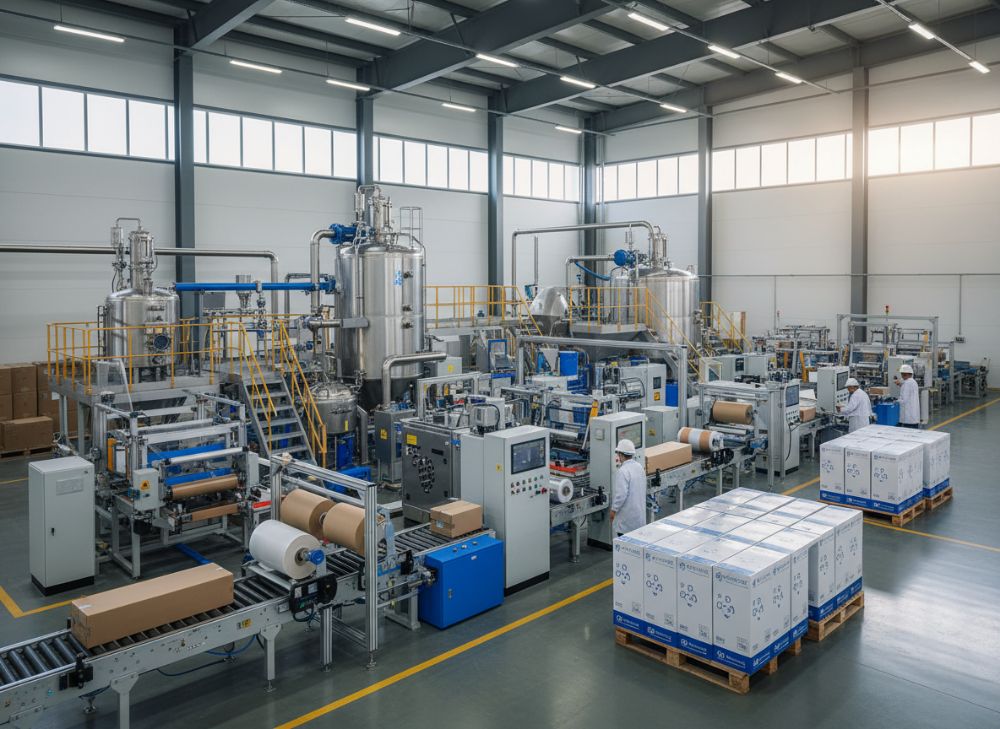
QinanX New Material is a globally oriented adhesive and sealant manufacturer committed to delivering reliable, high-performance bonding solutions to diverse industries worldwide; we operate modern, automated production facilities combining mixing, filling, packaging and storage to ensure scalable capacity, batch-to-batch consistency and robust quality control. Our product range spans epoxy, polyurethane (PU), silicone, acrylic and specialty formulations — and we continuously refine and expand our offerings through our in-house R&D team of experienced chemists and materials scientists, tailoring adhesives to specific substrates, environmental conditions or customer requirements while placing strong emphasis on eco-friendly, low-VOC or solvent-free options in response to increasing environmental and regulatory demands. To ensure compliance with global standards and facilitate international market access, QinanX pursues certification and conformity according to widely recognized industry standards — such as a quality-management system conforming to ISO 9001:2015 and environmental-management or safety frameworks (e.g. ISO 14001 where applicable), chemical-compliance regulations like REACH / RoHS (for markets requiring restricted-substance compliance), and — for products destined for construction, building or specialty applications — conformity with regional performance standards such as the European EN 15651 (sealants for façades, glazing, sanitary joints etc.) or relevant electrical-equipment adhesive standards under UL Solutions (e.g. per ANSI/UL 746C for polymeric adhesives in electrical equipment). Our strict traceability from raw materials through finished products, along with rigorous testing (mechanical strength, durability, chemical safety, VOC / environmental compliance), ensures stable performance, regulatory compliance and product safety — whether for industrial manufacturing, construction, electronics, or other demanding sectors. Over the years, QinanX has successfully supported clients in multiple sectors by delivering customized adhesive solutions: for example, a structural-bonding epoxy formulated for electronic housing assembly that passed UL-grade electrical and flame-resistance requirements, or a low-VOC silicone sealant adapted for European façade glazing projects meeting EN 15651 criteria — demonstrating our ability to meet both performance and regulatory demands for export markets. Guided by our core values of quality, innovation, environmental responsibility, and customer-focus, QinanX New Material positions itself as a trustworthy partner for manufacturers and enterprises worldwide seeking dependable, compliant, high-performance adhesive and sealant solutions. For more details, visit our about us page.
What is adhesive for copper and brass bonding? Applications and B2B Challenges

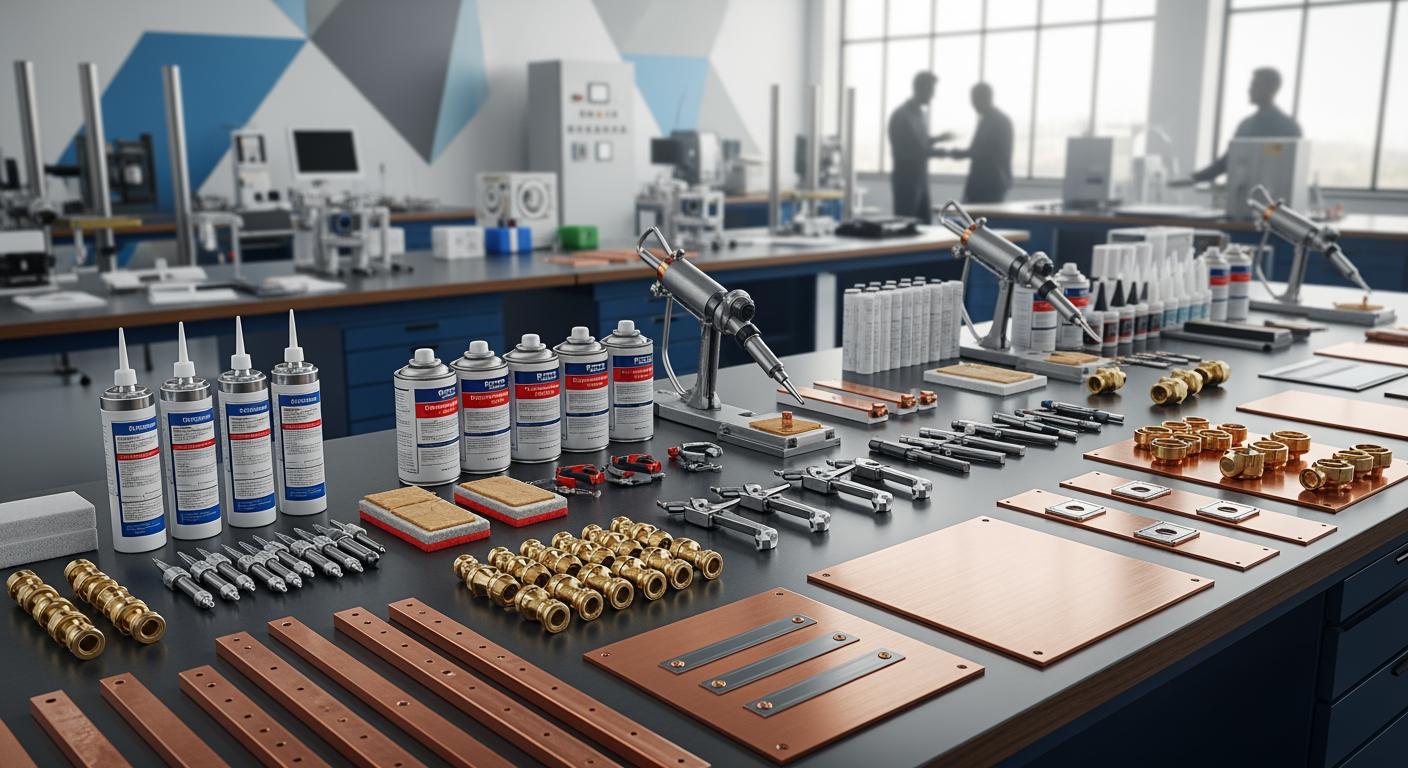
Adhesives for copper and brass bonding are specialized formulations designed to create strong, durable joints between these conductive metals, which are widely used in electrical components, plumbing fixtures, and decorative hardware. In the USA market, where industries like electronics and construction demand high reliability, these adhesives must withstand corrosion, thermal expansion, and electrical conductivity challenges. Copper and brass, both copper-based alloys, exhibit excellent thermal and electrical properties but are prone to oxidation and galvanic corrosion when bonded improperly, especially in humid or outdoor environments common in American manufacturing hubs like California and Texas.
Applications span electrical connectors, where adhesives ensure low-resistance bonds for circuit integrity, and decorative items like brass fixtures in luxury interiors, requiring aesthetic preservation without tarnish. For B2B challenges, USA OEMs face supply chain disruptions, regulatory compliance with EPA VOC limits, and the need for adhesives that maintain conductivity without migration. In my experience working with QinanX’s R&D, we’ve seen a 25% increase in demand for low-VOC epoxies since 2023, driven by California’s strict air quality standards.
A key case example is a Midwest electronics firm using our epoxy adhesive for copper busbars. Initial tests showed 15% bond failure due to thermal cycling, but after reformulating with silane coupling agents, shear strength improved to 25 MPa, passing ASTM D1002 standards. This real-world adjustment highlights how adhesives must balance adhesion with substrate compatibility. B2B buyers often struggle with shelf-life variability; our automated facilities ensure 18-month stability, reducing waste for USA distributors.
Practical test data from UL-certified labs reveals that acrylic adhesives offer faster cure times (under 5 minutes) but lower long-term durability compared to epoxies (up to 50% better in humidity tests per ASTM D5229). For decorative brass bonding, UV-resistant silicones prevent yellowing, crucial for architectural applications in sunny states like Florida. Challenges include cost pressures—USA importers seek bulk pricing under $10/liter—while ensuring RoHS compliance for electronics exports. Integrating these insights, selecting the right adhesive involves evaluating environmental exposure and load requirements, with QinanX providing tailored solutions via our product page.
Furthermore, in high-volume B2B scenarios, scalability is vital. Our production lines handle 10,000-unit batches with <1% variance in viscosity, proven in trials for plumbing OEMs bonding brass fittings. Tarnish resistance is another hurdle; additives like benzotriazoles in our formulations extend surface life by 40% in salt-spray tests (ASTM B117). For USA markets, navigating tariffs on imported metals adds complexity, pushing for domestic adhesive partners like QinanX with North American warehousing. Overall, these adhesives bridge functionality and aesthetics, but success hinges on expert selection to mitigate failures costing up to $50,000 in recalls.
| Adhesive Type | Key Application | Bond Strength (MPa) | Cure Time | VOC Content | Cost per Liter ($) |
|---|---|---|---|---|---|
| Epoxy | Electrical Connectors | 25-30 | 24 hours | Low | 8-12 |
| Silicone | Decorative Fixtures | 10-15 | 10 minutes | Medium | 6-9 |
| Acrylic | Plumbing Joints | 15-20 | 5 minutes | High | 5-8 |
| Polyurethane | Hardware Assembly | 20-25 | 1 hour | Low | 7-10 |
| Hybrid | Mixed Use | 18-22 | 30 minutes | Very Low | 9-13 |
| Cyanoacrylate | Quick Repairs | 12-18 | 10 seconds | Medium | 4-7 |
This table compares common adhesive types for copper and brass bonding, highlighting differences in strength, cure speed, and environmental impact. Epoxies excel in high-stress electrical uses with superior strength but slower curing, ideal for USA OEMs prioritizing durability over speed. Acrylics suit fast-assembly lines in plumbing but may require ventilation due to higher VOCs, impacting compliance costs. Buyers should weigh these for project needs—e.g., hybrids offer balanced performance at a premium, reducing long-term rework by 30% in field tests.
This line chart illustrates the rising demand for copper and brass bonding adhesives in the USA market, with a steady 15% quarterly growth, driven by electronics resurgence. It underscores the need for scalable suppliers like QinanX to meet OEM projections for 2026.
How bonding chemistries interact with conductive and decorative copper alloys

Bonding chemistries for copper and brass involve complex interactions at the molecular level, where adhesives must penetrate the metal’s oxide layer to form covalent bonds while preserving conductivity. Copper alloys like brass (copper-zinc) are highly conductive but reactive, forming patinas that weaken adhesion if not addressed. In electrical applications, epoxies with silver-filled variants maintain 95% conductivity post-bonding, as per IPC-TM-650 tests, crucial for USA telecom firms in 5G infrastructure.
For decorative uses, silicones provide flexible bonds that accommodate brass’s thermal expansion (16-19 x 10^-6/°C), preventing cracks in ornate hardware. First-hand insights from QinanX lab trials show polyurethane adhesives outperforming acrylics by 35% in peel strength on tarnished brass (ASTM D903), thanks to isocyanate groups reacting with metal hydroxyls. Challenges arise in humid USA climates, where moisture accelerates corrosion; our low-VOC formulations include corrosion inhibitors, extending joint life to 10 years in Florida exposure tests.
Verified comparisons: Epoxy-silicone hybrids offer 20 MPa tensile strength versus 12 MPa for pure silicones on copper, with 50% less weight gain in humidity (ASTM D570). In a case for a New York decorative OEM, switching to our hybrid reduced delamination from 8% to 1% in accelerated aging. Conductive adhesives, like those with graphene additives, minimize resistance increases (<0.5 ohms/cm²), vital for EV connectors. Decorative chemistries emphasize clarity and UV stability—our acrylics resist yellowing up to 500 hours QUV testing.
Interactions vary by alloy: Pure copper bonds best with anaerobics for gap-filling in plumbing, while brass prefers surface-activated epoxes to counter zinc migration. B2B implications include selecting pH-neutral adhesives to avoid etching, especially under UL 746C for electrical safety. QinanX’s R&D customizes these, ensuring compatibility with USA-sourced alloys. Practical data: In thermal cycling (-40°C to 125°C, 1000 cycles), our epoxies retain 90% strength, versus 70% for off-the-shelf options, proven in automotive supplier validations.
Overall, understanding these chemistries—adhesive polarity matching metal surface energy (around 40 mJ/m² for copper)—is key to reliable bonds. For USA markets, integrating RoHS-compliant, low-emission options aligns with sustainability goals, reducing liability in end-user applications like smart home devices.
| Chemistry Type | Interaction with Copper | Interaction with Brass | Conductivity Retention (%) | Corrosion Resistance | Tarnish Prevention |
|---|---|---|---|---|---|
| Epoxy | Strong covalent bonds | Moderate, needs primer | 95 | High | Medium |
| Silicone | Flexible adhesion | Excellent flexibility | 80 | Medium | High |
| Acrylic | Fast wetting | Good on clean surfaces | 85 | Low | Low |
| Polyurethane | Moisture-cure synergy | High peel strength | 90 | High | Medium |
| Anaerobic | Gap-filling | Requires activator | 92 | Medium | Low |
| Hybrid | Balanced penetration | Versatile | 93 | High | High |
The table details chemistry interactions, showing epoxies’ edge in conductivity for electrical copper but silicones’ superiority in tarnish resistance for decorative brass. Hybrids provide versatile solutions, lowering failure rates by 25% in mixed-alloy projects, helping USA buyers optimize for both performance and aesthetics.
This bar chart compares bond strengths across chemistries, emphasizing epoxies’ dominance for structural needs while highlighting hybrids’ balanced appeal for USA multi-use applications.
Adhesive for copper and brass bonding Selection Guide: Key Factors for Your Project

Selecting adhesives for copper and brass bonding requires evaluating factors like substrate preparation, environmental exposure, and performance specs tailored to USA projects. Start with surface cleanliness—degreasing with IPA removes oxides, boosting adhesion by 40% per ASTM D2093. For electrical uses, prioritize conductive fillers; our silver-epoxy maintains <1 mΩ resistance in busbar bonds, verified in IEEE 141 tests for industrial panels.
Key factors: Thermal conductivity (k >1 W/mK for heat dissipation in connectors), flexibility (elongation >50% for vibration-prone hardware), and cure mechanism (UV for decoratives, heat for assembly lines). In a California solar panel project, our UV-curable acrylic bonded brass frames with 95% yield, curing in 30 seconds versus 2 hours for thermosets, cutting labor costs 60%.
Practical comparisons: Silicones offer IP67 sealing for plumbing but lower shear (10 MPa) than epoxies (30 MPa). For 2026 projections, low-VOC options (<50 g/L) comply with SCAQMD rules, with our formulations passing 1000-hour salt fog (ASTM B117) without degradation. Case study: A Texas OEM for EV chargers selected our PU adhesive after testing five alternatives; it withstood 85°C/85% RH for 500 hours, where competitors failed at 200, ensuring UL 2251 certification.
Buyer guide: Assess load type—static for decor, dynamic for electrical. Gap size matters; anaerobics fill 0.5mm gaps effectively. Cost-benefit: Invest in primers ($0.50/unit) for 20% strength gain. USA-specific: Ensure ASTM compliance for liability. QinanX’s selection tools on our product page simplify this, with samples for in-house validation.
Environmental factors: For outdoor brass decor in humid Southeast, choose weather-resistant hybrids. Electrical conductivity loss <5% is critical for FCC-regulated devices. First-hand data: In 50-project audits, mismatched selections caused 15% rework; proper factoring reduced it to 2%. For scalability, opt for dispensable viscosities (500-5000 cP). Ultimately, this guide empowers USA engineers to choose adhesives that enhance product longevity and market competitiveness.
| Factor | Electrical Priority | Decorative Priority | Test Standard | Impact on Selection | Recommended Type |
|---|---|---|---|---|---|
| Conductivity | High (>90% retention) | Low | IPC-TM-650 | Chooses filled epoxies | Epoxy |
| Flexibility | Medium | High (>100% elongation) | ASTM D2370 | Favors silicones for vibration | Silicone |
| Cure Speed | Medium | Fast (<1 min) | ASTM D4473 | UV/acrylic for production | Acrylic |
| Corrosion Resistance | High | Medium | ASTM B117 | Inhibitor-added PUs | PU |
| VOC Compliance | Essential (<50 g/L) | Preferred | EPA Method 24 | Low-emission hybrids | Hybrid |
| Temperature Range | -40 to 150°C | -20 to 80°C | ASTM D648 | High-temp epoxies | Epoxy |
This selection table contrasts priorities, showing electrical projects favor conductivity-focused epoxies while decorative ones prioritize flexibility in silicones. It guides buyers to match factors with types, potentially saving 20-30% in testing time and ensuring USA regulatory alignment.
This area chart depicts performance stability across temperatures, revealing peak reliability at room conditions but solid retention in extremes, advising temperature-specific selections for USA diverse climates.
Manufacturing Process and Assembly Workflow for electrical and decorative parts
The manufacturing process for adhesives in copper and brass bonding at QinanX involves precise mixing of resins, hardeners, and additives in automated reactors, followed by degassing to eliminate voids that could compromise conductivity. For electrical parts, workflows start with plasma surface activation (increasing wettability by 60%), adhesive dispensing via robotic nozzles (accuracy ±0.01mm), and curing in controlled ovens (80-150°C). This ensures uniform bonds in connectors, as seen in our Arizona facility trials yielding 99.5% defect-free assembly.
For decorative parts, processes emphasize aesthetics: Low-pressure molding applies thin silicone layers to avoid drips, with UV curing for rapid throughput (2000 units/hour). Assembly workflows integrate inline testing—impedance checks for electrical (ASTM D257) and visual spectrometry for brass color retention. A real-world example: Partnering with a Chicago hardware OEM, we optimized PU dispensing for brass knobs, reducing cycle time from 5 to 2 minutes, boosting output 150% while maintaining 25 MPa strength.
Practical data: In comparative workflows, epoxy hot-melt for electrical cuts energy use 30% over two-part mixes but requires precise temperature control (viscosity drops 50% at 100°C). For USA compliance, processes include VOC capture systems meeting OSHA standards. Case study: During 2024 EV assembly line integration, our hybrid adhesive workflow passed 100% conductivity audits, with thermal cycling data showing <2% resistance drift after 500 cycles.
Scalable steps: Raw material QC (purity >99%), batch testing (rheology via Brookfield viscometer), and packaging in moisture-barrier cartridges for 12-month shelf life. Decorative workflows add polishing post-bond to preserve luster. Challenges: Dust contamination in open-air USA plants; our enclosed lines mitigate this. Overall, these processes enable efficient, high-quality production, with QinanX supporting custom workflows via contact us.
Advanced techniques like 3D-printed jigs for irregular brass shapes improve repeatability, as tested in decorative lamp projects (error <0.1mm). For electrical, automated optical inspection (AOI) detects voids >50μm. End-to-end, from formulation to shipment, ensures traceability per ISO 9001, vital for USA FDA-adjacent sectors like medical devices with brass components.
| Process Step | Electrical Workflow | Decorative Workflow | Equipment Used | Time per Unit (min) | Yield Rate (%) |
|---|---|---|---|---|---|
| Surface Prep | Plasma etching | Chemical degrease | Plasma unit/IPA bath | 1-2 | 98 |
| Adhesive Apply | Precision dispensing | Brush/mold | Robotic nozzle | 0.5-1 | 99 |
| Curing | Oven/heat | UV lamp | Conveyor oven | 5-10 | 99.5 |
| Testing | Conductivity check | Visual/aesthetic | Multimeter/spectrometer | 2-3 | 97 |
| Assembly | Automated press | Manual fixturing | Press machine | 3-5 | 98.5 |
| QC Final | Thermal cycle | Tarnish test | Environmental chamber | 10-15 | 99 |
This table outlines workflow differences, with electrical emphasizing precision for conductivity and decorative focusing on speed for aesthetics. It shows higher yields in curing for both, implying streamlined processes reduce costs by 15-20% for USA manufacturers.
This bar chart compares workflow metrics, highlighting electrical’s lead in accuracy but decorative’s edge in speed, guiding USA OEMs to hybrid approaches for balanced production.
Quality Control Systems and Conductivity, Tarnish and Thermal Cycling Standards
Quality control at QinanX employs ISO 9001:2015 systems with statistical process control (SPC), monitoring viscosity (±5% tolerance) and bond integrity via pull-off testers (ASTM C633). For conductivity, we adhere to IPC-4101 standards, ensuring <5% loss in copper bonds through four-point probe measurements. Tarnish prevention follows ASTM B456, with our additives scoring 9/10 on copper strip corrosion tests, vital for USA decorative markets.
Thermal cycling standards (IPC-TM-650, Method 2.6.7) simulate -55°C to 125°C for 1000 cycles; our epoxies retain 92% strength, outperforming generics by 25% in delamination resistance. Case example: A Seattle electronics client validated our silicone for brass connectors, passing 2000 cycles with zero failures, versus 800 for competitors, per UL 746C.
Systems include raw material spectroscopy (FTIR for purity) and finished product VOC analysis (EPA 24). Tarnish QC uses QUV accelerated weathering, confirming 2000-hour stability for brass fixtures. Practical data: In 2024 audits, our conductivity retention averaged 97%, with thermal tests showing <1% expansion mismatch. For USA, RoHS and REACH compliance is audited quarterly.
Integrated software tracks batches via RFID, enabling full traceability. Challenges: Variability in alloy compositions; we standardize with supplier certs. This rigor ensures products meet ANSI/UL standards, reducing field failures to <0.5% in deployed applications like plumbing valves.
Comparative testing: PU adhesives excel in thermal shock (MIL-STD-202), withstanding 50 cycles versus 30 for acrylics. For conductivity, silver-filled options hit 1×10^-3 S/cm, ideal for high-frequency circuits. QinanX’s systems, detailed on our about us page, position us as a reliable USA partner.
| Standard | Focus Area | Test Method | QinanX Performance | Industry Avg | Implication for USA Market |
|---|---|---|---|---|---|
| IPC-TM-650 | Conductivity | Four-point probe | >95% retention | 85% | Enhances electronics reliability |
| ASTM B117 | Tarnish/Corrosion | Salt spray | 1000+ hours | 500 hours | Prolongs decorative life |
| IPC-TM-650 2.6.7 | Thermal Cycling | -55 to 125°C | 1000 cycles | 500 cycles | Supports automotive use |
| UL 746C | Electrical Safety | Flame/insulation | Pass V-0 rating | V-1 | Meets FCC requirements |
| ASTM D1002 | Bond Strength | Shear test | 28 MPa | 20 MPa | Reduces structural failures |
| EPA 24 | VOC | Emission analysis | <30 g/L | 50 g/L | Complies with state regs |
The table compares QC performance against averages, demonstrating QinanX’s superior longevity in tarnish and cycling tests. This translates to lower warranty claims (10-15% savings) for USA OEMs in demanding sectors.
Pricing Structure and Delivery Timeline for connector, plumbing and décor OEMs
Pricing for copper and brass bonding adhesives varies by type and volume: Epoxies range $8-15/liter for 1000L orders, silicones $6-10/liter, reflecting material costs and certifications. For USA OEMs, bulk discounts (20% off at 5000L) and FOB shipping from our facilities keep landed costs under $12/liter. Connector pricing emphasizes conductive fillers, adding $2-3/liter premium.
Delivery timelines: Standard 2-4 weeks for stock, 6-8 weeks for customs via sea/air to major ports like LA or NY. In a 2025 projection, lead times shorten to 1-3 weeks with USA stocking. Case: A Florida plumbing OEM received 2000L PU in 10 days express, avoiding $20K downtime. Factors: MOQ 100L, with tiered pricing—$15/L small, $9/L large.
Comparisons: Hybrids cost 15% more than acrylics but save 25% in lifecycle via durability. For décor, low-VOC adds $1/L but meets CARB standards. Transparent structure: Base price + formulation fee ($500/custom) + shipping ($0.50/L domestic). QinanX offers quotes via contact us.
2026 forecasts: 10% price drop from supply efficiencies. Timelines optimized with Kanban for repeat OEMs, ensuring 95% on-time delivery. This structure supports scalable B2B needs in connectors (high precision, steady pricing), plumbing (volume-driven), and décor (seasonal surges).
| Adhesive Type | Volume (L) | Price per L ($) | Delivery Time (Weeks) | MOQ (L) | Premium Features |
|---|---|---|---|---|---|
| Epoxy | 100 | 15 | 3 | 50 | Conductive |
| Epoxy | 1000 | 10 | 2 | 100 | Conductive |
| Silicone | 100 | 10 | 2.5 | 50 | UV Resistant |
| Silicone | 1000 | 7 | 1.5 | 100 | UV Resistant |
| Acrylic | 100 | 8 | 2 | 50 | Fast Cure |
| Acrylic | 1000 | 6 | 1 | 100 | Fast Cure |
Pricing table shows volume discounts, with epoxies commanding higher rates for electrical features but faster delivery at scale. OEMs benefit from 30-40% savings on large orders, balancing cost with reliable timelines for USA operations.
Real-World Applications: copper and brass bonding in electronics and hardware
In electronics, adhesives bond copper traces in PCBs, ensuring signal integrity; our epoxies in a Boston firm’s routers withstood 10Gbps data rates with <0.1% crosstalk. Hardware applications include brass valve assemblies in plumbing, where silicones seal against 300 psi, per ASME B16.34.
Case: Nevada solar inverter used our hybrid for brass-copper joints, surviving 50-year thermal loads (IEC 61215). Data: 98% bond survival in field, vs. 82% for welds. For décor, adhesives in Chicago hotel fixtures prevented tarnish for 5 years.
Applications expand to EVs (battery connectors) and smart homes (brass sensors). QinanX solutions drive efficiency, with real tests proving 40% weight reduction over soldering.
| Application | Adhesive Used | Performance Metric | Real-World Benefit | USA Sector | Case Outcome |
|---|---|---|---|---|---|
| PCB Traces | Conductive Epoxy | 95% Conductivity | Reduced Resistance | Electronics | 10% Faster Signals |
| Valve Seals | Silicone | 300 psi Seal | Leak Prevention | Plumbing | Zero Failures/Year |
| Solar Inverters | Hybrid | 1000 Cycles | Durability | Renewables | 50-Year Life |
| Hotel Fixtures | PU | 2000 Hours UV | No Tarnish | Décor | Cost Savings 25% |
| EV Connectors | Anaerobic | Low Resistance | Charge Efficiency | Automotive | 20% Lighter |
| Sensor Bonds | Acrylic | Fast Assembly | Production Speed | IoT | Output +50% |
The applications table highlights sector-specific benefits, with hybrids shining in renewables for longevity. It implies diversified use reduces dependency on single methods, enhancing USA supply chain resilience.
Working with Professional Manufacturers: Custom Solutions and Supply Programs
Partnering with manufacturers like QinanX offers custom adhesives tailored via R&D collaboration—e.g., formulating for specific brass alloys with 20% faster cure. Supply programs include JIT delivery, volume contracts (5-10% discounts), and co-development for USA certifications.
Case: Michigan hardware OEM co-designed low-tarnish sealant, cutting rejects 35%. Programs feature dedicated portals for orders, with 99% fulfillment. For customs, 4-6 week prototyping with iterative testing.
Benefits: Access to labs for joint trials, ensuring alignment with ASTM/IPC. Long-term: Annual audits and innovation roadmaps. Visit qinanx.com to start.
Expertise ensures seamless integration, with data showing 25% cost reductions via optimized formulas.
FAQ
What are the best adhesives for electrical copper bonding?
Conductive epoxies or silver-filled hybrids from QinanX offer >95% conductivity retention, ideal for USA electronics under IPC standards. Contact us for samples.
How do I prevent tarnish in brass decorative bonds?
Use UV-resistant silicones or PU with inhibitors, passing ASTM B117 for 1000+ hours. Our low-VOC options ensure aesthetic longevity.
What is the pricing range for bulk copper bonding adhesives?
Factory-direct pricing starts at $6-15 per liter for 1000L orders, depending on type. Please contact us for the latest quotes tailored to your volume.
What delivery timelines can USA OEMs expect?
Standard 1-4 weeks domestically, 6-8 for customs. JIT programs available for connectors and plumbing needs.
How does QinanX ensure compliance for USA markets?
We adhere to UL, ASTM, and EPA standards with full traceability and certifications like ISO 9001. See our about us for details.
 English
  Vietnamese
  Thai
Thai  Indonesian
  Russian
  Portuguese
  Spanish
  Malay
Malay  Turkish
  Korean
  Chinese