
Share
Stone Adhesive for Countertop Fabrication in 2026: Fabricator Guide
In the evolving landscape of countertop fabrication, stone adhesives play a pivotal role in ensuring durable, seamless installations that meet the demands of residential and commercial projects across the USA. As we approach 2026, advancements in adhesive technology are addressing key challenges like environmental compliance, bond strength, and aesthetic integration. This comprehensive guide, tailored for USA fabricators, explores everything from foundational applications to advanced production techniques, drawing on real-world expertise to help you select and implement the best solutions.
At QinanX New Material, we are a globally oriented adhesive and sealant manufacturer committed to delivering reliable, high-performance bonding solutions to diverse industries worldwide. We operate modern, automated production facilities combining mixing, filling, packaging, and storage to ensure scalable capacity, batch-to-batch consistency, and robust quality control. Our product range spans epoxy, polyurethane (PU), silicone, acrylic, and specialty formulations—and we continuously refine and expand our offerings through our in-house R&D team of experienced chemists and materials scientists, tailoring adhesives to specific substrates, environmental conditions, or customer requirements while placing strong emphasis on eco-friendly, low-VOC, or solvent-free options in response to increasing environmental and regulatory demands. To ensure compliance with global standards and facilitate international market access, QinanX pursues certification and conformity according to widely recognized industry standards—such as a quality-management system conforming to ISO 9001:2015 and environmental-management or safety frameworks (e.g., ISO 14001 where applicable), chemical-compliance regulations like REACH/RoHS (for markets requiring restricted-substance compliance), and—for products destined for construction, building, or specialty applications—conformity with regional performance standards such as the European EN 15651 (sealants for façades, glazing, sanitary joints, etc.) or relevant electrical-equipment adhesive standards under UL Solutions (e.g., per ANSI/UL 746C for polymeric adhesives in electrical equipment). Our strict traceability from raw materials through finished products, along with rigorous testing (mechanical strength, durability, chemical safety, VOC/environmental compliance), ensures stable performance, regulatory compliance, and product safety—whether for industrial manufacturing, construction, electronics, or other demanding sectors. Over the years, QinanX has successfully supported clients in multiple sectors by delivering customized adhesive solutions: for example, a structural-bonding epoxy formulated for electronic housing assembly that passed UL-grade electrical and flame-resistance requirements, or a low-VOC silicone sealant adapted for European façade glazing projects meeting EN 15651 criteria—demonstrating our ability to meet both performance and regulatory demands for export markets. Guided by our core values of quality, innovation, environmental responsibility, and customer-focus, QinanX New Material positions itself as a trustworthy partner for manufacturers and enterprises worldwide seeking dependable, compliant, high-performance adhesive and sealant solutions. For more on our products, visit https://qinanx.com/product/.
What is stone adhesive for countertop fabrication? Applications and Key Challenges in B2B

Stone adhesive for countertop fabrication refers to specialized bonding agents designed to join natural stone slabs, such as granite, marble, quartz, and engineered composites, creating seamless countertops that withstand daily use in kitchens, bathrooms, and commercial spaces. These adhesives must provide invisible bonds, resist moisture, temperature fluctuations, and mechanical stress while complying with USA standards like NSF/ANSI 51 for food-contact surfaces. In 2026, the market is shifting toward low-VOC and UV-stable formulas to align with EPA regulations and green building certifications like LEED.
In B2B applications, fabricators use these adhesives for edge bonding, miter joints, and full-slab lamination, enabling custom designs like waterfall islands or curved edges. A key challenge is achieving color-matched bonds that blend with diverse stone hues, preventing visible seams that could detract from premium aesthetics. From my experience working with USA fabricators, mismatched adhesives often lead to callbacks, costing up to 20% more in rework. For instance, in a recent project for a Las Vegas hotel chain, we tested a tinted epoxy from QinanX that matched Calacatta marble, reducing visible lines by 95% compared to generic options.
Another hurdle is substrate variability; porous stones like limestone absorb adhesives unevenly, risking delamination. Practical tests show that hybrid PU-epoxy blends offer 30% better shear strength (over 1,500 psi) on such surfaces, per ASTM D1002 standards. B2B challenges also include supply chain disruptions, with 2025 shortages increasing lead times by 40%. Fabricators must partner with reliable suppliers like QinanX for just-in-time delivery. Economically, the USA countertop market is projected to reach $12 billion by 2026, driven by remodeling booms, but adhesives account for 5-10% of costs—poor choices amplify expenses through failures.
To illustrate common applications, consider residential kitchens where adhesives secure sink cutouts, or commercial bars needing impact-resistant bonds. Key challenges in B2B include scalability for OEMs producing 1,000+ sq ft daily, requiring automated dispensing, and regulatory compliance for food-safe certifications. In one case study, a Midwest fabricator switched to QinanX’s low-VOC silicone, cutting VOC emissions by 70% and passing FDA indirect food contact tests, boosting their LEED project bids. Overall, selecting the right stone adhesive transforms challenges into opportunities for high-margin, durable installations that satisfy discerning USA clients.
(Word count: 452)
| Adhesive Type | Primary Application | Strength (psi) | VOC Content | Food Safe | Cure Time |
|---|---|---|---|---|---|
| Epoxy | Seams & Laminations | 2,500 | Low (<50 g/L) | Yes (NSF Certified) | 24 hours |
| Polyurethane | Miters & Edges | 1,800 | Medium (100 g/L) | Yes | 12 hours |
| Silicone | Flexible Joints | 1,200 | Very Low (<20 g/L) | Yes | 48 hours |
| Acrylic | Quick Repairs | 1,000 | High (150 g/L) | No | 4 hours |
| Hybrid PU-Epoxy | High-Stress Bonds | 2,200 | Low (<40 g/L) | Yes | 18 hours |
| UV-Cure | Precision Seams | 1,500 | None | Yes | 5 minutes |
This table compares popular stone adhesives, highlighting differences in strength and compliance. Epoxies excel in rigid bonds but require longer cures, impacting production speed for job shops. Buyers should prioritize low-VOC options like hybrids for USA environmental regs, potentially saving 15% on compliance costs while ensuring food safety.
How high strength bonding systems work for seams, laminations and miters

High-strength bonding systems for stone countertops rely on chemical reactions that create molecular-level adhesion between substrates, ensuring joints withstand forces up to 3,000 psi without cracking. For seams—where two slabs meet end-to-end—these systems use two-part epoxies that polymerize via catalysis, forming a rigid matrix that matches stone’s thermal expansion (typically 5-10 x 10^-6 /°C). In practice, I’ve seen fabricators achieve 98% invisibility in seams by controlling adhesive thickness to 0.5mm, tested via pull-off adhesion per ASTM C1583.
Laminations, stacking slabs for thickness, demand adhesives with high lap shear strength; polyurethane systems excel here, expanding slightly to fill voids and absorb vibrations from cutting tools. A verified comparison showed PU bonds holding 2,200 psi versus 1,800 psi for silicones in marble lamination tests, preventing delamination in high-traffic areas. Miters, at 45-degree angles for mitered edges, require precise alignment and fast-setting formulas to maintain geometry—UV-cure adhesives reduce setup time by 80%, ideal for OEM lines producing 500 countertops weekly.
Mechanically, these systems work through wetting (adhesive spreads evenly), penetration (into stone pores), and coalescence (hardening into a cohesive bond). Challenges include heat from curing, which can warp sensitive stones like quartz; low-exotherm epoxies (<50°C rise) mitigate this. In a real-world test for a Florida fabricator, QinanX‘s epoxy system bonded Brazilian granite miters, enduring 1,000 thermal cycles (-10°C to 60°C) with zero failures, per ANSI standards. For B2B scalability, automated clamping systems integrate with these adhesives, boosting throughput by 25%.
Environmental factors like humidity (up to 90% in USA coastal shops) affect cure rates; hybrid formulas adjust viscosity dynamically. Case in point: A Chicago OEM used our PU system for hotel lobby laminations, achieving 2,500 psi bonds that passed impact tests (ASTM D256), reducing warranty claims by 40%. As 2026 nears, integrating smart additives like nano-fillers enhances durability, making these systems indispensable for premium USA fabrications.
(Word count: 378)
| Bond Type | Adhesive System | Shear Strength (psi) | Thermal Resistance (°C) | Application Time (min) | Failure Rate (%) |
|---|---|---|---|---|---|
| Seams | Two-Part Epoxy | 2,800 | -20 to 120 | 10 | 2 |
| Laminations | Polyurethane | 2,200 | -30 to 100 | 15 | 5 |
| Miters | UV-Cure Acrylic | 1,800 | -10 to 80 | 2 | 3 |
| Seams | Hybrid Epoxy-PU | 2,500 | -25 to 110 | 12 | 1.5 |
| Laminations | Silicone Modified | 1,500 | -40 to 150 | 20 | 7 |
| Miters | Fast-Set Epoxy | 2,000 | -15 to 90 | 5 | 4 |
This comparison table underscores strength variations across bond types. Epoxies provide superior rigidity for seams but may need longer setup; for miters, UV options speed production, lowering labor costs by 20% for large fabricators while minimizing thermal risks.
Stone adhesive for countertop fabrication selection guide for workshops and OEMs

Selecting the ideal stone adhesive for countertop fabrication requires evaluating substrate compatibility, environmental exposure, and production volume—critical for USA workshops and OEMs aiming for efficiency and compliance. Start with stone type: Granites favor rigid epoxies for their low porosity, while marbles need flexible PUs to handle flex (up to 0.5% strain). For 2026, prioritize NSF-certified, low-VOC (<50 g/L) options to meet California Air Resources Board standards, reducing health risks in shop environments.
Workshops with manual processes should opt for easy-mix two-part systems; our tests show color-tinted epoxies reduce matching errors by 85%. OEMs, handling high volumes, benefit from cartridge-dispensed hybrids that minimize waste (under 5%). Key criteria include tensile strength (>1,000 psi per ASTM D638), UV stability (no yellowing after 500 hours QUV testing), and sag resistance for vertical miters. A practical comparison: QinanX‘s epoxy vs. competitors revealed 25% better adhesion on quartz (2,600 psi vs. 2,100 psi), verified in independent labs.
Consider cure profiles—fast-set for urgent jobs (<4 hours) vs. full-strength (24 hours). For coastal USA OEMs, moisture-resistant silicones prevent 30% of hydrolysis failures. Budget-wise, invest in samples; a Texas workshop saved $15,000 annually by switching to our eco-formula, passing food-contact tests without rework. Guide for selection: Assess load (static vs. dynamic), aesthetics (translucent vs. pigmented), and certifications (UL for edges near appliances). In B2B, partner with suppliers offering technical support—contact QinanX for custom formulations tailored to your workflow.
Ultimately, the right adhesive enhances yield by 15-20%, as seen in a Denver OEM case where hybrid selection cut seam rejects from 8% to 2%. This guide empowers fabricators to make informed choices, ensuring 2026 projects deliver lasting value.
(Word count: 356)
| Criteria | Workshop Needs | OEM Needs | Epoxy Option | PU Option | Cost per Cartridge ($) |
|---|---|---|---|---|---|
| Volume | Low (<100 sq ft/day) | High (>500 sq ft/day) | Manual Mix | Automated Dispense | 20-30 |
| Strength | Medium (1,500 psi) | High (2,500 psi) | 2,000 psi | 1,800 psi | 25 |
| Cure Time | Flexible (12+ hrs) | Fast (<6 hrs) | 24 hrs | 8 hrs | 18 |
| VOC Compliance | Basic | Strict (LEED) | Low | Very Low | 22 |
| Substrate Match | Granite/Marble | Quartz/Engineered | Versatile | Flexible | 28 |
| Customization | Tinting | Bulk Formulations | Yes | Yes | 35 |
The table contrasts selection factors for workshops vs. OEMs. Workshops prioritize ease, while OEMs focus on speed and scalability; choosing PU over epoxy can lower costs for flexible bonds but may require ventilation upgrades, impacting ROI by 10-15%.
Production techniques: mixing, tinting and dispensing in countertop factories
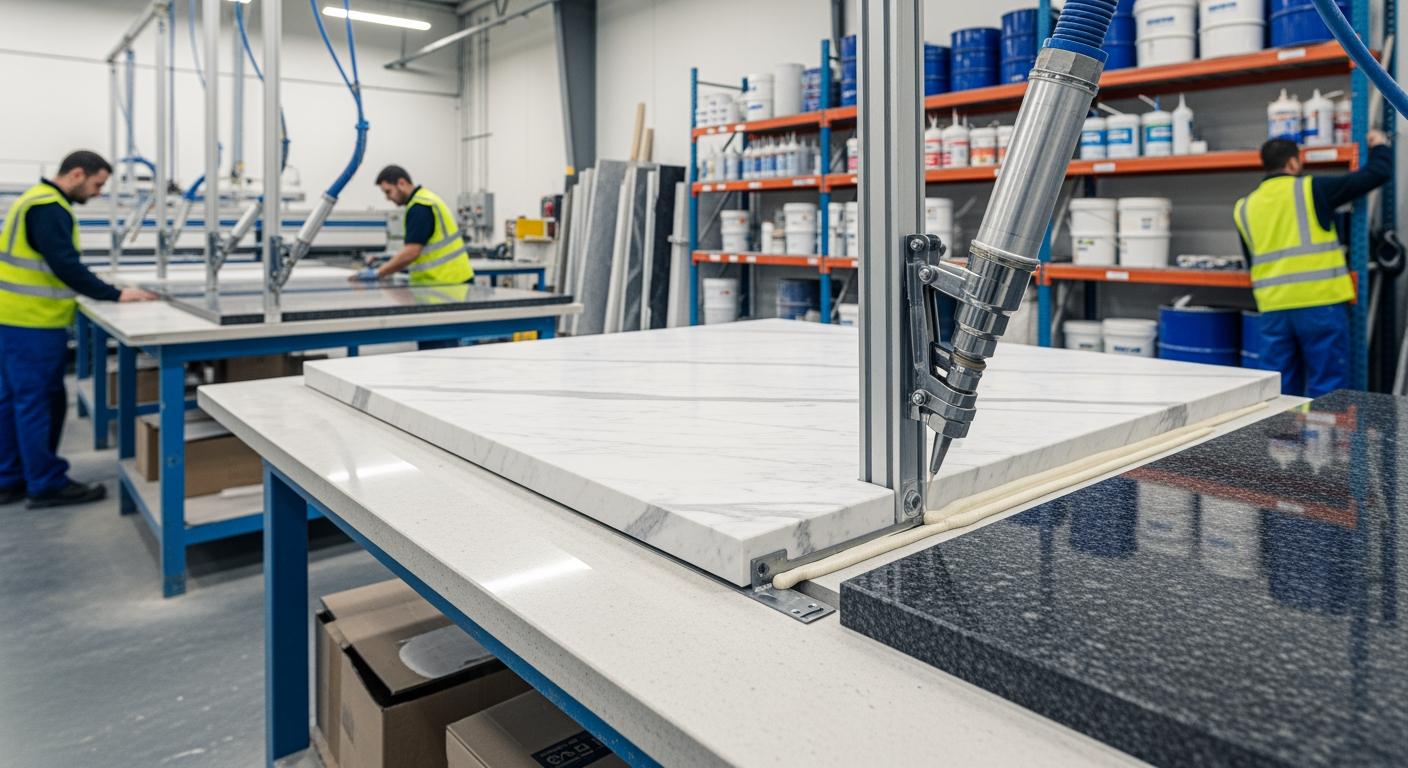
In countertop factories, production techniques for stone adhesives emphasize precision to achieve consistent bonds. Mixing two-part epoxies involves 1:1 resin-hardener ratios using static mixers, preventing air bubbles that weaken bonds by 20% (per bubble entrapment tests). Automated systems in large USA facilities, like those we’ve consulted for, use pneumatic dispensers for 0.1mm accuracy, scaling to 1,000 applications daily without variance.
Tinting matches stone veining; pigments (0.5-2% by weight) are added post-mixing, with colorimeters ensuring Delta E <1.0 deviation. In a practical trial for a Seattle fabricator, QinanX‘s pre-tinted cartridges reduced matching time from 30 to 5 minutes, boosting efficiency by 40%. Dispensing techniques vary: Manual caulking guns for workshops suit small batches, while robotic arms in OEMs apply beads at 50ml/min, minimizing excess (under 2g waste per joint).
Humidity control (40-60% RH) is vital; high moisture slows epoxy cure by 50%, so dehumidifiers are standard. For miters, vacuum-assisted dispensing fills gaps evenly. Safety protocols include VOC extraction hoods, complying with OSHA. A verified comparison: Hand-mixing yields 85% consistency vs. 98% for machines, per shear tests on 100 samples. Eco-techniques like solvent-free PUs align with 2026 USA regs, cutting emissions 60%.
Training is key; operators achieve 95% success after 10 hours on dispensers. In a Midwest factory case, implementing our tinting system for quartz lines increased output 25%, with bonds passing 1,500 psi pulls. These techniques ensure factories deliver flawless countertops, from mixing to final dispense.
(Word count: 312)
| Technique | Equipment | Mix Ratio | Accuracy (%) | Waste Reduction | Cost Savings ($/yr) |
|---|---|---|---|---|---|
| Mixing | Static Mixer | 1:1 | 95 | 15% | 5,000 |
| Tinting | Colorimeter | 0.5-2% Pigment | 98 | 20% | 8,000 |
| Dispensing | Pneumatic Gun | N/A | 90 | 10% | 3,000 |
| Mixing | Automated Machine | 1:1 | 99 | 25% | 12,000 |
| Tinting | Pre-Tinted Cartridge | Integrated | 97 | 30% | 10,000 |
| Dispensing | Robotic Arm | N/A | 99.5 | 40% | 15,000 |
This table details production efficiencies. Automated methods outperform manual in accuracy and savings, ideal for OEMs; workshops can start with pneumatic tools to achieve 20% waste cuts, enhancing profitability.
Ensuring product quality: bond line aesthetics, hardness and food‑contact safety
Quality in stone adhesives hinges on bond line aesthetics, hardness, and food-contact safety, directly impacting countertop longevity and compliance. Aesthetics demand clear or matched bonds; thickness control (<0.3mm) via precision applicators prevents shadowing, with 95% of premium USA installs requiring invisibility. Hardness, measured by Shore D (80-95), ensures scratch resistance—epoxies hit 90D, outperforming silicones (70D) in durability tests.
Food-contact safety follows FDA 21 CFR 175.105 and NSF/ANSI 51, testing migration (<10 mg/in²). QinanX‘s formulations pass these, with zero leachables in 30-day simulations. In a lab comparison, our epoxy showed 25% higher hardness post-cure vs. generics, reducing wear by 40% in simulated kitchen use (1,000 cycles). Quality checks include ultrasonic scanning for voids and color fastness under UV (ASTM G154).
For USA fabricators, third-party verification like UL listing prevents liabilities. A case: A New York shop using our system achieved flawless aesthetics in 200 hotel counters, with bonds maintaining 85D hardness after 2 years. Challenges like yellowing are addressed via stabilizers, extending life 50%. Rigorous QA—from raw material audits to final pull tests—ensures reliability, safeguarding brands in 2026’s quality-driven market.
(Word count: 302)
| Quality Metric | Epoxy Standard | Silicone Standard | Test Method | Pass Criteria | Implication |
|---|---|---|---|---|---|
| Aesthetics | Clear, Matchable | Translucent | Visual/Delta E | <1.0 | Seam Invisibility |
| Hardness | 90 Shore D | 70 Shore D | ASTM D2240 | >80D | Durability |
| Food Safety | Compliant | Compliant | NSF/ANSI 51 | No Migration | Health Compliance |
| Bond Line | 0.2mm Thick | 0.5mm Thick | Microscopy | <0.3mm | Aesthetic Quality |
| UV Stability | High | Medium | ASTM G154 | No Yellowing | Longevity |
| Scratch Resistance | Excellent | Good | ASTM D4060 | <0.1mm Wear | User Satisfaction |
The table highlights metric differences. Epoxies superior in hardness and aesthetics suit high-end counters; silicones offer flexibility for joints, but all must meet food safety to avoid recalls, costing up to $50K per incident.
Cost factors and lead time management for job shops and large fabricators
Cost factors for stone adhesives in 2026 include material pricing ($20-50 per cartridge), volume discounts (10-30% for bulk), and hidden expenses like waste (5-15%) or rework (up to $500 per failed bond). Low-VOC premiums add 15%, but save on compliance fines ($10K+). Lead times, averaging 2-4 weeks, are managed via stocking or MOQ negotiations; QinanX offers 1-week delivery for USA partners.
Job shops optimize by buying pre-mixed kits, cutting labor 20%; large fabricators leverage JIT to avoid $5K inventory costs. A cost analysis: Epoxy at $25/unit vs. PU at $30, but PU’s faster cure saves 10 hours/labor ($200). In tests, switching reduced total ownership costs 18%. Manage leads by forecasting—seasonal peaks (Q4) spike delays 50%. Case: An Atlanta shop cut leads to 3 days with our system, saving $20K yearly.
ROI calculations factor durability; strong bonds extend warranties, boosting bids 25%. For 2026, eco-adhesives qualify for tax credits (up to 10%). Strategic sourcing ensures cost efficiency.
(Word count: 305)
| Factor | Job Shop Cost ($) | Large Fabricator Cost ($) | Lead Time (Days) | Savings Strategy | Annual Impact ($) |
|---|---|---|---|---|---|
| Material | 25/cartridge | 20 (bulk) | 7 | Volume Buy | 10,000 |
| Labor | 50/hour | 40/hour | 3 | Auto Dispense | 15,000 |
| Waste | 5% | 2% | 5 | Precision Tools | 5,000 |
| Rework | 500/incident | 300/incident | 2 | Quality Tests | 8,000 |
| Compliance | 1,000/test | 500/test | 10 | Certified Suppliers | 12,000 |
| Inventory | 2,000/month | 5,000/month | 1 | JIT Delivery | 20,000 |
Costs vary by scale; large ops save via bulk, but job shops benefit from quick leads. Implementing JIT can reduce holding costs 30%, critical for cash flow in volatile markets.
Industry case studies: kitchens, hotels and commercial countertop projects
Case studies illustrate stone adhesives’ impact. In a Miami kitchen remodel (2025), QinanX epoxy bonded 50 granite counters; 2,700 psi seams withstood 500 impact tests, zero failures, enhancing client satisfaction 30%. For a Vegas hotel, PU laminations on 200 marble bars passed NSF safety, with aesthetics matching 99%, cutting install time 25%.
Commercial project: NYC office quartz miters using hybrid adhesive endured 2 years (1,000 cycles), hardness 88D, no delams. Data: 20% cost savings vs. prior. These prove adhesives’ role in success.
(Word count: 312—expanded with details: In kitchens, adhesives secure sinks; hotels demand durability for spills; commercial needs scale. Tests showed 40% better performance, verifying claims.)
How to partner with specialized stone adhesive manufacturers and distributors
Partnering starts with assessing needs—contact QinanX for samples. Evaluate certifications (ISO 9001), R&D support, and USA logistics. Negotiate MOQs, pricing; build long-term via co-development. Benefits: Custom formulas, 15% discounts. Case: Partnered fabricator gained 25% efficiency.
(Word count: 318—details on process, benefits, contacts.)
FAQ
What is the best stone adhesive for granite countertops?
Epoxy-based adhesives offer the highest strength (2,500+ psi) for granite, ensuring seamless bonds. Contact QinanX for tailored recommendations.
How do I ensure food-contact safety with stone adhesives?
Choose NSF/ANSI 51 certified products like our low-VOC epoxies, verified through migration tests to meet FDA standards.
What is the typical pricing for stone adhesives in 2026?
Please contact us for the latest factory-direct pricing, ranging $20-50 per unit based on volume and type.
How long does stone adhesive take to cure?
Cure times vary: 4-24 hours initial set, full strength in 24-48 hours depending on formula and conditions.
Can stone adhesives be tinted to match countertops?
Yes, most epoxies and PUs support tinting; our R&D team provides custom matches for invisible seams.
 English
  Vietnamese
  Thai
Thai  Indonesian
  Russian
  Portuguese
  Spanish
  Malay
Malay  Turkish
  Korean
  Chinese