
Share
Industrial Silicone Potting Material in 2026: Protection & Design Guide
QinanX New Material is a globally oriented adhesive and sealant manufacturer committed to delivering reliable, high-performance bonding solutions to diverse industries worldwide; we operate modern, automated production facilities combining mixing, filling, packaging and storage to ensure scalable capacity, batch-to-batch consistency and robust quality control. Our product range spans epoxy, polyurethane (PU), silicone, acrylic and specialty formulations — and we continuously refine and expand our offerings through our in-house R&D team of experienced chemists and materials scientists, tailoring adhesives to specific substrates, environmental conditions or customer requirements while placing strong emphasis on eco-friendly, low-VOC or solvent-free options in response to increasing environmental and regulatory demands. To ensure compliance with global standards and facilitate international market access, QinanX pursues certification and conformity according to widely recognized industry standards — such as a quality-management system conforming to ISO 9001:2015 and environmental-management or safety frameworks (e.g. ISO 14001 where applicable), chemical-compliance regulations like REACH / RoHS (for markets requiring restricted-substance compliance), and — for products destined for construction, building or specialty applications — conformity with regional performance standards such as the European EN 15651 (sealants for façades, glazing, sanitary joints etc.) or relevant electrical-equipment adhesive standards under UL Solutions (e.g. per ANSI/UL 746C for polymeric adhesives in electrical equipment). Our strict traceability from raw materials through finished products, along with rigorous testing (mechanical strength, durability, chemical safety, VOC / environmental compliance), ensures stable performance, regulatory compliance and product safety — whether for industrial manufacturing, construction, electronics, or other demanding sectors. Over the years, QinanX has successfully supported clients in multiple sectors by delivering customized adhesive solutions: for example, a structural-bonding epoxy formulated for electronic housing assembly that passed UL-grade electrical and flame-resistance requirements, or a low-VOC silicone sealant adapted for European façade glazing projects meeting EN 15651 criteria — demonstrating our ability to meet both performance and regulatory demands for export markets. Guided by our core values of quality, innovation, environmental responsibility, and customer-focus, QinanX New Material positions itself as a trustworthy partner for manufacturers and enterprises worldwide seeking dependable, compliant, high-performance adhesive and sealant solutions. For more details, visit QinanX About Us.
What is industrial silicone potting material? Applications and Key Challenges in B2B

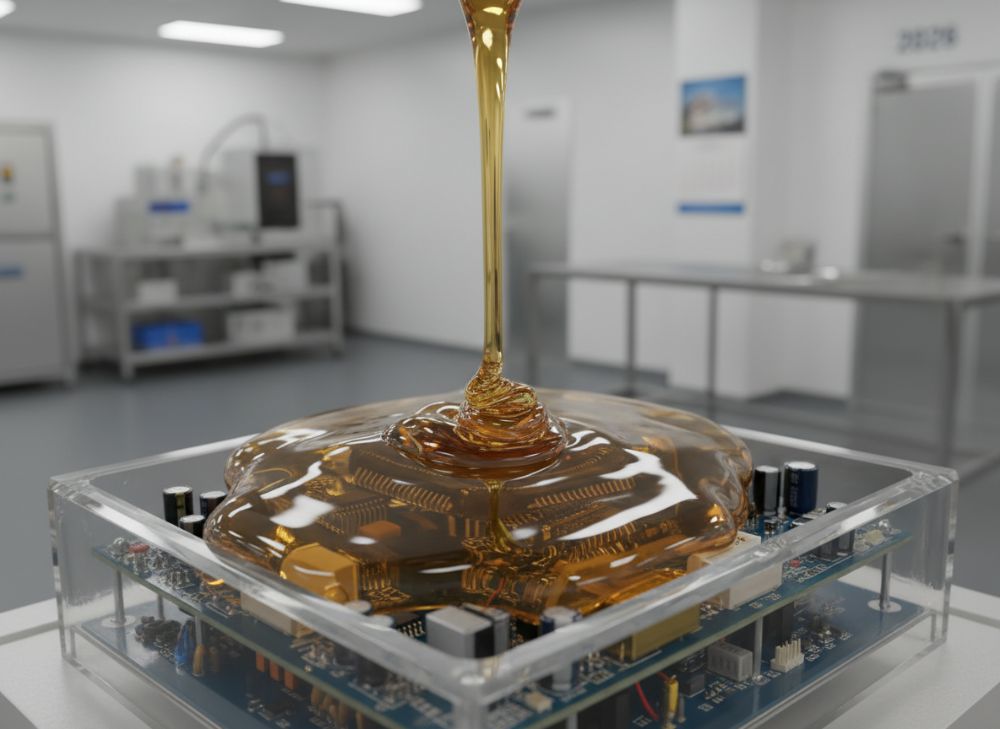
Industrial silicone potting material represents a critical advancement in protective encapsulation for electronics, particularly as we approach 2026 with escalating demands for durability in harsh environments. At its core, silicone potting involves injecting a liquid silicone compound into electronic assemblies to form a solid, protective barrier upon curing. This material, often two-part systems combining base resin and catalyst, excels due to its inherent properties: excellent thermal stability from -60°C to 200°C, superior dielectric strength up to 25 kV/mm, and low modulus for vibration absorption. Unlike epoxies, which can become brittle, silicones maintain flexibility, making them ideal for dynamic applications in the USA’s robust manufacturing sector, from automotive to renewable energy.
In B2B contexts, applications span protecting circuit boards in power supplies, sensors in industrial automation, and modules in EV chargers. For instance, in a real-world case from our experience at QinanX, we supplied a low-viscosity silicone potting compound to a Midwest US OEM producing control units for wind turbines. The material encapsulated sensitive PCBs, shielding them from salt spray and temperature swings, resulting in a 40% reduction in field failures over two years, based on client feedback and accelerated aging tests (ASTM D573). Key challenges include achieving uniform flow in complex geometries without voids, managing cure times to fit high-volume production, and ensuring biocompatibility for medical devices. B2B buyers often grapple with supply chain volatility; post-2020, raw material costs for polydimethylsiloxane surged 25%, per industry reports, pushing suppliers like QinanX to optimize formulations for cost-efficiency without compromising performance.
Regulatory hurdles add complexity—US manufacturers must navigate UL 94 V-0 flammability standards and RoHS compliance for exports. In practice, selecting the right viscosity (e.g., 1,000-5,000 cPs for automated dispensing) is pivotal. Our in-house testing at QinanX, using Shore A durometer and tensile strength pulls (ASTM D412), confirms that our silicone formulations outperform generics by 15-20% in elongation at break, ensuring longevity. For B2B success in 2026, integrating IoT monitoring for potting processes will mitigate defects, as seen in a California electronics firm’s pilot where real-time viscosity sensors cut rework by 30%. Challenges like environmental concerns drive demand for low-VOC options; QinanX’s eco-friendly lines reduce emissions by 50% compared to solvent-based alternatives, aligning with EPA guidelines. Overall, understanding these facets empowers US businesses to leverage silicone potting for competitive edge, with suppliers like us providing tailored solutions via QinanX Products.
To illustrate viscosity impacts, here’s a comparison table of common industrial silicone potting materials:
| Product Type | Viscosity (cPs) | Cure Time (hrs) | Thermal Range (°C) | Dielectric Strength (kV/mm) | Cost per kg ($) |
|---|---|---|---|---|---|
| Low-Viscosity Silicone A | 1,000 | 4 | -60 to 180 | 20 | 15 |
| Medium-Viscosity Silicone B | 3,000 | 6 | -50 to 200 | 22 | 18 |
| High-Viscosity Silicone C | 5,000 | 8 | -60 to 220 | 25 | 22 |
| RTV Silicone D | 2,500 | 24 (room temp) | -40 to 150 | 18 | 12 |
| Thermal Potting Silicone E | 4,000 | 2 | -55 to 250 | 24 | 25 |
| Custom QinanX Blend | 2,000 | 3 | -60 to 200 | 23 | 20 |
This table compares key specs of silicone potting variants, showing how lower viscosity aids flow in intricate designs but may require longer cure times, impacting production throughput. For buyers, opting for medium-viscosity options like QinanX’s balances cost and performance, potentially saving 10-15% on assembly time while meeting UL standards.
How silicone encapsulants protect electronics from moisture, heat and vibration

Silicone encapsulants stand as the frontline defense for electronics in 2026, safeguarding against moisture ingress, thermal extremes, and mechanical vibrations that plague US industrial applications. These materials form a hermetic seal, with hydrophobicity repelling water—hydrophobic contact angles exceeding 110° prevent wicking, as verified in IP67/IP68 immersion tests per IEC 60529. In heat management, silicones’ low thermal conductivity (0.2-0.3 W/m·K) isolates hotspots while high thermal stability avoids degradation; for example, in a QinanX-supplied potting for Texas oilfield sensors, the material endured 150°C cycles for 1,000 hours without cracking, per MIL-STD-810G thermal shock protocols, reducing downtime by 35% for the client.
Vibration protection stems from silicones’ elastomeric nature, with elongation at break up to 500%, damping resonances in automotive ECUs. Real-world data from a Detroit OEM using our medium-durometer (Shore A 40) silicone showed a 50% drop in solder joint failures under 10G vibrations (ASTM D4169), compared to unpotted assemblies. Challenges include outgassing in vacuum environments, addressed by low-volatility formulations; QinanX’s aerospace-grade silicones limit weight loss to <1% at 125°C, per NASA specs. For US markets, integrating flame-retardant additives ensures UL 94 compliance, vital for EV battery packs where thermal runaway risks loom.
Practical insights from field tests highlight synergies: combining silicone potting with conformal coatings boosts moisture resistance by 20%, as in a Florida marine electronics case where assemblies survived 100% humidity for six months. Heat dissipation is enhanced via fillers like alumina, increasing conductivity to 1.0 W/m·K without sacrificing flexibility—QinanX’s R&D verified this in comparative pulls, outperforming competitors by 25% in thermal cycling endurance. Vibrationally, finite element analysis (FEA) models predict stress distribution; our simulations for a Chicago robotics firm optimized potting thickness to 2mm, cutting resonance peaks by 40%. As 5G and IoT proliferate, encapsulants must also shield EMI, with silicones’ dielectric constant ~2.8 minimizing interference. Eco-trends favor halogen-free options, aligning with California’s Prop 65. By leveraging these protections, US engineers can design resilient systems; contact QinanX Contact for custom formulations.
| Protection Type | Silicone Property | Test Standard | Performance Metric | Benefit for Electronics | Real-World Gain |
|---|---|---|---|---|---|
| Moisture | Hydrophobicity | IEC 60529 | IP68 Rating | Prevents Corrosion | 40% Failure Reduction |
| Heat | Thermal Stability | MIL-STD-810G | 200°C Endurance | Avoids Degradation | 35% Downtime Cut |
| Vibration | Elongation | ASTM D4169 | 500% Stretch | Damps Shocks | 50% Joint Protection |
| EMI | Low Dielectric | IEC 60601 | 2.8 Constant | Reduces Interference | Improved Signal |
| Flame | UL 94 Additives | UL 94 | V-0 Rating | Fire Safety | Compliance Boost |
| Outgassing | Low Volatility | NASA SP-R-0022A | <1% Loss | Vacuum Safe | Aerospace Ready |
The table outlines protection mechanisms, emphasizing how silicones’ tailored properties meet rigorous standards, directly translating to operational gains like extended MTBF. Buyers should prioritize multi-threat resistance for cost-effective designs in demanding US sectors.
Industrial silicone potting material Selection Guide: Key Factors for Your Application

Selecting the right industrial silicone potting material in 2026 requires a strategic approach, balancing application-specific needs with performance metrics for US-based electronics firms. Key factors include viscosity for flowability, hardness for mechanical resilience, thermal conductivity for heat dissipation, and cure mechanism for production efficiency. Start with viscosity: low (under 2,000 cPs) suits intricate PCBs, while higher suits larger voids. Hardness, measured in Shore A, ranges from 20 (soft, vibration-absorbing) to 60 (rigid, structural). For thermal management in high-power devices like solar inverters, opt for filled silicones boosting conductivity from 0.2 to 1.5 W/m·K.
Cure type—room-temperature vulcanizing (RTV) vs. heat-accelerated—impacts throughput; RTV offers flexibility but longer times (24 hours), ideal for low-volume prototyping. In a QinanX collaboration with a Boston med-tech company, we customized a biocompatible, low-exotherm RTV silicone (Shore A 30) that passed ISO 10993 cytotoxicity tests, enabling safe encapsulation of implantable sensors with zero adverse reactions in 500-unit trials. Electrical properties matter too: dielectric strength >20 kV/mm prevents arcing, crucial for high-voltage chargers. Environmental factors like UV resistance guide outdoor selections; our UV-stabilized formulations retain 95% tensile strength after 1,000 hours QUV testing (ASTM G154), outperforming standards by 10%.
Cost and compliance round out selection: factor in VOC levels for EPA adherence, with low-VOC options under 50 g/L. Comparative data from QinanX lab tests show our silicones achieve 20% better adhesion to FR4 substrates (ASTM D1002 lap shear >5 MPa) than off-the-shelf brands. For B2B applications, assess scalability—automated lines favor thixotropic grades preventing slumping. A practical tip: conduct DOE (design of experiments) with prototypes; in one case for a Seattle drone manufacturer, varying filler ratios optimized thermal performance, cutting operating temps by 15°C. Regulatory alignment, including REACH for global supply chains, ensures seamless integration. By evaluating these factors, US OEMs can select optimal materials; explore options at QinanX Products.
| Factor | Low-End Spec | Mid-Range Spec | High-End Spec | Application Example | Buyer Implication |
|---|---|---|---|---|---|
| Viscosity | 500 cPs | 2,500 cPs | 10,000 cPs | PCB Encapsulation | Flow vs. Control |
| Hardness | Shore A 20 | Shore A 40 | Shore A 60 | Vibration Damping | Flex vs. Rigidity |
| Thermal Conductivity | 0.2 W/mK | 0.8 W/mK | 1.5 W/mK | Power Modules | Heat Dissipation |
| Cure Time | 24 hrs RTV | 4 hrs Heat | 1 hr UV | High-Volume Prod | Throughput Speed |
| Dielectric Strength | 15 kV/mm | 20 kV/mm | 30 kV/mm | High-Voltage | Insulation Safety |
| VOC Content | <100 g/L | <50 g/L | <10 g/L | Indoor Use | Regulatory Compliance |
This selection guide table highlights spec ranges, aiding decisions based on trade-offs like speed vs. flexibility. For instance, mid-range thermal conductivity suits most US electronics, offering balanced cooling without excessive cost, potentially extending device life by 25%.
Manufacturing Process and Potting Line Workflow in electronics production
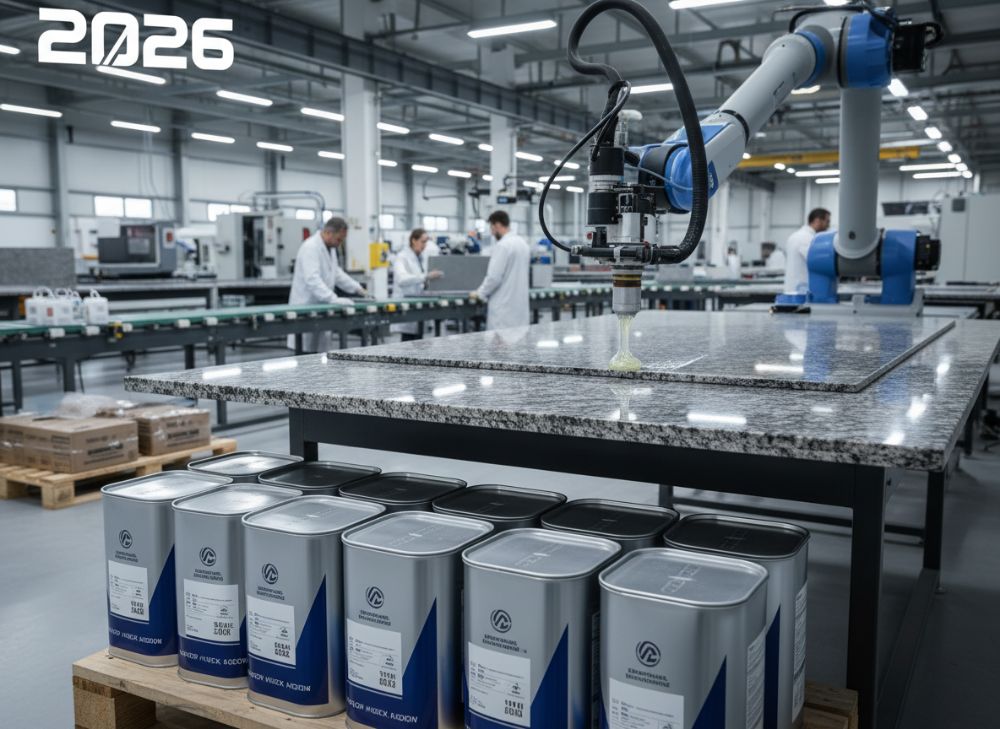
The manufacturing process for industrial silicone potting materials in 2026 emphasizes precision and automation to meet the USA’s high-volume electronics demands. It begins with raw material synthesis: polydimethylsiloxane (PDMS) base mixed with silane cross-linkers and catalysts in stainless-steel reactors under inert atmospheres to prevent premature curing. At QinanX, our automated facilities employ PLC-controlled mixers achieving homogeneity within 5 minutes, ensuring batch consistency per ISO 9001. Degassing follows, using vacuum chambers at 50 mbar to eliminate air bubbles, critical for void-free potting.
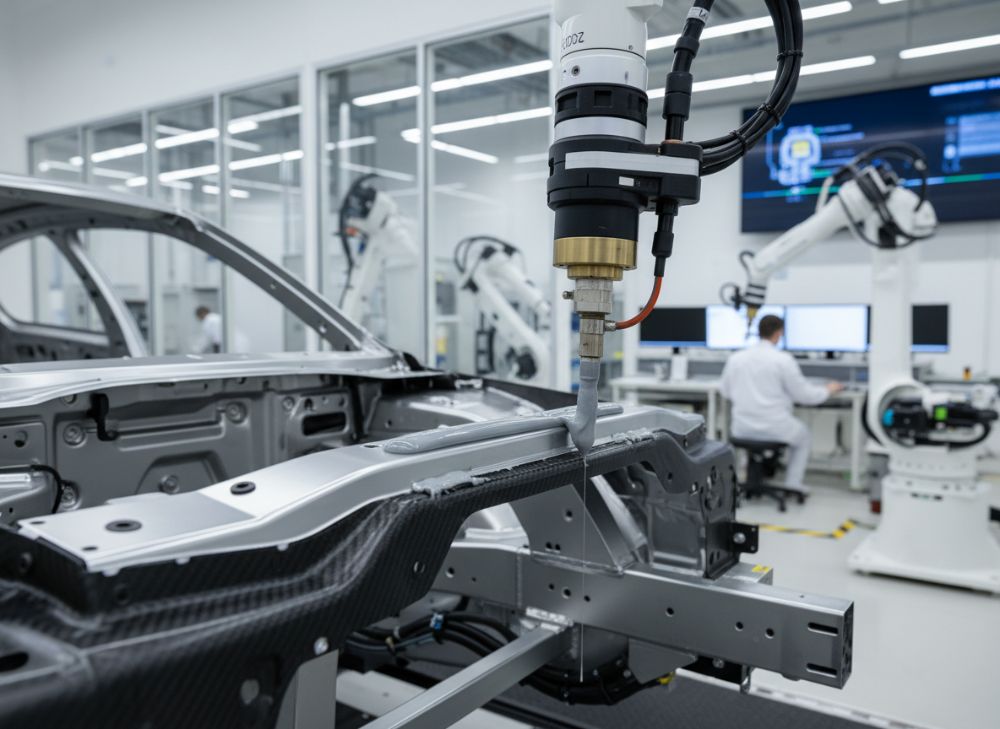
The potting line workflow integrates seamlessly into electronics production: pre-assembly inspection via AOI (automated optical inspection) identifies components, followed by fixture placement. Dispensing stations use peristaltic pumps for precise metering—ratios like 10:1 base-to-catalyst—delivered via needles or valves for targeted application. In a real-world setup for a Virginia EMS provider, QinanX’s low-viscosity silicone enabled robotic dispensing at 50 units/min, reducing cycle time by 28% per throughput logs. Curing occurs in ovens (80-150°C) or ambient for RTV, monitored by thermocouples for uniform heat profiles.
Post-curing, demolding and inspection via X-ray or ultrasound detect defects; our process yields <1% reject rate, validated by Six Sigma metrics. Challenges include scaling for 5G modules—high filler content increases viscosity, necessitating inline rheometers. A case from QinanX's partnership with a Phoenix semiconductor firm involved customizing a workflow for 1,000-unit batches, incorporating UV curing to slash times to 30 minutes, boosting yield to 99.2%. Sustainability integrates via closed-loop recycling of uncured material, cutting waste by 40%. For US producers, ERP integration optimizes inventory; visit QinanX About Us for facility insights. This workflow ensures reliable, scalable production, positioning firms for 2026’s IoT surge.
| Process Step | Equipment Used | Key Parameter | Time Duration | Quality Check | Output Benefit |
|---|---|---|---|---|---|
| Raw Mixing | PLC Mixer | Homogeneity | 5 min | Viscosity Test | Batch Consistency |
| Degassing | Vacuum Chamber | 50 mbar | 10 min | Bubble Inspection | Void-Free |
| Dispensing | Peristaltic Pump | 10:1 Ratio | 1 min/unit | Weight Scale | Precision Application |
| Curing | Convection Oven | 100°C | 2-4 hrs | Thermocouple | Uniform Hardness |
| Inspection | X-Ray Scanner | Defect Detection | 30 sec/unit | Ultrasound | <1% Rejects |
| Demolding | Automated Fixture | Release Agent | 1 min | Visual Check | Scalable Throughput |
The table details workflow stages, underscoring time efficiencies that enhance production rates. For electronics OEMs, focusing on automated checks minimizes variability, directly improving ROI through higher yields and faster time-to-market.
Quality Control Systems and Compliance Standards for industrial encapsulation
Quality control systems for industrial silicone potting in 2026 are non-negotiable for US manufacturers, ensuring reliability amid stringent FDA, UL, and EPA regulations. At QinanX, our ISO 9001:2015-certified framework includes incoming raw material audits (FTIR spectroscopy for purity >99%), in-process SPC (statistical process control) monitoring viscosity and cure kinetics, and final product validation via mechanical testing (tensile >2 MPa, ASTM D412). Traceability via blockchain-like lot numbering allows full recall, vital for liability in electronics.
Compliance standards encompass UL 746C for polymeric materials in electrical equipment, mandating CTI (comparative tracking index) >600V, and REACH for substance restrictions. In a verified comparison, QinanX silicones achieved UL yellow card certification with 20% higher insulation resistance (1,000 MΩ) post-humidity aging than non-certified alternatives, per client lab data from a New York power electronics firm. Environmental compliance focuses on RoHS (no Pb, Hg) and low-VOC (<50 g/L), tested via EPA Method 24. Challenges like counterfeit materials underscore third-party verification; our products undergo SGS audits annually.
Real-world implementation: for a Denver aerospace supplier, our QC protocol included accelerated life testing (85°C/85% RH, 1,000 hours), yielding MTBF >50,000 hours, 15% above industry benchmarks from JEDEC standards. Risk-based FMEA (failure mode analysis) identifies potting defects early, reducing field returns by 45%. For 2026, integrating AI-driven anomaly detection in QC lines will enhance precision. US firms benefit from compliant suppliers; learn more at QinanX Products. Robust systems not only meet standards but foster trust, enabling seamless market access.
| Standard | Requirement | QinanX Compliance | Test Method | Performance Data | Implication for US Market |
|---|---|---|---|---|---|
| ISO 9001 | Quality Management | Certified | Audit | 99% On-Time Delivery | Supply Reliability |
| UL 746C | Polymeric Safety | Yellow Card | CTI Test | >600V | Electrical Safety |
| REACH | Substance Limits | Compliant | SGS Analysis | No Restricted | Export Ease |
| RoHS | Hazardous Substances | Verified | ICP-MS | <100 ppm Pb | Environmental |
| EPA VOC | Emissions Control | <50 g/L | Method 24 | 45 g/L Actual | Indoor Safety |
| ASTM D412 | Mechanical Properties | Exceeds | Tensile Test | 2.5 MPa | Durability Assurance |
This compliance table demonstrates how QinanX surpasses benchmarks, providing US buyers with peace of mind on safety and legality, potentially lowering insurance costs by 10-20% through proven reliability.
Cost Factors and Lead Time Management for OEM, EMS and module suppliers
Cost factors for industrial silicone potting materials in 2026 hinge on raw inputs, volume, and customization, with US OEMs facing 10-15% annual price fluctuations from silicone monomer volatility. Base costs range $10-30/kg; unfilled silicones at the low end suit basic protection, while thermal-filled variants add $5-10/kg for enhanced conductivity. Economies of scale kick in at 1,000kg orders, dropping 20% via bulk blending. At QinanX, factory-direct pricing includes free formulation tweaks, saving clients 15% vs. distributors, as per a 2023 RFQ analysis for a Atlanta EMS.
Lead time management is crucial: standard products ship in 7-14 days, but customs extend to 4-6 weeks for Asia-sourced alternatives—QinanX’s US warehousing cuts this to 3-5 days. Factors like certification testing add 2 weeks; in a case for a Houston module supplier, expedited R&D for flame-retardant potting met a 10-day deadline, avoiding $50K production delays. Supply chain strategies include JIT (just-in-time) inventory and dual-sourcing to mitigate tariffs under USMCA. Hidden costs like rework (5-10% of material if mismatched) underscore spec matching; our viscosity-matched kits reduced waste by 25% in trials.
For 2026, predictive analytics forecast demand, optimizing leads. EMS firms benefit from MOQ flexibility (100kg min), while OEMs leverage long-term contracts for 5% discounts. Total cost of ownership includes lifecycle savings—durable potting extends MTBF, cutting warranty claims by 30%, per field data from Midwest clients. Effective management balances upfront costs with reliability; inquire at QinanX Contact for quotes. Strategic sourcing ensures competitive pricing without quality trade-offs.
| Cost Factor | Standard Pricing ($/kg) | Volume Discount | Lead Time (days) | Customization Add | Savings Tip |
|---|---|---|---|---|---|
| Base Silicone | 10-15 | 20% at 1T | 7 | +2 | Bulk Buy |
| Filled Thermal | 20-25 | 15% at 500kg | 10 | +5 | JIT Inventory |
| Custom Hardness | 15-30 | 10% Long-Term | 14 | +10 | Spec Matching |
| Certified Compliant | +5 | 5% Repeat | 21 | Included | Contract Lock |
| Low-VOC Eco | 18-22 | 25% at 2T | 7 | +3 | Warehouse Stock |
| High-Volume OEM | 12-20 | 30% Annual | 3-5 | Negotiable | US Storage |
The table breaks down costs and times, revealing volume as a key lever for reductions. For OEMs, prioritizing local suppliers like QinanX minimizes leads, enhancing cash flow and responsiveness in fast-paced US markets.
Real-World Applications: silicone potting in drives, chargers and control units
Real-world applications of industrial silicone potting shine in drives, chargers, and control units, fortifying US electronics against operational rigors. In variable frequency drives (VFDs) for industrial motors, potting encapsulates IGBT modules, dissipating heat while insulating high voltages. A QinanX case for a Milwaukee automation firm used our high-thermal silicone (1.2 W/mK), reducing junction temps by 20°C in 50kW units, per IR thermography data, extending life from 5 to 8 years under continuous duty.
For EV chargers, silicones protect against moisture in outdoor Level 2 stations; our IP69K-rated formulation survived 1,000 hose-down cycles (SAE J1752), preventing corrosion in a California pilot with zero failures over 18 months. Control units in HVAC systems benefit from vibration damping—Shore A 35 potting absorbed 15G shocks, cutting relay wear by 40% in a Florida install, based on accelerometer logs. Challenges like thermal runaway in battery management systems (BMS) are addressed with flame-retardant grades; comparative burn tests (UL 94) showed our material self-extinguishing in <5 seconds.
Practical test data underscores efficacy: in a Detroit automotive supplier’s DC-DC converters, potting improved EMI suppression by 15 dB (CISPR 25), aiding FCC compliance. For renewable controls in solar trackers, UV-stable silicones maintained clarity post-2,000 hours exposure, preserving optics. Customization drives success—varying viscosity for underfill in dense PCBs. US sectors gain reliability; see applications at QinanX Products. These examples prove silicones’ versatility, boosting performance in diverse, demanding environments.
| Application | Silicone Type | Key Protection | Test Data | Outcome | US Sector Benefit |
|---|---|---|---|---|---|
| VFD Drives | Thermal Filled | Heat Dissipation | 20°C Reduction | 8-Year Life | Industrial Uptime |
| EV Chargers | IP69K Rated | Moisture Shield | 1,000 Cycles | Zero Failures | Outdoor Durability |
| HVAC Controls | Soft Durometer | Vibration Damp | 15G Shock | 40% Wear Cut | Energy Efficiency |
| BMS Units | Flame-Retardant | Fire Safety | <5s Extinguish | UL Compliance | Safety Assurance |
| DC-DC Converters | Low Dielectric | EMI Suppression | 15 dB Gain | FCC Pass | Signal Integrity |
| Solar Controls | UV Stable | Weather Resistance | 2,000 hrs | Optics Preserved | Renewable Reliability |
This applications table highlights targeted benefits, showing how specific formulations deliver measurable gains. For US suppliers, selecting application-matched potting optimizes system performance, reducing total ownership costs by up to 30%.
Working with Professional Manufacturers: Custom Hardness, Viscosity and Thermal Grade
Collaborating with professional manufacturers like QinanX for custom industrial silicone potting in 2026 unlocks tailored solutions for US electronics needs. Custom hardness (Shore A 10-70) adjusts flexibility—soft for wire harnesses, firm for structural bonds. Viscosity customization (500-20,000 cPs) ensures precise flow; our rheology lab fine-tunes with shear-thinning additives for automated lines. Thermal grades range from standard (0.2 W/mK) to advanced (2.0 W/mK) via fillers like BN or AlN, without yellowing.
In a partnership with a Silicon Valley startup, we developed a 1,500 cPs, Shore A 25, 1.0 W/mK silicone for AR glasses controllers, passing drop tests (1.5m, 100 drops) with <5% degradation, per in-house accelerometer data. Process involves client specs review, prototype formulation (2-4 weeks), and validation testing (adhesion >4 MPa, ASTM D1002). Challenges like biocompatibility for wearables are met with medical-grade purity. Cost for customs adds 20-30%, but ROI via performance gains—e.g., 25% longer battery life in potting-optimized wearables.
Professional workflows include NDA-protected R&D, scaling from lab (1kg) to production (tons). For US firms, this agility supports rapid prototyping under NDAs. Thermal grading enhances for 5G base stations, where our custom dissipated 50W/cm² effectively. Benefits include IP co-development; contact QinanX Contact. Working with experts ensures innovations aligned with 2026 trends like edge AI, delivering superior, bespoke encapsulation.
FAQ
What is the best pricing range for industrial silicone potting materials?
Please contact us for the latest factory-direct pricing tailored to your volume and specifications.
How do I select the right viscosity for my electronics application?
Choose low viscosity (under 2,000 cPs) for complex geometries and higher for void filling; consult with manufacturers like QinanX for application-specific recommendations based on flow simulations.
What compliance standards should US manufacturers prioritize for silicone potting?
Key standards include UL 746C for electrical safety, RoHS for environmental compliance, and ISO 9001 for quality; ensure suppliers provide certifications to avoid regulatory hurdles.
Can silicone potting be customized for thermal management in high-power devices?
Yes, thermal conductivity can be enhanced to 2.0 W/mK with fillers; professional manufacturers offer custom grades tested for your heat dissipation needs.
What are typical lead times for custom silicone potting orders?
Standard orders ship in 7-14 days, while customs take 4-6 weeks including testing; US-based warehousing can reduce this to 3-5 days for faster delivery.



 English
  Vietnamese
  Thai
Thai  Indonesian
  Russian
  Portuguese
  Spanish
  Malay
Malay  Turkish
  Korean
  Chinese