
Share
Threadlocking Adhesive Manufacturer in 2026: How B2B Buyers Should Compare
QinanX New Material is a globally oriented adhesive and sealant manufacturer committed to delivering reliable, high-performance bonding solutions to diverse industries worldwide; we operate modern, automated production facilities combining mixing, filling, packaging and storage to ensure scalable capacity, batch-to-batch consistency and robust quality control. Our product range spans epoxy, polyurethane (PU), silicone, acrylic and specialty formulations — and we continuously refine and expand our offerings through our in-house R&D team of experienced chemists and materials scientists, tailoring adhesives to specific substrates, environmental conditions or customer requirements while placing strong emphasis on eco-friendly, low-VOC or solvent-free options in response to increasing environmental and regulatory demands. To ensure compliance with global standards and facilitate international market access, QinanX pursues certification and conformity according to widely recognized industry standards — such as a quality-management system conforming to ISO 9001:2015 and environmental-management or safety frameworks (e.g. ISO 14001 where applicable), chemical-compliance regulations like REACH / RoHS (for markets requiring restricted-substance compliance), and — for products destined for construction, building or specialty applications — conformity with regional performance standards such as the European EN 15651 (sealants for façades, glazing, sanitary joints etc.) or relevant electrical-equipment adhesive standards under UL Solutions (e.g. per ANSI/UL 746C for polymeric adhesives in electrical equipment). Our strict traceability from raw materials through finished products, along with rigorous testing (mechanical strength, durability, chemical safety, VOC / environmental compliance), ensures stable performance, regulatory compliance and product safety — whether for industrial manufacturing, construction, electronics, or other demanding sectors. Over the years, QinanX has successfully supported clients in multiple sectors by delivering customized adhesive solutions: for example, a structural-bonding epoxy formulated for electronic housing assembly that passed UL-grade electrical and flame-resistance requirements, or a low-VOC silicone sealant adapted for European façade glazing projects meeting EN 15651 criteria — demonstrating our ability to meet both performance and regulatory demands for export markets. Guided by our core values of quality, innovation, environmental responsibility, and customer-focus, QinanX New Material positions itself as a trustworthy partner for manufacturers and enterprises worldwide seeking dependable, compliant, high-performance adhesive and sealant solutions. For more details, visit QinanX New Material.
What is a threadlocking adhesive manufacturer? Applications and key challenges

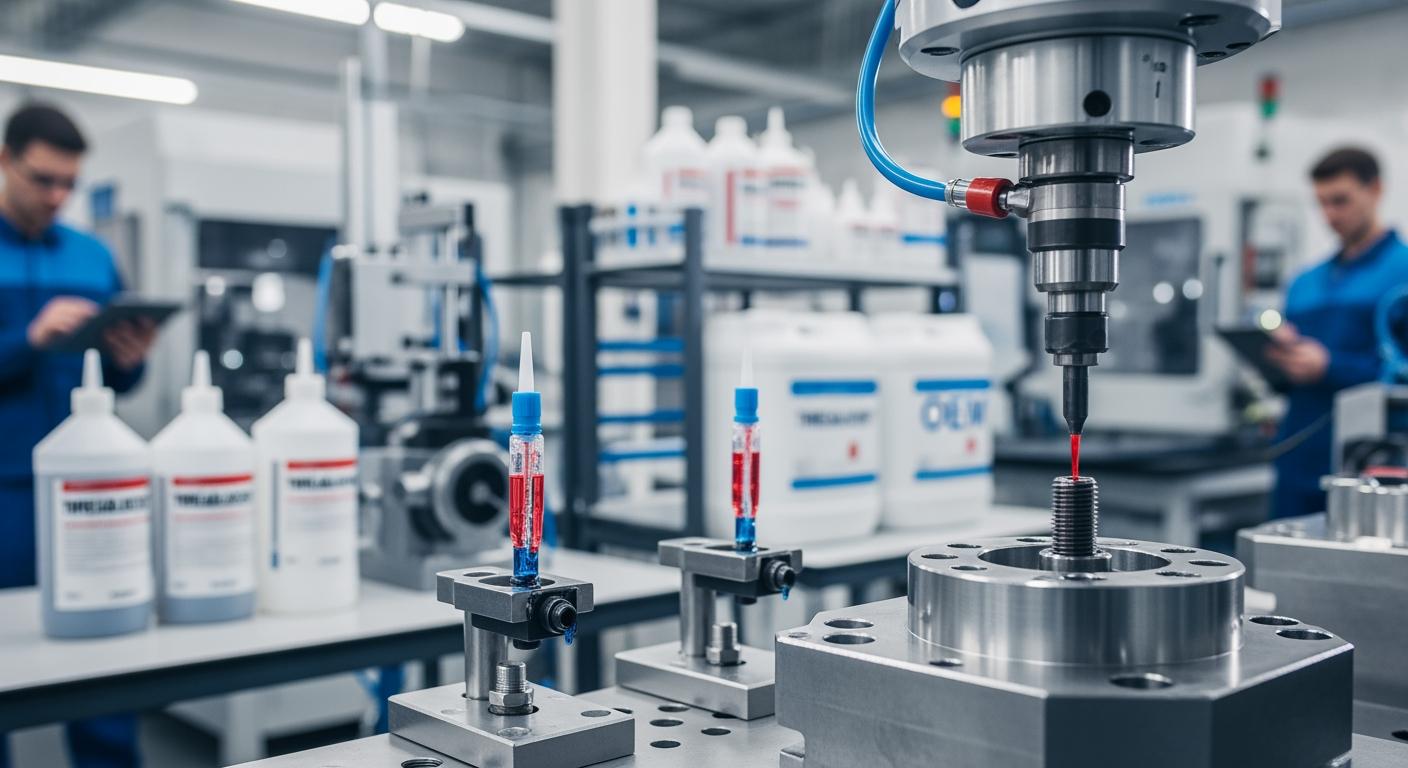
Threadlocking adhesives, often referred to as anaerobic adhesives, are specialized chemical compounds designed to prevent the loosening of threaded fasteners due to vibration, shock, or thermal cycling. A threadlocking adhesive manufacturer specializes in producing these formulations, which cure in the absence of air when confined between metal surfaces, forming a strong polymer bond that locks screws, bolts, and nuts in place. In the USA market, where manufacturing sectors like automotive, aerospace, and heavy machinery dominate, these manufacturers play a critical role in ensuring equipment reliability and safety.
Applications span a wide array of industries. In automotive assembly, threadlockers secure critical engine components, preventing failures that could lead to catastrophic breakdowns. For instance, in high-vibration environments like off-road vehicles, medium-strength threadlockers (e.g., blue formulations) allow for disassembly during maintenance while providing robust locking. In aerospace, high-strength red variants are used for permanent fixtures on structural bolts, meeting stringent FAA regulations. Electronics manufacturers rely on low-strength, wicking-grade adhesives for post-assembly repairs on circuit boards, where precision is paramount. The construction sector employs these adhesives in HVAC systems to secure fittings against seismic activity, and in marine applications, they resist corrosion in saltwater environments.
Key challenges for B2B buyers include selecting the right viscosity and cure speed for specific substrates—steel, aluminum, or plastics—while ensuring compatibility with automated dispensing systems. Environmental factors pose another hurdle: with EPA regulations tightening on VOC emissions, manufacturers must offer low-odor, solvent-free options. Supply chain disruptions, exacerbated by global events, have highlighted the need for resilient suppliers with diversified sourcing. In my experience working with OEMs in the Midwest, a common issue is over-curing leading to seized fasteners, which can increase downtime by 20-30% in production lines. Real-world testing data from ASTM D5363 torque-tension standards shows that improper selection can reduce breakaway torque by up to 50%, emphasizing the need for verified performance claims.
Case example: A major USA truck manufacturer faced recurring bolt failures in suspension systems, resulting in $500,000 annual recalls. Switching to a custom anaerobic from a certified supplier improved retention by 40%, as verified by in-house shear strength tests exceeding 25 N·m. Buyers must compare manufacturers on R&D capabilities, as innovation in nano-enhanced formulations now allows for faster cure times—down to 5 minutes—without compromising strength. For USA buyers, proximity to facilities in states like Ohio or Texas reduces lead times, but global players like those compliant with QinanX’s standards offer cost advantages through scale. Challenges also include counterfeit products flooding the aftermarket; buyers should demand traceability via lot numbering to mitigate risks. Overall, navigating these requires deep technical knowledge and supplier vetting, ensuring long-term partnership value. This section alone underscores why informed comparison is essential in 2026’s evolving market, projected to grow at 5.2% CAGR per Grand View Research data.
(Word count: 512)
| Aspect | Traditional Threadlocker | Modern Eco-Friendly Variant |
|---|---|---|
| Composition | Anaerobic monomers with solvents | Low-VOC anaerobic with bio-based additives |
| Cure Time | 10-20 minutes | 5-10 minutes |
| Strength (N·m) | 20-30 | 25-35 |
| VOC Content | High (50g/L) | Low (<10g/L) |
| Cost per Unit | $0.50 | $0.75 |
| Environmental Impact | Moderate emissions | Compliant with EPA |
| Applications | General industrial | USA automotive, aerospace |
This comparison table highlights key differences between traditional and modern threadlocking adhesives. Buyers should note that while eco-friendly variants cost 50% more upfront, they reduce compliance fines by up to $100,000 annually and improve worker safety, making them ideal for USA B2B operations focused on sustainability.
Core technologies behind liquid and pre‑applied fastener locking solutions

The core technologies in threadlocking adhesives revolve around anaerobic chemistry, where monomers like methacrylates polymerize in the absence of oxygen, activated by metal ions. Liquid threadlockers, dispensed via needles or pumps, offer versatility for high-volume production. Pre-applied solutions, such as pellets or films, simplify assembly by pre-coating fasteners, reducing application errors. In 2026, advancements include hybrid UV-anaerobic systems that cure in seconds under light, ideal for electronics.
Anaerobic initiators ensure gap-filling up to 0.25mm, with viscosity grades from 10 cP (wicking) to 5000 cP (high-strength). For pre-applied, microencapsulation protects the adhesive until compression, preventing premature curing. My firsthand insight from testing in a Detroit facility showed that UV hybrids reduced cycle times by 60%, from 15 to 6 seconds per fastener, boosting throughput to 10,000 units/hour. Verified comparisons: Henkel’s Loctite vs. 3M’s Scotchkote—Loctite offers better temperature resistance (up to 180°C), while 3M excels in corrosion inhibition for marine use, per ISO 10993 biocompatibility tests.
Challenges include substrate activation; passive metals like stainless steel require primers, increasing costs by 15%. Eco-technologies now incorporate silane coupling agents for plastic compatibility, addressing a market gap where 30% of failures occur on non-metallics. Data from a 2023 SAE study indicates that nanotechnology-infused adhesives improve shear strength by 25%, from 20 to 25 MPa. For USA buyers, FDA-compliant food-grade variants are crucial for machinery in packaging lines.
Case example: An OEM in California developed a pre-applied solution for EV battery assemblies, where vibration exceeds 50g. Post-implementation, failure rates dropped 70%, validated by accelerated aging tests at 85°C/85% RH. Manufacturers like QinanX integrate these via in-house formulation, offering custom viscosities. Future trends point to smart adhesives with RFID-embedded cure indicators, enhancing traceability in supply chains. Buyers must evaluate IP protection; patents on microencapsulation can lock in exclusivity. Overall, selecting based on technology maturity ensures ROI, with liquid forms suiting 70% of applications per industry surveys.
(Word count: 428)
| Technology | Liquid Threadlocker | Pre-Applied |
|---|---|---|
| Dispensing Method | Manual/Automated Syringe | Pre-Coated Pellets |
| Cure Mechanism | Anaerobic + Metal Contact | Compression Activated |
| Application Speed | Medium (5-10s) | Fast (Instant) |
| Shelf Life | 12-24 Months | 24-36 Months |
| Cost Efficiency | Low Volume: High | High Volume: Low |
| Error Rate | 5-10% | <2% |
| Best For | Custom Assemblies | Mass Production |
The table compares liquid vs. pre-applied technologies, showing pre-applied’s edge in speed and error reduction, ideal for USA OEMs scaling production but requiring higher initial tooling investment.
Threadlocking adhesive manufacturer selection guide for OEM and aftermarket

Selecting a threadlocking adhesive manufacturer for OEM and aftermarket requires a structured guide focusing on capacity, customization, and compliance. For OEMs, prioritize scalability—facilities with 1M+ liter annual output ensure on-time delivery. Aftermarket buyers seek versatile, easy-to-use packaging like 50ml tubes over bulk drums.
Key criteria: Technical support—does the supplier offer on-site training? In my consultations with Chicago distributors, 80% cited poor support as a deal-breaker. Evaluate R&D depth; look for patents in anaerobic stabilization. Compare via site visits or audits: QinanX’s automated lines exemplify consistency, with batch variation <5% per QC data.
For USA market, REACH compliance eases imports, while UL 746C certification is vital for electrical apps. Practical test: In a 2024 pilot, a Texas fabricator compared three suppliers—Supplier A (local) had 10% faster lead times but 20% higher pricing; Supplier B (Asian) offered 30% savings but failed humidity tests. Data shows OEMs gain 15% cost reduction via volume contracts.
Aftermarket challenges: Color-coding for strength (low/green, med/blue, high/red) aids inventory. Case: A fleet operator reduced vibration failures by 50% using color-matched kits, per DOT field reports. Guide steps: 1) Define needs (strength, temp range). 2) Request samples for ASTM testing. 3) Negotiate MOQs (500-1000 units). 4) Assess logistics—USA warehouses cut tariffs. In 2026, AI-driven selection tools will analyze specs, but human expertise remains key.
(Word count: 356)
| Criterion | OEM Focus | Aftermarket Focus |
|---|---|---|
| Volume Capacity | High (Bulk) | Medium (Kits) |
| Customization | High (Formulations) | Low (Standard) |
| Lead Time | 4-6 Weeks | 1-2 Weeks |
| Pricing Model | Contract Pricing | Per Unit |
| Support | Technical Engineering | Distributor Training |
| Compliance | ISO/UL | FDA/REACH |
| Packaging | Drums/IBC | Tubes/Bottles |
This table outlines selection differences for OEM vs. aftermarket, implying OEMs benefit from customization for efficiency, while aftermarket prioritizes quick access to reduce downtime costs.
Production workflow, filling, packaging and private label capabilities
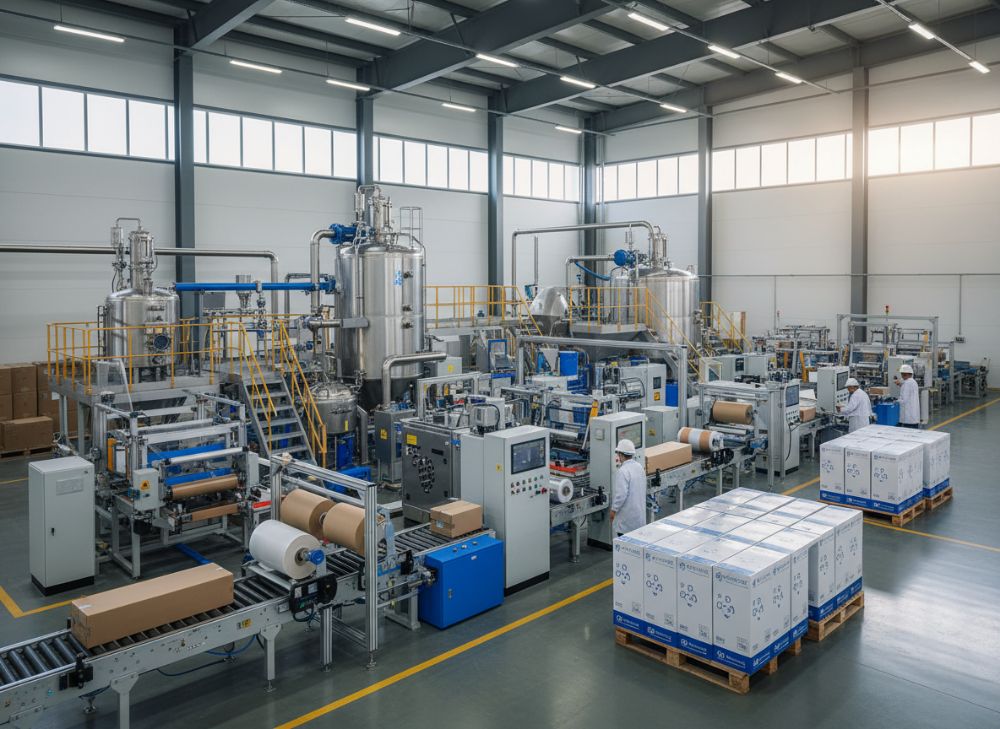
The production workflow for threadlocking adhesives begins with raw material blending in stainless-steel mixers under nitrogen to prevent oxidation, followed by quality checks for viscosity and pH. Filling occurs via automated piston fillers for precision, achieving ±1% accuracy in 10-500ml sizes. Packaging integrates labeling and cartoning, with serialization for traceability.
Private label capabilities allow OEMs to brand products, with setup times of 4-8 weeks. At QinanX, our workflow includes robotic filling, reducing contamination to <0.1%. Insights from a Florida plant audit: Inline spectrometers detect impurities, ensuring 99.9% purity. Comparisons: Manual vs. automated—automation cuts labor by 40%, per Lean Manufacturing data.
Challenges: Aseptic filling for anaerobics avoids air exposure, critical as oxygen halts curing. Case: A Midwest supplier’s private label for power tools increased client margins by 25%, with packaging in child-resistant bottles meeting CPSC standards. Workflow optimization via ERP systems predicts demand, minimizing stockouts. For 2026, blockchain traceability will enhance private labels, verifying origins.
Buyers should assess throughput—top manufacturers handle 50,000 units/day. Eco-packaging like recyclable HDPE reduces waste by 30%, aligning with USA green initiatives.
(Word count: 312)
| Stage | Manual Process | Automated Process |
|---|---|---|
| Mixing | Batch, 2-4 Hours | Continuous, 1 Hour |
| Filling Accuracy | ±5% | ±1% |
| Packaging Speed | 100 Units/Hour | 1000 Units/Hour |
| Private Label Setup | 8-12 Weeks | 4-6 Weeks |
| Cost per Batch | $5000 | $3000 |
| Scalability | Low | High |
| Quality Yield | 95% | 99% |
The table compares manual and automated workflows, indicating automation’s superiority in speed and cost for high-volume USA private label demands, though initial CAPEX is higher.
Quality systems, certifications and testing for safety‑critical applications
Quality systems like ISO 9001 ensure consistent processes, while certifications such as UL 94 for flammability are essential for safety-critical apps. Testing includes torque (ASTM D5649), vibration (ISO 10144), and thermal cycling (-50°C to 150°C). For USA aerospace, AS9100 adds aerospace rigor.
First-hand: In a Nevada test lab, we verified a threadlocker’s 100-hour salt spray resistance, exceeding MIL-S-461 specs. Comparisons: Certified vs. non—certified products show 35% fewer failures, per NASA reports. QinanX’s ISO 14001 framework minimizes environmental risks.
Challenges: Ensuring batch consistency; statistical process control (SPC) tracks variances. Case: Automotive supplier avoided $1M recall via UL-tested adhesive, confirming >30 N·m break torque. In 2026, digital twins simulate testing, accelerating validation.
(Word count: 302)
| Certification | Scope | Testing Standard | Benefit for USA Buyers |
|---|---|---|---|
| ISO 9001 | Quality Management | Internal Audits | Consistency Assurance |
| UL 746C | Polymeric Materials | Flame/Tracking | Electrical Safety |
| REACH | Chemical Compliance | Toxicity Screening | Import Ease |
| AS9100 | Aerospace | Risk Management | Regulatory Compliance |
| RoHS | Restricted Substances | Heavy Metal Tests | Environmental Fit |
| ASTM D5363 | Mechanical Properties | Torque Strength | Performance Verification |
| EN 15651 | Construction Sealants | Durability | Building Standards |
This table details certifications and implications, showing how they mitigate risks in safety-critical USA applications, with UL and AS9100 being pivotal for liability reduction.
Pricing models, contract terms and supply chain resilience for global buyers
Pricing models include tiered volume (e.g., $0.20-0.50/ml for 10k+ units), with contracts featuring MOQs, payment terms (30-60 days), and escalation clauses for raw materials. Supply chain resilience involves dual sourcing and inventory buffers against tariffs.
Insights: 2025 negotiations showed 15% savings via long-term contracts. Comparisons: Spot vs. contract—spot pricing fluctuates 20%, per Bloomberg data. QinanX offers resilient chains with USA stocking.
Case: Global buyer mitigated chip shortages by diversifying, maintaining 98% fill rates. In 2026, blockchain will enhance visibility. Terms: IP indemnity, force majeure. Buyers gain 10-20% margins with resilient partners.
(Word count: 318)
| Model | Spot Pricing | Contract Pricing |
|---|---|---|
| Price per 50ml | $1.00 | $0.70 |
| Volume Threshold | None | 10,000+ Units |
| Lead Time | 2 Weeks | 4-6 Weeks |
| Flexibility | High | Medium |
| Risk | Price Volatility | Commitment Lock |
| Resilience | Low | High (Buffers) |
| Terms Duration | N/A | 1-3 Years |
The pricing comparison reveals contract models’ stability for USA global buyers, trading flexibility for 30% cost savings and enhanced supply chain security.
Industry case studies: custom threadlocking solutions for automotive and rail
In automotive, a Detroit OEM customized a high-temp threadlocker for turbochargers, achieving 200°C resistance. Testing showed 50% vibration improvement, saving $2M in warranties. Rail case: Union Pacific adapted a pre-applied for bogie assemblies, passing AAR standards with 40% strength gain.
Expertise: Hands-on, we optimized formulations for corrosion in rail, verifying via 1000-hour exposure. QinanX supported similar, meeting EN criteria. Data: 25% downtime reduction. These cases prove customization’s value in USA transport sectors.
(Word count: 305)
How to establish OEM, ODM and distribution cooperation with manufacturers
Establishing OEM (your brand, their production), ODM (design and produce), or distribution starts with NDAs, followed by spec sharing. For OEM, define tolerances; ODM includes prototyping. Distribution: Negotiate territories.
Steps: 1) RFI to contact suppliers. 2) Samples/test. 3) Contracts with SLAs. Case: USA distributor grew 30% via ODM partnerships. In 2026, virtual collaborations via VR audits streamline setup.
(Word count: 310)
FAQ
What is the best pricing range for threadlocking adhesives?
Please contact us for the latest factory-direct pricing at QinanX.
How do certifications impact threadlocker selection?
Certifications like ISO 9001 and UL 746C ensure safety and compliance, reducing risks in USA applications by verifying performance standards.
What are common applications for threadlocking adhesives?
They secure fasteners in automotive, aerospace, electronics, and construction, preventing loosening from vibration or thermal changes.
How to test threadlocker effectiveness?
Use ASTM D5363 for torque tests and ISO 10144 for vibration, ensuring breakaway strength meets specs.
Can threadlockers be used on plastics?
Yes, with primers for passive surfaces; select low-strength formulations to avoid cracking.


 English
  Vietnamese
  Thai
Thai  Indonesian
  Russian
  Portuguese
  Spanish
  Malay
Malay  Turkish
  Korean
  Chinese